

Cómo se integra la aspiración de la rodilla en la atención de las articulaciones
Respuesta rápida: Understanding how knee aspiration fits into joint care usually starts with a swollen knee that needs clinical evaluation. Knee aspiration, also called knee arthrocentesis or joint aspiration, removes fluid from the knee joint with a needle. It may help with evaluation, may reduce pressure from swelling for some people, and may fit before or alongside other treatments when appropriate. It is not a stand-alone answer for arthritis, injury, or ongoing knee pain.
If you are trying to understand whether knee aspiration belongs in your care plan, the first step is a clinical assessment. Joint Health Solutions offers knee arthrocentesis at the Clínica de Charlotte; patients may Solicite una cita o llame 704-833-3566 with scheduling questions. Suitability depends on individual evaluation.
Understanding how knee aspiration fits into joint care during evaluation
Knee swelling can feel straightforward from the outside: the knee looks larger, feels tight, and may be harder to bend. Clinically, though, swelling can have different causes. Fluid may build up after irritation, inflammation, injury, bleeding into the joint, crystal-related arthritis, infection, or other joint conditions. That is why how knee aspiration fits into joint care starts with evaluation rather than a promise that one procedure will solve the problem.
In plain language, aspiration means drawing fluid out. In the knee, the fluid is synovial fluid, the lubricating fluid inside the joint. When there is too much fluid, clinicians may call it an effusion. Merck Manual Professional Edition’s knee arthrocentesis procedure guidance describes arthrocentesis as a procedure used to remove synovial fluid for diagnostic or therapeutic reasons. NCBI Bookshelf also describes arthrocentesis as a procedure used to remove synovial fluid and notes both diagnostic and therapeutic purposes.
For many patients, the most important question is not simply “Can the fluid be removed?” It is “Why is there extra fluid in the first place?” Knee aspiration may help answer that question. The appearance of the fluid and, when appropriate, lab testing may give useful information. That information can shape the next part of joint care, such as monitoring, additional evaluation, injections, bracing, physical therapy, or referral for urgent care if infection or another serious problem is suspected.
How knee aspiration fits into joint care is also different from general knee pain care. General knee pain education may focus on activity changes, strengthening, arthritis management, or injection options. Knee aspiration is more specific: it focuses on a swollen joint and the fluid inside it. It may be used to gather information, reduce pressure, or prepare the joint for another treatment when appropriate.
What knee arthrocentesis means in plain language
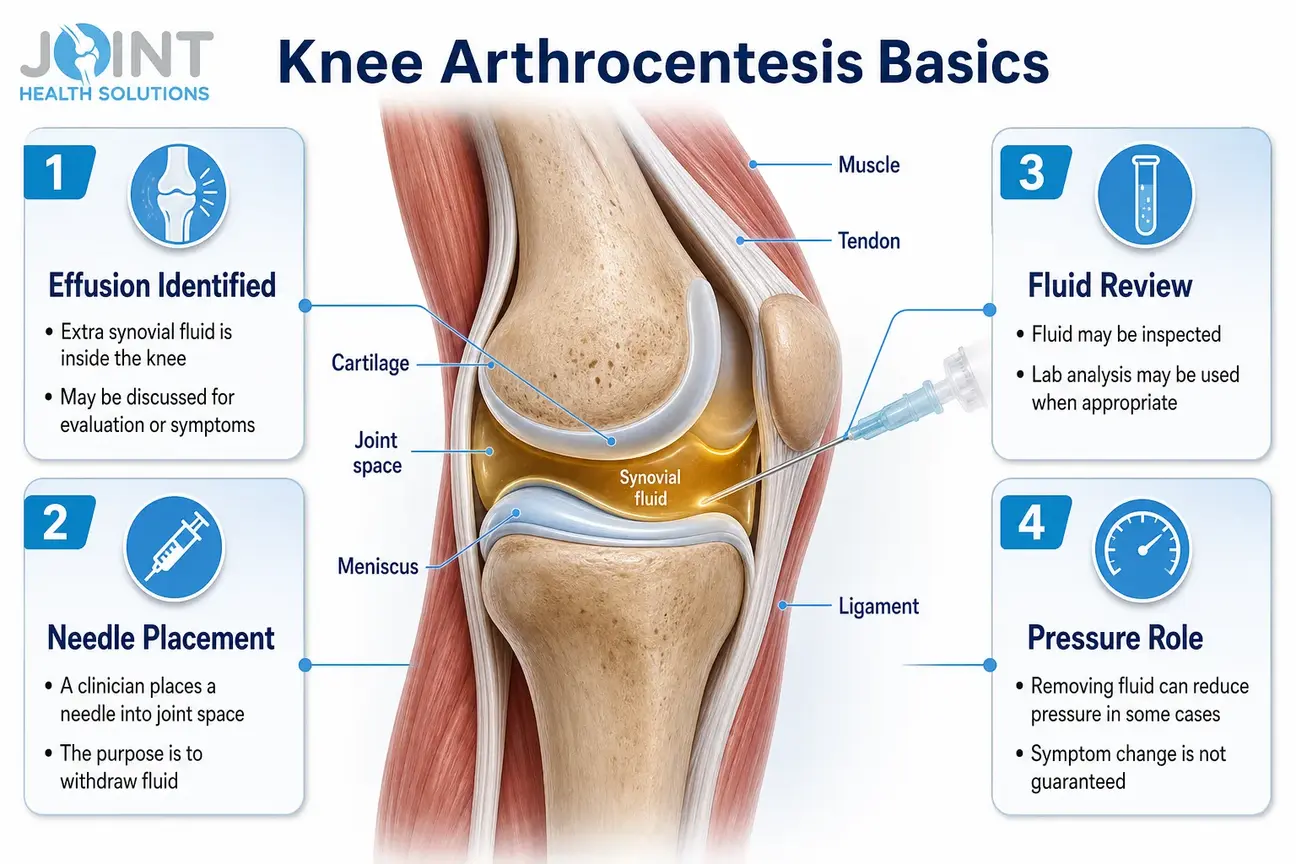
Knee arthrocentesis is the medical term for removing fluid from the knee joint with a needle. You may also hear it called knee aspiration, knee joint aspiration, or knee fluid removal. The procedure is typically discussed when the knee has an effusion that needs evaluation, symptom management, or both.
The word “arthrocentesis” can sound technical, but the purpose is practical. A clinician places a needle into the joint space and withdraws fluid. The fluid may be inspected and, when clinically appropriate, sent for lab analysis. In some situations, removing fluid can also reduce pressure inside the knee. Cleveland Clinic’s patient education on arthrocentesis describes joint aspiration as a way to remove fluid that may be tested and, in some cases, to help relieve swelling or pressure. Some patients may notice less tightness or easier movement afterward, but results vary and depend on the underlying cause of swelling.
It is important to separate the procedure from the diagnosis. Knee arthrocentesis is not a diagnosis by itself. It is a tool that may help a clinician understand what is happening in the joint. For example, fluid related to inflammation may lead to one set of next steps, while fluid that raises concern for infection or bleeding may lead to a different clinical pathway.
At Joint Health Solutions, knee aspiration is part of conservative, minimally invasive, non-surgical joint care when it is appropriate for the patient’s situation. It may be considered alongside other options, but it does not replace a full clinical assessment. If knee arthritis is part of the concern, the broader plan may include education about knee arthritis care as well as other non-surgical options.
For that reason, how knee aspiration fits into joint care is most clearly understood as a decision point within a larger visit. The clinician is not only removing fluid; the clinician is also asking what the swelling means, whether testing is needed, and what conservative care options may be reasonable next.
Why is knee fluid aspirated?
People often ask, why is knee fluid aspirated if swelling might come back? The main reason is that fluid can be useful information. Removing and evaluating fluid may help clinicians assess possible causes of a swollen knee, including inflammatory conditions, crystal-related arthritis, bleeding into the joint after trauma, or infection concerns.
AAFP’s 2016 review on acute monoarthritis describes synovial fluid analysis as an important diagnostic step when infection, crystals, or inflammatory causes are part of the concern. UCSF Hospital Handbook’s acute monoarthritis and synovial fluid analysis guidance also emphasizes that fluid testing can help separate broad categories such as noninflammatory, inflammatory, crystal-related, hemorrhagic, and infectious causes. These sources support using aspiration as a diagnostic tool when the clinical picture calls for it.
Aspiration may also be considered when a large effusion is painful or creates pressure. Merck Manual Professional Edition’s knee arthrocentesis guidance and Cleveland Clinic’s arthrocentesis education both describe removal of joint fluid as potentially therapeutic in selected situations. That does not mean knee fluid removal fixes the reason fluid developed. It means removing fluid may help with pressure or symptoms in selected cases while the clinician continues to evaluate and manage the underlying issue.
A NCBI Bookshelf clinical review on knee effusion emphasizes that swelling can come from multiple causes and that evaluation depends on the clinical picture. This is why how knee aspiration fits into joint care is often tied to the story around the swelling: Did it happen after an injury? Is the knee warm? Is there fever? Has swelling developed gradually with arthritis symptoms? Are there signs of inflammation?
Fluid may be aspirated for several practical reasons:
- To help identify a cause: The fluid may provide clues about infection, crystals, bleeding, or inflammation when lab testing is appropriate.
- To reduce pressure: A tense effusion can make the knee feel tight and difficult to bend. Removing fluid may help some patients feel less pressure.
- To support treatment planning: The results of evaluation may help guide whether conservative care, injections, bracing, therapy, or additional evaluation is appropriate.
- To prepare for another procedure: In some cases, aspiration may be performed before an injection when a clinician determines that approach fits the situation.
None of these reasons should be interpreted as an assured outcome. A swollen knee can be complex. Removing fluid can be useful, but the larger goal is understanding the reason for swelling and choosing an evidence-informed plan.
Knee fluid removal is different from a knee injection
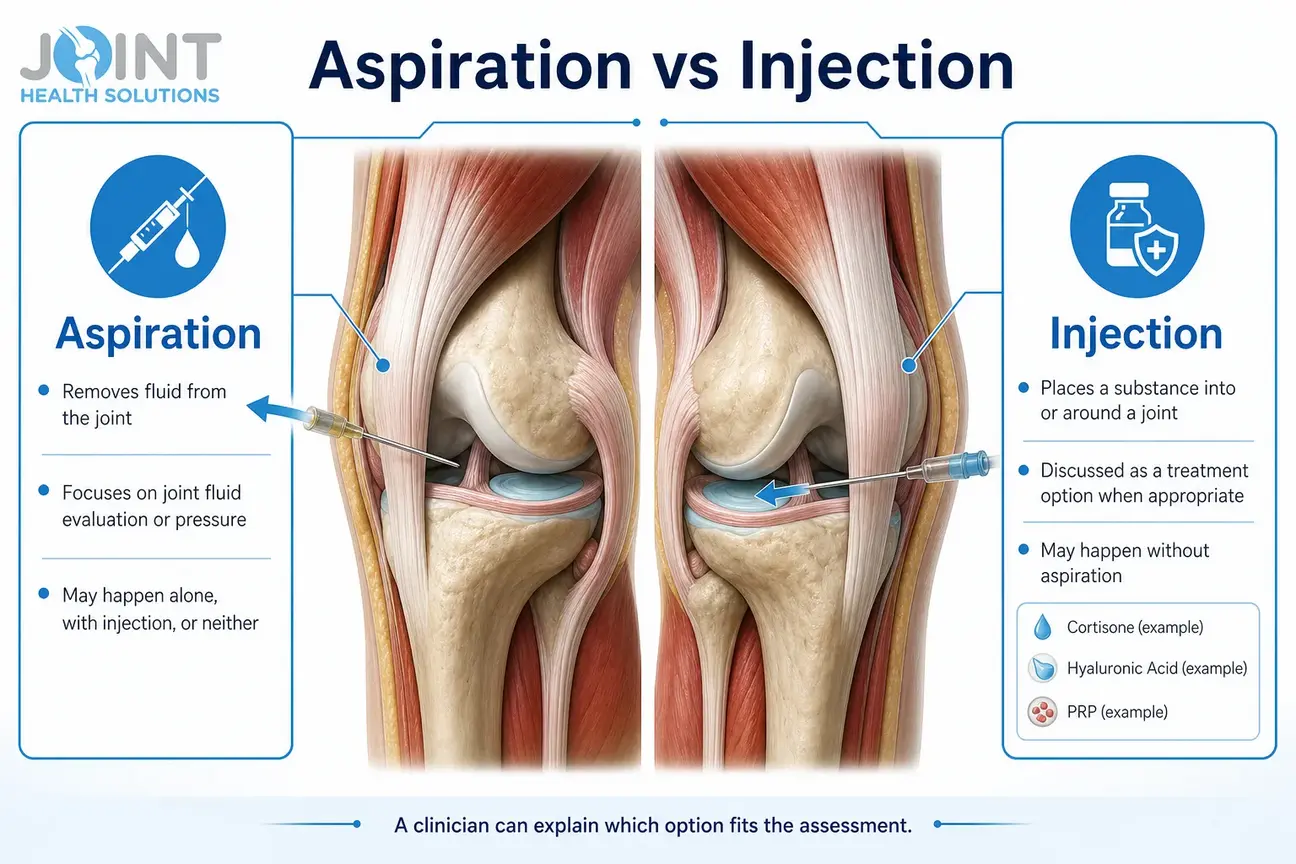
Knee fluid removal and knee injections may happen in the same overall care conversation, but they are not the same thing. Aspiration removes fluid from the joint. An injection places medication or another therapeutic substance into or around a joint when appropriate. Some visits may involve one, both, or neither, depending on assessment.
This distinction matters because people sometimes search for aspiration when they are really thinking about gel injections, cortisone injections, PRP therapy, or other injection options. Aspiration is primarily about joint fluid: removing it, evaluating it, or reducing pressure from it. Injections are treatment options that may be discussed for certain conditions after clinical review.
Joint Health Solutions proporciona knee injections for adults with clinically assessed knee pain or conditions when appropriate. The practice also provides fluoroscopy-guided injections for patients for whom image-guided injection is appropriate. Whether aspiration, injection, imaging guidance, or another non-surgical option is relevant depends on the patient’s exam, history, symptoms, and goals.
How knee aspiration fits into joint care before an injection may depend on the size and character of the effusion. If a knee is very swollen, a clinician may want to understand why. Sometimes fluid evaluation is more important than moving directly to an injection. In other situations, aspiration may be part of preparing the joint for a therapeutic injection. Merck Manual Professional Edition’s knee arthrocentesis guidance notes that aspirating fluid may be done before injecting intra-articular medications when clinically appropriate. The sequence should be individualized rather than assumed.
Patients also benefit from knowing what each procedure can and cannot tell the care team. Knee fluid removal may provide information about the joint environment. A knee injection is chosen for a treatment purpose. Understanding how knee aspiration fits into joint care can help patients ask clearer questions before agreeing to either step.
How aspiration may guide the next part of conservative care
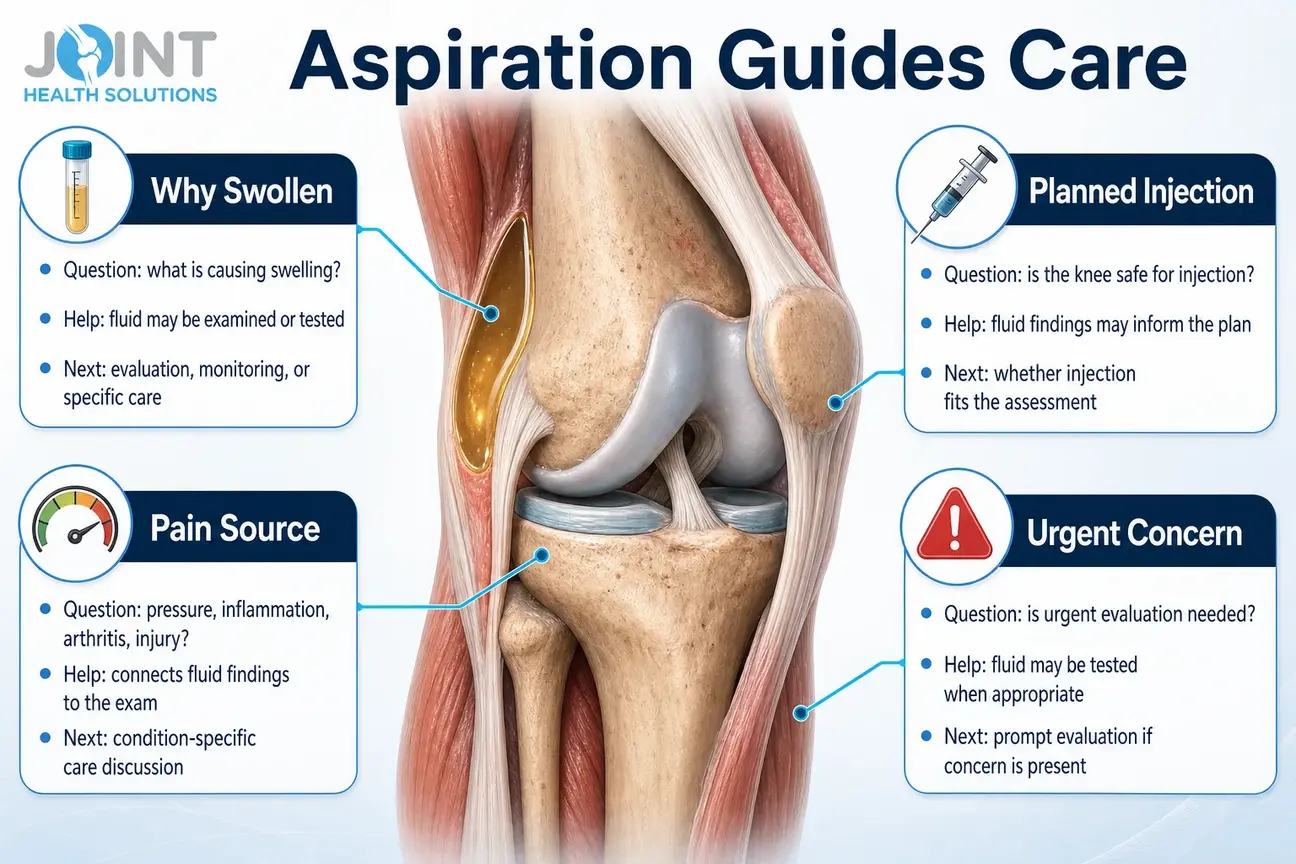
Aspiration often makes the most sense when it is connected to a bigger clinical question. What is causing the swelling? Is the knee safe for a planned injection? Is the pain mainly from pressure, inflammation, arthritis, injury, or another issue? Is urgent evaluation needed? The answers shape next steps.
The following table shows how knee aspiration may fit into a broader plan without treating it as a single answer for every swollen knee.
| Care question | How aspiration may help | Possible next discussion |
|---|---|---|
| Why is the knee swollen? | Fluid may be examined or sent for testing when clinically appropriate. | Further evaluation, monitoring, or condition-specific care. |
| Is swelling causing pressure or stiffness? | Removing fluid may reduce pressure for some patients. | Movement plan, physical therapy, bracing, or symptom-focused treatment. |
| Could this be infection or another urgent issue? | Fluid evaluation may help assess serious causes of acute swelling. | Urgent medical care, emergency care, or additional testing when needed. |
| Is an injection being considered? | Aspiration may be discussed before or alongside an injection in selected cases. | Corticosteroid, viscosupplementation, PRP, or other options only when appropriate. |
| Is arthritis contributing? | Aspiration may address fluid, while arthritis care addresses the underlying joint condition. | Education, injections, therapy, bracing, nutrition support, or other conservative care. |
For example, a person with chronic knee arthritis may have periodic swelling, stiffness, and pain. Aspiration might help evaluate an effusion or relieve pressure at a particular visit, but the longer-term plan may focus on arthritis management. That could include movement strategies, fisioterapia, offloading support, or injection options when appropriate.
Another person may have sudden swelling after an injury. In that case, knee arthrocentesis may be considered differently, especially if bleeding into the joint or another acute problem is suspected. The same procedure can serve a different purpose depending on the clinical context.
This is why how knee aspiration fits into joint care should be described in relation to the patient’s exam and history. The procedure may answer a diagnostic question, address a pressure-related symptom, or help the clinician decide whether a different pathway is needed.
Knee swelling treatment options after evaluation
Knee swelling treatment options depend on why swelling is present. Aspiration may be one option, but it is not the only part of care. A conservative care plan may include education, activity modification, physical therapy, bracing, injections, nutrition support, or monitoring, depending on the assessment.
If swelling is related to knee arthritis, the plan may focus on improving comfort, mobility, and function while recognizing that arthritis is usually managed rather than resolved by a single procedure. Joint Health Solutions provides education and non-surgical care pathways for knee pain and knee arthritis concerns. Aspiration may fit into that plan when there is excess joint fluid and a clinical reason to remove or evaluate it.
If swelling is tied to stiffness and movement limits, the plan may include a discussion of range of motion, strength, and mechanics. Some patients may be appropriate for offloading knee braces or guided rehabilitation. Others may need additional evaluation before choosing a treatment direction.
If swelling is significant and an injection is being considered, the clinician may discuss whether aspiration should happen first. This may be relevant when the knee is tense with fluid or when fluid evaluation could change the treatment plan. The key point is that how knee aspiration fits into joint care depends on the purpose of the visit, not just the presence of swelling.
Patients should also understand that some causes of swelling require urgent medical attention rather than routine joint care. A hot, very red, severely painful, rapidly worsening knee, especially with fever or feeling very ill, should be treated as urgent. Joint Health Solutions does not provide emergency or 24/7 urgent care. For emergencies, call 911 or go to an emergency department.
What patients may notice after aspiration
Some patients feel less tightness after fluid is removed, especially if the effusion was large. They may notice that the knee bends more easily or feels less pressured. This is one reason aspiration may be discussed as part of symptom management for a swollen joint.
However, symptom changes are not assured. If the underlying driver of swelling is still active, fluid may return. If arthritis, inflammation, injury, or another condition is contributing, aspiration alone may not address the whole problem. This is why how knee aspiration fits into joint care should be explained as part of a plan, not as a stand-alone solution.
NCBI Bookshelf’s arthrocentesis review describes arthrocentesis as having diagnostic and therapeutic roles, including removal of synovial fluid. Cleveland Clinic’s arthrocentesis education similarly explains that joint aspiration may be used to remove excess fluid and may help relieve swelling or pressure in some cases. That supports the idea that aspiration may serve more than one purpose. Still, the evidence and clinical guidance do not support promising lasting symptom resolution from aspiration alone.
It is also possible that the most valuable result of aspiration is not how the knee feels immediately, but what the fluid evaluation shows. If the fluid suggests crystals, infection concerns, bleeding, or inflammation, that information can change the next steps. For some patients, clarity is the main benefit.
Before the procedure, patients should ask what the clinician hopes to learn, whether fluid will be sent for testing, whether an injection is being considered, and what follow-up might look like. They should also ask which symptoms should prompt urgent care after leaving the clinic.
When aspiration may be discussed before or alongside injections
Aspiration and injections can be related, but they should not be automatically bundled together. A clinician may discuss aspiration before an injection if fluid is making the knee tense, if the fluid needs evaluation, or if removing fluid may help the planned treatment proceed more appropriately. In other cases, an injection may be discussed without aspiration.
The broad category of joint injections includes different approaches with different purposes. Corticosteroid injections are different from hyaluronic acid injections, and both are different from PRP therapy. Aspiration is different again because it removes joint fluid rather than delivering a treatment substance.
How knee aspiration fits into joint care around injections often depends on the diagnosis being considered. If infection is a concern, guidance such as AAFP’s 2016 acute monoarthritis review supports prioritizing synovial fluid evaluation when septic arthritis is a possibility. A clinician may prioritize evaluation and appropriate urgent management rather than a routine therapeutic injection. If arthritis-related swelling is being evaluated, aspiration may be part of understanding the effusion before choosing a non-surgical plan.
Patients should avoid assuming that swelling always means they need a specific injection. Swelling is a sign that deserves context. The clinician may consider the physical exam, health history, imaging when available or appropriate, prior treatments, and patient goals before recommending a path.
This is also where image guidance may enter the conversation. Some injections may be performed with imaging guidance when appropriate, but image guidance is not necessary for every situation. The decision depends on anatomy, treatment target, procedure type, and clinical judgment.
Questions to ask before knee aspiration
Because knee arthrocentesis can be used for more than one reason, patients should feel comfortable asking what role it plays in their care. Clear questions can help keep expectations realistic and make the plan easier to understand.
- What is the main reason for aspiration in my case? Is the goal diagnosis, pressure relief, preparation for another treatment, or a combination?
- Will the fluid be sent to a lab? If so, what information is the clinician looking for?
- What conditions are you considering? Ask whether arthritis, injury, crystal-related arthritis, infection, or another cause is being evaluated.
- How will results affect the plan? The answer can clarify whether next steps may include monitoring, medication discussion, injections, bracing, therapy, or urgent referral.
- Could fluid come back? Understanding that aspiration may not stop the underlying cause of swelling can prevent disappointment.
- What symptoms should prompt urgent care? Ask what to watch for after the visit and when to seek emergency help.
- Are there alternatives? Depending on the situation, options may include observation, imaging, therapy, bracing, injections, or other conservative care.
These questions are especially helpful when people are researching knee fluid removal online and comparing it with injection procedures. The right question is not “Which procedure is generally better?” It is “What is the purpose of this procedure for my knee, today?”
They also reflect how knee aspiration fits into joint care in a patient-centered setting. The procedure should have a clear reason, and patients should understand how the information or symptom change may influence the next decision.
When a swollen knee needs urgent attention
Some knee swelling should not wait for a routine appointment. If the knee is hot, very red, severely painful, rapidly worsening, or accompanied by fever or feeling very ill, urgent evaluation may be needed. These symptoms can occur for more than one reason, but infection is one concern clinicians take seriously.
AAFP’s 2016 review on acute monoarthritis notes that delays in recognizing septic arthritis can have serious consequences, and UCSF Hospital Handbook’s acute monoarthritis guidance emphasizes synovial fluid analysis when infection is a concern. NCBI Bookshelf clinical review content on acutely painful swollen joints also notes the importance of considering serious causes in acute monoarticular presentations. Patients should not try to self-diagnose a hot or acutely worsening knee based on internet research. If symptoms suggest an emergency, call 911 or go to an emergency department.
Joint Health Solutions is a non-surgical joint care clinic, not an emergency or 24/7 urgent care provider. Routine evaluation may be appropriate for many people with chronic or recurring swelling, but urgent symptoms should be handled through emergency services or an emergency department.
Even without emergency signs, it is reasonable to seek clinical assessment when swelling is persistent, recurrent, unexplained, or interfering with walking, bending, exercise, work, or daily activity. Evaluation can help distinguish general knee pain from an effusion that may need aspiration, testing, or a more targeted plan.
How this fits into non-surgical joint care in Charlotte
For people researching how knee aspiration fits into joint care in the Charlotte area, the local relevance is practical: care occurs at the Joint Health Solutions Clínica de Charlotte. Patients may travel from nearby communities, but the clinic location is in Charlotte, not in separate branches elsewhere. For scheduling questions, call 704-833-3566.
Joint Health Solutions focuses on conservative, minimally invasive, non-surgical joint care. An individual treatment plan may include assessment, injections, physical therapy, braces, IV therapies, or nutrition support when appropriate. Knee aspiration fits that model when there is a swollen knee and a clinical reason to remove or evaluate joint fluid.
That does not mean every person with knee swelling is a candidate for aspiration. Some patients may need imaging, labs, urgent evaluation, therapy, bracing, or a different care pathway. Others may need a broader arthritis plan rather than a fluid-focused procedure. A clinical assessment helps determine what is appropriate.
If you are unsure whether swelling, stiffness, or recurrent fluid should be evaluated, you can Crea una cita para una consulta to discuss conservative options. A visit does not promise a specific procedure or outcome, but it can help clarify whether knee arthrocentesis, injections, therapy, bracing, or another direction should be considered.
Key takeaways for patients researching aspiration
How knee aspiration fits into joint care can be summarized in three ideas: evaluation first, symptom relief sometimes, and treatment planning afterward. Aspiration may help clinicians understand why fluid is present. It may reduce pressure from a large effusion for some people. It may also help determine whether another treatment, such as an injection or therapy plan, is appropriate.
It should not be viewed as a universal answer to knee arthritis, stiffness, or pain. If the underlying issue continues, fluid can return. If symptoms are driven by arthritis, injury, inflammation, or another condition, a broader plan may be needed. That plan should be based on the patient’s history, exam, goals, and clinical findings.
The most helpful mindset is to ask what the fluid means. A swollen knee is a clue. Knee arthrocentesis is one way to gather more information and, in some cases, reduce pressure. When used thoughtfully, it can support patient-centered conservative care without overpromising what one procedure can do.
Ultimately, how knee aspiration fits into joint care depends on the reason for swelling, the purpose of fluid removal, and the next steps that follow evaluation. Patients who understand those pieces can have a clearer conversation about conservative joint care options.
Solo para educación general; no sustituye a los consejos médicos profesionales, el diagnóstico ni el tratamiento. La adecuación y los resultados varían y las necesidades individuales requieren una evaluación clínica.
Preguntas frecuentes
What is the difference between knee aspiration and a knee injection?
Knee aspiration removes fluid from the knee joint. A knee injection places medication or another therapeutic substance into or around the knee when appropriate. Sometimes aspiration may be discussed before or alongside an injection, but they are separate procedures with different purposes.
Does knee fluid removal always relieve pain?
No. Knee fluid removal may reduce pressure, swelling, or tightness for some people, especially when the effusion is large. Relief is not assured, and fluid may return if the underlying cause of swelling is still active.
Why would a clinician send knee fluid to a lab?
Lab testing may help evaluate possible causes of swelling, such as infection concerns, crystals, bleeding, or inflammation. The decision to send fluid for testing depends on the clinical situation and the clinician’s assessment.
Can knee aspiration be done before a steroid, PRP, or gel injection?
It can be discussed in some cases, but it is not automatic. A clinician may consider aspiration before an injection if the knee is very swollen, if fluid needs evaluation, or if removing fluid fits the treatment plan. Eligibility for any injection depends on clinical assessment.
Does knee fluid always mean arthritis?
No. Arthritis can contribute to swelling, but knee fluid can also be related to injury, inflammation, crystal-related arthritis, bleeding into the joint, infection concerns, or other causes. A swollen knee should be evaluated in context.
When should a swollen knee be treated as urgent?
A hot, very red, severely painful, rapidly worsening knee, especially with fever or feeling very ill, needs urgent medical evaluation. For emergencies, call 911 or go to an emergency department rather than waiting for a routine clinic visit.
Fuentes
- Merck Manual Professional Edition: How To Do Knee Arthrocentesis
- American Family Physician / AAFP (2016): Acute Monoarthritis: Diagnosis in Adults
- Cleveland Clinic: Arthrocentesis / Joint Aspiration
- UCSF Hospital Handbook: Acute Mono-Arthritis and Synovial Fluid Analysis
- NCBI Bookshelf: Arthrocentesis
- NCBI Bookshelf: Knee Effusion clinical review
- NCBI Bookshelf clinical review on acutely painful swollen joints




 Spanish
  English