
Knee Osteoarthritis • Support Options • Charlotte, NC
Knee Brace vs Knee Sleeve for Osteoarthritis
A knee brace vs knee sleeve comparison starts with the support each device provides. A sleeve offers compression and light support. A hinged brace adds structure or motion control. An offloading brace applies forces intended to reduce loading through a specific knee compartment.
The most suitable option depends on your diagnosis, symptoms, activity goals, and ability to use the device comfortably. Greater rigidity does not automatically mean better relief. A device should address a defined problem and fit your daily activities.
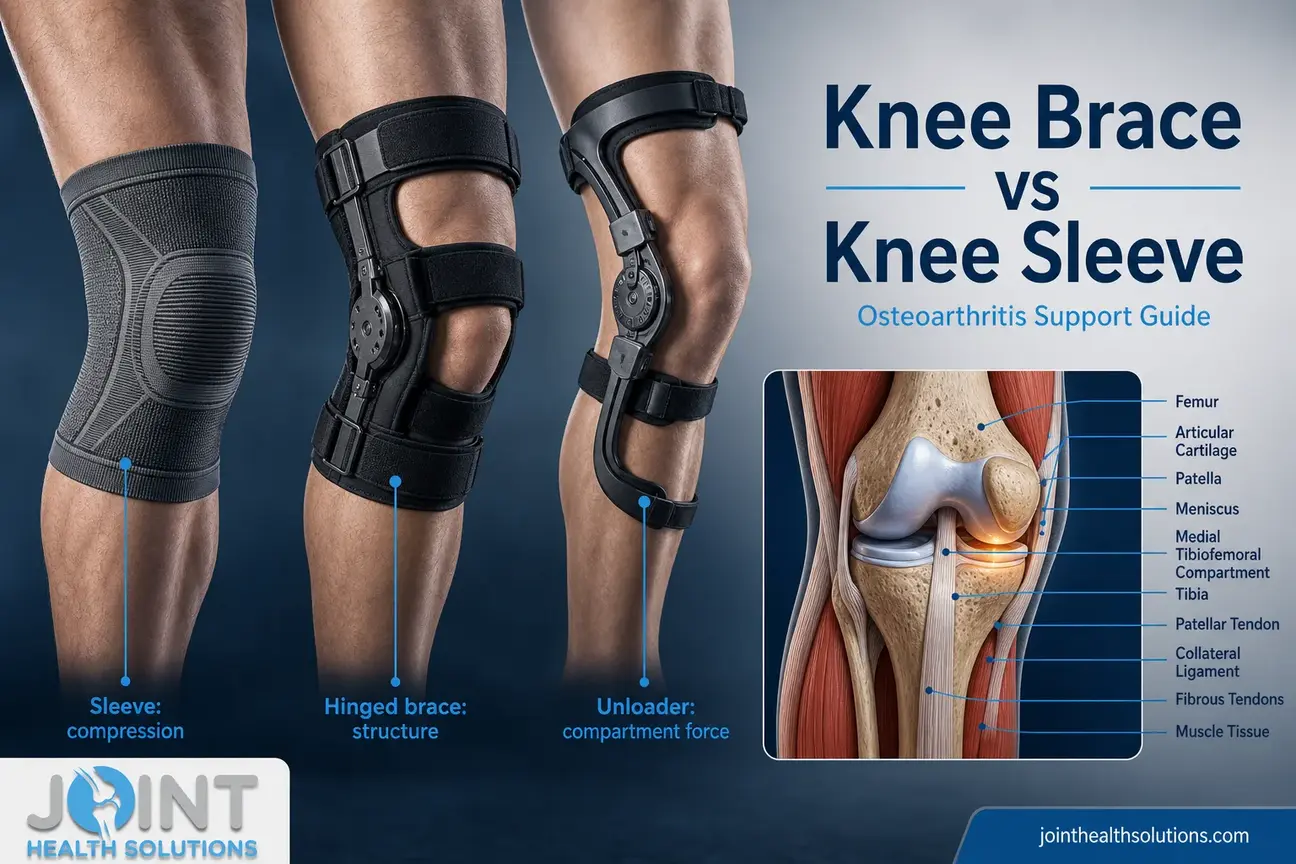
Joint Health Solutions evaluates knee concerns at its Charlotte clinic. Patients from Charlotte, Huntersville, and surrounding communities can discuss whether bracing belongs in their treatment plan. Suitability, comfort, and results vary.
Knee Brace vs Knee Sleeve: Practical Differences
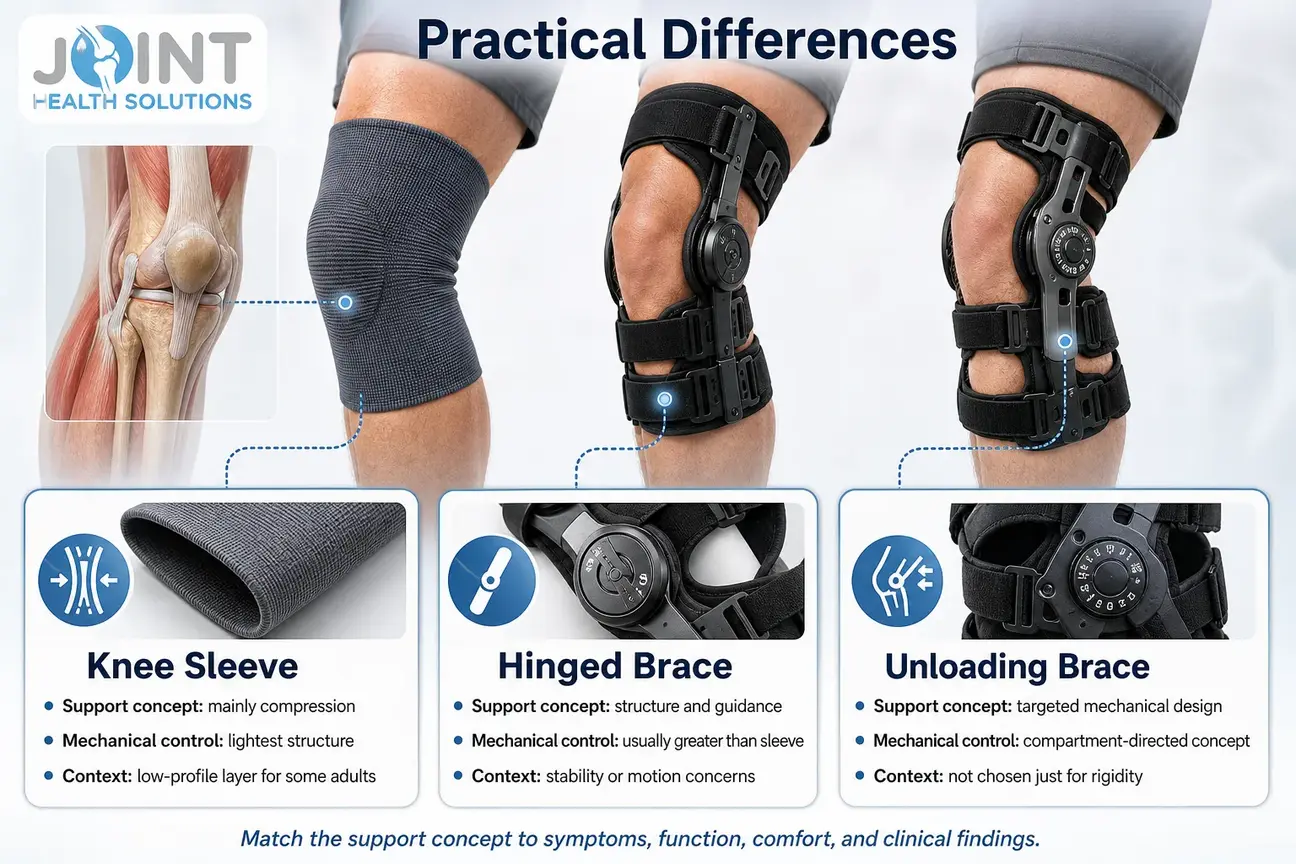
These devices differ in construction, intended function, and fitting requirements. The table summarizes their main distinctions without suggesting that one category works best for everyone.
| Device | Main purpose | Potential role | Importante limitación |
|---|---|---|---|
| Compression sleeve | Compression, warmth, and light support | A low-profile support option for selected activities | Usually does not provide substantial motion control or compartment-specific unloading |
| Hinged brace | Structural support and, depending on design, motion guidance or restriction | Selected stability or movement-control needs | A hinge does not automatically make a brace an unloader |
| Offloading brace | Directional force intended to reduce loading through a targeted compartment | Selected cases of compartment-specific tibiofemoral osteoarthritis | Requires an appropriate clinical target, fitting, adjustment, and tolerance |
The categories can overlap. Some sleeves include flexible stays, while some hinged braces incorporate unloading features. Check the specific design and intended use rather than relying on the word “brace” on a label.
What Does a Knee Sleeve Do for Arthritis?
A knee sleeve is generally an elastic garment that surrounds the knee. It may provide compression, warmth, and a sense of support during movement. Some people prefer its low profile because it fits more easily under clothing than a framed brace.
A typical sleeve does not have a rigid frame or adjustable unloading mechanism. It should not be described as correcting joint alignment, restoring cartilage, or reversing osteoarthritis. Feeling supported also does not establish that the device is treating the cause of pain.
A sleeve may be worth discussing when the goal is light support during ordinary activities. However, symptoms that repeatedly limit walking, stairs, or exercise deserve a broader evaluation. An elastic support cannot determine whether discomfort comes from arthritis, instability, an injury, or another condition.
What makes a sleeve practical to wear?
Material, sizing, seams, and the shape of your leg all affect comfort. A sleeve should not bunch behind the knee or repeatedly slide down. If swelling changes during the day, a size that initially feels comfortable may later feel restrictive.
Consider how easily you can put the sleeve on and remove it. Hand strength, bending tolerance, and clothing can affect daily use. Follow the manufacturer’s sizing and care instructions, and seek guidance if the sleeve creates pressure or worsens symptoms.
What Does a Hinged Knee Brace Add?
A hinged brace adds structural components around the knee. Depending on its design, it may resist certain movements, guide bending, or limit a prescribed range of motion. Hinged braces vary considerably, so their purposes should not be treated as identical.
Some models combine flexible fabric with side hinges. Others use a more substantial frame and adjustable straps. A brace intended for a specific injury or postoperative restriction should not be selected casually for arthritis symptoms.
A feeling of giving way may prompt a discussion about structural support. However, giving way can have several contributors and does not establish ligament instability by itself. Assessment helps distinguish the problem before deciding what support, rehabilitation, or other treatment may be appropriate.
Is every hinged brace an offloading brace?
No. Hinges alone do not establish compartment-specific unloading. An offloading design uses a particular arrangement of frame, straps, and corrective forces. A general hinged brace may offer support without the same unloading function.
Ask what the specific brace is intended to accomplish. The answer should describe a functional goal, such as controlling a particular movement or reducing compartment loading. “More support” is too broad to explain why a device fits your clinical situation.
How Does an Offloading Brace Differ From a Sleeve?
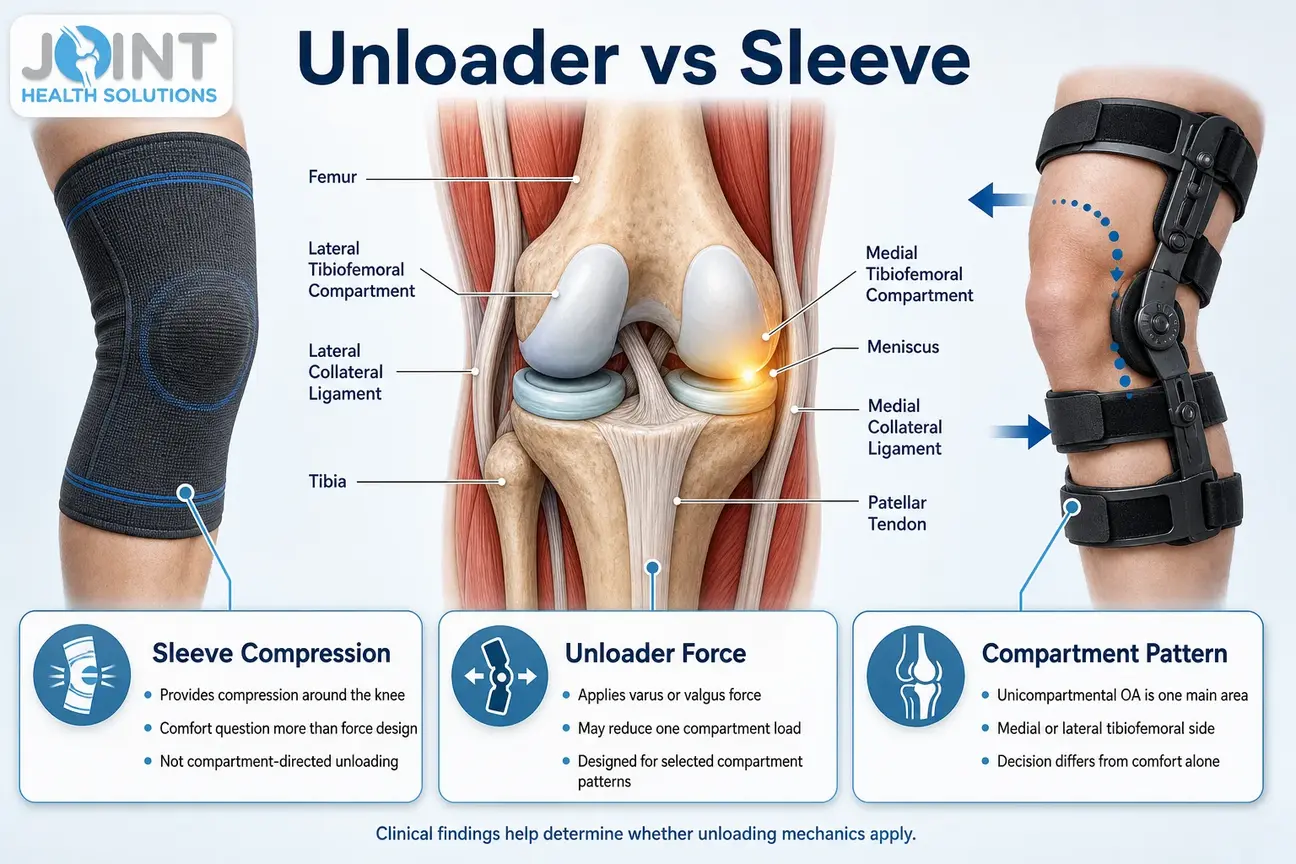
An offloading brace, also called an unloader brace, is designed to influence forces across the knee. Its intended target is usually a medial or lateral tibiofemoral compartment. These are the inner and outer areas where the thigh bone and shin bone meet.
A sleeve surrounds the knee with compression. An offloading brace uses directional forces intended to reduce loading through a selected compartment. That mechanical distinction matters when osteoarthritis is concentrated mainly on one side of the tibiofemoral joint.
Compartment-specific disease is different from a general statement that someone has knee arthritis. Symptoms may involve more than one compartment, the kneecap joint, or surrounding structures. Pain location alone cannot establish which unloading direction, if any, is suitable.
An unloader is not automatically the next step when a sleeve feels insufficient. The diagnosis, movement limitations, and treatment goals may need reassessment first. More complex equipment can add fitting demands without addressing the original problem.
For a detailed explanation of compartment selection, alignment, and fitting, read how to choose an offloading knee brace . To explore the clinic’s service, visit offloading knee braces at Joint Health Solutions .
Which Option Fits Your Main Concern?
Start by describing the activity you want to improve. “My knee hurts” is important, but a more specific description helps guide the discussion. Examples include difficulty standing at work, discomfort during errands, or uncertainty while descending stairs.
The situations below can help organize questions for a clinician. They are not a diagnostic checklist or a recommendation to buy a particular product. Different problems can produce similar symptoms.
| Your main concern | Useful discussion | What to avoid assuming |
|---|---|---|
| Wanting light support during routine activity | Whether a comfortable compression sleeve serves that limited goal | That compression corrects alignment or treats every source of pain |
| Repeated giving way or difficulty trusting the knee | Assessment of stability, strength, movement, and possible support needs | That symptoms alone identify the cause or the required brace |
| Documented compartment-specific osteoarthritis | Whether a targeted unloading design belongs in the treatment plan | That imaging findings guarantee comfort or benefit |
| Persistent pain despite using a support | Reassessment of the diagnosis, fit, activity demands, and alternatives | That buying a stiffer device is always the solution |
What Does the Evidence Say About Braces for Osteoarthritis?
The 2021 American Academy of Orthopaedic Surgeons clinical practice guideline supports considering brace treatment for knee osteoarthritis. Its recommendation addresses possible improvements in pain, function, and quality of life. The recommendation strength is Moderate.
That recommendation does not establish that every brace works equally well. The guideline discusses differences across studies, including brace designs, patient characteristics, and measured outcomes. These differences limit direct comparisons between a simple sleeve and an unloading device.
The guideline also identifies a need for stronger comparative research in patients with similar alignment and osteoarthritis severity. This is an important limitation when someone asks whether an unloader is always better than a sleeve. The evidence does not support such a universal conclusion.
A 2015 Cochrane review found uncertainty about the benefits of braces and orthoses for medial-compartment knee osteoarthritis. That older review should be interpreted alongside later guidance. It helps explain why patient selection and realistic expectations remain important.
Evidence about bracing as a category is different from evidence about a particular commercial product. Product advertising, a testimonial, or a more substantial frame does not establish superior clinical results. Ask how the proposed device fits your condition and what outcome will be evaluated.
No sleeve or brace should be presented as regrowing cartilage, curing osteoarthritis, or guaranteeing avoidance of surgery. Bracing is a potential component of symptom and function management. Whether it is worthwhile depends on the individual response and the broader care plan.
How Do Fit and Comfort Affect Everyday Use?
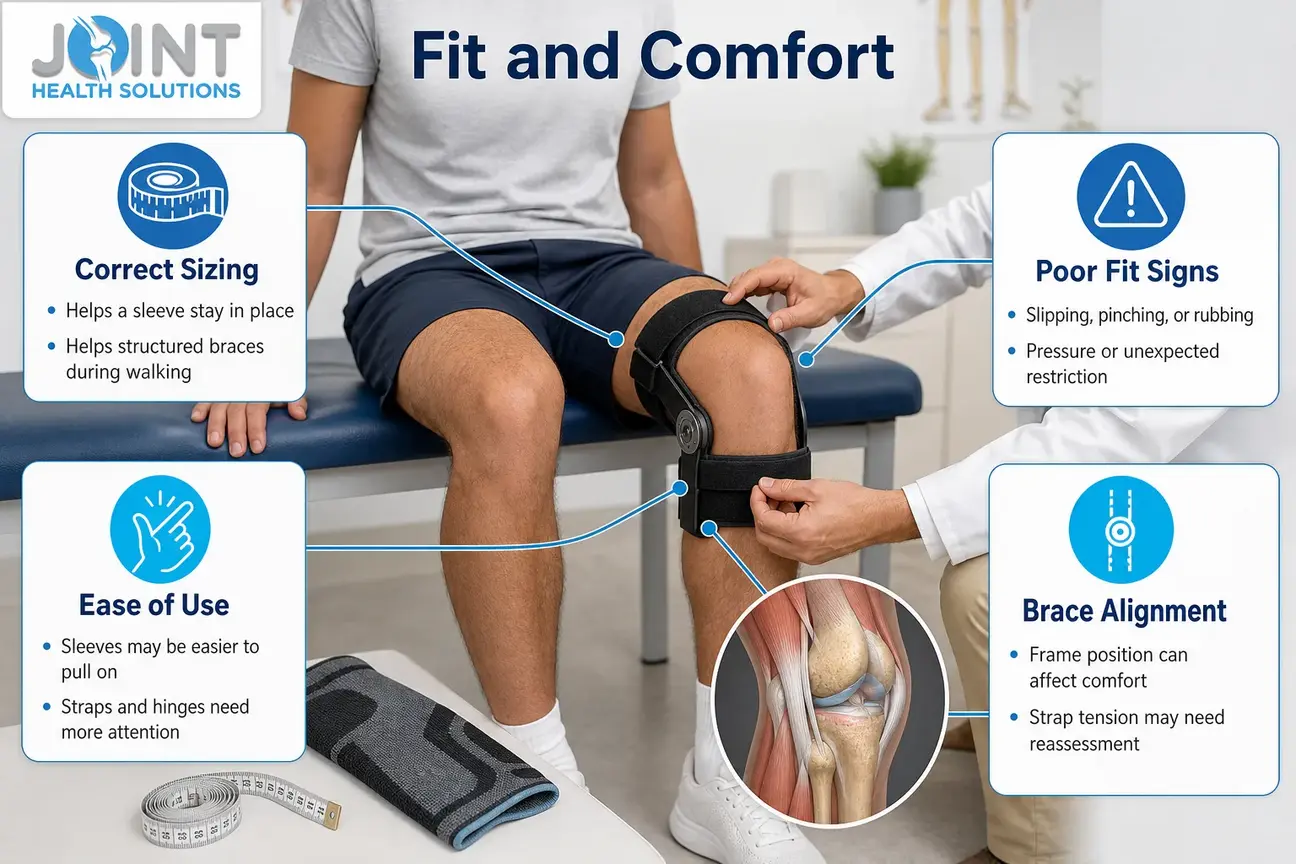
Fit determines whether a device can be worn as intended. A support that slips, rubs, or restricts ordinary movement may be difficult to use consistently. Comfort during a brief fitting also may differ from comfort during a longer walk.
Consider the activities that matter in your routine. Sitting at a desk, driving, climbing stairs, and walking outdoors place different demands on a support. A device should be assessed for relevant activities when safe and appropriate.
Compare ease of use, not just support
Pulling on a sleeve and positioning a framed brace require different movements. Consider whether you can reach the straps, align the device, and remove it safely. A clinician or qualified fitter can explain the intended application method.
Clothing and footwear also matter. A low-profile sleeve may fit under pants more easily, while a framed brace may require additional room. Bring relevant clothing or footwear questions to the fitting discussion rather than assuming they will be easy to resolve.
Do not treat discomfort as proof the device is working
Pressure is not a reliable measure of therapeutic benefit. Repeated slipping should not automatically be addressed by tightening the support further. Follow fitting instructions and seek reassessment when a device creates persistent irritation or worsens movement.
There is no universal wear schedule for every sleeve and brace. Intended use depends on the device, clinical purpose, and individual instructions. Ask when to wear it, when to remove it, and how to recognize a problem.
When Should You Seek a Knee Assessment?
Seek guidance when symptoms persist, recur, or interfere with daily activities. Repeated swelling, giving way, and difficulty with walking or stairs deserve attention. A support should not postpone evaluation of an unclear or worsening problem.
Assessment may include symptom history, movement observations, examination, and imaging when clinically appropriate. The purpose is to understand the problem before selecting equipment. Imaging findings alone do not describe your activity tolerance, balance, comfort, or ability to use a brace.
Describe previous supports and what happened when you used them. Explain whether they slipped, caused pressure, felt helpful, or changed your walking. These observations can be more useful than simply saying a product was “good” or “bad.”
Joint Health Solutions provides information about knee pain evaluation y knee arthritis care. The appropriate next step depends on the findings rather than the support category you initially preferred.
What Problems Should Prompt Reassessment?
A sleeve or brace should not cause persistent numbness, skin breakdown, or worsening pain. Stop the activity and seek guidance if the device produces concerning symptoms. People with impaired sensation, circulation concerns, or existing skin problems should discuss those issues before use.
- Repeated slipping, bunching, or loss of position during ordinary movement.
- Persistent pressure, rubbing, redness, blisters, or broken skin.
- New tingling, numbness, or concerning changes in the foot.
- Worsening walking, balance, pain, or confidence while using the device.
- Difficulty applying the support according to its instructions.
Sudden severe pain, major injury, inability to bear weight, or a hot, swollen knee with fever requires prompt medical assessment. Do not rely on a newly purchased support to manage these symptoms. For emergency symptoms, call 911 or go to an emergency department.
Do not modify hinges, remove structural components, or change unloading settings without appropriate instructions. Altering a device can change its intended function. Persistent problems may require adjustment, a different approach, or discontinuation under clinical guidance.
How Does Bracing Fit With Other Osteoarthritis Care?
A support may address only part of the difficulty you experience. Strength, flexibility, activity demands, and other health factors can influence knee function. Treatment planning should consider these factors rather than relying on equipment alone.
Depending on the assessment, conservative care may include therapeutic exercise, activity adjustments, or fisioterapia. Medication or injection discussions may also be appropriate for selected patients. Each option has its own indications, limitations, and risks.
A brace should not replace an exercise or rehabilitation plan without a clinical reason. Likewise, discomfort during exercise should not automatically lead to a stronger brace. Discuss the activity, symptom pattern, and treatment goals so the plan can be adjusted appropriately.
If symptoms remain substantially limiting, ask whether further evaluation or specialist referral is appropriate. Choosing conservative care does not require ignoring other options. The goal is an informed plan that reflects your condition, preferences, and functional needs.
Does Insurance Treat Sleeves and Braces the Same Way?
No. Coverage depends on the device, applicable benefit rules, medical necessity, documentation, and supplier requirements. A retail sleeve and a prescribed knee orthosis should not be assumed to have the same coverage. A prescription or arthritis diagnosis alone does not guarantee payment.
Medicare’s Knee Orthoses policy includes criteria for specified varus- or valgus-adjustable braces. The policy revision effective January 25, 2026 includes an osteoarthritis coverage pathway. It does not establish automatic coverage for every knee support or every person with arthritis.
Before ordering, ask about the proposed device, supplier participation, required documentation, authorization, and estimated personal cost. Medicare Advantage and other plans may have additional plan-specific requirements. Confirm benefits with the insurer and relevant provider or supplier.
Review the clinic’s Información sobre seguros for general guidance. The separate offloading-brace selection guide explains documentation considerations in greater detail.
How Can You Prepare for a Brace Discussion?
Bring a short description of your main limitations and any supports you have already tried. Note which activities trigger symptoms and whether the knee feels painful, stiff, unstable, or swollen. Include practical concerns such as work clothing, stairs at home, and difficulty fastening straps.
- What problem are we trying to address with this device?
- Is the goal compression, structural support, motion control, or compartment-specific unloading?
- What findings support that choice?
- How will the device be sized, fitted, and checked during movement?
- When should I wear it, and what instructions should I follow?
- What symptoms mean I should stop using it and contact the clinician?
- How will we decide whether it is helping enough to continue?
- What alternatives should be considered if it does not help?
Agree on a practical outcome to review. That might involve a particular walking task, stair activity, or ability to complete an ordinary errand. Avoid treating ownership of a brace as the outcome; the important question is whether the plan serves your needs.
Discuss Knee Support Options at the Charlotte Clinic
Joint Health Solutions is located at 9350 Benfield Rd, Suite 109, Charlotte, NC 28269. Patients from Huntersville and surrounding communities can request evaluation at this Charlotte location. A service area should not be confused with a separate clinic office.
The decision between a sleeve, hinged brace, and offloading brace should follow the clinical concern. A lighter device may suit a limited support goal, while a targeted brace may require more detailed assessment. Neither choice guarantees relief or determines the rest of your treatment.
Before your visit, review what to expect at Joint Health Solutions. Bring your questions about symptoms, activity goals, previous treatment, and insurance. An appointment provides an opportunity to discuss options without assuming that a particular device will be prescribed.
This article provides general education and does not replace professional medical advice, diagnosis, or treatment. Individual suitability and results vary.
Preguntas frecuentes
Is a knee sleeve the same as a knee brace?
No. A sleeve generally provides compression and light support, while a brace may add hinges, straps, motion control, or compartment-directed unloading. The terms are sometimes used loosely, so the brace design matters.
Is a knee sleeve for arthritis likely to unload the knee?
A typical compression sleeve should not be described as a compartment-specific unloading device. An unloading brace is designed differently and may use a varus or valgus adjustment to influence load through a targeted compartment.
Is a hinged knee brace an unloader brace?
Not necessarily. A hinged knee brace may provide stability or motion control, but only some designs are intended to unload the medial or lateral compartment. Product design and fitting determine its intended function.
When might an unloader brace be considered?
An unloader may be considered when clinical findings suggest compartment-specific tibiofemoral osteoarthritis and the person has relevant pain or functional limitations. Suitability depends on assessment, fitting, comfort, and the specific brace design.
Can a brace help if knee osteoarthritis limits walking?
A brace may be considered as one part of conservative care, but walking limitation can have different causes and may warrant clinical assessment. Guidance uses conditional wording for braces and assistive devices in listed scenarios, not as a universal recommendation.
Which is more comfortable, a sleeve or a brace?
A sleeve is often lower profile, but comfort varies with material, sizing, swelling, skin sensitivity, brace structure, and activity. A more supportive brace may also feel more restrictive or bulky.
Does the evidence prove that an unloading brace works better than a sleeve?
No. Direct comparisons remain uncertain for comparable patient groups. Evidence across brace studies varies by brace type, patient selection, use instructions, and outcomes.
Should someone with knee osteoarthritis choose a brace without an assessment?
Some people may try a general sleeve, but choosing an unloading or more structured brace is more dependent on the knee’s symptoms, mechanics, mobility, and fit. Assessment may be appropriate when symptoms are persistent, activity-limiting, unstable, or difficult to localize.
Fuentes
- American Academy of Orthopaedic Surgeons. Management of Osteoarthritis of the Knee (Non-Arthroplasty): Evidence-Based Clinical Practice Guideline . Published August 31, 2021.
- American Academy of Orthopaedic Surgeons. Appropriate Use Criteria for Osteoarthritis of the Knee .
- Centers for Medicare & Medicaid Services. Knee Orthoses: Local Coverage Determination L33318 . Revision effective January 25, 2026.
- Centers for Medicare & Medicaid Services. Knee Orthoses: Policy Article A52465 .
- Cochrane Database of Systematic Reviews. Braces and orthoses for treating osteoarthritis of the knee . Published 2015.
Revisado médicamente por:

Dr. Jeffrey Galvin
Medical Director, Joint Health Solutions

Ariel Curtis, FNP-C
Family Nurse Practitioner, Joint Health Solutions
 Spanish
 English