
Outer Hip Pain: Why Does the Outside of My Hip Hurt?
Outer hip pain often comes from the tendons and cushioning tissues beside the hip rather than from the ball-and-socket joint itself. The location, activities that provoke it, and symptoms that accompany it can help narrow the possibilities—but they cannot confirm a diagnosis.
This guide explains common causes of outer hip pain, why side sleeping and stairs can matter, which symptoms need prompt or emergency care, how clinicians evaluate the problem, and how treatment may differ by diagnosis.
Quick Answer: What Usually Causes Pain on the Outside of the Hip?
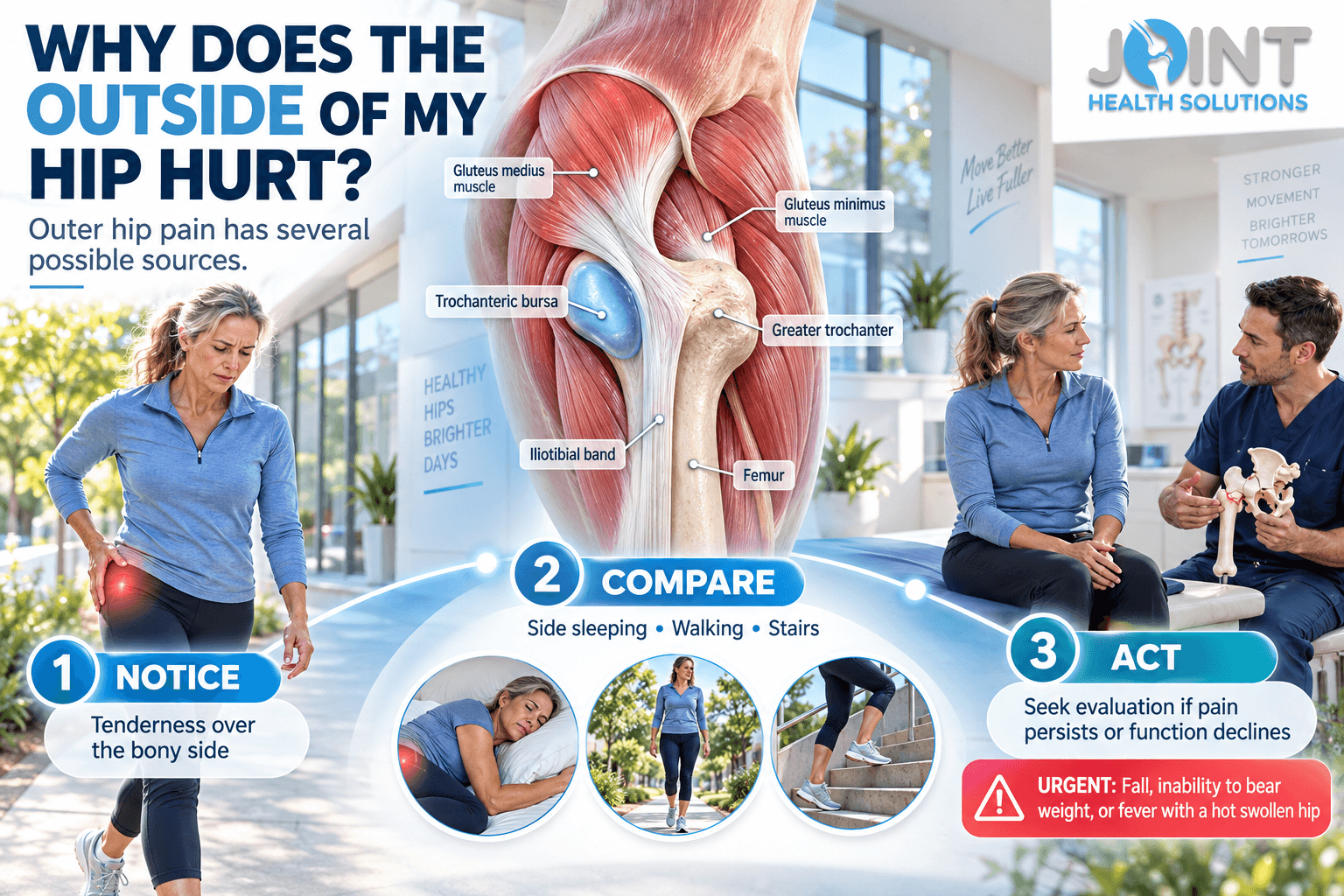
A common explanation is greater trochanteric pain syndrome (GTPS), an umbrella term for pain involving the gluteal tendons, nearby bursae, or both. It often causes tenderness over the bony side of the hip and may worsen with side sleeping, prolonged standing, walking, stairs, running, or getting up from a chair.
Outer hip pain can also come from a muscle or tendon injury, snapping of the iliotibial band, hip osteoarthritis, a nerve problem, referred pain from the lower back, or—less commonly—a fracture or infection. Severe pain after a fall, inability to bear weight, a hot swollen joint with fever, or chest pain and shortness of breath with one-sided leg swelling requires urgent assessment.
What Does “Outside of the Hip” Mean Anatomically?
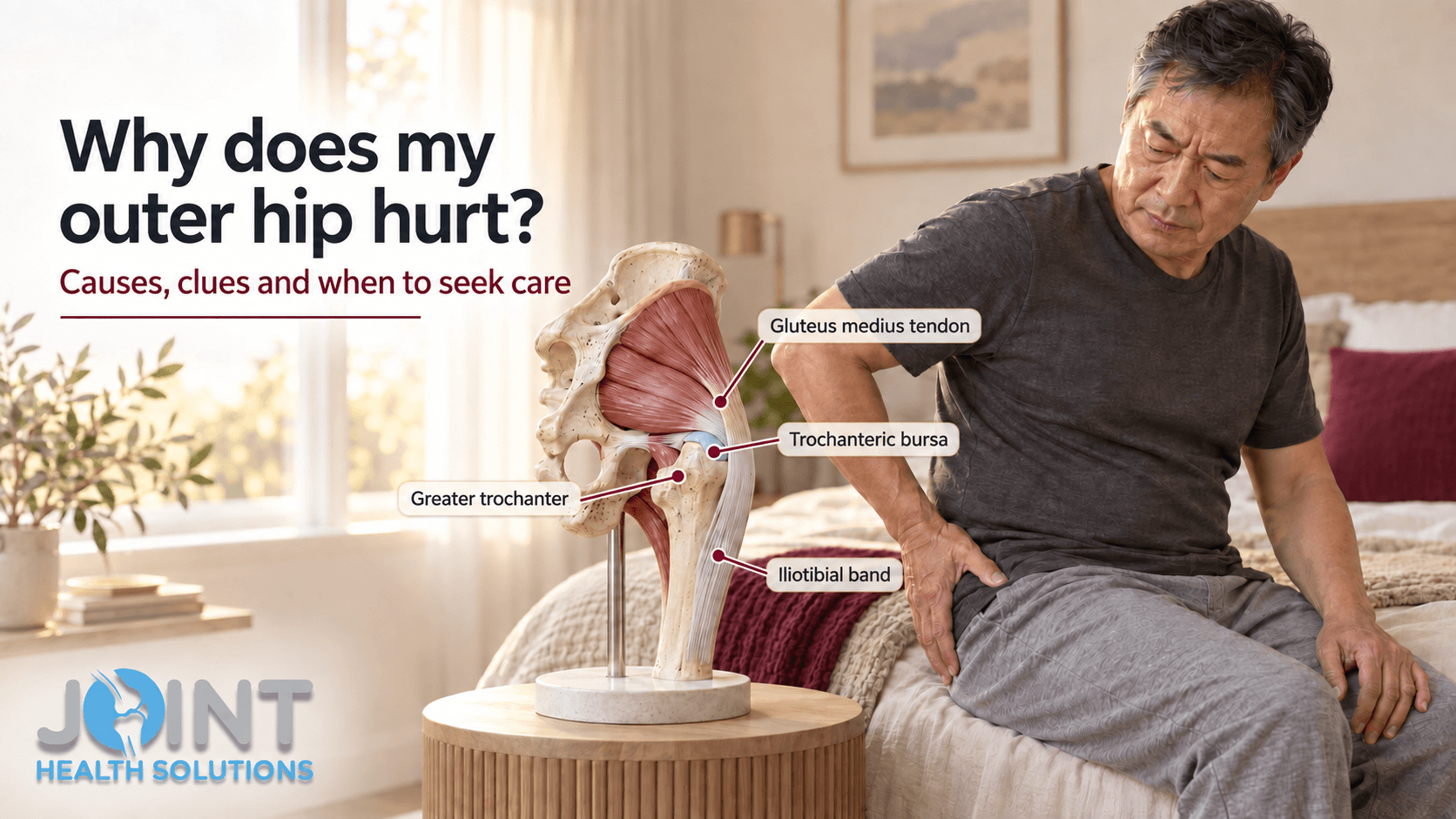
The prominent bone you can feel at the side of the upper thigh is the greater trochanter, part of the femur. The gluteus medius and gluteus minimus tendons attach in this region and help stabilize the pelvis when you stand on one leg, walk, climb stairs, or run. Small fluid-filled sacs called bursae reduce friction as tendons and other soft tissues move over bone. The iliotibial band also crosses the outside of the hip.
Pain centered over this bony prominence is called lateral hip pain. It is different from pain felt primarily in the groin, deep buttock, lower back, or outer thigh skin. Those locations can overlap, however, so the spot that hurts is a clue—not a diagnosis.
The phrase hip bursitis is commonly used for lateral pain, but bursitis may not tell the whole story. Many people have gluteal tendon involvement with or without bursal irritation. Clinicians may therefore use the broader term greater trochanteric pain syndrome.
Which Outer Hip Pain Pattern Sounds Most Like Yours?
No single symptom can identify the cause, but the pattern can guide the next step. Use this table as an orientation tool, not a self-diagnosis.
| Pattern | Possible explanation | Useful distinction |
|---|---|---|
| Tender over the bony side; worse lying on that side, walking, or stairs | Greater trochanteric pain syndrome, gluteal tendinopathy, or bursal irritation | Direct pressure and single-leg loading commonly provoke symptoms |
| Snapping or clicking over the outer hip during movement | External snapping hip involving the iliotibial band or nearby tendon | Snapping without pain may not require treatment; painful snapping deserves evaluation |
| Deep groin pain, stiffness, or reduced rotation | Hip-joint source such as osteoarthritis or a labral condition | Pain can spread to the outer hip, but the groin and restricted motion are important clues |
| Burning, tingling, or numb skin on the outer thigh | Meralgia paresthetica, a sensory-nerve compression problem | Usually affects sensation rather than hip-joint movement |
| Back or buttock pain that travels down the leg, sometimes below the knee | Lumbar nerve irritation or another referred-pain source | Numbness, tingling, weakness, or symptoms affected by spinal position raise suspicion |
| Sudden severe pain after a fall or pain that prevents weight bearing | Fracture or significant soft-tissue injury | Requires urgent assessment, especially in older adults or people with weak bones |
What Can Cause Pain on the Outside of the Hip?
1. Greater Trochanteric Pain Syndrome and Gluteal Tendinopathy
GTPS is one of the most common clinical labels for lateral hip pain. The gluteal tendons help control the pelvis during weight-bearing movement. A sudden increase in walking, hills, running, side-to-side exercise, or prolonged hip compression can exceed their current tolerance. Symptoms may also emerge gradually without one memorable injury.
Typical clues include focal tenderness over the side of the hip, discomfort when lying on the painful side, pain during stairs or prolonged walking, and aching that may extend down the outer thigh without reaching the foot. Some people notice pain when standing with most of their weight on one leg or when crossing their legs.
A clinician may assess tenderness, hip-abductor strength, gait, single-leg control, range of motion, and whether specific loading tests reproduce the familiar pain. Imaging findings must be interpreted with the examination because structural changes may occur in people without symptoms.
2. Trochanteric Bursal Irritation
A bursa can become irritated after repetitive loading, a direct impact, surgery, or altered mechanics around the hip. This may cause sharp pain initially and a broader ache later. Direct pressure from sleeping on the affected side can be particularly uncomfortable.
Bursal irritation and gluteal tendon pain can coexist, which is why treatment should not automatically focus on “reducing inflammation” alone. Restoring appropriate strength, movement capacity, and load tolerance may be central to longer-term improvement.
3. External Snapping Hip
When the iliotibial band or a tendon moves over the greater trochanter, a person may feel or hear a snap at the outer hip. Painless snapping can occur without damage or a need for treatment. If it becomes painful, swollen, or limits activity, an examination can help determine whether tendon overload, bursal irritation, training changes, or another cause is involved.
4. Hip Osteoarthritis or Another Joint Source
Hip osteoarthritis more often causes groin-centered pain, stiffness after rest, and reduced hip motion, but discomfort can be felt along the side of the hip or into the thigh. Symptoms may affect putting on shoes, getting into a car, walking, or rising from a low chair.
Joint-centered symptoms need a different evaluation from isolated GTPS. If pain is deep in the groin with catching or mechanical symptoms, the clinician may also consider a labral problem. Joint Health Solutions has a separate guide to hip labral tear evaluation and treatment so this article does not duplicate that intent.
5. Muscle Strain or Gluteal Tendon Tear
A muscle or tendon can be strained during a sudden sprint, slip, change of direction, lifting task, or unfamiliar workout. A more substantial gluteal tendon injury may produce weakness, a limp, bruising, or difficulty stabilizing the pelvis on one leg. Sudden functional loss or marked weakness should be evaluated rather than managed as routine soreness.
6. Pain Referred From the Back or Deep Buttock
The painful spot is not always the source. Irritated lumbar nerves, spinal joints, sacroiliac structures, and deep gluteal tissues may refer symptoms toward the outer hip. Back pain, tingling, numbness, weakness, or pain extending below the knee make a nerve-related source more likely. Deep buttock pain with leg symptoms has its own differential; see the separate guide to piriformis syndrome and sciatica-like symptoms.
7. Meralgia Paresthetica
Meralgia paresthetica occurs when the lateral femoral cutaneous nerve is compressed. It can cause burning, tingling, numbness, or unusual sensitivity over the outer thigh. Tight clothing, weight gain, pregnancy, diabetes, or pressure near the groin may contribute. Because this nerve is sensory, true muscle weakness suggests a different or additional problem.
8. Stress Fracture or Traumatic Hip Fracture
A fracture can follow a fall or direct trauma, especially in an older adult or someone with osteoporosis. Stress fractures may develop with repetitive impact, rapid training increases, low energy availability, or reduced bone strength. Pain may begin only during activity and become more persistent. Continuing to train through suspected bone pain can worsen the injury.
9. Less Common but Important Causes
Inflammatory arthritis, infection, complications involving a hip replacement, and tumors are less common explanations but can be serious. Persistent pain that is progressive, unexplained, accompanied by fever or systemic illness, or associated with a history of cancer deserves timely medical evaluation.
Why Does My Outer Hip Hurt During Certain Activities?
| When it hurts | What may be happening | What to notice |
|---|---|---|
| Lying on the painful side | Direct compression of sensitive lateral-hip tissues | Whether the opposite side also hurts because the top leg drops inward |
| Walking or standing for a long time | Repeated demand on hip-abductor tendons | Distance to symptom onset, limp, and whether hills are worse |
| Stairs or rising from a chair | Higher load through the hip and surrounding muscles | Weakness, pelvic drop, groin pain, or knee symptoms |
| Running or a recent training increase | Load exceeded current tendon, muscle, or bone capacity | Mileage, speed, hills, shoes, recovery, and pain during hopping |
| Crossing the legs or hanging on one hip | Compression across the outer hip | Whether changing posture eases symptoms |
When Is Outer Hip Pain an Emergency?
Seek emergency or urgent medical care when outer hip pain occurs with:
- A fall or significant injury followed by severe pain, deformity, a shortened or rotated leg, or inability to stand or bear weight
- Rapidly worsening pain, a hot or swollen joint, fever, chills, or feeling seriously unwell
- New loss of bladder or bowel control, numbness around the groin or saddle area, or rapidly progressing leg weakness
- One-sided leg swelling or calf pain with chest pain, sudden shortness of breath, coughing blood, fainting, or a very fast heartbeat—call 911
- Coldness, pallor, blue discoloration, or new loss of feeling in the leg or foot
Arrange a prompt appointment for pain that keeps worsening, repeatedly wakes you, causes a persistent limp, follows a rapid increase in impact activity, or occurs with unexplained weight loss or a history of cancer. Night pain alone does not identify the cause: GTPS can hurt at night because side lying compresses the area, but persistent unexplained night pain still deserves assessment.
What Can I Do for Mild Outer Hip Pain at Home?
If there was no significant injury and no warning sign, a short period of sensible load modification may help. The aim is to reduce irritation without becoming completely inactive.
- Reduce the aggravating dose. Temporarily shorten walks, reduce hills or stairs, and avoid repeatedly testing painful movements.
- Change sleep pressure. Avoid lying directly on the painful side. When lying on the other side, a pillow between the knees may keep the top leg from dropping across the body.
- Avoid prolonged compression. Limit crossing the legs, sitting in very low chairs, or standing with most weight shifted onto one hip if those positions reproduce pain.
- Use cold or warmth safely. A wrapped cold pack after a flare or gentle warmth for surrounding stiffness may feel soothing. Protect the skin and keep sessions brief.
- Keep movement tolerable. Gentle, comfortable motion is usually preferable to prolonged bed rest. Stop an exercise that causes sharp pain, increasing weakness, or worsening symptoms afterward.
- Check before using medication. Nonprescription pain relievers are not safe for everyone. Ask a clinician or pharmacist if you have kidney disease, ulcers, cardiovascular disease, take blood thinners, are pregnant, or use other medicines.
Aggressive stretching, hard foam rolling directly over the sore greater trochanter, or pushing through escalating pain may increase compression and irritation. Generic online exercises can also miss a fracture, nerve problem, significant tendon tear, or joint condition. If symptoms persist or function declines, an individualized examination is more useful than adding more self-treatment.
How Is Pain on the Outside of the Hip Evaluated?
Evaluation starts with the story. A clinician may ask where the pain began, whether it followed trauma or a training change, how far it travels, what happens at night, and whether there is groin pain, back pain, numbness, weakness, fever, or difficulty bearing weight. Medical history matters, including osteoporosis risk, cancer, inflammatory disease, infection risk, pregnancy, medication use, and previous hip or spine surgery.
The physical examination may include gait, balance, hip and back motion, focal tenderness, hip-abductor strength, resisted movements, single-leg loading, and a neurologic and circulation check when indicated. The goal is not merely to make the painful spot hurt; it is to determine which finding reproduces the person’s familiar symptoms and whether another region is contributing.
Not everyone needs imaging. When imaging is appropriate, the test should answer a specific question.
| Test | What it may help assess | Important limitation |
|---|---|---|
| X-ray | Fracture, osteoarthritis, bone shape, or another bony cause | Does not show tendons and bursae in the same detail as ultrasound or MRI |
| Diagnostic ultrasound | Gluteal tendons, bursae, dynamic snapping, or image guidance | Operator skill matters, and findings must match the symptoms |
| MRI | Suspected tendon tear, occult or stress fracture, joint disorder, infection, or mass | Incidental abnormalities may not be the source of pain |
| Blood tests | Possible infection, inflammatory disease, or selected systemic causes | Not routinely needed for straightforward mechanical lateral hip pain |
For a broader explanation of what happens before treatment is selected, see the clinic’s guide to a non-surgical joint evaluation. Symptoms that may represent a fracture, infection, blood clot, or serious nerve compression should be directed to urgent or emergency care rather than a routine office visit.
How Is Outer Hip Pain Treated?
Treatment depends on the diagnosis, severity, goals, health history, and response to initial care. There is no single best treatment for every person with pain on the outside of the hip.
Education and Load Management
For many cases of gluteal tendinopathy or GTPS, reducing repeated compression and adjusting the amount of walking, running, stairs, or standing can calm symptoms while preserving activity. The plan can then build capacity gradually rather than cycling between complete rest and sudden overload.
Physical Therapy and Progressive Exercise
A tailored rehabilitation program may address hip-abductor strength, pelvic control, mobility, gait, balance, and return to work or sport. Exercise selection and dosage should reflect symptom irritability and the suspected tissue. A randomized clinical trial in gluteal tendinopathy found that education plus exercise performed better than a wait-and-see approach for global improvement, with durable benefit at 52 weeks; results from a study population do not guarantee an individual outcome.
Learn more about physical therapy at Joint Health Solutions.
Medication
A clinician may discuss topical or oral medication for short-term symptom control when medically appropriate. Medication can have interactions and gastrointestinal, kidney, cardiovascular, bleeding, or pregnancy-related risks. It does not replace evaluation when symptoms suggest a fracture, infection, nerve problem, or meaningful loss of function.
Image-Guided or Diagnostic Procedures
In selected cases, a clinician may consider an injection after the diagnosis and alternatives are reviewed. A corticosteroid injection around a painful bursa may provide temporary relief for some patients, but response varies and repeated exposure can affect soft tissue. An injection does not rebuild a tendon, correct every movement factor, or prove that all outer hip pain came from bursitis.
Hip-joint procedures address a different target from lateral-hip soft tissues. The location should be selected from the clinical assessment, and risks, expected benefit, alternatives, and insurance coverage should be discussed before treatment. Joint Health Solutions does not promise a cure or a guaranteed outcome.
Specialist Referral or Surgery
Surgery is uncommon for routine GTPS. Referral may be appropriate for a substantial tendon tear, fracture, progressive neurologic deficit, advanced hip-joint disease, infection, or persistent disability despite a well-matched nonsurgical plan. The underlying diagnosis—not pain intensity alone—guides that decision.
Outer Hip Pain Evaluation in Charlotte, NC
Joint Health Solutions evaluates joint and musculoskeletal concerns with the goal of identifying the likely pain source before discussing treatment. An appointment may include symptom history, physical examination, review of prior imaging, and recommendations for additional testing or referral when appropriate.
Soluciones para la Salud Articular
9350 Benfield Rd, #109
Charlotte, NC 28269
Phone: 704-833-3566
Frequently Asked Questions About Outer Hip Pain
1. Why does the outside of my hip hurt when I sleep?
Side sleeping places direct pressure on the tissues over the greater trochanter. GTPS, gluteal tendinopathy, or bursal irritation may therefore hurt when you lie on the affected side. The opposite side can also hurt if the top leg drops across the body and compresses the painful region. A pillow between the knees may help some people, but persistent night pain warrants evaluation.
2. Is outer hip pain always bursitis?
No. Gluteal tendon pain is common and can occur with or without bursal irritation. Arthritis, muscle injury, snapping hip, nerve compression, referred back pain, and fractures can also cause pain in or near the outer hip. That is why the broader term GTPS is often more useful than assuming every case is isolated bursitis.
3. Can hip arthritis cause pain on the outside of the hip?
Yes, although hip osteoarthritis more often produces groin pain, stiffness, and reduced range of motion. Joint pain may be felt at the side of the hip or into the thigh, and arthritis can coexist with lateral soft-tissue pain. Examination and, when appropriate, X-rays can help distinguish the sources.
4. Why does my outer hip hurt when walking or climbing stairs?
Walking and stairs require the gluteal muscles and tendons to stabilize the pelvis. Pain may appear when the load exceeds current tissue capacity, especially after a change in activity. Arthritis, weakness, altered gait, tendon injury, and referred pain are other possibilities.
5. Does pain from GTPS travel down the leg?
It can ache along the outer thigh, often without reaching the foot. Burning, tingling, numbness, weakness, or pain traveling below the knee raises more concern for a nerve-related source and should be assessed in context.
6. Should I stretch outer hip pain?
Not automatically. Some stretches place more compression across irritated gluteal tendons and can aggravate symptoms. Gentle motion may be appropriate, but the best exercise depends on the diagnosis and irritability. A clinician or physical therapist can help select and progress exercises safely.
7. How long does outer hip pain last?
Duration varies widely. Mild overload may settle with early activity changes, while persistent tendinopathy can take weeks or months of progressive management. A precise timeline cannot be promised. Seek evaluation if pain is worsening, repeatedly returning, disturbing sleep, or limiting walking and daily activities.
8. Do I need an MRI for pain on the outside of my hip?
Usually not as the first step. Many cases can be assessed from the history and examination. X-rays may be used when bone or arthritis is a concern. Ultrasound or MRI may be considered for a suspected tendon tear, occult fracture, persistent unexplained symptoms, or when the result would change management.
9. Can an injection cure outer hip pain?
No injection can be assumed to cure every cause. A targeted corticosteroid injection may provide temporary symptom relief in selected cases of bursal-region pain, but response varies and it does not rebuild a tendon or address every contributing factor. Diagnosis, rehabilitation, risks, and alternatives should be discussed first.
10. When should I see a clinician for outer hip pain?
Make an appointment when pain persists despite reasonable activity changes, worsens, causes a limp, limits sleep or daily function, or occurs with numbness or weakness. Seek urgent care after significant trauma, if you cannot bear weight, or if the hip is hot and swollen with fever. Call 911 for chest pain or sudden shortness of breath with one-sided leg swelling.
The Takeaway
Pain on the outside of the hip is often related to the gluteal tendons and nearby bursae, particularly when side sleeping, walking, or stairs provoke it. But location alone cannot distinguish GTPS from hip-joint, nerve, spine, muscle, or bone problems. Match treatment to a careful evaluation, and do not delay urgent care for trauma, fever with a hot swollen joint, major neurologic symptoms, or possible blood-clot warning signs.
Medical References
- StatPearls: Greater Trochanteric Pain Syndrome. National Center for Biotechnology Information.
- Hip Bursitis. American Academy of Orthopaedic Surgeons.
- ACR Appropriateness Criteria: Chronic Hip Pain. American College of Radiology.
- Osteoarthritis of the Hip: Patient Handout. American Academy of Orthopaedic Surgeons.
- Hip Fractures. American Academy of Orthopaedic Surgeons.
- Meralgia Paresthetica. National Institute of Neurological Disorders and Stroke.
- About Blood Clots. Centers for Disease Control and Prevention.
- Septic Arthritis: Symptoms and Causes. Mayo Clinic.
- Education plus exercise versus corticosteroid injection versus wait and see for gluteal tendinopathy. BMJ.
Medical Review
Publish the reviewer attribution below only after the named clinicians have reviewed and approved the final article.
 Spanish
  English