

Can Physical Therapy Help Joint Pain? Goals and Limits
Respuesta rápida: Can physical therapy help joint pain? It may help some adults improve movement, strength, daily function, and activity tolerance when symptoms are related to arthritis, stiffness, mobility limitations, or musculoskeletal injury. It is not a promise of relief, and it should not be treated as a one-size-fits-all exercise list. A clinical assessment helps determine whether therapy, another conservative option, or a combination of options may be appropriate.
If joint pain is limiting walking, stairs, work, exercise, sleep, or routine tasks, it is understandable to ask whether therapy is worth considering. The realistic answer is that therapy can be useful for many people, but the goals should be practical: better movement, stronger support around the joint, improved confidence with activity, and safer self-management strategies. It cannot diagnose an unseen reader, promise relief, or determine whether a specific exercise is right for you without evaluation.
At Joint Health Solutions, the focus is conservative, patient-centered joint care. If you are exploring fisioterapia as part of a non-surgical plan, you can Solicite una cita to discuss whether an assessment may be appropriate for your situation.
Can physical therapy help joint pain? Goals and limits
Physical therapy is designed to address how a joint and the surrounding muscles, tendons, ligaments, and movement patterns are functioning. For some people, pain is linked with stiffness, weakness, reduced range of motion, balance changes, altered walking, or difficulty performing daily tasks. For others, pain may come from a condition that needs medical evaluation before exercise is progressed.
That is why the first expectation should not be “Which exercise fixes this?” A better starting point is, “What is contributing to my symptoms, what can be safely modified, and what goals make sense for my life?” PT for joint pain may include education, therapeutic exercise, movement retraining, activity modification, and home guidance when appropriate. The details depend on the person’s condition, tolerance, goals, and exam findings.
Good physical therapy goals are often functional rather than vague. A goal might involve walking more comfortably, improving shoulder motion for reaching, strengthening muscles that support a painful knee, or learning how to adjust activities that repeatedly aggravate symptoms. These goals are not promises. They are targets that guide an individualized care plan and may change as the person responds.
Physical therapy goals for movement, strength, and daily function
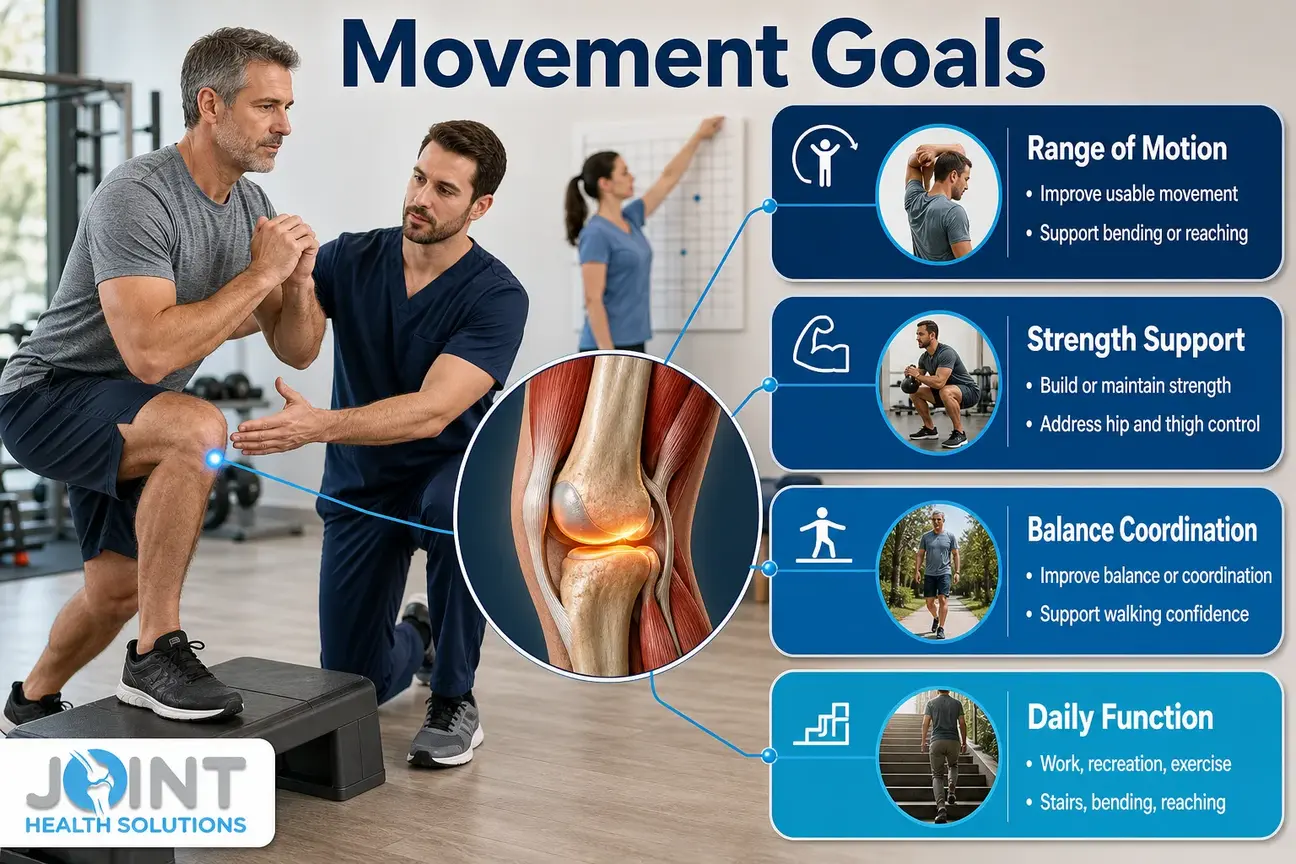
Common physical therapy goals may include improving usable range of motion, building or maintaining strength, improving balance or coordination, and supporting participation in work, recreation, or exercise. Therapy may also help a person understand how certain movements, positions, surfaces, or loads affect symptoms. That education can be just as important as the exercises themselves.
For example, someone with knee pain may need help with walking mechanics, stair tolerance, hip and thigh strength, or confidence with bending. A person with shoulder pain may need assessment of motion, strength, reaching patterns, and symptom irritability. A person with hip stiffness may need a plan that respects joint tolerance while addressing flexibility, strength, and activity demands. These examples are general; they are not exercise prescriptions.
Physical therapy goals should also reflect what matters to the person. Daily goals may include getting in and out of a car, standing long enough to cook, returning to a modified fitness routine, or managing work tasks with less symptom aggravation. For active adults and athletes, goals may include movement control, gradual return to sport-specific activities, and strategies for load management, when appropriate.
PT for joint pain is often most useful when the plan connects clinic work with real-life activities. A program that improves an isolated movement but does not translate to stairs, lifting, reaching, walking, or recreation may need to be adjusted. The value of assessment is that therapy can be aligned with the person’s actual limitations instead of relying on a generic exercise handout.
Arthritis physical therapy evidence differs by joint
Arthritis physical therapy is not supported by the same level of evidence for every joint or every diagnosis. Knee osteoarthritis, hip osteoarthritis, and shoulder arthritis are different clinical problems. Even within one joint, symptom severity, imaging findings, fitness level, other health conditions, and activity goals can affect what a clinician considers appropriate.
For knee osteoarthritis, the AAOS knee osteoarthritis guideline states that “Supervised exercise, unsupervised exercise, and/or aquatic exercise are recommended over no exercise to improve pain and function.” This supports the role of exercise-based conservative care for many people with symptomatic knee osteoarthritis, while still leaving room for individual assessment and modification.
The same AAOS knee guidance also recommends that patients with symptomatic osteoarthritis of the knee participate in self-management programs, strengthening, low-impact aerobic exercise, neuromuscular education, and physical activity consistent with national guidelines. Neuromuscular work may include balance, coordination, or movement-control training. That does not mean every person needs the same plan, but it does show why exercise therapy and education are central to many knee arthritis plans.
Hip osteoarthritis guidance is more cautious. The AAOS hip osteoarthritis guideline states that physical therapy “could be considered” for people with mild to moderate symptomatic hip osteoarthritis to improve function and reduce pain. That wording matters. “Could be considered” is not the same as a promise, and it should not be extended to every hip problem or every severity level.
AAOS OrthoInfo also explains that specific exercises may help increase hip range of motion and flexibility and strengthen hip and leg muscles, while noting that a doctor or physical therapist can develop an individualized program. This is a helpful patient-education point: arthritis physical therapy is usually more than copying a list of stretches. The plan should be matched to symptoms, movement, strength, and activity goals.
Shoulder arthritis has a different evidence picture. In its glenohumeral osteoarthritis guideline, AAOS states that it is unable to recommend for or against physical therapy for initial treatment because evidence was insufficient. That does not mean therapy is never considered for shoulder symptoms. It means claims should be balanced, and decisions should be based on clinical assessment rather than assuming the same evidence applies across all joints.
This distinction is important for people researching osteoarthritis, artritis de rodilla, or artritis de la rodilla. Joint pain may come from arthritis, tendinitis, bursitis, injury, referred pain, inflammation-related problems, or other musculoskeletal concerns. A painful joint is not a diagnosis by itself.
What a physical therapy assessment may look at
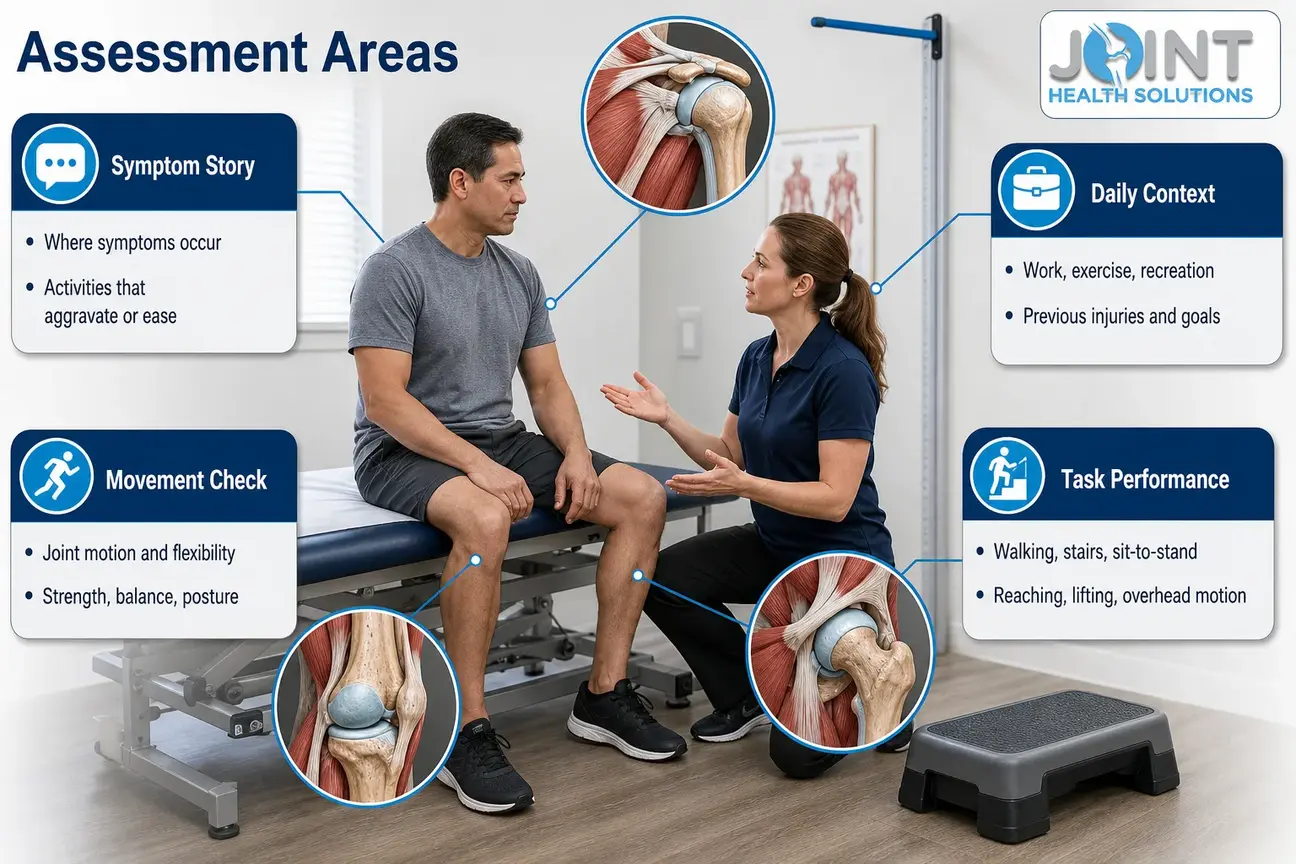
A physical therapy assessment is meant to connect symptoms with movement, function, and goals. It may include a discussion of where symptoms occur, when they started, what activities aggravate or ease them, and how they affect daily life. The clinician may also ask about work, exercise, recreation, previous injuries, current activity level, and goals.
The movement portion may consider joint motion, flexibility, strength, balance, walking, posture, coordination, or task performance where relevant. For example, a knee-focused assessment may look at walking, stairs, or sit-to-stand movement. A shoulder-focused assessment may look at reaching, lifting, and overhead motion. A hip-focused assessment may consider walking, standing, turning, and lower-body strength.
Assessment also helps determine whether PT for joint pain is the right starting point or whether further medical evaluation should be considered. Therapy may be appropriate for many musculoskeletal concerns, but not every painful or swollen joint should be self-managed. Persistent, worsening, unexplained, or severe symptoms deserve clinical attention.
A good evaluation does not simply label a body part. It helps identify what can be modified, what should be monitored, and what goals are realistic. It can also help decide whether education, exercise therapy, manual techniques, bracing, medical assessment, or other conservative options may fit the person’s situation.
Joint pain exercises are individualized, not universal
Many people search for joint pain exercises because they want something practical they can do at home. That is understandable, but no article can safely prescribe the right movements, resistance, range, pace, frequency, or progression for every person. The right approach depends on the diagnosis, symptom irritability, strength, balance, mobility, goals, and other health factors.
Joint pain exercises may be used to improve strength, range of motion, coordination, endurance, or confidence with movement. In therapy, exercise selection is usually adjusted based on how the person moves and how symptoms respond. A movement that is useful for one person may be too irritating, too easy, too advanced, or simply irrelevant for another.
The AAOS ankle osteoarthritis guideline describes physical therapy as potentially including patient education and self-management strategies, progressive therapeutic exercise, neuromuscular and motor-control interventions, manual therapy, gait retraining, and development or progression of a home exercise program. That source is specific to ankle osteoarthritis and includes evidence limitations, so it should not be treated as proof that every therapy component works for every joint.
Still, the broader idea is useful: exercise therapy is only one part of a larger plan. PT for joint pain may also include education about symptom monitoring, activity pacing, movement options, and ways to modify tasks. For some people, the most helpful change is learning how to keep moving without repeatedly exceeding current tolerance.
Joint pain exercises should also be progressed carefully. Progression may involve changing range, resistance, position, speed, balance demand, or task complexity. It may also involve reducing or modifying activities temporarily. A clinician can help decide whether symptoms reflect expected challenge, excessive irritation, or a reason to change direction.
Education, self-management, and activity modification
Education is a core part of conservative joint care. Many people with pain become understandably cautious with movement. Others push through symptoms until everyday activity becomes harder. Therapy can help a person find a more measured approach: staying active when appropriate, modifying aggravating tasks, and building capacity gradually without assuming that more is always better.
Self-management strategies may include learning how to monitor symptom response, plan activity breaks, change positions, adjust exercise choices, or modify work and recreation tasks. These strategies do not replace medical care, but they can help people participate more confidently in daily life. Physical therapy goals often include helping a person understand what they can do between visits, not only what happens during appointments.
Activity modification does not necessarily mean stopping everything enjoyable. It may mean changing how an activity is performed, reducing a provoking load, using a different surface, adjusting rest periods, or temporarily choosing a less irritating option. The specifics should be individualized. A person with knee stiffness, a person with shoulder pain, and a person recovering from a musculoskeletal injury may need very different modifications.
Manual therapy may be considered in some situations, but it should not be viewed as a stand-alone solution. The AAOS knee guideline states that manual therapy may be used in addition to an exercise program to improve pain and function. That phrasing keeps the emphasis where it belongs: manual techniques, when appropriate, are generally part of a broader plan that includes active participation.
Realistic physical therapy goals and limits
Physical therapy goals are most useful when they are specific enough to guide care but flexible enough to change with new information. Pain can be influenced by joint structure, inflammation, strength, sleep, activity level, stress, prior injury, and other health factors. Therapy may address some contributors, but it cannot control all of them.
The table below summarizes realistic expectations. It is not a prediction of what will happen for any individual person.
| Possible goal | What PT cannot promise |
|---|---|
| Improve movement or usable function | Complete or permanent pain relief |
| Build strength or movement control | A specific recovery timeline |
| Support daily activity, work, recreation, or exercise | That every painful joint will respond |
| Teach activity modification and self-management strategies | Avoidance of injections, procedures, or surgery |
| Improve confidence with selected movements | A diagnosis without clinical assessment |
These limits are not meant to discourage anyone. They are meant to make care more honest and useful. If a person starts therapy expecting complete pain elimination, any normal ups and downs may feel like failure. If the goal is to improve function, understand triggers, and build a plan that can be adjusted, progress can be evaluated more realistically.
PT for joint pain may be one part of conservative care, but it is not the only option. Some people may benefit from bracing, medical evaluation, injections, nutrition support, or other approaches depending on the assessment. Others may need referral or a different level of care. Suitability should be determined by a clinician who can evaluate the individual situation.
PT for joint pain versus injections
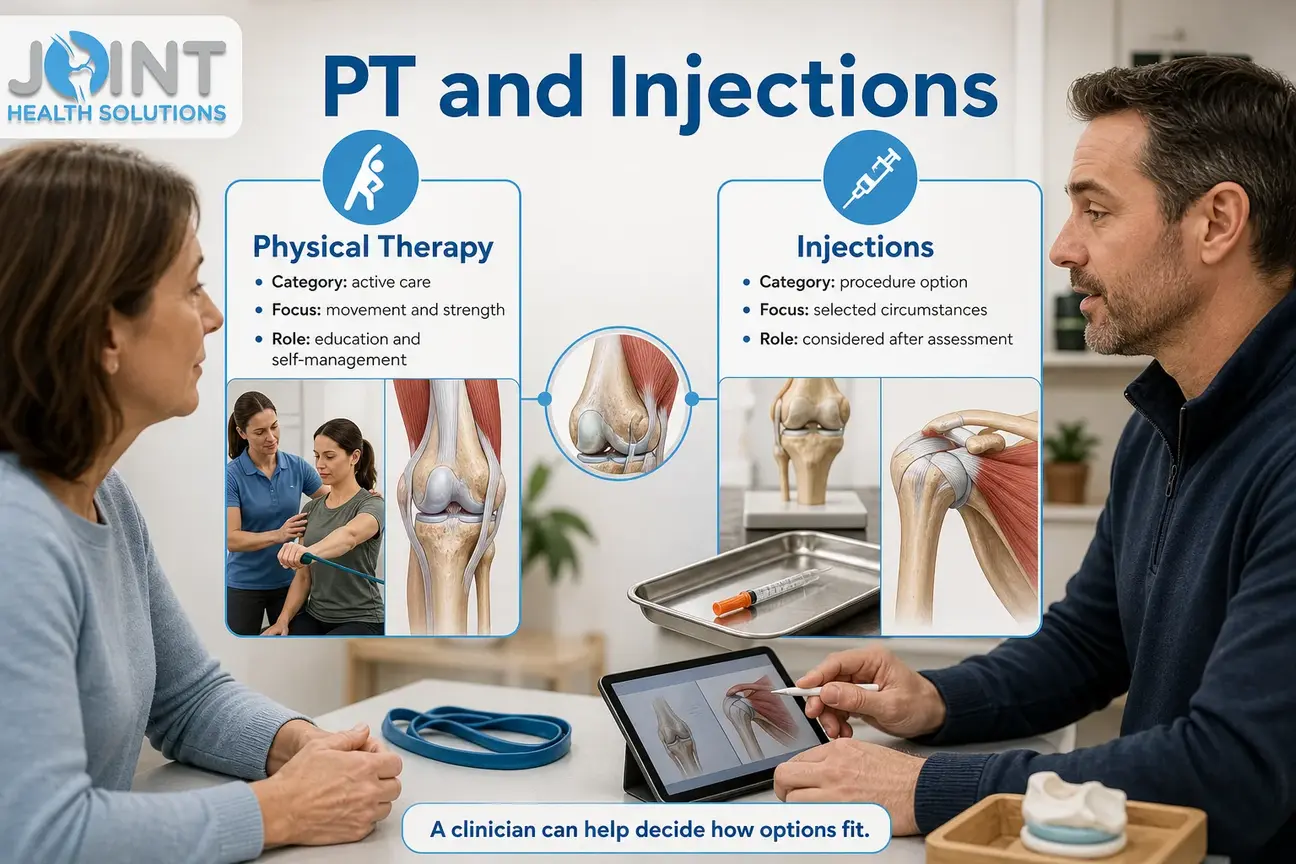
PT for joint pain and injections are different categories of care. Therapy focuses on movement, strength, function, education, activity modification, and self-management. An injection is a procedure considered for selected clinical circumstances after assessment. Neither should automatically be described as a replacement for the other.
At Joint Health Solutions, confirmed conservative options include physical therapy and several injection-related services for appropriate patients. General Inyecciones conjuntas, knee injections, y Inyecciones en la zona del hombro are discussed separately because the reasons for considering a procedure differ from the reasons for starting therapy. A clinician may consider combining conservative options when appropriate, but that decision depends on the condition, exam findings, goals, and individual circumstances.
It is not accurate to say that an injection automatically makes therapy work, that therapy always prevents a procedure, or that one option is universally better. Some people are mainly limited by movement tolerance and strength deficits. Others have inflammation-related pain, arthritis symptoms, stiffness, or another issue that requires a broader plan. The most appropriate next step is the one supported by assessment, not by a generic comparison.
Insurance and coverage questions also vary by treatment and plan. This article is focused on educational information about therapy goals and limits, not procedure-specific coverage. Patients should verify coverage details with the practice and their insurer before treatment.
When an evaluation may be appropriate
An evaluation may be appropriate when joint pain is persistent, recurrent, worsening, or limiting daily activities. It may also be worth seeking guidance when stiffness or reduced mobility affects walking, stairs, reaching, work, exercise, or recreation. Symptoms after an injury, uncertainty about safe movement, or difficulty returning to activity are also common reasons people ask about assessment.
People researching Dolor en la rodilla, Dolor en la rodilla, hip pain, or other joint conditions should avoid assuming that the same exercise plan fits every diagnosis. Joint pain exercises may be helpful in some situations and inappropriate in others. An assessment helps clarify whether therapy, medical evaluation, activity modification, or another conservative option should be considered.
Prompt medical attention is important for urgent symptoms, major trauma, rapidly worsening symptoms, or concern for serious injury. For a medical emergency, call 911 or go to an emergency department. Joint Health Solutions does not provide emergency or 24/7 urgent care.
If you are preparing for a visit, reviewing Qué esperar can help you think through your symptoms, activity limits, and goals before the appointment. Bringing clear examples of what hurts, what has changed, and what you want to return to can make the conversation more useful.
Physical therapy at Joint Health Solutions for patients from Gastonia
Joint Health Solutions lists physical therapy for patients with joint pain, osteoarthritis, mobility limitations, or musculoskeletal injuries. The practice’s care approach emphasizes personalized, conservative, non-surgical care and minimally invasive options when appropriate. Not every reader is a candidate for every service, and suitability depends on clinical assessment.
For people traveling from Gastonia, care is provided at the Clínica de Charlotte, located at 9350 Benfield Rd, #109, Charlotte, NC 28269. You can call 704-833-3566 o Contacte la clínica de Charlotte for current appointment-related information. Gastonia is a patient origin and service area, not a separate Joint Health Solutions clinic.
During an assessment-based visit, the discussion may include symptoms, functional limits, goals, and whether conservative options fit the situation. For some people, therapy may be the main focus. For others, therapy may be considered alongside other non-surgical options. The important point is that decisions should be individualized and should not be based solely on a search result, a social media exercise, or another person’s diagnosis.
How to think about your next step
If you are asking whether therapy can help, start by defining the problem in functional terms. What activity is limited? What movements feel stiff, weak, unstable, or difficult? What have you stopped doing because of symptoms? What are you hoping to do more comfortably? These answers can help shape physical therapy goals that are meaningful and measurable in daily life.
Next, be cautious with self-directed plans. Joint pain exercises found online may be too general to account for arthritis, prior injury, mobility limitations, balance concerns, or other health factors. They may also miss the larger issue: how activity, strength, movement patterns, and symptom response fit together. If pain is persistent or activity-limiting, a clinical assessment is a safer way to decide what type of conservative care may fit.
Finally, keep expectations realistic. Physical therapy for joint pain may help some people improve movement, strength, and function, but results vary. It cannot promise a particular outcome, diagnose you without evaluation, or mean that other treatments will never be needed. Used thoughtfully, therapy can be a practical part of an evidence-informed, conservative plan for joint health.
Disolución médica: Solo para educación general; no sustituye a los consejos médicos profesionales, el diagnóstico ni el tratamiento. La adecuación y los resultados varían y las necesidades individuales requieren una evaluación clínica.
Preguntas frecuentes
Can physical therapy help arthritis-related joint pain?
It may help some people improve pain, movement, strength, or function, but evidence and expected benefit vary by joint and condition. Knee osteoarthritis has stronger guideline support for exercise-based care than some other joints, while hip and shoulder guidance is more qualified.
What are the main goals of physical therapy for joint pain?
Goals may include improving movement, strength, balance, coordination, daily function, and activity management. The appropriate goals depend on clinical assessment, the condition being treated, and the person’s daily activities or recreation goals.
Is physical therapy appropriate for shoulder arthritis?
It may be considered after assessment, but evidence is not the same for every shoulder condition. For glenohumeral shoulder osteoarthritis, AAOS found insufficient evidence to recommend for or against physical therapy as the initial treatment.
Are joint pain exercises safe for everyone?
No exercise plan is universally appropriate. A clinician or physical therapist can help determine which movements fit the condition, examination findings, tolerance, and functional goals.
Can physical therapy and an injection be used together?
A clinician may consider combining conservative options when appropriate, but the decision depends on assessment, the condition being treated, and the person’s goals. PT and injections serve different purposes and should not be treated as interchangeable.
Does physical therapy mean surgery will be avoided?
No. Physical therapy may support movement and function, but it cannot promise a particular outcome, eliminate the need for another treatment, or prevent surgery for every person.
Fuentes
- AAOS, Management of Osteoarthritis of the Knee (Non-Arthroplasty)
- AAOS, Clinical Practice Guideline for the Management of Osteoarthritis of the Knee
- AAOS, Management of Osteoarthritis of the Hip
- AAOS, Management of Osteoarthritis of the Hip—Guideline Overview
- AAOS, Treatment of Glenohumeral Joint Osteoarthritis
- AAOS, Management of Ankle Osteoarthritis
- AAOS OrthoInfo, Hip Osteoarthritis



 Spanish
 English