
Knee Osteoarthritis • Exercise and Rehabilitation • Charlotte, NC
Physical Therapy for Knee Osteoarthritis: Exercises, Goals, and What to Expect
Physical therapy for knee osteoarthritis combines assessment, exercise, education, and practical movement strategies. The aim is to improve symptoms and function, including walking, stairs, strength, and everyday activity. Treatment does not reverse osteoarthritis, and results vary.
An effective plan connects exercises to the activities you want to manage more comfortably. It also accounts for your health, current abilities, symptoms, and access to care. The right starting point is not necessarily the hardest exercise or the longest routine.
Joint Health Solutions evaluates knee concerns and helps coordinate conservative care at its Charlotte clinic. The practice can provide referrals to external physical therapists. Depending on individual needs, care may also include in-house guidance or coordination with local PT clinics.
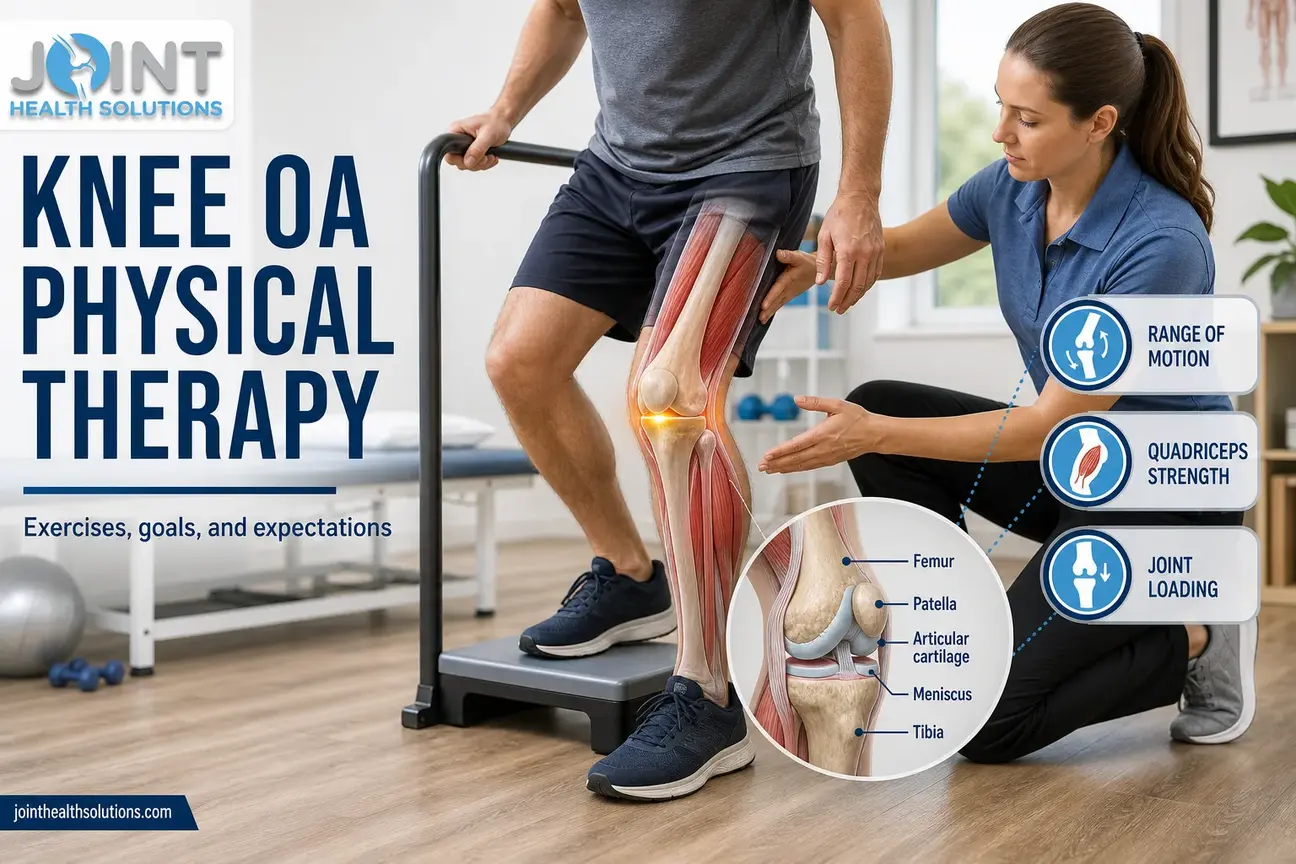
Is Physical Therapy Recommended for Knee Osteoarthritis?
Exercise is a core part of nonsurgical knee osteoarthritis care. The 2021 American Academy of Orthopaedic Surgeons guideline strongly recommends supervised, unsupervised, or aquatic exercise over no exercise. The recommendation addresses improvements in pain and function.
The American College of Rheumatology and Arthritis Foundation guideline also strongly recommends exercise for knee osteoarthritis. These recommendations support an active approach. They do not establish one exercise routine that suits every patient.
Physical therapy helps translate general exercise guidance into an individual plan. A therapist considers movement limitations, strength, balance, activity demands, and symptom response. Someone who struggles with stairs may need a different emphasis than someone limited mainly by stiffness.
Strong evidence for exercise does not mean every session feels easy or every person improves equally. Temporary muscle soreness or increased knee discomfort can occur. Exercise selection and progression should account for these responses rather than follow a rigid schedule.
Physical therapy also has limits. It does not regrow cartilage, cure osteoarthritis, or guarantee that surgery will never be needed. Its value is assessed through symptoms, function, participation, and progress toward realistic goals.
How Joint Health Solutions Coordinates Physical Therapy
A visit at Joint Health Solutions begins with a clinical evaluation of your knee concerns. The provider considers your symptoms, health history, functional limitations, and previous care. Imaging may be considered when appropriate to clarify the diagnosis or treatment plan.
When physical therapy is appropriate, the practice can provide a detailed referral to an external physical therapist. In some cases, the practice offers in-house guidance or works with trusted local PT clinics. Your care pathway depends on your needs and the arrangements discussed during the visit.
Medical evaluation, exercise guidance, and formal physical therapy are related but distinct services. A referral helps communicate the medical findings and rehabilitation goals. The treating physical therapist then evaluates movement and develops or adjusts the therapy program.
Before scheduling, ask where formal PT sessions would occur and who would provide them. Also confirm insurance participation, referral requirements, and how information will move between providers. This helps distinguish the Charlotte medical appointment from any separate therapy appointments.
Read more about the practice’s physical therapy coordination and conservative-care approach. An appointment does not guarantee that PT, an injection, or another treatment will be recommended.
What Happens During a Physical Therapy Evaluation?
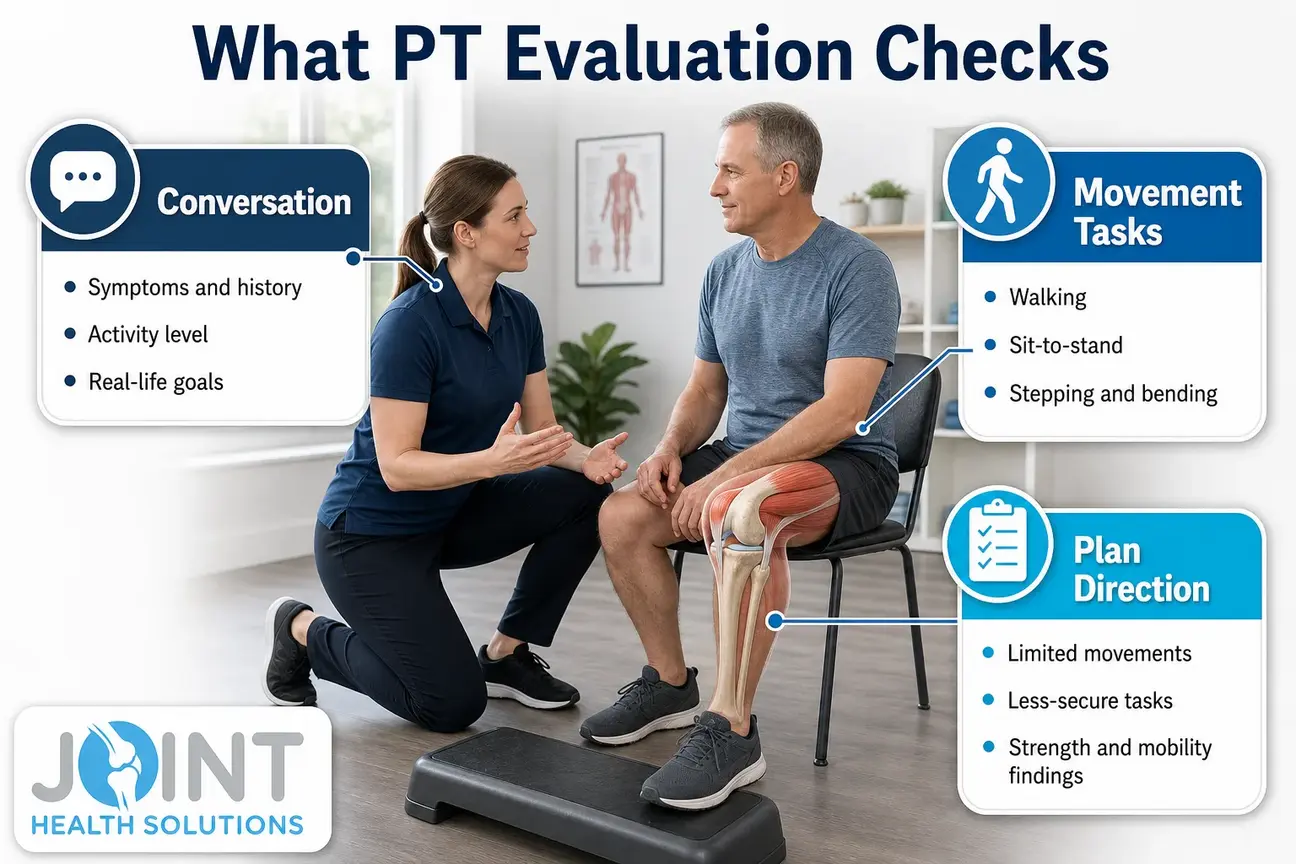
A physical therapist usually starts by asking what your knee prevents you from doing comfortably. Useful details include walking distance, stair difficulty, stiffness after sitting, and problems getting out of a chair. Your goals help make the evaluation relevant to daily life.
The examination may assess knee bending and straightening, lower-extremity strength, balance, and walking. The therapist may also observe a functional task, such as standing from a chair. Testing should reflect your abilities and safety needs.
Knee function depends on more than the joint alone. Hip strength, ankle mobility, balance, and movement strategies may influence how you perform a task. This is why treatment sometimes includes exercises beyond the knee itself.
Bring information about previous injuries, surgery, treatments, and supports you use. Tell the therapist about falls, giving way, recurring swelling, or symptoms affecting other areas. These details may influence exercise selection or prompt further medical assessment.
The visit should end with an understandable plan. Ask what you should practice, what assistance you need, and when progress will be reviewed. You should also know whom to contact if symptoms change between appointments.
Five Exercise Categories Used in Knee Osteoarthritis Rehabilitation
Knee rehabilitation may combine several exercise categories. The examples below explain their purposes; they are not a complete home program. A clinician should determine which movements, repetitions, resistance, and support are appropriate.
| Category | Example | Functional purpose | Possible adjustment |
|---|---|---|---|
| Strengthening | Supported sit-to-stand | Rising from a chair | Chair height, hand support, or movement range |
| Mobility | Gentle knee bending or extension work | Maintaining useful knee motion | Position, assistance, or comfortable range |
| Aerobic activity | Walking, stationary cycling, or aquatic exercise | Conditioning and activity tolerance | Duration, pace, resistance, or setting |
| Balance and coordination | Supported weight shifts or stepping | Movement control and walking tasks | Hand support, task complexity, or supervision |
| Functional practice | Individualized stair or transfer practice | Everyday task performance | Step height, pacing, support, or technique |
1. Strengthening for standing, walking, and stairs
Strength work may target the quadriceps, hips, calves, and other muscles involved in lower-extremity function. Exercise selection depends on the evaluation. Someone unable to rise comfortably from a low chair may start differently from someone returning to recreational activity.
Supported sit-to-stand practice is one example of connecting strength with a daily task. A therapist may adjust seat height, available support, speed, or movement range. Progression should reflect technique and response rather than a requirement to advance every session.
2. Mobility for bending and straightening
Mobility exercises address movement needed for walking, sitting, and transitions. A limitation in straightening may need a different approach from difficulty bending. Exercises should work toward useful motion without forcing the knee through sharp or escalating pain.
A therapist may use supported positions or gentle repeated movements. Instructions should explain the purpose, expected sensation, and when to stop. Avoid adding force because a stretch appears less intense than another person’s exercise.
3. Aerobic activity for conditioning
Walking, cycling, and aquatic activity are examples of aerobic options. Access, balance, overall health, and knee tolerance influence the choice. Low impact does not mean every activity is suitable at every intensity.
The plan may adjust distance, time, resistance, or recovery periods. Some people tolerate shorter activity blocks better than one prolonged session. Aquatic exercise may be useful for selected patients, but this does not imply that Joint Health Solutions provides pool-based therapy.
4. Balance and neuromuscular training
Neuromuscular training addresses control of movement, including balance, coordination, and agility. AAOS gives a Moderate recommendation for adding this training to traditional exercise to improve performance-based function and walking speed. It is not a requirement for every patient.
Examples may include supported weight shifts, controlled stepping, or changes in direction. Difficulty should match the person’s abilities and fall risk. Balance challenges should not be attempted without the support or supervision specified by the treating professional.
5. Functional practice for daily activities
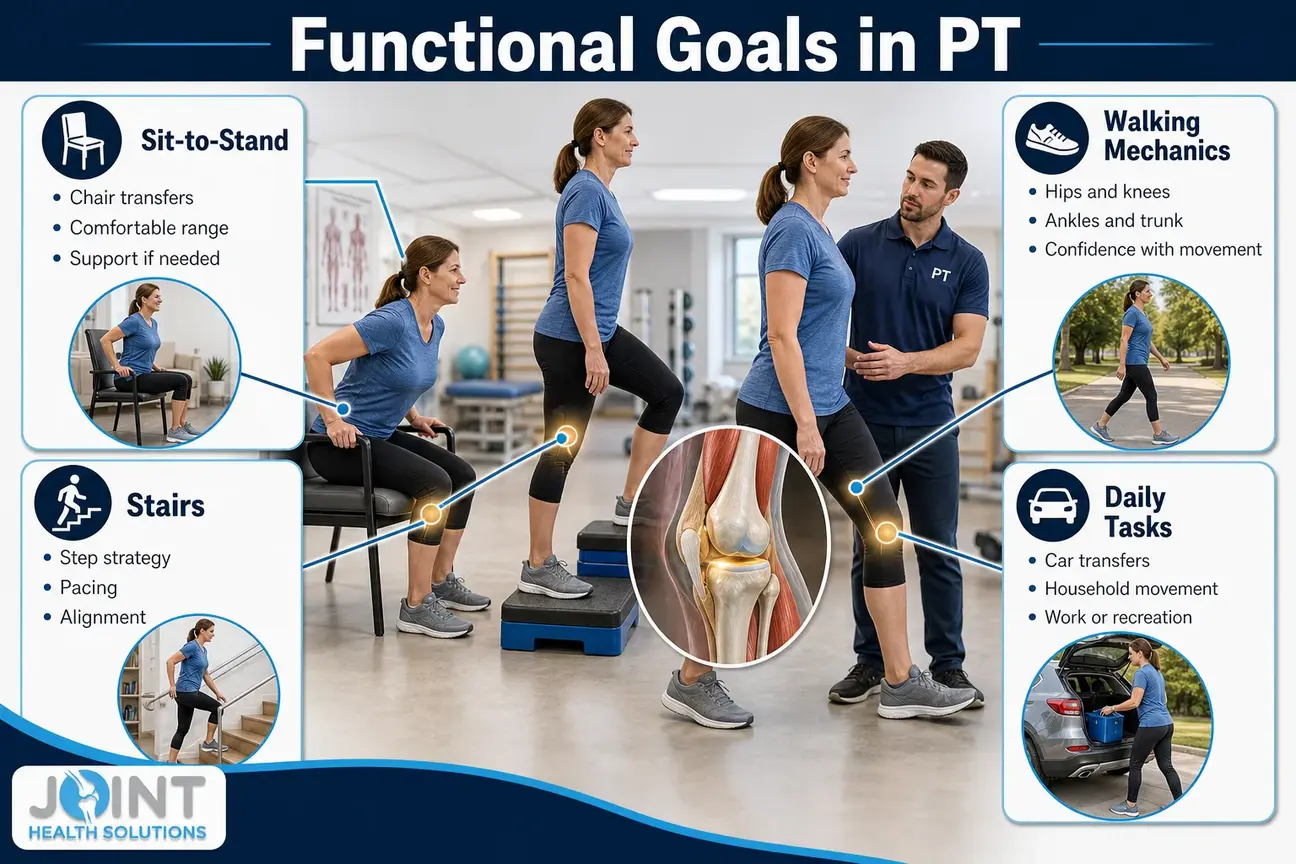
Functional practice links rehabilitation to specific activities. These may include stairs, getting out of a car, standing from a chair, or completing a household task. The therapist observes how the whole body contributes to the movement.
Changes in pacing, task height, hand support, or movement strategy may make practice more manageable. The purpose is not to perform a task perfectly for its own sake. It is to develop an approach that serves your practical needs.
Is Supervised PT Better Than Home Exercise?
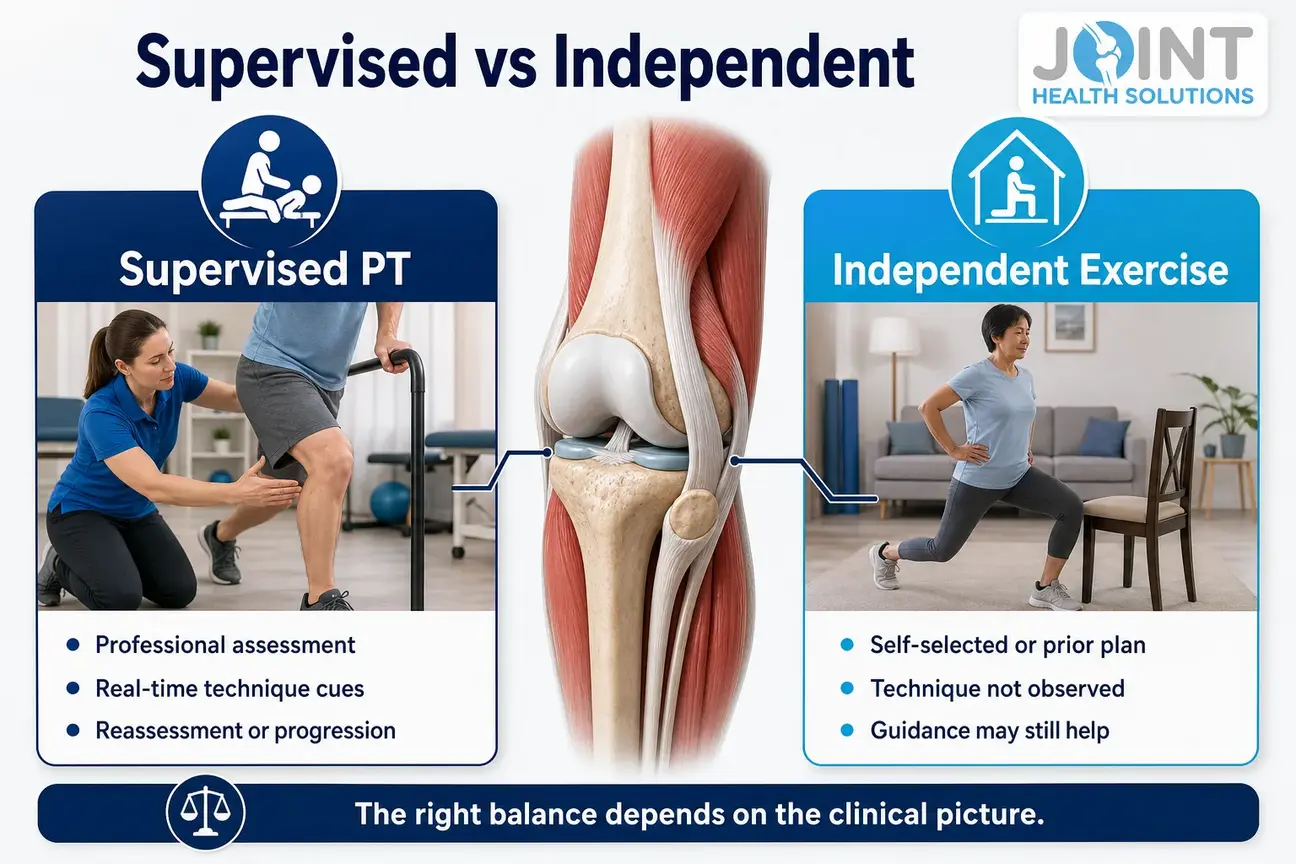
Both supervised and independent exercise can help people with knee osteoarthritis. AAOS reports mixed findings when comparing supervision with home-based approaches. The ACR/Arthritis Foundation guideline also recognizes better outcomes associated with supervision, while supporting individualized exercise choices.
These findings do not establish that everyone needs the same number of supervised visits. Supervision can provide assessment, feedback, and adjustment. Independent practice can help make exercise sustainable between appointments and after formal treatment.
| Consideration | Supervised PT | Independent exercise |
|---|---|---|
| Technique | Observed and adjusted during the session | Practiced using an understood plan, with feedback sought when needed |
| Progression | Guided by assessment and response | Follows agreed instructions and review arrangements |
| Access | Requires appointments and coordination with the treating provider | Can fit around daily routines when exercises are suitable |
| Reassessment | Provides an opportunity to review movement and goals directly | Requires knowing when symptoms or difficulty warrant further guidance |
How Are Goals, Progress, and Visit Frequency Decided?
Progress should be assessed against a useful starting point. Depending on the evaluation, that may include knee motion, walking tolerance, strength, or a functional task. Recording the same task over time can make changes easier to discuss.
A practical goal might involve standing to prepare a meal or using stairs with greater confidence. Goals should describe what matters to you rather than focus only on an exercise number. They may change as symptoms and priorities change.
Visit frequency depends on the evaluation, instruction needs, response, access, and insurance arrangements. Some people need more hands-on teaching or reassessment. Others can move toward greater independence once they understand and tolerate the plan.
Ask when the plan will be reviewed and what would prompt a change. Limited progress may lead to adjustments in technique, exercise selection, load, or the overall approach. It may also prompt medical reassessment if symptoms do not fit the expected pattern.
A meaningful response can include easier task performance, improved movement, or better activity tolerance. Pain scores are useful, but they are not the only measure. A temporary fluctuation does not, by itself, establish success or failure.
Should You Exercise Through Knee Pain?
Some people experience temporary soreness or increased discomfort when beginning an exercise program. That differs from treating all pain as harmless. Ask your therapist what sensations to expect and which changes require stopping or contacting the treating team.
Do not use a universal pain score from an article to decide whether an exercise is safe. The type of pain, symptom trend, swelling, and effect on walking all matter. Sharp pain, worsening symptoms, or a new loss of function warrants reassessment.
- Stop an exercise that causes sharp or escalating pain and seek guidance.
- Report new or increasing swelling, repeated giving way, or persistent symptom worsening.
- Ask for clarification if you cannot perform the movement as instructed.
- Do not add resistance or repetitions simply to make up for a missed session.
Seek prompt medical assessment after significant injury or sudden inability to bear weight. A hot, swollen knee with fever also needs urgent evaluation. For emergency symptoms, call 911 or go to an emergency department.
Joint Health Solutions does not provide emergency or 24/7 urgent care. Routine appointment requests should not delay evaluation of potentially serious symptoms. A clinician must determine whether symptoms relate to osteoarthritis or another condition.
How Can Daily Activities Be Adjusted During Rehabilitation?
Activity modification usually means changing how an activity is performed rather than stopping all movement. A therapist may discuss pacing, terrain, task height, rest breaks, or available support. The adjustment should address an identified difficulty.
For example, someone may tolerate shorter walks more comfortably than a single long outing. Another person may need guidance on stair strategy or chair height. These examples illustrate possible adaptations, not rules for everyone with knee osteoarthritis.
Consider the total demands of the day. Work, errands, household tasks, and exercise can all contribute to fatigue or symptom aggravation. A manageable plan accounts for these demands instead of treating rehabilitation as an isolated activity.
Keep instructions practical enough to use outside the clinic. Written guidance can help clarify exercise setup, frequency, and progression. If the plan is confusing or difficult to fit into daily life, discuss those barriers early.
For broader education beyond formal rehabilitation, read the knee osteoarthritis self-management plan . That guide addresses everyday management, while this article focuses on rehabilitation and exercise planning.
Can Physical Therapy Help Advanced or Bone-on-Bone Knee Arthritis?
Advanced imaging findings do not automatically rule out rehabilitation. Some people may still work on strength, mobility, balance, and practical movement strategies. The starting point and expected goals depend on symptoms, examination, and overall function.
Physical therapy cannot restore lost joint space or reverse advanced osteoarthritis. It also should not be used to postpone a needed discussion about other options. Persistent, substantial limitations may warrant further evaluation or specialist referral.
The relevant question is what a rehabilitation plan can reasonably address in your situation. A person may value maintaining independence even when the joint remains structurally affected. Another may need a broader treatment discussion because daily activity remains severely limited.
Joint Health Solutions proporciona knee arthritis evaluation and conservative-care information. A clinical assessment helps distinguish useful rehabilitation goals from expectations that exercise cannot meet.
How Does PT Fit With Other Knee Osteoarthritis Treatments?
Exercise may be combined with education, self-management, and other appropriate care. Weight management may be relevant for people who are overweight or obese. Medication, a walking aid, or a brace may also be discussed according to individual findings.
An injection may be considered for selected patients, but it does not replace rehabilitation goals. Each treatment has its own evidence, risks, and expected role. Combining services does not automatically produce a better outcome.
If you have an injection or procedure, ask both providers how it affects your activity plan. Restrictions and progression depend on the treatment and clinical circumstances. Do not assume that every injection uses the same return-to-exercise instructions.
Patients specifically researching activity after viscosupplementation can read exercise considerations after knee gel injections . Follow your treating clinician’s instructions when they differ from general educational material.
If a support device is being considered, the knee brace versus knee sleeve comparison explains the different support concepts. A device should address a clinical need rather than be added automatically to every rehabilitation plan.
What Should You Bring to Your First Appointment?
Bring a current medication list and information about relevant injuries, procedures, or previous treatment. Include any restrictions another clinician has given you. Ask whether existing imaging or reports should be shared before the visit.
Wear clothing that allows comfortable movement and access to the knee. Bring your usual walking aid or support if you use one. Follow any specific preparation instructions from the provider performing the evaluation.
Write down the activities you most want to improve. Examples include walking around a store, managing stairs at home, or standing during work. Also note what has made exercise difficult, such as transportation, fatigue, fear of falling, or unclear instructions.
Before formal PT begins, confirm referral requirements and coverage with the treating provider and insurer. Network participation and authorization requirements may differ between the medical clinic and an external therapy practice. Review the clinic’s Información sobre seguros for general guidance, then verify your individual benefits.
Discuss Your Knee Rehabilitation Goals in Charlotte
Joint Health Solutions is located at 9350 Benfield Rd, Suite 109, Charlotte, NC 28269. Patients from Charlotte and surrounding communities can request a medical evaluation at this location. Any external physical therapy appointments occur through the arrangements discussed with the treating providers.
A visit can help clarify the diagnosis, rehabilitation goals, and next steps. These may include a detailed PT referral, coordination with a local therapy clinic, or appropriate in-house guidance. The plan depends on your clinical needs.
Review what to expect at Joint Health Solutions before your appointment. Bring questions about who will provide each part of care, where treatment will occur, and how progress will be communicated.
This article provides general education and does not replace professional medical advice, diagnosis, or treatment. Exercise selection, progression, and treatment decisions require consideration of individual needs.
Preguntas frecuentes
Is physical therapy recommended for knee osteoarthritis?
Exercise is strongly recommended for knee osteoarthritis in the AAOS and ACR/Arthritis Foundation guidelines. Physical therapy can help translate that guidance into an individualized plan through assessment, education, exercise instruction, and progression. Whether formal supervised treatment is appropriate depends on your symptoms, function, health, and ability to exercise independently. Results vary, and exercise does not reverse osteoarthritis.
What exercises are commonly used for knee osteoarthritis?
Programs may include strengthening, knee mobility, aerobic activity, balance and coordination, and practice with functional tasks. Examples include supported sit-to-stand, gentle knee motion, cycling, walking, and individualized stepping exercises. These are categories to discuss with a therapist rather than a universal routine. The appropriate resistance, repetitions, support, and progression depend on assessment and response.
Is supervised PT better than exercising at home?
Both supervised and independent exercise can be useful. AAOS reports mixed findings when comparing supervised programs with home exercise, while ACR guidance recognizes benefits associated with supervision. Supervised care provides assessment, technique feedback, and adjustment. Home practice can support consistency and independence. The appropriate balance depends on your abilities, symptoms, access, and need for instruction.
How does Joint Health Solutions arrange physical therapy?
Joint Health Solutions evaluates knee concerns and can provide a detailed referral to an external physical therapist. In some cases, the practice offers in-house guidance or works with local PT clinics. Ask where formal therapy will occur, who will provide it, and how the medical and rehabilitation teams will communicate. Available arrangements depend on the individual care plan.
How many physical therapy visits will I need?
Visit frequency and duration depend on the evaluation, functional goals, instruction needs, response, access, and insurance arrangements. A therapist may recommend more supervision initially or greater independence when you can follow the plan safely. Ask when progress will be reviewed and what would change the schedule. A personalized recommendation is more useful than a fixed visit count from an article.
Should I continue exercising if my knee hurts?
Temporary soreness can occur, but not all pain should be ignored. Ask your treating professional what sensations are expected and when to stop. Sharp or escalating pain, new swelling, repeated giving way, or worsening function needs reassessment. Significant injury, sudden inability to bear weight, or a hot swollen knee with fever warrants prompt medical evaluation rather than continued exercise.
Can PT help with balance and walking?
Physical therapy may address strength, mobility, walking strategies, and balance when these affect function. AAOS gives a Moderate recommendation for adding neuromuscular training to traditional exercise to improve performance-based function and walking speed. Tasks should match your abilities and fall risk. Appropriate support and supervision matter, particularly when practicing balance or changes in direction.
Can physical therapy help bone-on-bone knee arthritis?
Advanced osteoarthritis does not automatically rule out rehabilitation. Selected patients may work on strength, movement, balance, and daily-task strategies despite substantial joint changes. Physical therapy cannot restore lost cartilage or guarantee avoidance of surgery. Goals should reflect your examination and functional needs. Persistent severe limitations may require further evaluation or discussion of additional treatment options.
¿Qué debería llevar a mi primera consulta?
Bring your medication list, relevant treatment history, existing restrictions, and questions about daily activities. Ask whether imaging reports or a referral should be sent ahead. Wear clothing suitable for movement and bring your usual walking aid if applicable. Confirm whether the appointment is a medical evaluation at Joint Health Solutions or a formal therapy evaluation with another provider.
What if my home exercises make symptoms worse?
Stop the movement that causes sharp or escalating pain and contact the treating professional for guidance. Explain which exercise triggered symptoms, what changed, and whether swelling or walking difficulty followed. The plan may need a different setup, range, resistance, or exercise. Do not increase the workload to compensate. Urgent or emergency symptoms require appropriate medical assessment.
Can physical therapy be combined with injections or a knee brace?
These options may be considered together when each has an appropriate clinical purpose. An injection or brace does not replace exercise planning, and adding treatments does not guarantee better results. Tell the therapist about procedures, supports, and restrictions. The medical provider and therapist should coordinate activity guidance according to the treatment and your response.
Does insurance cover physical therapy coordinated through the Charlotte clinic?
Coverage depends on your plan, medical necessity, referral or authorization requirements, and the treating provider’s participation. A medical appointment at Joint Health Solutions and sessions at an external PT clinic may involve different benefits or costs. Confirm coverage with your insurer and each provider before treatment. A referral does not by itself guarantee payment.
Fuentes
- American Academy of Orthopaedic Surgeons. Management of Osteoarthritis of the Knee (Non-Arthroplasty): Evidence-Based Clinical Practice Guideline . Published August 31, 2021.
- American Academy of Orthopaedic Surgeons. Osteoarthritis of the Knee: Clinical Practice Guideline Resources .
- Kolasinski SL, Neogi T, Hochberg MC, and colleagues. 2019 American College of Rheumatology/Arthritis Foundation Guideline for the Management of Osteoarthritis of the Hand, Hip, and Knee . Arthritis Care & Research. Published 2020.
- American Physical Therapy Association, ChoosePT. Physical Therapy Guide to Knee Osteoarthritis .
Revisado médicamente por:

Dr. Jeffrey Galvin
Medical Director, Joint Health Solutions

Ariel Curtis, FNP-C
Family Nurse Practitioner, Joint Health Solutions
 Spanish
 English