
Knee Arthrocentesis Before Gel Injections: Why It Improves Results
If you have osteoarthritis of the knee, you may know the feeling of a swollen, tight, achy joint that seems to fill with fluid after activity. That swelling is not just discomfort—it can interfere with how well injected treatments work. Many patients wonder whether having the fluid drained first makes a difference. In this article, we explain how knee arthrocentesis before gel injections may enhance outcomes, what the procedure involves, and what you should consider before scheduling it.
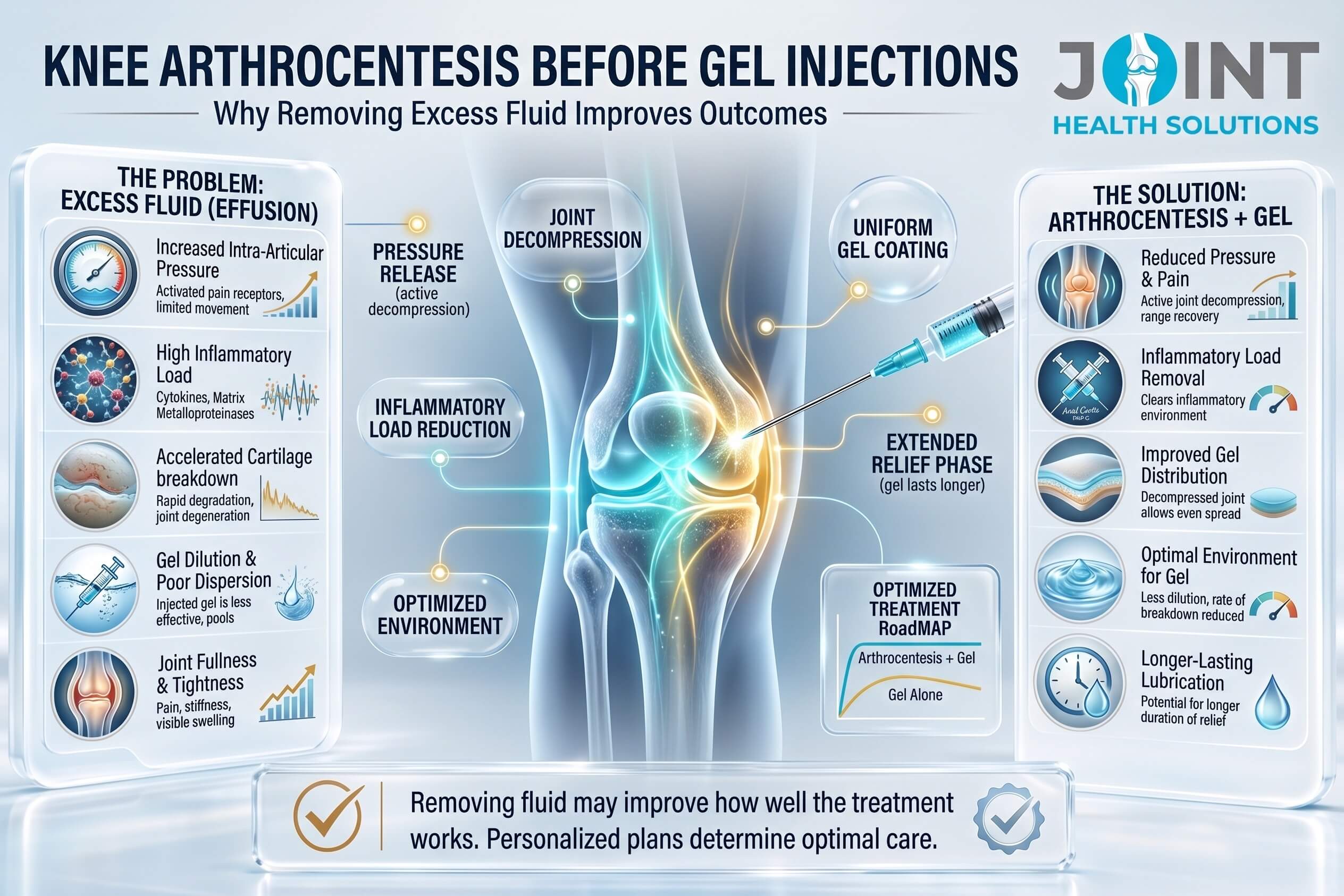
The concept is straightforward: if the joint is already distended with excess fluid, there is less room for the injected gel to spread, and the inflammatory environment may dilute or break down the hyaluronic acid more quickly. By removing that fluid first, the joint space is decompressed, and the gel may have a better chance to coat the cartilage and provide longer-lasting lubrication. This is why many practitioners recommend knee arthrocentesis before gel for patients who present with a significant effusion.
What Is Knee Arthrocentesis?
Knee arthrocentesis, also called joint aspiration, is a procedure in which a healthcare provider uses a needle to withdraw fluid from the knee joint. At Joint Health Solutions, we use this technique therapeutically—to relieve pressure and pain and to prepare the joint for a gel injection. The primary goal is to remove excess synovial fluid that may dilute the injected hyaluronic acid or increase intra-articular pressure.
The procedure is typically done in the office under sterile conditions. The skin is cleaned with antiseptic, and in some cases a local anesthetic is applied. Using ultrasound guidance, the provider inserts a thin needle into the joint space and aspirates the fluid. The procedure usually takes only a few minutes. After the fluid is removed, the same needle or a new one can be used to inject the gel, though some clinicians prefer to wait a few minutes to allow the joint to settle.
Arthrocentesis is not new; it has been used for decades to manage knee effusions. However, its role as a preparatory step for viscosupplementation has gained attention as research and clinical experience suggest that removing fluid may improve the distribution and persistence of the injected gel. The procedure is generally safe, but as with any injection, there are risks, which we will discuss later.
Why Fluid Accumulates in the Knee Joint
The knee joint is surrounded by a synovial membrane that produces a small amount of fluid to lubricate and nourish the cartilage. In a healthy knee, the volume of this fluid is minimal—just enough to reduce friction. However, when the joint is irritated—whether from osteoarthritis, injury, or inflammatory conditions—the synovium becomes inflamed and produces excess fluid. This fluid is often rich in inflammatory mediators, such as cytokines and matrix metalloproteinases, which can further damage cartilage.
In osteoarthritis, the cartilage that normally cushions the joint wears down, leading to bone-on-bone contact. The body responds by increasing synovial fluid production, but this fluid is not the same as healthy joint fluid. It contains higher levels of inflammatory proteins that can accelerate cartilage breakdown. The increased volume also stretches the joint capsule, causing pain and stiffness. This is why a swollen knee often feels hot, tight, and difficult to bend.
Other causes of knee effusion include meniscal tears, ligament injuries, gout, pseudogout, rheumatoid arthritis, and infection. In each case, the fluid is a symptom of an underlying problem. Draining the fluid provides temporary relief, but it does not treat the cause. That is why arthrocentesis is often combined with other treatments, such as gel injections, to address both the fluid and the underlying joint degeneration.
The Role of Excess Fluid in Knee Pain and Stiffness
Excess fluid in the knee joint does more than just make the knee look swollen. It increases intra-articular pressure, which can activate pain receptors in the joint capsule and ligaments. This pressure can also limit the range of motion, making it difficult to fully straighten or bend the knee. Patients often describe a feeling of fullness or tightness that worsens with activity.
Moreover, the inflammatory nature of the fluid can contribute to the progression of osteoarthritis. Elevated levels of inflammatory cytokines in the synovial fluid have been associated with more rapid cartilage loss. By removing this fluid, you are not only relieving pressure but also clearing out some of the inflammatory mediators that may be contributing to joint irritation.
When it comes to gel injections, excess fluid can be a significant obstacle. The hyaluronic acid gel is designed to increase the viscosity of the synovial fluid, providing better shock absorption and lubrication. However, if the joint is already filled with watery inflammatory fluid, the gel may be diluted and less effective. In addition, the increased pressure may cause the injected gel to leak out through the needle track or be absorbed more quickly. Therefore, reducing the effusion before injection is thought to optimize the environment for the gel to work.
How Arthrocentesis Prepares the Knee for Gel Injections
The rationale for performing arthrocentesis before a gel injection is based on the physical and biochemical environment of the joint. When the knee is distended with fluid, the injected hyaluronic acid may not distribute evenly. Instead, it may pool in one area or be diluted by the existing fluid. By aspirating the excess fluid first, the joint space is decompressed, allowing the gel to spread more uniformly over the cartilage surfaces.
Additionally, removing inflammatory fluid may reduce the rate at which the injected hyaluronic acid is degraded. Inflammatory enzymes, such as hyaluronidase, can break down hyaluronic acid. By clearing these enzymes, the gel may persist longer in the joint, potentially extending the duration of symptom relief. Clinical evidence on this specific combined approach is still limited, but many practitioners believe that this preparatory step improves the likelihood of a good response when a significant effusion is present.
It is important to note that not every patient needs arthrocentesis before a gel injection. If the knee is not swollen, there may be no benefit to draining fluid. The decision is based on clinical evaluation, including physical examination and sometimes ultrasound to assess the volume of effusion.
Here is a comparison of the two approaches to help you understand the potential differences:
| Aspect | Gel Injection Alone | Arthrocentesis + Gel Injection |
|---|---|---|
| Joint pressure | May remain elevated if effusion is present | Reduced by fluid removal |
| Gel distribution | May be uneven or diluted | More uniform distribution |
| Inflammatory load | Inflammatory fluid remains | Inflammatory mediators removed |
| Potential for gel breakdown | Higher | Lower |
| Clinical evidence | Mixed (AAOS rates as Inconclusive) | Limited but promising |
Step-by-Step: What to Expect During the Procedure
If your provider recommends knee arthrocentesis before gel, here is what you can expect during the procedure at Joint Health Solutions in Charlotte, NC.
- Evaluation: Your provider will review your history, examine your knee, and possibly use ultrasound to assess the effusion and guide the needle.
- Preparation: The skin over the knee is cleaned with antiseptic. A local anesthetic may be sprayed or injected to numb the area.
- Aspiration: Using ultrasound guidance, a thin needle is inserted into the joint space. The excess fluid is withdrawn into a syringe. You may feel pressure, but sharp pain is usually minimal.
- Injection: After the fluid is removed, the provider may use the same needle (or a new one) to inject the hyaluronic acid gel into the joint. The injection site may be slightly different to ensure proper placement.
- Aftercare: The needle is removed, and a bandage is applied. You will be asked to rest the knee for a few minutes before walking. You may be given instructions on ice and activity restrictions.
The entire process typically takes 15 to 20 minutes. Most patients tolerate it well and can return home immediately.
Potential Risks and How They Are Managed
As with any injection, there are potential risks, though serious complications are rare. The most common side effects include temporary pain, swelling, or bruising at the injection site. These usually resolve within a few days. Infection is possible but uncommon when strict sterile technique is used. Bleeding or nerve injury are also rare.
When arthrocentesis is performed before a gel injection, there is a theoretical risk of introducing bacteria into the joint if the fluid is not removed under sterile conditions. However, using a new, sterile needle and proper skin preparation minimizes this risk. Some patients may experience a transient increase in pain after the procedure, often called a post-injection flare. This can be managed with ice and over-the-counter pain relievers.
If you have a known allergy to hyaluronic acid or to any of the components of the gel, you should not receive the injection. Also, if you have an active infection in the knee or elsewhere, the procedure should be postponed until the infection is resolved.
Your provider will discuss these risks with you before the procedure and will take steps to minimize them. It is important to follow all pre- and post-procedure instructions to reduce the risk of complications.
Who Is a Good Candidate for Arthrocentesis Before Gel Injections?
Not everyone with knee osteoarthritis is a candidate for this combined approach. The ideal candidate has a significant knee effusion that is contributing to pain and stiffness. If the knee is not swollen, there is little fluid to remove, and the benefit is unclear.
Good candidates typically have:
- Moderate to severe knee osteoarthritis with symptoms that have not responded to conservative measures such as physical therapy or oral pain medications.
- A visible or palpable effusion on physical exam, or fluid detected on ultrasound.
- No evidence of infection or bleeding disorder.
- No known allergy to hyaluronic acid.
- Realistic expectations about what the treatment can and cannot do.
On the other hand, patients with very mild OA and no swelling may not benefit from arthrocentesis. Also, if the knee is severely deformed or if there is a large Baker’s cyst that is at risk of rupture, the provider may choose a different approach. The decision is always individualized after a thorough evaluation.
Recovery and What to Do After the Procedure
Recovery after knee arthrocentesis with gel injection is generally quick, but it is important to follow your provider’s instructions to optimize healing and results.
Immediately after the procedure, you may be asked to rest the knee for the remainder of the day. Ice can be applied in 15-20 minute intervals to reduce swelling. You may also be advised to elevate the leg. Most patients can resume normal daily activities within 24 hours, but you should avoid strenuous exercise, heavy lifting, or prolonged standing for at least 48 hours. Your provider may recommend avoiding nonsteroidal anti-inflammatory drugs (NSAIDs) for a few days after the injection, as they may interfere with the inflammatory response that helps the gel integrate.
You may notice some increased pain or swelling in the first few days—this is a common post-injection flare and usually subsides within a week. If you experience severe pain, fever, or redness that worsens, you should contact your provider immediately, as these could be signs of infection.
The full benefit of the gel injection may take several weeks to appear, as the hyaluronic acid needs time to integrate with the joint tissues. Individual responses vary, and some patients experience relief for months, while others may not respond as well. Your provider will schedule a follow-up to assess your progress and discuss further options if needed.
Combining Arthrocentesis with Other Non-Surgical Treatments
Arthrocentesis and gel injections are often part of a broader non-surgical treatment plan. At Joint Health Solutions, we offer a range of services that can be combined to address knee pain from multiple angles. These include hyaluronic acid injections in Charlotte, which are the gel injections discussed in this article. We also offer PRP therapy, which uses your own blood platelets to concentrate growth factors that may support healing. While PRP is not FDA-approved as a drug (the device used to concentrate platelets is FDA-cleared, and evidence for knee OA is mixed), some patients find it helpful.
Other non-surgical options include offloading knee braces, which redistribute load away from the damaged part of the knee, and physical therapy to strengthen the muscles around the joint. Anti-inflammatory IV therapy may be used to reduce systemic inflammation, though it delivers nutrients with near-complete bioavailability rather than being a categorical substitute for oral hydration when you can drink. Nutrition plans can help with weight management, which reduces joint stress.
The key is to create a personalized plan that addresses your specific needs. Removing fluid and injecting gel may be a good starting point, but combining it with other treatments may enhance overall outcomes.
Questions to Ask Your Doctor Before the Procedure
Before you decide on knee arthrocentesis before gel, it is wise to ask your doctor several questions to ensure you are fully informed.
- Why do you recommend arthrocentesis for my knee?
- How much fluid do you expect to remove?
- Will you use ultrasound guidance?
- What are the risks and benefits specific to my situation?
- How long will the gel injection last?
- What are the signs of complications I should watch for?
- When can I return to work and normal activities?
- Are there any alternatives to this approach?
- What is the total cost, and what payment options are available?
- How many injections will I need, and how often?
These questions will help you make an informed decision and set realistic expectations.
Is This Approach Right for You?
Deciding whether to undergo knee arthrocentesis before gel is a personal choice that should be made in consultation with a qualified physician. The evidence supporting this combined approach is limited but promising, and many patients report significant improvement. However, results vary, and not everyone is a candidate.
If you are struggling with knee pain and swelling, and you are considering gel injections, schedule a consultation with Joint Health Solutions in Charlotte, North Carolina. Our team, including Dr. Jeffrey Galvin — Board-certified physician in Emergency Medicine and Obesity Medicine, and Ariel Curtis, FNP-C — Board-certified Family Nurse Practitioner, can evaluate your knee, discuss your options, and determine if arthrocentesis before gel injections is appropriate for you. We also offer gel injections for knee pain as part of our comprehensive non-surgical treatment approach.
Call us at 704-833-3566 to schedule your consultation and take the next step toward better knee health.
Institutional Sources
- AAOS Clinical Practice Guideline: Treatment of Osteoarthritis of the Knee (4th Ed., 2021)
- Arthrocentesis (Joint Aspiration) – Mayo Clinic
- Osteoarthritis – National Institute of Arthritis and Musculoskeletal and Skin Diseases (NIAMS)
- Viscosupplementation for Knee Osteoarthritis – Arthritis Foundation
- Hyaluronic Acid Injections for Knee Osteoarthritis – PubMed (PMID 34011337)
Frequently Asked Questions
Is knee arthrocentesis painful?
Most patients experience minimal pain. A local anesthetic may be used to numb the skin, and the needle is thin. You may feel pressure or mild discomfort as the fluid is withdrawn, but it is generally well-tolerated.
How long does it take to recover from arthrocentesis?
Recovery is usually quick. Many patients return to normal activities within a day or two, but you should avoid strenuous exercise for 48 hours. Individual recovery times vary.
Can I have gel injections without arthrocentesis?
Yes, gel injections can be done without arthrocentesis, especially if there is no significant effusion. However, if your knee is swollen, your doctor may recommend removing fluid first to improve the injection’s effectiveness.
How soon after arthrocentesis can I get gel injections?
Often, the gel injection is given immediately after the fluid is removed in the same session. Some providers may prefer to wait a week to allow any inflammation to subside, but same-day is common.
Are there any restrictions after arthrocentesis?
You should avoid heavy lifting, prolonged standing, or high-impact activities for at least 48 hours. Ice and elevation can help reduce swelling. Follow your provider’s specific instructions.
Do I need arthrocentesis every time I get a gel injection?
No. Arthrocentesis is only recommended when there is a significant effusion. If your knee isn’t swollen at the time of a repeat injection, your provider may proceed directly to the gel injection without draining fluid first.
Does removing fluid before a gel injection hurt more than a regular injection?
Not significantly. Both steps use a thin needle and are typically performed in the same session with the skin numbed beforehand. Most patients describe the sensation as pressure rather than sharp pain.
What does knee arthrocentesis with a gel injection cost?
Joint Health Solutions operates on a self-pay basis with transparent, upfront pricing. Cost depends on whether fluid removal is needed and which hyaluronic acid product is used. Our team can provide an estimate during your consultation.
Can arthrocentesis be combined with other treatments?
Yes. Arthrocentesis and gel injections are often part of a broader plan that may include physical therapy, offloading knee braces, or weight management to address knee pain from multiple angles.
Will removing fluid from my knee weaken the joint?
No. Removing excess fluid does not weaken the joint. The fluid being removed is typically inflammatory in nature and not part of the joint’s normal structural support. Relieving pressure may actually improve comfort and range of motion.