
Shoulder pain is one of the most common complaints we see at Joint Health Solutions. Among the many causes, shoulder impingement stands out as a frequent source of discomfort that can limit your ability to reach, lift, or even sleep comfortably.
The good news is that most cases of shoulder impingement can be effectively treated without surgery. With a combination of physical therapy, targeted injections, and regenerative medicine, patients can regain pain-free motion and avoid the risks and downtime of surgical intervention.
In this article, we explain what shoulder impingement is, how it develops, and the non-surgical options available to patients in the Charlotte area.
Shoulder pain is one of the most common complaints we see at Joint Health Solutions. Among the many causes, shoulder impingement stands out as a frequent source of discomfort that can limit your ability to reach, lift, or even sleep comfortably.
The good news is that most cases of shoulder impingement can be effectively treated without surgery. With a combination of physical therapy, targeted injections, and regenerative medicine, patients can regain pain-free motion and avoid the risks and downtime of surgical intervention.
In this article, we explain what shoulder impingement is, how it develops, and the non-surgical options available to patients in the Charlotte area.
Shoulder impingement occurs when the tendons of the rotator cuff or the bursa (a fluid-filled sac that cushions the joint) become compressed or pinned beneath the acromion – the bony tip of the shoulder blade.
Each time you raise your arm, the rotator cuff tendons pass through a narrow space called the subacromial space. When this space is narrowed due to inflammation, bone spurs, or poor mechanics, the tendons rub against the bone, causing pain, inflammation, and eventually tendon damage.
Impingement is often the first step in a continuum that can lead to rotator cuff tendinopathy or even tears if left untreated.
Diagnosis begins with a thorough history and physical examination. Your provider will perform specific tests, such as the Neer or Hawkins-Kennedy test, to reproduce impingement symptoms. Imaging – such as X-ray to rule out arthritis or bone spurs, and ultrasound or MRI to assess the rotator cuff – may be used to confirm the diagnosis and evaluate for tears.
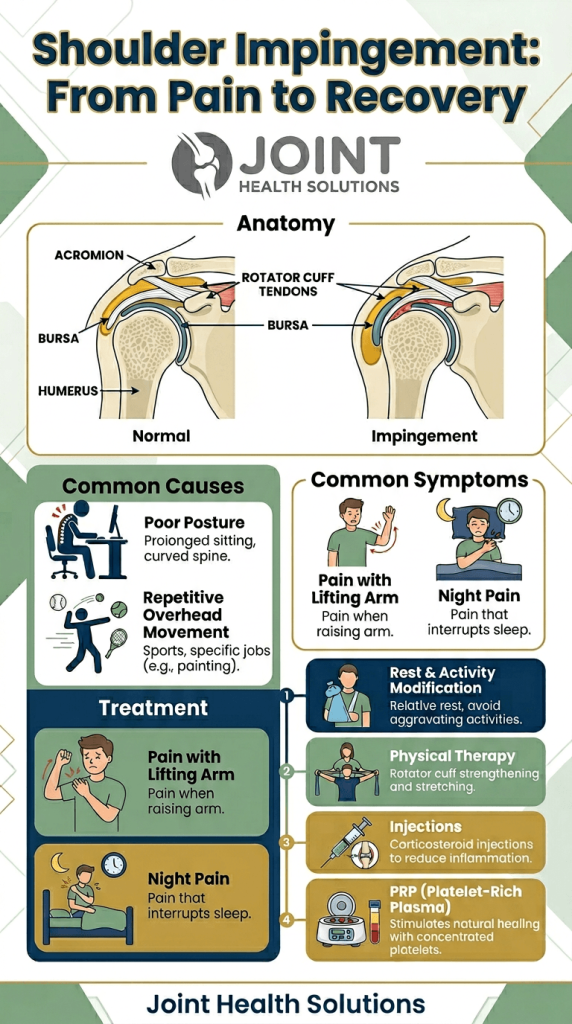
Diagnosis begins with a thorough history and physical examination. Your provider will perform specific tests, such as the Neer or Hawkins-Kennedy test, to reproduce impingement symptoms. Imaging – such as X-ray to rule out arthritis or bone spurs, and ultrasound or MRI to assess the rotator cuff – may be used to confirm the diagnosis and evaluate for tears.
Diagnosis begins with a thorough history and physical examination. Your provider will perform specific tests, such as the Neer or Hawkins-Kennedy test, to reproduce impingement symptoms. Imaging – such as X-ray to rule out arthritis or bone spurs, and ultrasound or MRI to assess the rotator cuff – may be used to confirm the diagnosis and evaluate for tears.
Most patients with shoulder impingement improve without surgery. We typically begin with a combination of conservative measures.
Physical therapy is the cornerstone of non-surgical treatment. A skilled therapist will focus on mechanics, strength, flexibility, and posture so the shoulder moves with less compression in the subacromial space.
Home exercises are essential for long-term success and help reduce the chance of recurrence once symptoms improve.
Injections can provide relief and create a window for physical therapy. A corticosteroid injection into the subacromial space can rapidly reduce inflammation and pain, allowing fuller participation in rehabilitation.
Hyaluronic acid injections may also be considered when shoulder symptoms are accompanied by arthritic changes.
For patients with chronic impingement or early tendon damage, PRP Therapy offers a regenerative approach. Platelet-rich plasma is injected into the affected area to stimulate healing of the rotator cuff tendons and reduce inflammation.
PRP can be particularly valuable when cortisone is not ideal, such as after multiple prior injections or when the goal is to promote tissue repair rather than temporary suppression of symptoms.
Temporary modification of aggravating activities is important. This does not mean complete rest; it means avoiding motions that trigger sharp pain while staying active within a pain-free range.
Your therapist or provider can guide you on when and how to resume overhead activity safely.
Physical Therapy | Improves shoulder mechanics, posture, strength, and flexibility so the tendons move with less compression. | 4-8 weeks for meaningful improvement |
Cortisone Injection | Rapidly decreases inflammation and pain so patients can participate more fully in rehab. | Often helps within days |
PRP Therapy | Supports tendon healing and may provide longer-lasting improvement for chronic cases. | Gradual improvement over weeks to months |
Activity Modification | Reduces ongoing irritation while tissues calm down and mechanics improve. | Immediate start; adjusted as symptoms improve |
Surgery is reserved for cases where conservative treatment fails after 3-6 months, or when there is a full-thickness rotator cuff tear or a significant bone spur that mechanically blocks movement.
Even in these cases, a well-designed non-surgical program can sometimes help patients avoid surgery or improve their condition before surgery. Arthroscopic subacromial decompression is the most common surgical procedure for impingement.
If you are considering surgery, Joint Health Solutions can provide a second opinion and explore whether advanced regenerative options may still be appropriate.
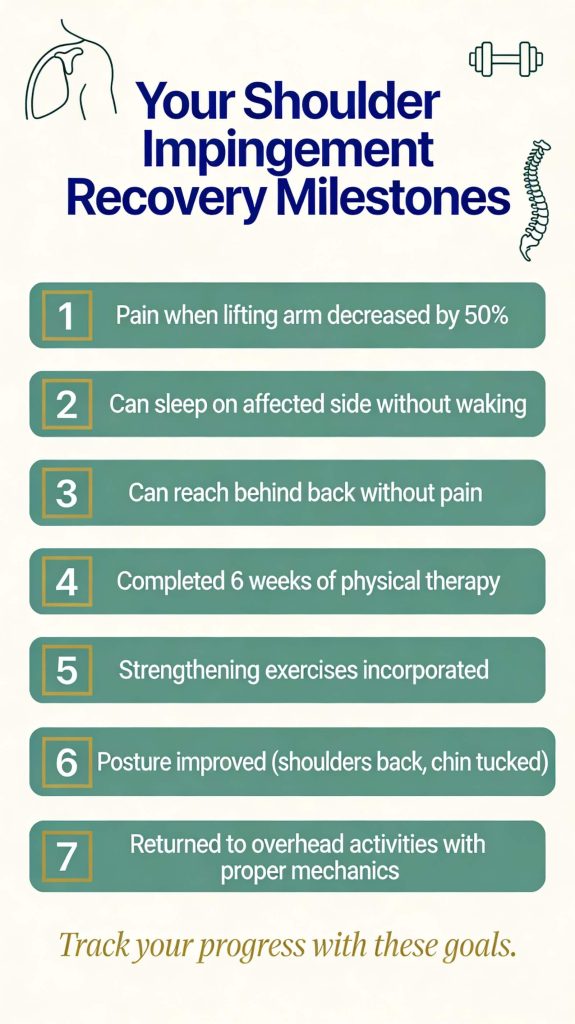
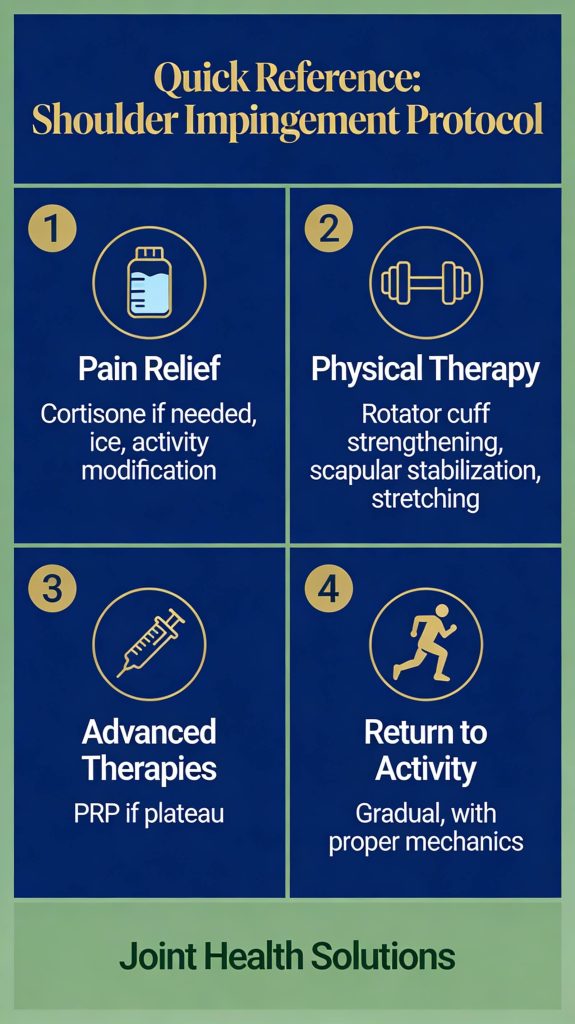
If you are struggling with shoulder pain that limits your daily activities, you do not have to live with it – or rush into surgery. At Joint Health Solutions, we offer a comprehensive approach that combines physical therapy, advanced injections, and regenerative medicine to help you recover.
Call to Action: Call our office at 704-833-3566 to schedule a consultation and start your journey to a pain-free shoulder. |
With consistent physical therapy and appropriate injections, many patients see significant improvement in 4-8 weeks. Full recovery may take 3-6 months.
Mild cases may improve with rest and activity modification, but most benefit from guided therapy to address underlying mechanics and prevent recurrence.
Yes, when used appropriately. One or two injections can provide a valuable window to perform therapy. However, repeated injections should be avoided because of potential tendon weakening.
Cortisone suppresses inflammation temporarily; PRP stimulates healing of the rotator cuff tendons and may offer longer-lasting improvement, especially for chronic cases or partial tears.
Avoid overhead presses, upright rows, and behind-the-neck movements until cleared by your therapist. Focus on pain-free range of motion and rotator cuff strengthening.
Depending on your job, you may need temporary modifications. Your provider can help coordinate with your employer if needed.
Often, X-rays are done to rule out arthritis or bone spurs. If a rotator cuff tear is suspected, ultrasound or MRI may be ordered.
Yes. Chronic impingement can weaken the rotator cuff tendons, increasing the risk of a tear. Early treatment helps prevent progression.
If after 3-6 months of conservative care, including physical therapy and appropriate injections, you still have significant pain and dysfunction, surgery may be considered.
Look for a therapist experienced in shoulder rehabilitation who focuses on both strengthening and correcting mechanics. Our team can guide you to trusted partners.