
Prepare for your first visit with our new patient forms. Learn what information to gather, how to complete forms, and what to expect to streamline your appointment.
You’ve scheduled your first visit to Joint Health Solutions. You’re hopeful about finding the root cause of your joint pain. But then you receive an email with a packet of forms – pages of questions about your medical history, symptoms, lifestyle, and more.
Filling out new patient forms can feel tedious, but this information is essential to our root‑cause approach. The more we know about you before you walk through the door, the more we can focus our time together on solutions, not paperwork.
In this guide, we’ll explain what’s in the forms, why each section matters, and how to prepare for a smooth, productive first visit.
Unlike a typical 10‑minute orthopedic visit, our initial consultation is 60‑90 minutes – and we want to spend that time talking with you, not watching you fill out forms.
Your answers help us:
Every question has a purpose. Even questions that seem unrelated to your joint pain – like digestive health, sleep, or stress – often hold the key to your condition.
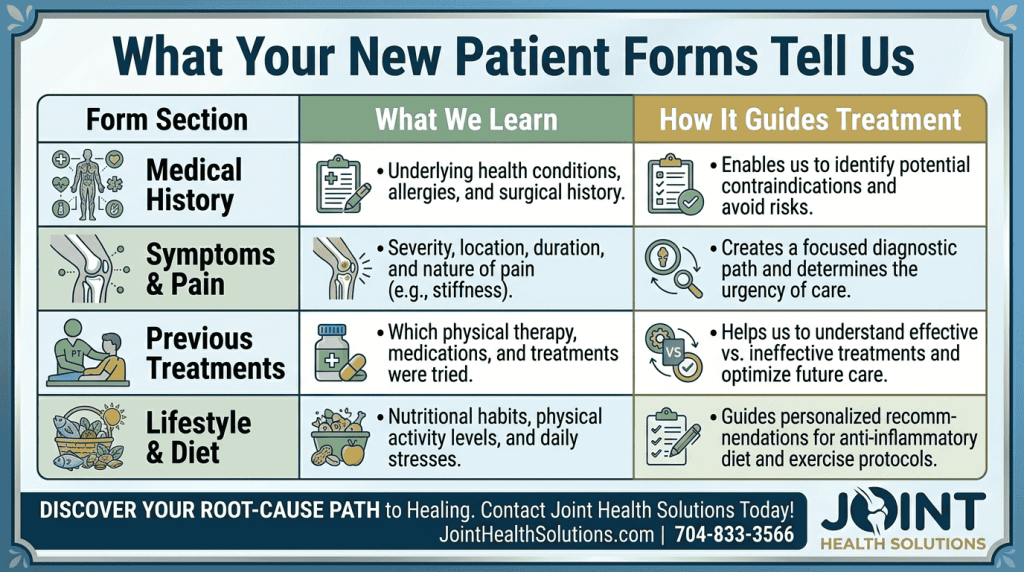
Past medical conditions (diabetes, thyroid disease, autoimmune disorders, cancer, etc.)
Surgeries and hospitalizations
Current and past medications (prescription, over‑the‑counter, supplements)
Allergies (medications, foods, latex, contrast dye)
Family history of arthritis, autoimmune disease, or gut disorders
Why it matters: Many medical conditions (e.g., diabetes, hypothyroidism) contribute to joint pain or affect treatment decisions. A thorough medical history review helps us connect systemic issues to your joint symptoms.
Location of pain (knee, shoulder, hip, hand, etc.) – often marked on a body diagram
Pain intensity (0‑10 scale) and quality (sharp, dull, burning, throbbing)
What makes it better or worse (activity, rest, weather, certain foods)
Morning stiffness duration (a key clue for inflammatory arthritis)
Other symptoms: swelling, clicking, locking, giving way, weakness
Why it matters: Symptom patterns help distinguish mechanical OA from inflammatory or gut‑driven arthritis. Learn more about our comprehensive pain assessment process.
Physical therapy (how many sessions, what helped or didn’t)
Injections (cortisone, hyaluronic acid, PRP – when, where, how many, how long relief lasted)
Oral medications (NSAIDs, acetaminophen, opioids, supplements)
Alternative therapies (acupuncture, chiropractic, massage)
Surgeries (including dates and outcomes)
Why it matters: Knowing what hasn’t worked prevents us from repeating failed treatments and guides us toward new options. See how we build on your prior treatment history to create a personalized plan.
Diet (typical meals, food sensitivities, sugar intake, gluten/dairy consumption)
Exercise (type, frequency, intensity)
Sleep (hours per night, quality, trouble falling/staying asleep)
Stress (work, family, financial – perceived level)
Tobacco, alcohol, caffeine use
Occupation and hobbies (repetitive movements, heavy lifting, overhead work)
Why it matters: Lifestyle factors are often the most modifiable drivers of chronic inflammation and joint pain. Explore our lifestyle and diet recommendations to start reducing inflammation today.
We use a secure, HIPAA‑compliant patient portal. Here’s how it works:
If you don’t have internet access or prefer paper forms, call our office and we’ll mail you a packet. Please bring the completed paper forms to your visit.
Important: Forms must be completed before your appointment time. Otherwise, we may need to reschedule.
Pro tip: Gather your medication bottles and any prior medical records before you start the forms. This saves time and improves accuracy.
We accept most major insurance plans, including Medicare, BlueCross BlueShield, Aetna, Cigna, and UnitedHealthcare—and we proudly work with out-of-network benefits as well. For a complete, up‑to‑date list of our in‑network providers, please visit our Insurance and Financing page.
Coverage does vary by plan:
Medical services (office visits, injections, imaging) – typically covered subject to deductibles/co‑pays.
Functional medicine testing (stool analysis, food sensitivity, SIBO breath test) – may not be covered; we’ll provide a cost estimate.
Regenerative medicine (PRP, IV therapy) – often not covered; self‑pay rates and packages are available.
Our dedicated patient advocates will verify your benefits before your visit so you receive a clear, easy‑to‑understand breakdown of what your insurance covers and what your out‑of‑pocket costs will be.
If you don’t have insurance, we offer transparent, competitive self‑pay rates for all diagnostics and treatments. Call our office or visit our Insurance and Financing page for more details. We can also provide a full cost estimate before your first visit.
To make your care as affordable as possible, we offer several convenient payment methods:
Health Savings Accounts (HSA) & Flexible Spending Accounts (FSA) – Use your pre‑tax health dollars toward eligible diagnostic assessments, co‑pays, and many of our joint relief therapies.
CareCredit Financing – We partner with CareCredit to offer flexible, low‑to‑no‑interest payment plans. This allows you to get the care you need immediately and pay for it comfortably over time.
Credit cards, HSA/FSA cards, and cash are all accepted at our office.
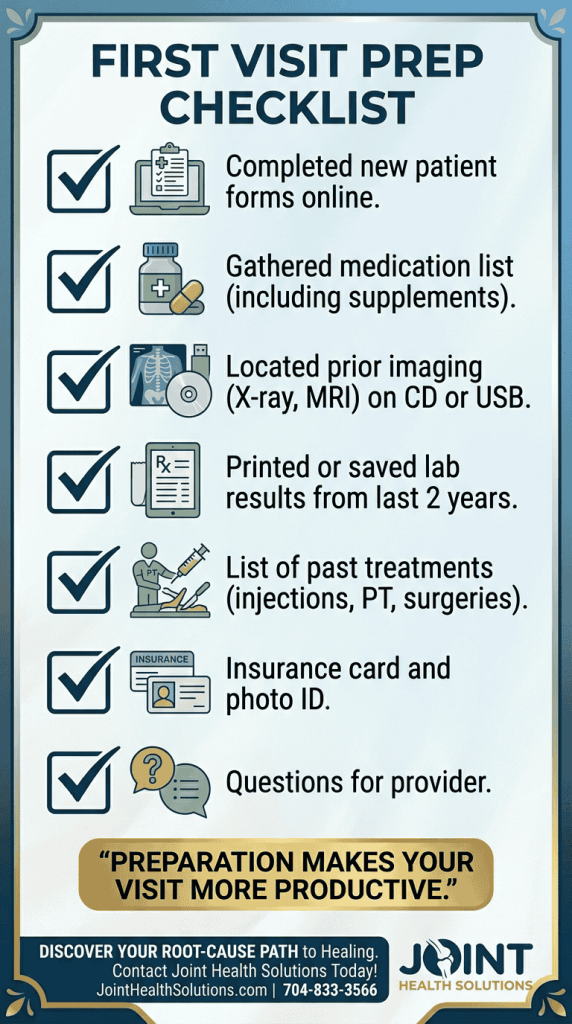
Bring your insurance card and a valid photo ID.
Have a list of current medications and allergies ready.
Gather any relevant medical records or imaging reports (X‑ray, MRI) from previous providers.
Do you accept Medicare?
Yes, we accept Medicare. Many diagnostic procedures and fluoroscopy‑guided injections are covered by Medicare.
Does insurance cover PRP or other regenerative therapies?
Some advanced regenerative therapies, like PRP, may be considered elective by certain carriers. We’ll verify your exact benefits before any treatment begins.
Do I need a referral from my primary care doctor?
In many cases, you do not need a referral to schedule a consultation with our specialists. However, some specific HMO plans do require one. Our team can help you determine your plan’s exact requirements when you call.
What if my insurance isn’t listed?
Don’t see your provider listed? Contact our office. We frequently work with out‑of‑network benefits and can help verify your specific coverage.
Understanding costs upfront removes barriers to treatment. Whether you have insurance or pay out‑of‑pocket, at Joint Health Solutions, our goal is to make high‑quality joint care accessible and transparent. Our team is dedicated to empowering individuals to reclaim their mobility and enhance their quality of life through innovative, non‑invasive treatments.
For any further questions about insurance, pricing, or to schedule an appointment, please don’t hesitate to reach out through our Contact page.
About 20‑30 minutes if you have your information ready. If you need to gather records, set aside 45 minutes.
Yes, the patient portal is mobile‑friendly. However, a computer or tablet is easier for longer sections.
Please call us. We may need to reschedule if forms aren’t completed, as we can’t perform a thorough evaluation without them.
Yes, bring the CD or USB as a backup. Sometimes our system doesn’t read uploaded files correctly.
No problem. We can order X‑rays or other imaging after your visit if needed.
Absolutely. We comply with HIPAA regulations and use a secure, encrypted patient portal.
No, email is not secure. Please use the patient portal or bring paper forms to your visit.
It depends on your insurance. Call your plan or ask our office to verify.
Please call at least 24 hours in advance. Late cancellations may incur a fee.
Call our office and we’ll mail you a paper packet. Please allow 5‑7 days for delivery.
HIPAA Journal: “Patient portal security” –  www.hipaajournal.com/patient-portal-hipaa/
American Medical Association: “Preparing for a first visit” – www.ama-assn.org/delivering-care/preparing-first-visit