
PRP knee injections in Charlotte are becoming a leading choice for patients suffering from knee osteoarthritis (OA), a condition that affects millions of adults and causes chronic pain and reduced mobility. While traditional treatments like physical therapy help many, others continue to struggle. Corticosteroid injections offer temporary relief but do not address the underlying joint damage.
Enter platelet-rich plasma (PRP) therapy – a regenerative medicine treatment that uses your body’s own healing factors to potentially slow OA progression and provide lasting pain relief. At Joint Health Solutions, we specialize in these advanced treatments for various joints.
PRP is derived from a small sample of your own blood. After a simple blood draw, the sample is placed in a centrifuge to separate platelets and growth factors from red blood cells. The resulting concentration is then injected directly into the arthritic knee joint. Platelets contain hundreds of growth factors that:
Recruit stem cells to the damaged area.
Stimulate cartilage repair and reduce inflammation.
Modulate pain signals.
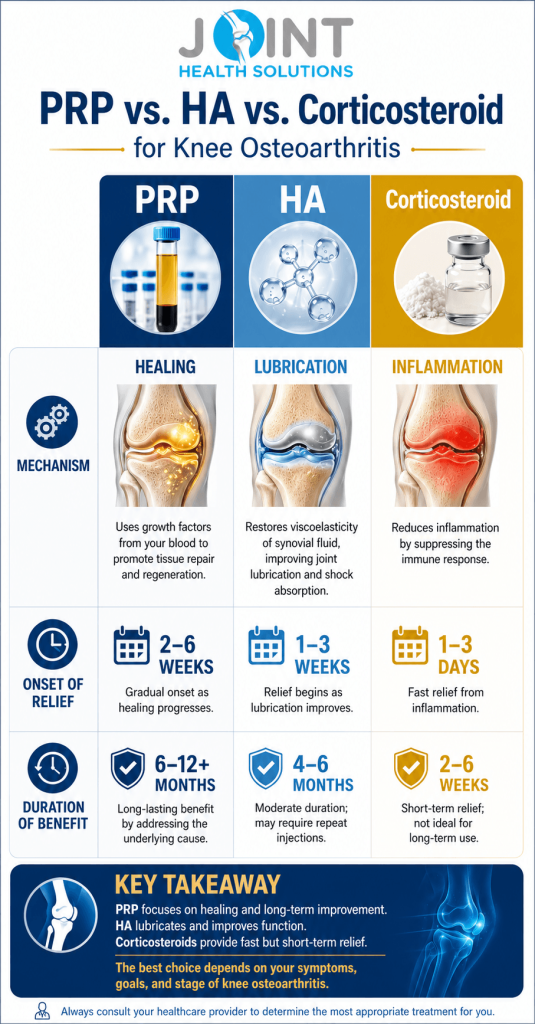
Unlike cortisone, which simply suppresses inflammation, PRP aims to heal tissue and improve the joint environment.
Multiple high-quality studies have evaluated the efficacy of PRP knee injections in Charlotte and globally. A 2021 meta-analysis in the American Journal of Sports Medicine reviewed 14 randomized controlled trials and found that PRP provided significant pain reduction compared to placebo and hyaluronic acid (HA) at 6 and 12 months. Furthermore, PRP was superior to corticosteroid injections for functional improvement lasting beyond 3 months.
For more information on managing your symptoms, visit our Knee Arthritis Treatment Charlotte page.
Ideal candidates for PRP knee injections:
PRP is generally not recommended for severe, bone‑on‑bone OA (grade 4) or for patients with active infection, bleeding disorders, or low platelet counts.
Consultation: Your provider reviews your history and may use Fluoroscopy-Guided Injections or ultrasound for precision.
Blood Draw & Centrifugation: 30-60 mL of blood is processed to concentrate platelets.
Injection: The PRP is injected directly into the knee joint.
Recovery: Most patients notice improvement starting at 2-4 weeks.
At Joint Health Solutions, we often enhance PRP results by combining them with:
Offloading Knee Braces: To reduce mechanical stress on the joint.
Anti-Inflammatory IV Therapy: To lower systemic inflammation.
Physical Therapy: To strengthen supporting muscles.
One of the most compelling reasons patients choose PRP is its safety profile; because the serum is autologous (derived from your own blood), the risk of allergic reaction or rejection is virtually non-existent. While corticosteroids can lead to cartilage degradation over repeated use, research suggests that PRP may have a disease-modifying effect, potentially slowing the loss of cartilage volume over time. Success rates are high, with 70-80% of patients achieving meaningful clinical improvement. By addressing the biological environment of the knee rather than just masking the pain, PRP serves as a vital bridge for those looking to delay or altogether avoid total knee replacement surgery.
Most patients notice improvement starting at 2-4 weeks, with maximal benefit at 3-6 months.
For long‑term relief (beyond 3 months), yes. PRP treats the underlying inflammation and promotes healing, while cortisone only masks symptoms.
Typically 1-3 injections, spaced 2-4 weeks apart.
Most plans do not cover PRP for OA; we offer competitive self-pay rates.
It is less effective for severe (grade 4) OA, where joint replacement may be better.
Risks are very low—mild soreness, swelling, or bruising at the site.
Avoid NSAIDs (ibuprofen, naproxen) for 4-6 weeks; Tylenol is safe.
Typically 1‑3 injections, spaced 2‑4 weeks apart. Your provider will recommend a protocol based on your OA grade.
Yes—shoulder, hip, and ankle arthritis. See Shoulder Pain Charlotte.
Call our office or book through our Treatments & Services page.

A board-certified physician in Emergency Medicine and Obesity Medicine with over 25 years of experience

A board-certified Family Nurse Practitioner with over 12 years of nursing experience