

Knee Arthritis Relief | Hyaluronic Acid for Active Adults in Charlotte
Published July 23, 2026 | Category: Joint Health | Location: Charlotte, North Carolina | 🕒 12 min read
For active adults in Charlotte, knee arthritis can feel like an unwelcome barrier to the life you’ve built around movement. That familiar twinge during your morning jog, the stubborn stiffness after a weekend hike, or the grating sensation when you tackle a flight of stairs — these are signs that your knee’s shock-absorbing capacity is declining. The encouraging news? Modern non-surgical therapies — particularly hyaluronic acid injections — can help restore that cushioning for many patients.
At Joint Health Solutions, we’re dedicated to helping active individuals regain their mobility without surgery. In this guide, we explain why hyaluronic acid matters for shock absorption, how the treatment works, what the evidence actually shows, and whether it aligns with your lifestyle and goals.
Why Active Adults Face Unique Challenges with Knee Arthritis
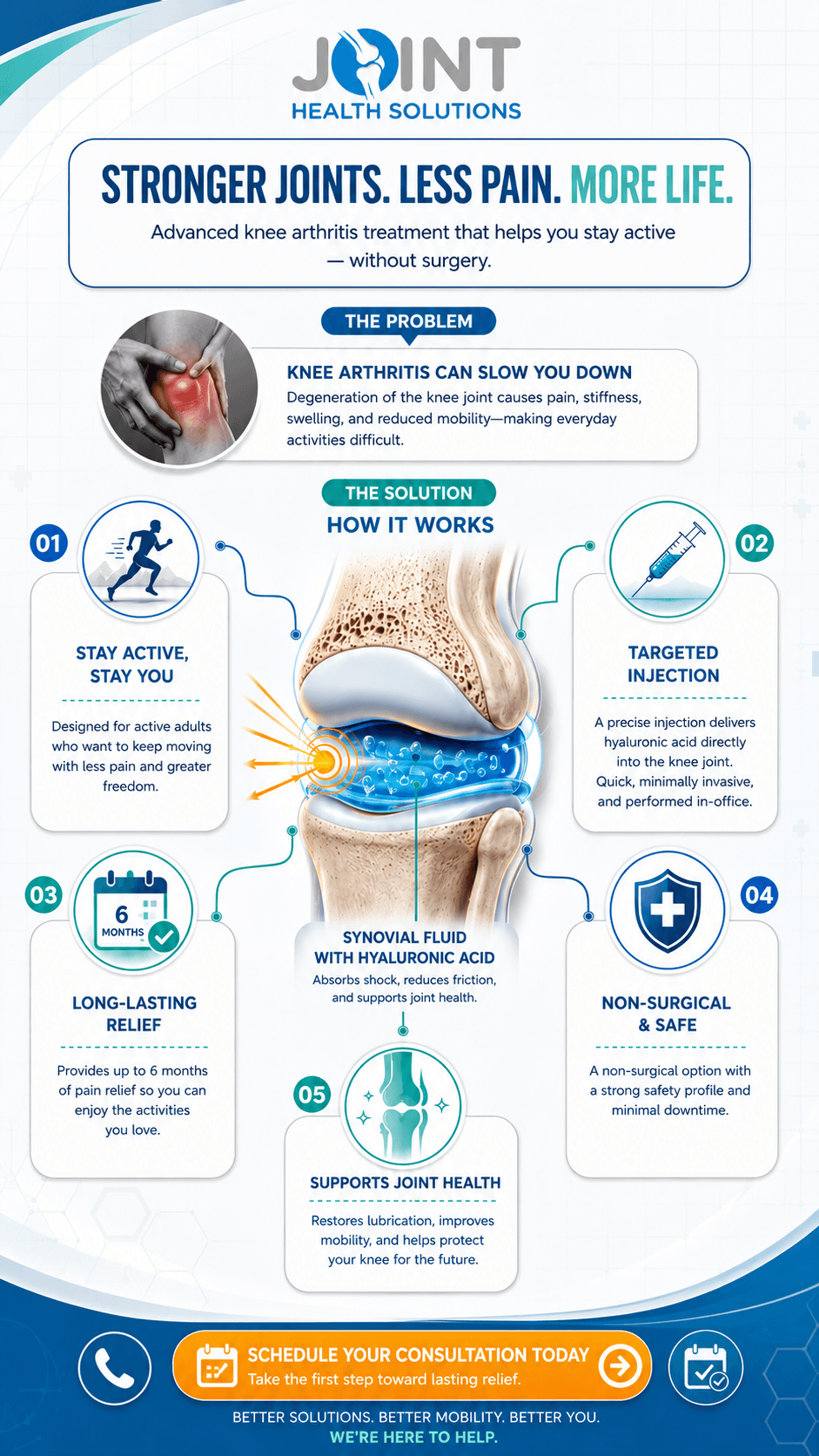
Knee arthritis doesn’t discriminate, but it does take a heavier toll on those who stay physically active. Repetitive impact from running, jumping, and prolonged walking accelerates wear on cartilage and synovial fluid — the joint’s natural lubricant and shock absorber. The key molecule in that fluid is hyaluronic acid, which gives it a thick, gel-like consistency. When hyaluronic acid levels decline, the joint loses cushioning capacity, leading to increased friction, inflammation, and progressive limitation of movement.
Hyaluronic acid injections aim to directly replenish this substance, supporting the knee’s lubrication and shock-absorption properties. For active adults, successful treatment can mean less discomfort during activities they value — though outcomes are variable and depend significantly on the degree of arthritis, individual biology, and lifestyle factors.
Advances in non-surgical orthopedics now offer several pathways for managing knee arthritis without surgery. At Joint Health Solutions, our injection therapies — including hyaluronic acid, corticosteroids, and PRP — are tailored to each patient’s specific condition and activity goals.
What Is Happening in the Joint
Knee osteoarthritis is a degenerative process in which protective cartilage on the ends of bones gradually thins. But cartilage isn’t the only shock absorber — synovial fluid within the joint capsule is equally important. This fluid is rich in hyaluronic acid, giving it the viscous, shock-absorbing properties that allow smooth joint movement. In a healthy knee, synovial fluid distributes forces across the joint, reducing wear and tear.
As arthritis progresses, the body produces less hyaluronic acid, and the synovial fluid becomes thinner and less effective. Hyaluronic acid injections introduce a purified solution directly into the joint to supplement this depleted fluid. Active adults are especially susceptible to this depletion because repetitive, high-impact activities accelerate the breakdown of synovial fluid over time.1
What Hyaluronic Acid Does — and How It Restores Cushioning
Hyaluronic acid is a naturally occurring molecule found throughout the body, particularly in joints, skin, and connective tissues. In the knee, it is produced by synoviocytes and is a major component of synovial fluid. Its molecular structure allows it to bind water, forming a thick, elastic gel that lubricates the joint and helps absorb mechanical shock. When arthritis sets in, both the concentration and molecular weight of hyaluronic acid in synovial fluid decrease, compromising the joint’s protective function.
Hyaluronic acid injections introduce a sterile solution directly into the knee joint to supplement this loss. The procedure is performed in-office and typically takes under 30 minutes.
Many patients report some improvement in pain and function within a few weeks, with benefits ranging from six months to over a year depending on arthritis severity and activity level. However, responses vary considerably — some patients notice substantial improvement while others experience limited benefit. Treatment is generally most effective as part of a broader plan that includes physical therapy, weight management, and activity modification.2
Who Benefits Most from Hyaluronic Acid Injections?
Ideal candidates for hyaluronic acid injections are adults with mild-to-moderate knee osteoarthritis who remain active and wish to postpone or avoid surgery. You may be a good fit if you:
- Experience knee pain during or after physical activity
- Have morning stiffness that eases with movement
- Have not found lasting relief from over-the-counter medications or physical therapy
Even patients with more advanced arthritis or bone-on-bone changes may experience some benefit, though results are generally less predictable in these cases. A thorough evaluation — including a physical exam and imaging — helps determine whether this treatment is appropriate for you.
Hyaluronic acid injections are not recommended for individuals with active infections near the knee, blood-clotting disorders, or known allergies to hyaluronic acid or avian-derived products (for products derived from bird tissue). Pregnant or breastfeeding individuals should consult their physician.
At Joint Health Solutions, our team — including Dr. Jeffrey Galvin and Ariel Curtis, FNP-C — evaluates your unique condition and goals to ensure the most appropriate care plan.
What the Injection Experience Looks Like
- Preparation — The skin over your knee is cleaned with an antiseptic. A local anesthetic may be applied to minimize discomfort.
- Injection — A thin needle delivers the hyaluronic acid solution into the joint space. Most patients feel a brief pinch or pressure.
- Duration — The entire appointment takes about 15 to 30 minutes.
- Afterward — You rest briefly and then go home. Some protocols involve a series of three weekly injections; single-injection formulations are also available. Your provider will recommend the most appropriate regimen based on the specific product and your condition.
Mild swelling or discomfort for a day or two after each injection is normal. Applying ice and avoiding strenuous activity helps manage this. Most patients resume normal activities within 24–48 hours. Rare complications include joint infection and local allergic reaction; your provider will review these risks with you beforehand and provide detailed aftercare instructions.
Recovery and Long-Term Gains for Active Adults
Recovery from hyaluronic acid injections is typically quick compared to surgical options. You should avoid high-impact activities for a few days after each injection; light activity like walking or cycling is usually fine within 24–48 hours. The full effect develops over several weeks as the hyaluronic acid integrates with the synovial environment.
Patients who respond well often report:
- Reduction in pain with activity
- Greater range of motion
- Improved ability to participate in lower-impact sports and recreation
When present, benefits typically last six months to over a year. Some patients opt for repeat injections annually to sustain relief. When combined with physical therapy, weight management, and supportive bracing, hyaluronic acid therapy can be a useful tool in the long-term non-surgical management of knee arthritis — though it does not reverse cartilage loss or stop disease progression.
Why Conventional Options Often Fall Short
| Treatment | How It Works | Shortcomings | Risks |
|---|---|---|---|
| Oral NSAIDs | Reduce inflammation and pain systemically | Do not restore shock absorption; provide temporary relief only | GI bleeding, kidney damage, cardiovascular issues with long-term use |
| Corticosteroid Injections | Potent localized anti-inflammatory effect | Short-lived relief (weeks to months); repeated use may accelerate cartilage breakdown | Joint infection, tendon damage, cartilage loss with repeated dosing |
| Knee Replacement Surgery | Replaces damaged joint surfaces | Long recovery; major risks; best suited for severe end-stage arthritis | Infection, blood clots, implant failure, nerve damage |
| Hyaluronic Acid Injections | Supplements synovial fluid viscosity and shock-absorbing properties | Variable results; may require repeat injections; not effective for all patients | Mild local swelling, rare infection; no systemic side effects |
How Joint Health Solutions Treats Knee Arthritis Without Surgery
At Joint Health Solutions, we offer individualized, non-surgical plans that may combine several of the following therapies depending on your specific condition and goals.
Injection-Based Therapies
Hyaluronic Acid (Viscosupplementation) — FDA-approved for knee osteoarthritis pain in patients who have not responded adequately to conservative therapy. We use high-molecular-weight formulations to supplement the synovial fluid’s cushioning and lubrication properties. Explore hyaluronic acid injections.
Corticosteroid (Cortisone) Injections — Appropriate for rapid relief of acute flare-ups. Often used alongside hyaluronic acid to manage both immediate inflammation and longer-term joint health, though frequency must be limited to avoid tissue effects. Learn more.
PRP (Platelet-Rich Plasma) Therapy — Uses growth factors concentrated from your own blood to support tissue healing. Note: PRP is not FDA-approved as a drug; the device used to prepare the concentrate has received FDA clearance. Evidence for PRP in knee OA is mixed; it is typically considered when other therapies have not provided sufficient relief. Learn more about PRP therapy.
Fluoroscopy-Guided Injections — For complex cases, real-time X-ray guidance ensures precise needle placement. Learn more.
Supportive & Rehabilitative Services
Physical Therapy — Customized programs to strengthen the quadriceps, hamstrings, and surrounding muscles. Stronger muscles reduce daily joint strain and can prolong the effects of injections. Explore physical therapy options.
Offloading Knee Braces — Custom-fitted braces that shift weight away from the damaged compartment of the knee, reducing pain during activity. Learn about offloading knee braces.
Anti-Inflammatory Nutrition Plans — Dietary guidance to reduce systemic inflammation and support overall joint health. Learn more.
Advanced Adjunctive Treatments
Anti-Inflammatory IV Therapy — Delivers nutrients and antioxidants directly into the bloodstream to support recovery from systemic inflammation. Learn more about IV therapy.
Sports Recovery IV Therapy — Formulated to support tissue recovery in active adults after strenuous activity. Explore sports recovery IV therapy.
Toradol IM Injections — An intramuscular NSAID for short-term pain relief, sometimes used to bridge patients to longer-acting therapies.
Trigger Point Injections — For muscle-related knee pain, these injections relieve tension in surrounding muscles and may improve mobility and reduce compensatory strain. Learn more.
Knee Arthrocentesis (Joint Fluid Aspiration) — Removes excess fluid to reduce pressure and pain; often performed before an injection to create space in the joint capsule. Learn more.
The Evidence Behind the Treatment
The clinical evidence for hyaluronic acid in knee osteoarthritis is substantial in volume but mixed in conclusions. Several large systematic reviews and meta-analyses have found statistically significant reductions in pain compared to placebo; others have found the effect size to be small and of uncertain clinical significance.3,4 High-molecular-weight formulations are biologically plausible as superior, but head-to-head clinical trial evidence comparing them to lower-MW products is limited and inconsistent.
Evidence and Clinical Research
| Component | FDA Status | Evidence Level | Key Findings |
|---|---|---|---|
| Hyaluronic Acid Injections (Viscosupplementation) | FDA-approved for knee OA pain in patients who failed conservative therapy | Mixed / established in volume but variable in effect size | Multiple meta-analyses show statistically significant pain reduction vs. placebo; effect size is often modest and clinical significance is debated2,3 |
| High Molecular Weight HA Formulations vs. Low MW | FDA-approved (both MW ranges have approved products) | Limited / mixed evidence | Biologically plausible superiority of high MW; head-to-head RCT evidence is inconsistent4 |
| Hyaluronic Acid vs. Placebo | Not a separate FDA indication | Established in number of studies; clinically significant difference debated | Meta-analyses consistently show pain reduction vs. placebo; AAOS 2021 rates evidence as Inconclusive due to heterogeneity across trials5 |
| Hyaluronic Acid for Active Adults Specifically | Not a separate FDA indication | Limited human evidence | Most trials enrolled broad OA populations; data specific to physically active subgroups is limited |
- FDA-approved: The product has received FDA approval for a specific indication.
- Established clinical evidence: Supported by multiple peer-reviewed human studies.
- Limited human evidence: Some human studies exist but are small or inconsistent.
- Mechanistic/animal studies: Findings from laboratory or animal research; do not prove patient benefit.
- Investigational: Not yet approved; being studied in clinical trials.
Important Note: Hyaluronic acid injections do not reverse cartilage loss or cure arthritis. Individual results vary considerably. A thorough evaluation is required to determine whether viscosupplementation is appropriate for your specific condition.
Your First Visit: What Happens
Your journey begins with a comprehensive consultation. We will:
- Review your medical history and current symptoms
- Discuss your activity goals and lifestyle
- Perform a focused physical examination
- Order imaging (X-ray or MRI as appropriate) to assess arthritis severity
Based on the findings, we walk you through all viable options — including hyaluronic acid injections — explaining the procedure, expected outcomes with a realistic picture of what the evidence shows, and any potential risks. You will have time to ask questions and make an informed decision. If you choose to proceed, we can often perform your first injection the same day.
Our team, under the clinical leadership of Dr. Jeffrey Galvin and Ariel Curtis, FNP-C, is here to make your experience clear, comfortable, and empowering. Schedule your consultation.
Why Trust Joint Health Solutions
Joint Health Solutions serves Charlotte’s active community with a focused commitment to non-surgical orthopedic care. Our approach is backed by current research and delivered by board-certified providers who understand the unique demands of staying active with joint pain. We offer flexible scheduling and are conveniently located in Charlotte. When you choose us, you’re choosing a team genuinely invested in your long-term quality of life. Learn more about Joint Health Solutions.
Ready to Explore Your Options?
Knee arthritis doesn’t have to sideline you. Contact Joint Health Solutions to discuss whether hyaluronic acid injections and a comprehensive non-surgical plan are right for your situation.
Call 704-833-3566 or schedule your visit online.
Sources
- Bhosale AM, Richardson JB. Articular cartilage: structure, injuries and review of management. Br Med Bull. 2008;87:77–95. PMID 18514821
- Bannuru RR, et al. OARSI guidelines for the non-surgical management of knee, hip, and polyarticular osteoarthritis. Osteoarthritis Cartilage. 2019;27(11):1578–1589. PMID 31278997
- Bellamy N, et al. Viscosupplementation for the treatment of osteoarthritis of the knee. Cochrane Database Syst Rev. 2006;(2):CD005321. PMID 17143954
- Huang HR, et al. Efficacy of hyaluronic acid for knee osteoarthritis: A meta-analysis of randomized controlled trials. Knee Surg Sports Traumatol Arthrosc. 2021;29(12):4146–4154. PMID 34011337
- Altman RD, et al. Effect of intra-articular hyaluronic acid (HA) on the outcome of total knee replacement (TKR): evidence from a controlled, randomized, double-blind, multicenter study. Semin Arthritis Rheum. 2015;45(3):263–270. PMID 26578847
- American Academy of Orthopaedic Surgeons. Clinical Practice Guideline: Treatment of Osteoarthritis of the Knee, 4th Edition (2021). aaos.org
Frequently Asked Questions
How long do hyaluronic acid injections last?
For patients who respond to treatment, benefits typically last six months to over a year. Duration varies based on the severity of arthritis, activity level, and the specific product used. Some patients choose repeat injections annually to maintain relief.
Are hyaluronic acid injections painful?
Most patients experience only a brief pinch or pressure during the injection. A local anesthetic is applied beforehand to minimize discomfort. Any soreness or mild swelling at the site typically resolves within 24–48 hours.
Can I exercise after getting hyaluronic acid injections?
Light activity such as walking is generally fine within 24–48 hours. High-impact activities — running, jumping, heavy lifting — should be avoided for a few days after each injection. Your provider will give you specific guidance based on your protocol and condition.
How many injections will I need?
The most common protocol involves one to three injections given one week apart, depending on the product. Some formulations are designed as a single injection. Your provider will recommend the regimen that best matches the approved product and your clinical profile.
Is hyaluronic acid covered by insurance?
Coverage varies by insurance plan. Hyaluronic acid injections are FDA-approved for knee OA, and many plans provide coverage — but prior authorization requirements and coverage thresholds differ. We recommend contacting your insurer before your appointment. Our team can help with documentation.
What is the difference between hyaluronic acid and cortisone injections?
Cortisone injections are anti-inflammatory and typically provide faster but shorter-lasting relief (weeks to a few months). Hyaluronic acid injections aim to restore the lubricating and cushioning properties of synovial fluid, with effects that may last longer. The two are sometimes used together — cortisone for acute flare management and hyaluronic acid for longer-term joint support.
Can hyaluronic acid injections help with severe arthritis?
Results in severe or end-stage arthritis (grade IV, bone-on-bone) are less predictable. Some patients with advanced arthritis report benefit; others do not. A thorough evaluation including imaging helps set realistic expectations. In very advanced disease, surgical options may ultimately be more appropriate.
How soon will I feel relief after the injection?
Many patients notice improvement within two to four weeks. Some report relief sooner; others require the full treatment course before seeing benefit. The effects of hyaluronic acid are generally not immediate — unlike cortisone, which tends to act faster but lasts a shorter time.
Are there any side effects?
The most common side effects are temporary local reactions: mild swelling, warmth, or discomfort at the injection site, typically resolving within 48 hours. Rare but more serious complications include joint infection and local allergic reaction (including for avian-derived products in patients with bird or egg allergies). Your provider will review these risks with you and screen for any contraindications.
Can I have hyaluronic acid injections in both knees?
Yes, both knees can be treated — though typically not in the same session. Injecting both knees simultaneously is possible in some cases, but your provider will evaluate whether staged treatment or same-session bilateral injections is more appropriate based on your overall health and presentation.