
Fluoroscopy-Guided Injections Concord NC are available at Joint Health Solutions for adults dealing with knee pain, shoulder pain, osteoarthritis, stiffness, inflammation, swelling, or reduced mobility. Fluoroscopy-guided injections use real-time imaging to help guide treatment placement for selected knee and shoulder joint concerns.
For patients from Concord, NC and nearby areas, Fluoroscopy-Guided Injections Concord NC focus on non-surgical osteoarthritis management and personalized joint care. Our team creates treatment plans based on your symptoms, joint condition, activity level, and mobility goals.
Medically reviewed by: Dr. Jeffrey Galvin & Ariel Curtis, FNP-C
Fluoroscopy is a real-time imaging method that helps providers view the treatment area during certain injection procedures. At Joint Health Solutions, fluoroscopy may be used when image guidance is helpful for selected knee or shoulder injections.
Fluoroscopy-Guided Injections Concord NC may support more accurate placement, a more controlled procedure, and better treatment planning for patients with arthritis-related joint pain, stiffness, swelling, or inflammation.

Ideal for accurately targeting treated joints such as the knee and shoulder when image-guided precision is needed.

Ensures medication is delivered to the intended target.

Avoids accidental injection into blood vessels or unintended spaces.

Increases the likelihood of therapeutic success.
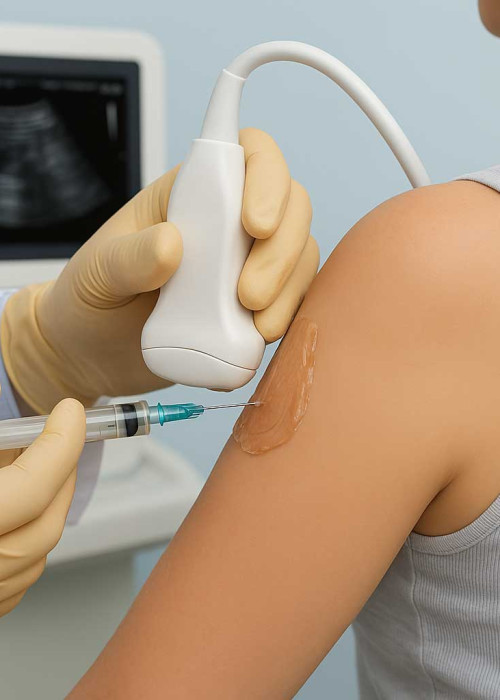
Fluoroscopy and ultrasound are both image-guidance tools, but they work differently. Your provider will determine which option is appropriate based on the joint being treated and your specific care plan.
| Feature | Fluoroscopy | Ultrasound |
|---|---|---|
| Imaging Type | Real-time X-ray | Sound waves |
| Best For | Knee, Shoulder, joint, and deep bony structures. | Soft tissues, tendons, bursae, fluid, and superficial joints. |
| Advantages | Excellent bone visualization; confirms precise contrast spread. | No radiation exposure; visualizes soft tissue pathology in real-time. |
| Disadvantages | Small radiation exposure; limited soft-tissue detail. | Limited penetration for deep structures; highly operator dependent. |
Not every injection requires imaging. For patients receiving Fluoroscopy-Guided Injections Concord NC, your provider will explain whether fluoroscopy or another method is recommended for your treatment.
Fluoroscopy-Guided Injections Concord NC may be recommended for selected knee and shoulder conditions after a clinical evaluation. At Joint Health Solutions, care is focused on non-surgical osteoarthritis management and joint support.

Fluoroscopy-guided injections may be used for selected patients with knee osteoarthritis, knee stiffness, swelling, inflammation, or painful flare-ups.

Selected shoulder conditions may benefit from guided injection care, including shoulder arthritis, stiffness, inflammation, bursitis, and pain that limits reaching or lifting.

Image guidance may support accurate placement for selected knee and shoulder injection procedures when precision is helpful.
Joint Health Solutions does not provide fluoroscopy-guided injections for hips, ankles, elbows, hands, spine, facet joints, sacroiliac joints, epidural procedures, nerve blocks, or diagnostic lab testing.
Knee injections may be used for osteoarthritis, inflammation, stiffness, swelling, or painful flare-ups.
Shoulder injections may be used for shoulder arthritis, inflammation, bursitis, stiffness, or limited mobility.
Cortisone injections may help reduce inflammation and painful flare-ups in selected knee or shoulder conditions.
Hyaluronic acid injections may help support knee joint lubrication for selected knee osteoarthritis patients. Joint Health Solutions offers Orthovisc, Hyalgan, GenVisc, Monovisc, and Durolane.
PRP therapy may support the body’s natural healing response for selected knee or shoulder joint concerns. PRP is discussed here only as a joint-related option, not as a cosmetic or facial service.
Toradol injection is now offered and may be considered for selected patients who need non-opioid support for inflammation-related knee or shoulder discomfort.

Your provider reviews your medical history, performs a physical exam, and reviews imaging such as MRI, CT, or X-ray to determine if a fluoroscopy-guided injection is appropriate. We discuss the procedure, risks, benefits, and alternatives.
You will lie on a fluoroscopy table, typically on your stomach or side depending on the target area. The skin is cleansed with an antiseptic, and a local anesthetic is used to numb the injection site.
The fluoroscope is positioned to visualize the target. The physician advances a small needle while watching real-time images. A small amount of contrast dye may be injected to confirm placement before the therapeutic medication is delivered.
Once placement is confirmed, the medication, such as corticosteroid, anesthetic, or regenerative agent, is injected. You may feel temporary pressure or a brief sensation as the medication spreads.
You will be observed for a short period to ensure stability. You may receive a pain diary to track your response. Most patients can resume normal activities within 24 hours, although specific restrictions depend on the procedure.
Fluoroscopy-Guided Injections Concord NC may provide several benefits for selected patients with knee or shoulder joint pain.
Potential benefits may include:
Results vary by patient, condition, injection type, and treatment response.
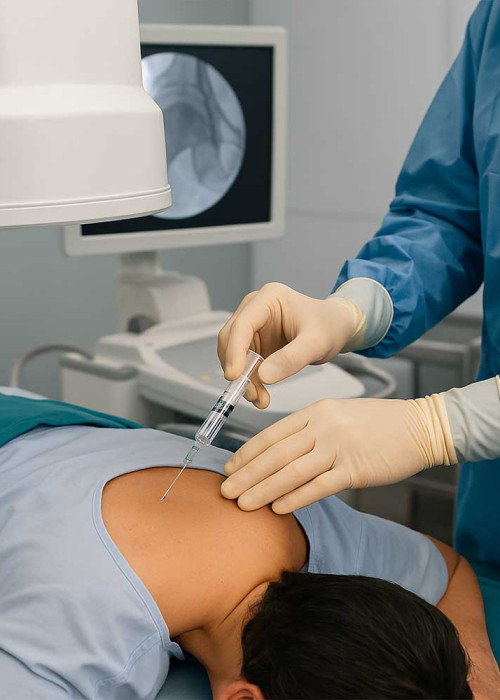
Fluoroscopy-guided injections are generally well tolerated, but every procedure has possible risks. Your provider will review your health history and explain what to expect before treatment.
Possible side effects may include:
Fluoroscopy uses real-time X-ray imaging, so your provider will use appropriate precautions and only recommend this guidance method when it is useful for your care.
After Fluoroscopy-Guided Injections Concord NC, follow your provider’s aftercare instructions and contact the office if symptoms feel unusual or worsen.
For trusted general education about osteoarthritis and arthritis symptoms, patients can also review information from the Arthritis Foundation.
| Procedure | Typical Duration |
|---|---|
| Cortisone Injection | Relief may last weeks to months, depending on the joint condition and patient response. |
| Hyaluronic Acid Injection | Results may last 6–12 months for many knee osteoarthritis patients. |
| PRP Therapy | Results may last 6–12+ months, depending on the patient’s condition, healing response, and care plan. |
| Toradol Injection | Short-term relief; used for acute flare-ups when clinically appropriate. |
Results depend on the injection type, joint condition, osteoarthritis severity, activity level, and overall health. Your provider will explain what may be realistic for your situation.

Dr. Jeffrey Galvin and Ariel Curtis, FNP-C, have extensive training in interventional osteoarthritis management and regenerative medicine.
All injections are performed under ultrasound or fluoroscopy for accuracy and safety.
We offer a full spectrum of injection therapies, from traditional to regenerative.
Your treatment plan is tailored to your specific condition, goals, and lifestyle.
Serving patients from Charlotte, Huntersville, Concord, Matthews, and surrounding areas.
Fluoroscopy uses real-time X-ray to visualize bone and joint spaces, making it ideal for knee and shoulder. Ultrasound uses sound waves to visualize soft tissues such as tendons and bursae and is preferred for shoulder, knee, and superficial structures. Both are image-guided techniques that improve accuracy and safety.
Yes. When performed by trained specialists using sterile technique and low-dose radiation protocols, fluoroscopy-guided injections are very safe. Risks are rare and typically minor, such as temporary pain or bruising.
Fluoroscopy uses a low dose of radiation, typically equivalent to only a few chest X-rays. We use the ALARA principle—as low as reasonably achievable—to minimize exposure while maintaining image quality.
It depends on the type of blood thinner and the procedure’s risk profile. Some patients may need to temporarily hold medication with approval from their prescribing physician, while others may proceed with precautions. We review each case individually.
The procedure itself typically takes 10–20 minutes. Including preparation and post-procedure monitoring, plan to be in the office for about 45–60 minutes.
Most patients feel a brief sting from the local anesthetic and then pressure as the needle is advanced. The injection of medication may cause temporary discomfort or a sensation of fullness. Overall, the procedure is well tolerated.
Corticosteroids often begin working within 24–72 hours, though full effect may take up to a week. Diagnostic blocks may provide immediate relief within minutes if the anesthetic reaches the correct target.
It depends on the condition. Some patients need only one injection, while others may benefit from a series, such as an epidural series for radiculopathy. If a diagnostic block is positive, longer-lasting options such as radiofrequency ablation may be recommended.
Coverage for image-guided joint injections can vary by treatment type, insurance plan, and medical necessity. Our team will review your benefits before treatment and explain any expected out-of-pocket costs so you can make an informed decision.
You may be a candidate if you have spine-related pain such as neck pain, back pain, or sciatica that has not improved with conservative care; hip pain suspected from osteoarthritis or labral pathology; need diagnostic confirmation to guide further treatment; or are preparing for physical therapy and need pain relief to participate effectively.
Yes. Joint Health Solutions provides Fluoroscopy-Guided Injections Concord NC for selected knee and shoulder joint concerns.
Knee and shoulder joint pain can affect how you walk, lift, reach, sleep, exercise, work, and enjoy daily life. If osteoarthritis, stiffness, swelling, or inflammation is limiting your movement, Joint Health Solutions can help you explore image-guided, non-surgical treatment options.
Schedule your visit today for Fluoroscopy-Guided Injections Concord NC and take the next step toward better comfort, improved mobility, and personalized joint support.