

Cortisone Injections for Knee Osteoarthritis: How Long Does Relief Last?
Knee osteoarthritis pain has a way of narrowing your world — stairs become a calculation, a walk around the block gets shorter, and a flare-up can derail an otherwise good week. Cortisone injections are one of the most commonly used non-surgical treatments to interrupt that cycle. If you’re considering one, the question that usually comes up first is simple: how long will the relief actually last? This article covers how cortisone works in the knee, what influences how long it lasts, what to expect from the procedure, and how it fits alongside other treatment options.
.
What Is a Cortisone Injection?
Cortisone is a corticosteroid — a synthetic version of a hormone your body produces naturally to help regulate inflammation. When injected directly into the knee joint, it suppresses local inflammation, which can reduce swelling, stiffness, and pain associated with osteoarthritis. The injection typically combines the corticosteroid with a local anesthetic, which provides quick, short-term numbing while the corticosteroid takes effect over the following days.
Cortisone does not repair cartilage or reverse the underlying joint damage associated with osteoarthritis. It is a symptomatic treatment — it calms the inflammatory response that contributes to pain, giving you a window where movement and daily activities may be more comfortable. Many patients find this window valuable not just for day-to-day comfort, but as an opportunity to make more progress in physical therapy or resume light exercise that had become too painful.
Why Inflammation Plays Such a Large Role in Osteoarthritis Pain
It’s easy to think of osteoarthritis purely as “wear and tear,” but inflammation is a significant part of the picture too. As cartilage breaks down, small fragments can irritate the joint lining, or synovium, triggering a low-grade inflammatory response. This inflamed synovium can produce excess joint fluid, leading to swelling, and it releases chemical messengers that sensitize nerve endings in and around the joint — which is part of why an arthritic knee can feel disproportionately painful compared to what X-rays alone might suggest.
This is precisely the process a cortisone injection is designed to interrupt. By delivering a concentrated anti-inflammatory medication directly into the joint space, cortisone can meaningfully quiet this local inflammatory response, at least temporarily. Understanding this mechanism helps explain both why cortisone can work well for some patients and why its benefits are, by nature, time-limited — it treats the inflammatory symptom, not the structural cause.
How Long Does Relief Typically Last?
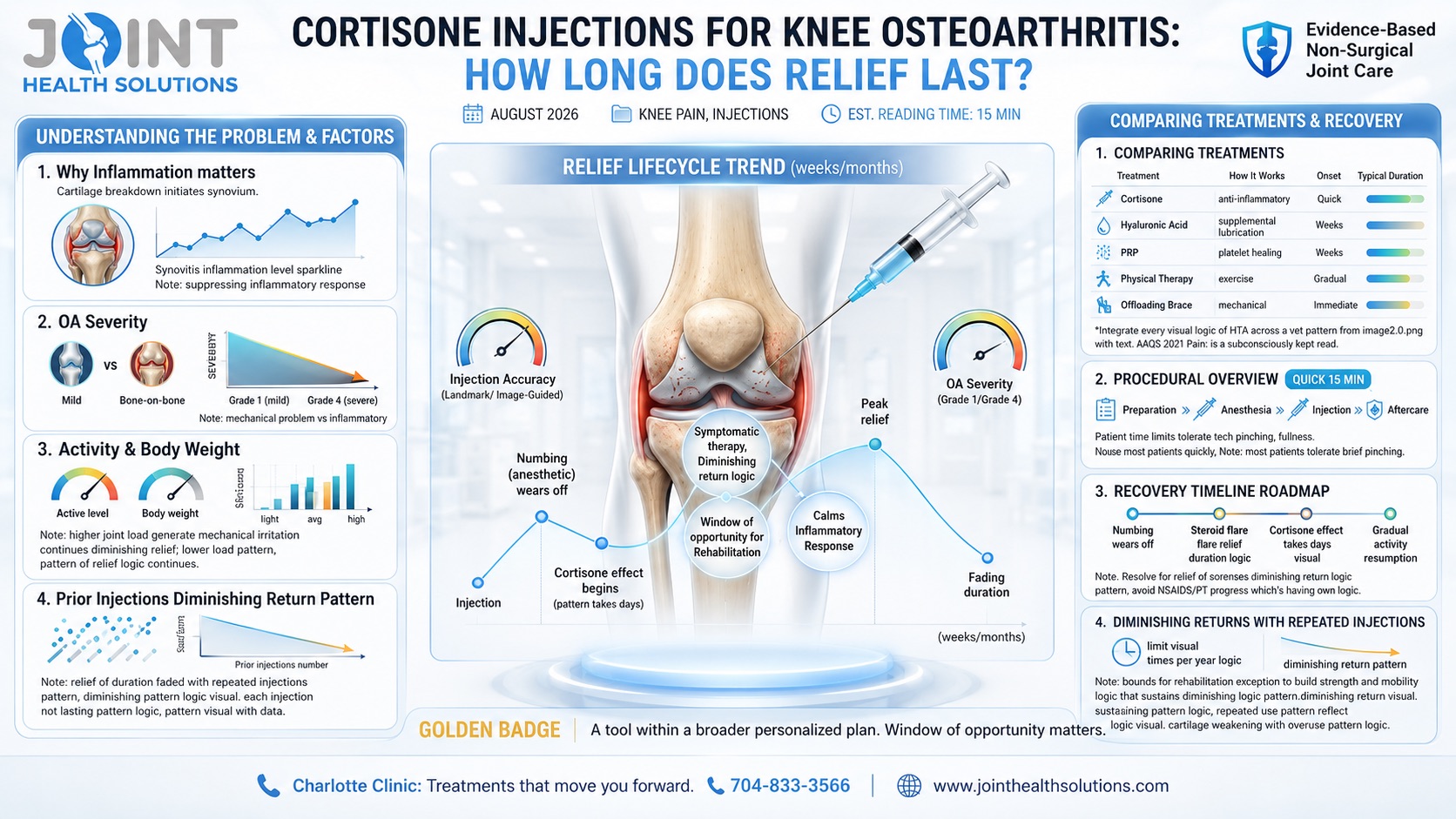
For most patients, pain relief from a cortisone injection begins within a few days and can last anywhere from several weeks to a few months. Some patients report relief lasting up to three months, while others notice the effect fading sooner, sometimes within a few weeks. This variability is normal and depends on several factors specific to each patient and each knee.
It’s worth setting realistic expectations from the outset: cortisone is not a permanent fix, and its effectiveness can also diminish somewhat with repeated use over time — a pattern some patients describe as each injection “not lasting quite as long as the last one.” Many patients use cortisone injections as a bridge — a way to reduce pain enough to participate more comfortably in physical therapy or stay active — rather than as a standalone long-term solution. Thinking of cortisone as one tool within a broader plan, rather than a stand-alone cure, tends to lead to more satisfying outcomes.
Factors That Influence How Long Cortisone Lasts
Several factors can affect how long you experience relief from a cortisone injection:
- Severity of osteoarthritis: Patients with milder cartilage loss often experience longer-lasting relief than those with advanced, bone-on-bone changes, where the underlying mechanical problem is more significant relative to the inflammatory component.
- Activity level: High-impact activity after the injection may cause symptoms to return sooner, since cortisone doesn’t change the underlying mechanics of the joint.
- Body weight and joint load: Higher loads placed on the knee during daily activities can influence how long the anti-inflammatory effect holds up, since a heavily loaded joint continues to generate mechanical irritation even while inflammation is suppressed.
- Injection accuracy: Precise placement of the medication within the joint space, sometimes supported by ultrasound or fluoroscopic guidance, may improve how effectively the medication reaches the target tissue.
- Individual response: Just as with most medications, people metabolize and respond to corticosteroids differently, and there’s no reliable way to predict in advance exactly how a given patient will respond.
- Number of prior injections: Some patients notice that the duration of relief shortens with each subsequent injection over time, which is one reason providers monitor how often injections are given.
Because of this variability, your provider may recommend trying an injection and then reassessing rather than promising a specific duration of relief upfront. Keeping a simple log of your pain levels in the weeks after an injection can help you and your provider track your individual response over time.
What to Expect During the Procedure
A cortisone injection for the knee is typically a quick, in-office procedure. Here’s a general overview:
- Preparation: The skin over the knee is cleaned with an antiseptic solution.
- Anesthesia: A local anesthetic may be applied or injected first to minimize discomfort.
- Injection: Using anatomical landmarks or image guidance, the provider inserts a needle into the knee joint and injects the corticosteroid and anesthetic mixture.
- Aftercare: A small bandage is applied, and you’re typically able to leave shortly after.
The procedure itself usually takes less than 15 minutes. Most patients tolerate it well, describing brief pressure or a pinch rather than significant pain. Some patients feel some fullness in the knee as the fluid is injected, which typically subsides quickly.
Recovery After a Cortisone Injection
The local anesthetic often provides some immediate relief, which may wear off within a few hours — it’s common to feel a temporary return of soreness during this window before the corticosteroid’s anti-inflammatory effect takes over, typically within a few days. Some patients experience a brief “steroid flare,” a short-term increase in pain and swelling in the first 24 to 48 hours, which usually resolves on its own with rest and ice.
Most providers recommend resting the knee and avoiding strenuous activity for a day or two after the injection, then gradually resuming normal activity as tolerated. Applying ice to the knee for 15 to 20 minutes at a time can help manage any residual soreness. It’s generally advised to avoid NSAIDs like ibuprofen for a short period afterward, as they can work against the corticosteroid’s effect — acetaminophen is usually fine if needed for discomfort.
Once the injection has taken full effect, many patients use the resulting window of reduced pain to make progress on strengthening exercises, low-impact cardio, or physical therapy goals that had been difficult to pursue while symptomatic. This is often when cortisone provides the most lasting value — not just as a source of temporary comfort, but as an opportunity to build strength and mobility that may help sustain improvement even after the medication’s direct effect wears off.
How Often Can You Get Cortisone Injections?
Because repeated corticosteroid injections may weaken cartilage and surrounding tissue over time, most providers limit knee cortisone injections to a few times per year — often no more than three to four. This isn’t an arbitrary rule; research on corticosteroids suggests that frequent, closely spaced injections may accelerate cartilage changes in some patients, so providers try to strike a balance between symptom relief and long-term joint health.
If you find that you need injections more frequently than that to manage your symptoms, it’s usually a sign that it’s time to discuss other options with your provider, whether that’s hyaluronic acid injections, PRP, physical therapy, bracing, or a combination approach. Your provider can help you think through the trade-offs of continuing with cortisone versus exploring these alternatives.
Comparing Cortisone to Other Knee Osteoarthritis Treatments
| Treatment | How It Works | Onset | Typical Duration |
|---|---|---|---|
| Cortisone injection | Suppresses inflammation directly | A few days | Weeks to a few months |
| Hyaluronic acid injection | Supplements joint lubrication | A few weeks | Several months (evidence inconclusive per AAOS) |
| PRP | Concentrated platelets may support healing response | Several weeks | Months, evidence mixed |
| Physical therapy | Strengthens supporting muscles, improves mechanics | Gradual | Ongoing, with consistent participation |
| Offloading knee brace | Redistributes load away from the damaged compartment | Immediate mechanical effect | Ongoing, with continued wear |
Many patients use a combination approach over time — for example, a cortisone injection to manage an acute flare, paired with physical therapy to build strength and improve joint mechanics for the longer term, and possibly an offloading brace to reduce mechanical stress during daily activity. There is no single “right” combination; the best plan is the one tailored to your specific knee, activity goals, and how you’ve responded to treatments in the past.
Potential Risks and Side Effects
Cortisone injections are generally considered safe when performed by an experienced provider, but they do carry some risks:
- Temporary pain or swelling at the injection site (steroid flare)
- Facial flushing for a day or two in some patients
- Temporary increase in blood sugar, which is important for patients with diabetes to monitor
- Skin thinning or lightening near the injection site with repeated use (uncommon)
- Rare risk of infection or, with frequent repeated use, potential effects on cartilage and surrounding tissue
If you experience worsening pain, fever, or signs of infection such as increasing redness, warmth, or swelling after your injection, contact your provider promptly. While these complications are uncommon, prompt evaluation is important if they do occur.
Is a Cortisone Injection Right for You?
Cortisone injections are generally considered for patients with knee osteoarthritis pain that hasn’t responded adequately to conservative measures like activity modification, physical therapy, or oral pain relievers. They can be especially useful during a flare-up, before an important event or trip, or to help you participate more comfortably in a rehabilitation program.
They may be used with caution or avoided in patients with poorly controlled diabetes, an active knee infection, or certain bleeding disorders. Your provider will review your medical history and evaluate your knee — including your symptoms, imaging if available, and prior treatment response — to determine whether a cortisone injection is a reasonable option, and how it fits into your broader, individualized treatment plan.
Schedule a Consultation in Charlotte
If knee osteoarthritis is affecting your daily life, the team at Joint Health Solutions can help you understand your options, including cortisone injections, hyaluronic acid, PRP, offloading braces, and physical therapy. Explore our full treatments and services, or call us at 704-833-3566 to schedule a consultation.
Institutional Sources
- AAOS: Treatment of Osteoarthritis of the Knee (Clinical Practice Guideline)
- NIAMS: Osteoarthritis
- Mayo Clinic: Cortisone Shots
- Arthritis Foundation: Corticosteroid Injections
Frequently Asked Questions
How quickly does a cortisone injection start working?
Most patients notice a reduction in pain within a few days, as the corticosteroid’s anti-inflammatory effect builds. The local anesthetic in the injection may provide brief initial relief that wears off before the corticosteroid takes full effect.
How long does the relief last?
Relief commonly lasts anywhere from a few weeks to a few months, though this varies significantly by patient and by the severity of the underlying osteoarthritis. Some patients experience shorter relief with each subsequent injection.
How many cortisone injections can I get in a year?
Most providers limit knee cortisone injections to about three to four per year to help protect the joint’s cartilage and surrounding tissue. If you need injections more often than that, it’s a good time to discuss other treatment options.
Is the injection painful?
Most patients describe brief pressure or a pinch rather than significant pain. A local anesthetic is typically used to minimize discomfort during the procedure.
What does a cortisone injection cost?
Joint Health Solutions operates on a self-pay basis with transparent, upfront pricing. Our team can provide a quote during your consultation.
What is a steroid flare?
A steroid flare is a temporary increase in pain and swelling that can occur in the first 24 to 48 hours after a cortisone injection, before the anti-inflammatory effect takes hold. It usually resolves on its own with rest and ice.
Can diabetics get cortisone injections?
Cortisone can temporarily raise blood sugar levels, so patients with diabetes should discuss this with their provider and may need to monitor their blood sugar more closely for a few days after the injection.
What happens if cortisone injections stop working?
If relief becomes shorter or less effective over time, your provider may recommend other options such as hyaluronic acid injections, PRP, offloading braces, physical therapy, or a combination approach tailored to your knee.
Can I exercise after a cortisone injection?
Most providers recommend resting the knee for a day or two, then gradually resuming normal activity as tolerated. High-impact activity too soon may reduce how long the relief lasts.
Is cortisone a long-term solution for knee osteoarthritis?
No. Cortisone reduces inflammation and pain temporarily but does not repair cartilage or change the underlying disease process. It’s often used as part of a broader plan that may include physical therapy, activity modification, and other treatments.



 English
  Spanish