

If you are living with chronic knee osteoarthritis (OA), you already know how exhausting the daily grind of joint pain can be. Simple actions you used to take for granted—like stepping out of bed in the morning, walking through a grocery store, or climbing a flight of stairs—become monumental tasks.
When conservative management strategies such as physical therapy, weight management, and over-the-counter anti-inflammatory medications stop providing sufficient relief, it is easy to feel like you are running out of options. Many patients worry that their only remaining path is major orthopedic surgery. However, effective joint care is never about jumping straight from basic pills to a total knee replacement. It is about identifying the specific physiological breakdown within your joint and applying a targeted, minimally invasive intervention to restore function.
At Joint Health Solutions, we specialize in non-surgical orthopedic care designed to bridge the gap between conservative therapies and invasive surgeries. One of the most effective tools in our comprehensive treatment menu is hyaluronic acid (HA) injections, clinically referred to as viscosupplementation. Rather than simply masking your discomfort or introducing heavy systemic medications, HA injections take a physiologic approach: they restore the natural lubricating properties of your joint fluid, helping your body move the way it was designed to.
This comprehensive, patient-centered guide will break down the science behind hyaluronic acid, help you understand if you are an ideal candidate, outline exactly what to expect during and after the procedure, and explain how we use this therapy to deliver lasting pain relief right here in Charlotte, North Carolina.
To understand why viscosupplementation is so effective, it helps to look at the internal mechanics of a healthy knee joint. Inside your joints, there is a clear, thick substance known as synovial fluid. This fluid serves two foundational purposes: it acts as a premium lubricant to minimize friction between the moving bones, and it functions as a dynamic shock absorber that protects the joint structures during high-impact movements like walking, running, or jumping.
The primary molecule responsible for the thick, gel-like consistency of healthy synovial fluid is hyaluronic acid, a naturally occurring compound that your body produces in high concentrations within joint spaces. Hyaluronic acid has a remarkable ability to retain moisture and maintain viscosity under structural stress.
| Joint Type | Characteristics |
|---|---|
| Healthy Joint (High HA Concentration) | Smooth Gliding & Shock Absorption |
| Osteoarthritic Joint (Low HA Concentration) | Friction, Inflammation, & Pain |
As osteoarthritis develops, this internal environment undergoes a profound degradation:
Loss of Concentration: The overall volume and concentration of naturally occurring hyaluronic acid within the synovial fluid drop significantly.
Molecular Weight Reduction: The remaining HA molecules break down into a lower molecular weight, meaning the fluid loses its thickness and becomes watery.
Mechanical Failure: Without adequate viscosity, the protective cushion is lost. The bones of the knee begin to grate against one another with increased friction, driving chronic structural inflammation, progressive cartilage wear, and debilitating pain.
When you undergo viscosupplementation at Joint Health Solutions, we physically replenish this depleted essential fluid. By injecting a highly purified, medical-grade hyaluronic acid gel directly into the synovial space, we restore the biological mechanics of the knee.
The Structural Advantage: This is not a chemical block of your nerve signals, nor is it a steroid designed to artificially suppress your immune response. Viscosupplementation is a mechanical and physiological restoration. It lowers friction, coats the internal cartilage surfaces, and allows the bones to glide smoothly across one another once again.
Hyaluronic acid knee injections are highly effective, but like any specialized medical treatment, they are not a one-size-fits-all cure. The success of viscosupplementation relies heavily on identifying the patient’s specific stage of joint degradation. We utilize a detailed structural and symptomatic evaluation to determine eligibility.
You are likely an excellent candidate for hyaluronic acid therapy if you meet the following clinical criteria:
Mild to Moderate Knee Osteoarthritis: Your joint changes fall within Kellgren-Lawrence grades 1 to 3. This means that while there is clear radiographic evidence of cartilage thinning, joint space narrowing, or early bone spur formation, a functional joint space still exists. There must be an intact structural framework for the HA gel to cushion.
Inadequate Response to Conservative Care: You have diligently tried first-line treatments—such as physical therapy, targeted weight loss, and oral anti-inflammatories—but your knee pain continues to limit your daily activities and quality of life.
A Desire to Delay or Avoid Surgery: You want to postpone or completely bypass invasive procedures like a total knee arthroplasty (knee replacement), allowing you to maintain your natural joint structure for as long as possible.
Ineligibility for Corticosteroid Injections: Certain health conditions make standard steroid shots risky. For example, patients with diabetes often experience dangerous spikes in blood sugar following cortisone use. Because HA is a naturally occurring structural molecule and not a hormone, it offers a safe alternative for individuals with uncontrolled blood sugar or those who wish to avoid the cartilage-thinning risks associated with repeated steroid use.
Conversely, there are specific scenarios where hyaluronic acid injections may not yield the desired therapeutic results:
Severe, End-Stage Osteoarthritis (Grade 4): When a joint has reached “bone-on-bone” status, the structural cartilage is entirely gone, and the joint space has collapsed. Without a physical space to contain the gel, the injected HA cannot form an effective shock-absorbing layer, and the mechanical benefits are minimal.
Active Inflammatory Arthritis: If your joint pain is primarily driven by systemic autoimmune conditions like rheumatoid arthritis, or crystalline arthropathies like acute gout, standard viscosupplementation is not the primary line of defense. These conditions require systemic immunomodulatory therapies to address the underlying root causes.
Active Infecciones or Severe Allergies: Injections cannot be performed if there is an active skin or joint infection in or around the knee. Additionally, because certain older formulations of hyaluronic acid are synthesized from avian sources (like rooster combs), patients with documented, severe allergies to feathers, eggs, or poultry must be carefully screened so that an alternative, synthetically derived bio-fermented HA product can be utilized instead.
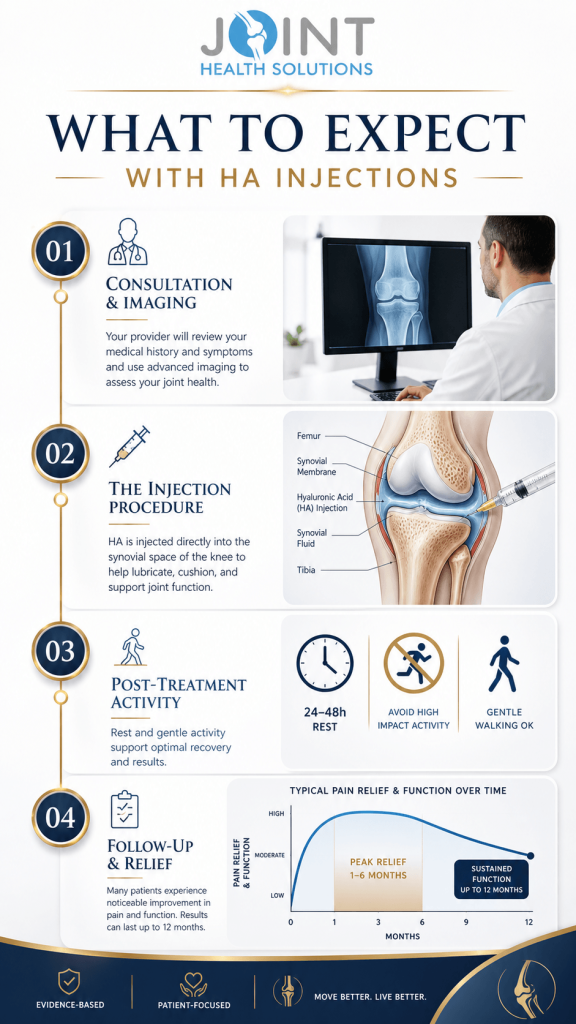
A major benefit of viscosupplementation at Joint Health Solutions is that the entire procedure is performed comfortably right in our Charlotte clinic. It requires no downtime, no general anesthesia, and allows you to walk out and drive yourself home immediately following your appointment.
We begin by positioning you comfortably with the knee appropriately flexed or extended. The skin over and around the injection site is thoroughly cleansed using a medical-grade sterile antiseptic solution to ensure absolute safety. To minimize physical discomfort, a small amount of local anesthetic is applied to numb the skin and the underlying tracking tissue. Most patients report feeling nothing more than a minor pinch or a localized pressure sensation during the treatment.
At Joint Health Solutions, we do not believe in blind injections. To maximize the effectiveness of your treatment, our clinicians routinely utilize advanced ultrasound or fluoroscopy guidance. This real-time imaging technology allows us to visualize the internal anatomy of your knee as the treatment occurs. By tracking the needle precisely, we ensure that the hyaluronic acid gel is delivered directly into the synovial joint capsule where it belongs, avoiding surrounding fat pads, ligaments, or blood vessels. Studies show that image-guided joint injections drastically increase accuracy and significantly improve clinical outcomes compared to standard “blind” or anatomical landmark palpation techniques.
Depending on your unique anatomical needs, your insurance coverage, and your lifestyle preferences, your provider will select one of two primary injection protocols:
Single-Injection Protocols: Advanced cross-linked formulations (such as Gel-One or Durolane) are designed to deliver a complete therapeutic dose in a single, convenient office visit. This is ideal for busy individuals or patients traveling from outer areas of North Carolina.
Multi-Injection Series: Traditional multi-dose formulations (such as Synvisc or Euflexxa) involve a series of 3 to 5 weekly injections performed exactly seven days apart. Each subsequent dose progressively builds up the thickness and cushioning power of your synovial fluid.
Once the injection is complete, a small sterile bandage is applied to the site. You are free to stand up and walk normally. However, to allow the hyaluronic acid gel to distribute evenly across the joint cartilage and prevent localized irritation, we recommend adherence to the following recovery rules:
First 24 to 48 Hours: Rest your joint from any strenuous, weight-bearing activities. Avoid high-impact exercises, prolonged standing, heavy lifting, running, or strenuous fitness classes.
Managing Soreness: It is entirely normal to feel a mild sense of fullness or localized aching within the joint for the first couple of days. Applying a cold compress or ice pack wrapped in a cloth for 15 to 20 minutes every few hours will quickly soothe any localized discomfort.
When implemented as part of a structured orthopedic plan, viscosupplementation provides significant clinical benefits that extend far beyond simple symptom management.
The primary goal of hyaluronic acid injections is sustained pain reduction. Most patients begin to notice a gradual decrease in grinding, stiffness, and aching within a few weeks of completing their treatment protocol. This relief typically peaks around week 4 to 6 and consistently lasts between 6 to 12 months. Because HA is safe and biocompatible, the treatment can be repeated every six months as a long-term maintenance strategy for managing chronic osteoarthritis.
By restoring proper joint lubrication, viscosupplementation drastically improves everyday mobility. Patients report an enhanced range of motion, allowing them to walk longer distances, navigate staircases with confidence, and participate in low-impact recreational activities like cycling, swimming, or golf without the limiting fear of sudden knee pain.
One of the most profound benefits of hyaluronic acid therapy is its ability to buy you valuable time. By maintaining joint mechanics and reducing chronic friction, many patients successfully postpone total knee replacement surgery for years. Delaying surgery allows you to maintain your natural bone structure, avoid the extensive recovery timelines associated with joint replacement, and keep your surgical options open for later in life if degeneration eventually progresses.
Unlike oral NSAIDs (like ibuprofen or meloxicam), which can cause gastrointestinal ulcers, kidney strain, and elevated cardiovascular risks with long-term use, hyaluronic acid remains localized inside the knee joint capsule. It carries no risk of tendon weakening or localized tissue breakdown—a known side effect of repeated cortisone injections—making it an exceptionally safe choice for long-term joint preservation.
While viscosupplementation boasts an outstanding safety profile, no medical procedure is entirely without risk. We believe in absolute transparency, ensuring our patients understand all potential outcomes before proceeding with care.
In a small percentage of cases (approximately 1% to 5%), patients may experience mild, transient side effects at the localized injection site. These symptoms are typically mild and self-limiting, resolving completely within a few days without medical intervention:
Localized Swelling and Warmth: A temporary feeling of tightness, mild redness, or physical warmth inside the joint as the thick gel integrates with your natural synovial fluid.
Injection Site Aching: Minor tenderness around the precise pathway where the needle entered the joint space.
A “Flare” Reaction: On rare occasions, the knee may experience a temporary inflammatory spike shortly after the injection, resulting in a brief increase in pain and visible swelling. This is not an infection or a sign of joint damage; it is a localized reactivity to the sudden shift in joint volume and pressure. It is easily managed with rest, elevation, and consistent icing.
Extremely rare complications include localized joint infection or a severe systemic allergic reaction. At Joint Health Solutions, we mitigate these risks by maintaining a strictly sterile clinical environment, utilizing premium FDA-approved product formulations, and employing highly trained medical personnel who specialize exclusively in advanced image-guided joint care.
In modern orthopedic medicine, the most successful outcomes are achieved when we look at the joint through a multi-dimensional lens. While hyaluronic acid is an exceptional standalone treatment for lubricating a dry, arthritic knee joint, its benefits can be significantly amplified when systematically combined with other complementary modalities.
| Complementary Therapy | Primary Mechanism of Action | Synergy with Hyaluronic Acid (HA) |
|---|---|---|
| Offloading Knee Bracing | Mechanically shifts structural weight away from the damaged, arthritic compartment of the knee. | Reduces physical pressure on the newly injected HA gel, allowing it to coat the joint surfaces evenly and last longer. |
| Platelet-Rich Plasma (PRP) | Concentrates natural growth factors from your blood to modulate inflammation and support cellular repair. | The ultimate complement: HA provides immediate lubrication, while PRP works over time to stabilize the cellular environment. |
| Anti-Inflammatory IV Therapy | Delivers powerful antioxidants and micronutrients directly into the bloodstream. | Lowers systemic inflammatory markers, preventing your body from rapidly breaking down the newly injected HA gel. |
By combining these advanced modalities into a customized, cohesive treatment plan, we can attack your knee osteoarthritis from multiple physiological angles at once, maximizing your overall pain relief and significantly extending the functional lifespan of your natural joint.
Chronic knee pain should not dictate the boundaries of your life, nor should it force you prematurely onto an operating table. When the natural shock absorbers of your knees break down due to osteoarthritis, replacing that lost fluid from the inside out is the most logical, low-risk, and physiologically sound intervention available.
Through precision-guided viscosupplementation, the clinical team at Joint Health Solutions can help you restore the youthful mechanics of your joints, damp down chronic internal friction, and secure up to a year of profound pain relief. Don’t wait for your joint space to collapse entirely before taking action.
Contact Joint Health Solutions today to schedule your comprehensive evaluation, and let us help you find your stride again.
Most patients begin to experience a noticeable reduction in joint friction and stiffness within 2 to 4 weeks following their injection protocol. The full therapeutic benefits usually peak around 4 to 6 weeks. Once fully established, the pain relief and functional improvements consistently last between 6 to 12 months. The exact duration depends on the baseline severity of your osteoarthritis and your daily physical activity levels.
Yes, the vast majority of major commercial insurance plans, as well as Medicare, provide comprehensive coverage for viscosupplementation when it is medically indicated for the treatment of symptomatic knee osteoarthritis. Because insurance guidelines vary regarding specific brand preferences and prior authorization requirements, our dedicated medical billing team at Joint Health Solutions pre-verifies your exact insurance benefits before your procedure to ensure complete transparency.
The choice between a single-dose injection (like Gel-One or Durolane) and a multi-dose weekly series (like Synvisc or Euflexxa) depends on your unique knee anatomy, your personal schedule, and your insurance provider’s specific formulary requirements. During your initial consultation, we will review your imaging and lifestyle needs to recommend the clinical protocol best suited for your body.
We take every precaution to ensure your treatment is as comfortable as possible. By utilizing a highly effective local anesthetic to numb the skin and underlying tissue, the actual insertion of the injection needle causes minimal discomfort. Furthermore, by utilizing real-time ultrasound or fluoroscopic image guidance, our experienced providers can navigate the joint space smoothly on the first attempt, avoiding sensitive tissues and preventing unnecessary procedural pain.
Absolutely. If you suffer from bilateral knee osteoarthritis, we can safely and effectively administer viscosupplementation to both joint spaces during the very same clinic session. Alternatively, if you prefer to see how your body responds to the therapy one step at a time, we can schedule your injections across separate weekly appointments.
We strictly advise patients to avoid any strenuous or high-impact weight-bearing activities for the first 24 to 48 hours following their treatment. This includes running, jumping, heavy lifting, tennis, or standing for hours on hard surfaces. Engaging in low-impact everyday movements, light walking, and gentle range-of-motion stretching is perfectly safe and actually encouraged to help distribute the gel evenly throughout your joint.
f you have recently received a corticosteroid (cortisone) injection in the target knee, you should wait a minimum of 4 to 6 weeks before undergoing viscosupplementation. Cortisone is a powerful anti-inflammatory that alters the local joint environment; allowing this waiting period ensures that your joint has stabilized and can maximize the mechanical benefits of the hyaluronic acid gel.
Yes. Hyaluronic acid injections should not be performed if you have an active skin infection or open wound near the injection site, or a known infection inside the joint capsule. It is also contraindicated for individuals with severe, end-stage “bone-on-bone” osteoarthritis (Grade 4), as the physical joint space has collapsed. Additionally, if you have a documented life-threatening allergy to avian products, eggs, or feathers, you must notify our team so we can utilize a synthetically manufactured, non-avian HA alternative.
A simple way to look at the difference is: Hyaluronic acid lubricates, while Platelet-Rich Plasma heals. HA acts as an immediate biological replacement fluid, providing immediate mechanical shock absorption and lubrication to worn-out surfaces. PRP uses concentrated growth factors from your own blood to calm chronic inflammation and stimulate long-term cellular health. Because they target joint degradation through entirely different pathways, they work beautifully when combined.
Taking the first step toward lasting knee pain relief is incredibly simple. All you need to do is call our Charlotte office directly or request an appointment online through the Joint Health Solutions website. We will schedule a comprehensive diagnostic consultation where we will perform a physical exam, review your imaging, and build a customized, non-surgical treatment plan tailored to your health goals.
American Academy of Orthopaedic Surgeons (AAOS): Viscosupplementation Treatment for Knee Arthritis. AAOS Patient Education Portal
Cleveland Clinic: Hyaluronic Acid Injections for Arthritis / Viscosupplementation Protocols. Cleveland Clinic Health Library
Mayo Clinic: Viscosupplementation for Knee Osteoarthritis: What to Expect and Clinical Outcomes. Mayo Clinic Test & Procedures Guide

A board-certified physician in Emergency Medicine and Obesity Medicine with over 25 years of experience

A board-certified Family Nurse Practitioner with over 12 years of nursing experience