

Prevent Heat-Induced Muscle Cramps | IV Hydration Therapy in Charlotte
Published July 22, 2026 | Category: Nutrition & Wellness | Location: Charlotte, North Carolina | 🕒 12 min read
Introduction: Summer Heat and Muscle Spasms in Charlotte
Summer in North Carolina is intense. With temperatures frequently above 90°F and humidity that makes the afternoon air feel thick and heavy, residents of Charlotte understand the daily challenge of staying comfortable outdoors. Beyond baseline heat discomfort lies a more disruptive problem: heat-induced muscle spasms.
These sudden, involuntary contractions can strike during outdoor training, after a long afternoon in the sun, or even wake you from sleep. For many, they are a recurring problem that disrupts an active lifestyle.
Traditional remedies like drinking plain water and stretching often provide only partial relief when the body’s electrolyte and micronutrient stores are substantially depleted. IV hydration therapy is one approach that aims to correct this more directly — by delivering essential fluids and electrolytes into the bloodstream, bypassing the digestive system. This article explains how it works, what the evidence says, and how it fits into a broader approach to summer wellness.
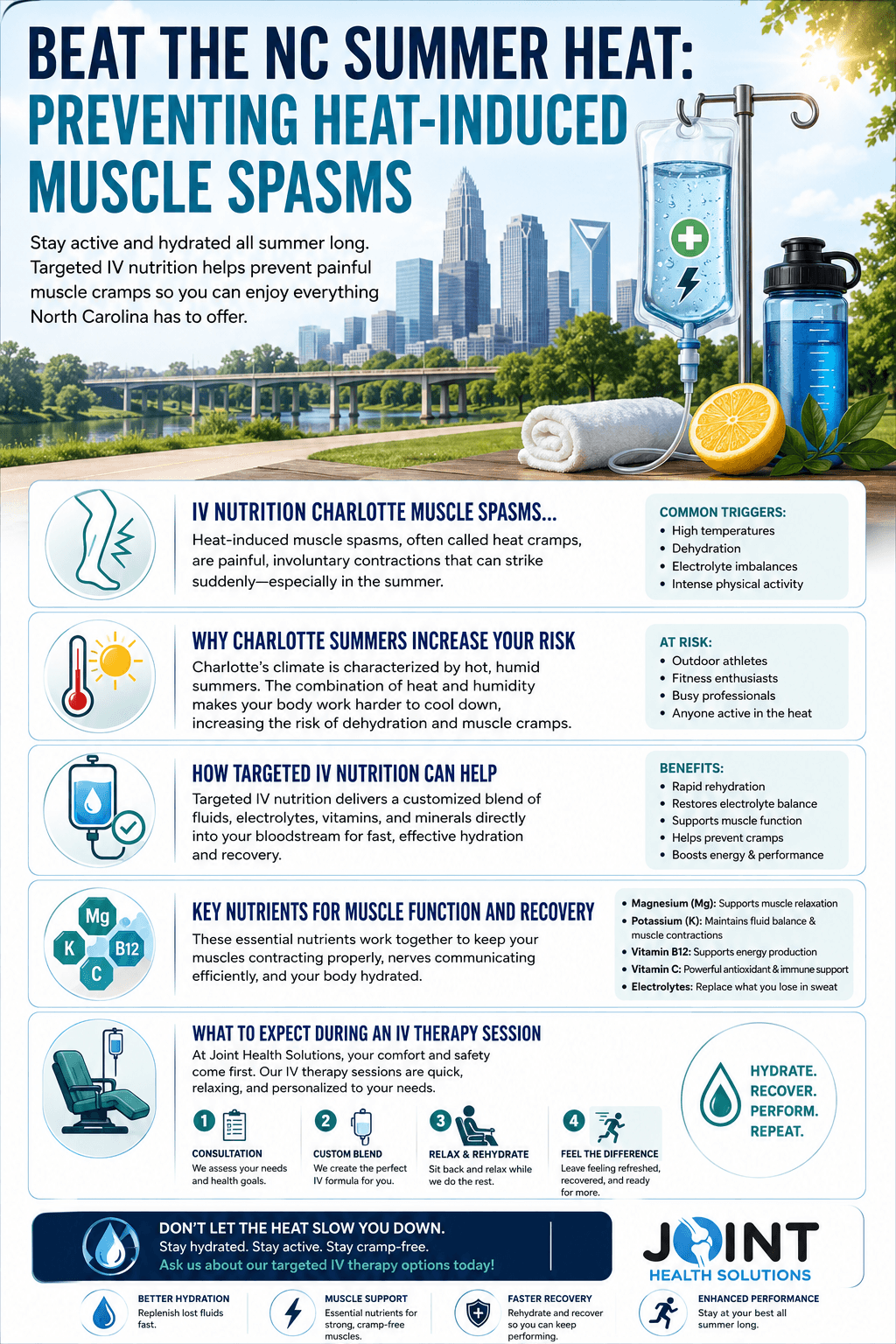
Beat the NC Summer Heat: Preventing Heat-Induced Muscle Spasms with Targeted IV Nutrition — infographic
Understanding Heat-Induced Muscle Spasms
Heat-induced muscle spasms — historically classified as heat cramps — are painful, involuntary skeletal muscle contractions that occur during or immediately following physical exertion in high-temperature environments. They most frequently affect the calves, hamstrings, quadriceps, and abdominal wall.
The primary physiological driver is an acute imbalance of electrolytes: sodium, potassium, calcium, and magnesium are minerals that govern neuromuscular signaling. As you sweat to cool your body, you lose both water and these minerals. If you replace fluid losses with plain water alone, you risk diluting the remaining electrolytes in the bloodstream — a process that disrupts the electrical gradients that allow muscle fibers to contract and relax smoothly, which can trigger cramping.1
Risk is higher for individuals not yet acclimated to high humidity, those managing chronic conditions that affect fluid balance (such as certain kidney conditions or diabetes), or those taking diuretic medications for blood pressure control. Rehydration — whether oral or intravenous — addresses this by replenishing both fluid volume and electrolyte concentrations.
Why Charlotte Summers Increase Your Risk
Charlotte’s summer climate creates conditions for rapid fluid and mineral depletion. Average summer highs hover around 90°F, but the humidity creates a heat index that frequently pushes perceived temperature well past 100°F. High atmospheric humidity impairs sweat evaporation — the body’s primary cooling mechanism — causing core temperature to rise and triggering heavier sweating, which accelerates fluid and mineral loss.
Popular local summer activities — hiking trails in Uwharrie National Forest, walking 18 holes, or attending outdoor festivals — can deplete physical reserves faster than expected. Many people also shift between heavily air-conditioned spaces and intense outdoor heat, which reduces the body’s gradual acclimatization to sustained heat exposure, increasing vulnerability to cramping.
How Targeted IV Hydration Can Help
When you consume oral electrolyte drinks or supplements, they must pass through the stomach and intestines before entering circulation. IV delivery bypasses this step, achieving near-complete bioavailability and allowing therapeutic electrolyte levels to be reached more quickly. This can be an advantage in situations where rapid correction is needed or where oral intake is not possible (e.g., nausea, vomiting, or gastrointestinal intolerance).
It is worth noting, however, that for most healthy adults with mild to moderate heat cramps who are able to drink normally, oral rehydration with electrolytes is well-supported and generally sufficient.2 IV therapy’s primary advantage over oral rehydration is speed of delivery and certainty of absorption — not a categorically superior therapeutic effect.
The components most commonly included in IV hydration formulas for muscle cramps, and their roles:
- Magnesium: Modulates calcium binding within muscle fibers, supporting relaxation after contraction; IV delivery allows for faster serum repletion when deficiency is suspected.
- Calcium: Directly regulates muscle contraction and nerve-to-muscle signaling.
- Potassium and Sodium: Maintain the electrical gradients across cellular membranes that allow normal neuromuscular function.
- B-Complex Vitamins: Support cellular energy production and nerve health; benefit for acute cramps specifically is not well-established.
- Antioxidants (Vitamin C & Glutathione): May reduce oxidative stress associated with heat exposure; evidence for their role in acute cramp relief is largely mechanistic.
Key Nutrients for Muscle Function and Hydration
| Nutrient | Role in the Body | Notes on IV Delivery |
|---|---|---|
| Magnesium | Supports muscle relaxation by modulating calcium at muscle fiber binding sites; reduces nerve excitability | IV delivery may achieve faster serum repletion; high-dose oral magnesium can cause GI discomfort. Evidence for IV magnesium specifically for heat cramps is limited. |
| Calcium | Triggers muscle contraction; governs nerve-to-muscle signaling | Restores balance with magnesium; IV delivery allows precise dosing under medical supervision. |
| Potassium | Maintains the resting electrical potential of neuromuscular cells; deficiency can cause weakness and involuntary contractions | IV potassium requires careful medical supervision due to cardiac risks at high doses; should only be given when clinically indicated. |
| Sodium | Regulates fluid distribution and blood volume; required for initial nerve impulse generation | Delivered via balanced saline base; rapidly restores blood volume and counters dilutional hyponatremia from excess plain water intake. |
| Vitamin B Complex | Supports cellular ATP production and nerve health | May benefit patients with documented deficiency; direct evidence for acute cramp relief is limited. |
| Vitamin C | Antioxidant; may modulate inflammatory cytokine production | High-dose IV use is off-label; evidence for muscle cramp relief specifically is mechanistic rather than established in clinical trials.3 |
The Limitations of Conventional Treatments
| Treatment | How It Works | Limitations | Key Risks |
|---|---|---|---|
| Oral Pain Relievers (NSAIDs) | Reduces pain and systemic inflammation | Does not restore lost electrolytes or fluids; addresses symptoms rather than cause | GI irritation, kidney strain with long-term use |
| Prescription Muscle Relaxants | Acts centrally to reduce muscle tone | Does not correct dehydration or electrolyte imbalance; not appropriate for mild heat cramps | Drowsiness, dependency risk, cognitive effects |
| Corticosteroid Injections | Reduces localized joint inflammation | Not a treatment for systemic dehydration or electrolyte-driven cramping | Tissue atrophy, tendon weakness with repeated use |
| Oral Electrolyte Rehydration | Replaces fluid and electrolytes via the digestive system | Slower to raise serum levels than IV; absorption may be reduced with nausea or GI distress | Generally safe; excess potassium can be harmful in renal disease |
| IV Hydration Therapy | Delivers fluids and electrolytes directly into the bloodstream | Requires in-office session; not typically covered by insurance; not necessary for most mild cases | Minimal — occasional bruising at IV site; rare infection |
How Joint Health Solutions Treats Muscle Spasms Without Surgery
At Joint Health Solutions, we offer a range of non-surgical services designed to support recovery from heat-related muscle spasms and address any underlying musculoskeletal contributors:
Anti-Inflammatory IV Therapy: A formulation including antioxidants and micronutrients designed to reduce systemic inflammatory burden and support muscle recovery. Best suited for patients with documented micronutrient insufficiency or those whose oral intake is compromised. Learn more about IV therapy.
Sports Recovery IV Therapy: A formula targeting electrolyte replenishment and tissue recovery for athletes in active training. Includes core electrolytes and, in some formulations, amino acids. Explore sports recovery IV therapy.
Joint Injections: When chronic joint breakdown is altering movement mechanics — causing surrounding muscles to overcompensate and cramp — precise localized injections can help address the underlying joint issue. Learn more about joint injections.
Physical Therapy: Our physical therapy team works with you to strengthen stabilizing muscle groups, improve flexibility, and build conditioning plans that reduce overexertion risk. Explore physical therapy options.
Nutrition Planning: Sustainable hydration and electrolyte balance begin with daily habits. Our nutrition counseling helps you build eating and drinking patterns that support muscle health throughout the season. Learn more.
The Science of IV Rehydration
IV fluid delivery allows fluids and electrolytes to enter systemic circulation directly, without the absorption variability of the digestive system. This is particularly relevant in cases of severe dehydration, when GI function may be compromised, or when very rapid fluid restoration is a clinical priority.
Research on exercise-associated muscle cramps (EAMC) suggests the primary cause is altered neuromuscular control — not purely electrolyte depletion in all cases, though electrolyte loss is a recognized contributing factor, particularly in heat and prolonged exertion.1 Magnesium plays a documented role in muscle relaxation and neuromuscular excitability; deficiency is associated with increased cramping risk, and IV magnesium is a standard clinical treatment for specific conditions (notably eclampsia).4
For most otherwise healthy adults with mild to moderate heat cramps, the clinical literature supports oral rehydration with electrolyte-containing beverages as the first-line approach.5 IV rehydration provides a clinically appropriate option when oral intake is not feasible, when cramps are severe and persistent, or when the patient requires rapid recovery for competitive or occupational reasons. Patients should discuss with a provider whether IV therapy is the most appropriate choice for their specific situation.
Evidence and Clinical Research
| Component | FDA Status | Evidence Level | Key Findings |
|---|---|---|---|
| IV Rehydration for Fluid Restoration | Not a medical device; IV fluids are FDA-approved for clinical use | Established clinical evidence (acute care settings); limited evidence specifically for exercise-induced heat cramps | IV rehydration restores plasma volume faster than oral in severe dehydration; for mild-moderate cases in patients who can drink, oral rehydration is generally equivalent2 |
| Electrolyte Replacement for Muscle Cramps | Not applicable (dietary/clinical practice) | Established clinical evidence | Electrolyte depletion through sweating is a recognized contributor to heat cramps; replacement is the standard treatment approach1 |
| IV Magnesium for Muscle Spasm | FDA-approved for specific indications (hypomagnesemia, eclampsia); off-label for heat cramps | Limited human evidence for heat cramps specifically | Magnesium deficiency is linked to increased neuromuscular excitability; IV magnesium is established for eclampsia; direct RCT evidence for exercise heat cramps is limited4 |
| High-Dose Vitamin C (IV) | FDA-approved as a nutrient; high-dose IV use is off-label | Mechanistic / limited human evidence | May reduce oxidative stress; no proven benefit for heat cramps specifically in high-quality trials3 |
| Glutathione (IV) | Not FDA-approved as a drug; available as a supplement | Mechanistic / limited human evidence | Antioxidant properties established; no proven benefit for heat cramps or muscle spasms in high-quality trials |
- FDA-approved: The product has received FDA approval for a specific indication.
- Established clinical evidence: Supported by multiple peer-reviewed human studies.
- Limited human evidence: Some human studies exist but are small or inconsistent.
- Mechanistic/animal studies: Findings from laboratory or animal research; do not prove patient benefit.
- Investigational: Not yet approved; being studied in clinical trials.
Important Note: IV hydration therapy for heat-induced muscle spasms is a personalized clinical approach, not a separately FDA-approved protocol. Large-scale RCTs comparing combined IV micronutrient therapy to oral rehydration specifically for heat cramps are lacking. For most mild cases, oral rehydration with electrolytes is the first-line recommendation. Individual results vary, and not every patient is a candidate for IV therapy.
What to Expect During an IV Therapy Session
Consultation: Your appointment begins with a medical consultation to review your symptoms, activity level, and health history. This allows your provider to select an appropriate nutrient blend and confirm IV therapy is suitable for you.
IV Placement: You relax in a comfortable treatment chair while a clinical nurse places a thin IV catheter into a vein in your arm. This takes approximately 5–10 minutes.
Active Infusion (30–60 minutes): The fluids and nutrients infuse slowly. Most patients can read, respond to messages, or rest during the session. Some notice a mild cooling sensation as the fluids enter.
After the session: There is no required downtime. Most patients can return to normal activities immediately, though we recommend avoiding intense exercise for several hours after treatment. Continue oral hydration throughout the day.
When to Consider IV Rehydration for Cramps
IV rehydration is not the first step for most mild heat cramps — oral rehydration with electrolytes is typically sufficient. Consider discussing IV therapy with a provider if you:
- Experience severe, persistent cramping that does not resolve with oral electrolyte replacement
- Have nausea or vomiting that prevents adequate oral intake
- Manage a chronic condition (such as certain kidney or metabolic conditions) that makes maintaining fluid balance inherently difficult
- Take medications that increase fluid loss (such as diuretics for blood pressure)
- Are a competitive athlete or have occupational demands requiring rapid recovery before the next performance
- Find that standard electrolyte drinks consistently fail to prevent your cramping episodes, despite adequate volume
Why Joint Health Solutions
Joint Health Solutions serves the Charlotte community with non-surgical orthopedic and wellness care. Our clinical team includes board-certified providers who understand the physical demands of active adults in North Carolina’s climate. We combine evidence-informed therapies with individualized treatment planning to address both immediate symptoms and the underlying patterns that contribute to them. Learn more about Joint Health Solutions.
Book Your Evaluation
Don’t let heat cramps sideline your summer. Contact our Charlotte clinic at 704-833-3566 or use our Online Consultation Scheduler to find the right recovery plan for you.
Sources
- Schwellnus MP. Cause of exercise associated muscle cramps (EAMC) — altered neuromuscular control, dehydration or electrolyte depletion? Br J Sports Med. 2009;43(6):401–408. PMID 19528063
- Maughan RJ, et al. IOC Consensus Statement: Dietary Supplements and the High-Performance Athlete. Br J Sports Med. 2018;52(7):439–455. PMID 29540394
- Carr AC, Maggini S. Vitamin C and Immune Function. Nutrients. 2017;9(11):1211. PMID 29099763
- Volpe SL. Magnesium in disease prevention and overall health. Adv Nutr. 2013;4(3):378S–383S. PMID 23674807
- Sawka MN, et al. American College of Sports Medicine Position Stand: Exercise and Fluid Replacement. Med Sci Sports Exerc. 2007;39(2):377–390. PMID 17277604
- American College of Sports Medicine — Hydration and Exercise in Heat. acsm.org
- Mayo Clinic — Muscle Cramps: Causes and Treatments. mayoclinic.org
Frequently Asked Questions
How quickly does IV therapy work for muscle spasms?
Results vary by individual and severity. Some patients notice relief within a few hours of the infusion as fluids and electrolytes restore normal neuromuscular function. Others require 24 hours or more, or benefit most from a series of sessions. IV therapy tends to work faster than oral rehydration in the bloodstream, but “immediate” relief is not guaranteed.
Can IV nutrition prevent heat cramps?
Pre-hydration — whether oral or IV — can help maintain electrolyte stores and reduce cramping risk, particularly for athletes or those with a history of recurring heat cramps. That said, oral rehydration with electrolytes is the recommended first line for prevention in most healthy individuals. IV therapy may offer an advantage for those who cannot adequately hydrate orally or who need rapid pre-activity repletion.
Is IV therapy safe for people with chronic health conditions?
Many chronic conditions require a modified approach. For example, patients with kidney disease need careful management of potassium and sodium; those with heart conditions require attention to fluid volume. At Joint Health Solutions, we conduct a medical evaluation before any IV treatment to confirm it is appropriate and safe for you.
How often should I get IV therapy in summer?
Frequency depends on your activity level, risk factors, and response to treatment. Some patients benefit from a session before particularly demanding exertion periods; others find a monthly or weekly schedule works during peak summer months. Your provider will guide the timing based on your individual circumstances.
What electrolytes are included in the IV?
Our IV formulations typically include sodium, potassium, magnesium, and calcium delivered via a balanced saline base. Specific blends are customized to your clinical presentation. Vitamins such as B complex and Vitamin C may also be added depending on your needs.
Can I combine IV therapy with other treatments?
Yes. IV therapy is often combined with physical therapy, joint injections, or nutrition counseling for a more comprehensive approach to muscle health. We will coordinate your care across modalities as appropriate.
Is there any downtime after IV therapy?
No significant downtime is required. We recommend drinking plenty of water after your session and avoiding intense exercise for a few hours, but you can otherwise return to normal activities immediately.
Will my insurance cover IV therapy for muscle spasms?
Coverage varies widely. Elective IV nutrition therapy is often not covered. We recommend contacting your insurance provider and asking about your specific plan. Our team can provide documentation of medical necessity to support a coverage inquiry.
Are there any side effects?
Side effects are generally mild and may include bruising at the IV site or a slight feeling of coolness or metallic taste during infusion. Serious complications are rare when treatment is administered by trained clinical staff following a proper medical evaluation.
How do I know if I need IV therapy rather than oral rehydration?
For most people with mild heat cramps, oral electrolyte drinks are sufficient. Consider IV therapy if your cramps are severe or persistent despite oral rehydration, if nausea prevents you from drinking adequately, or if you have a medical condition that affects how your body manages fluids. A consultation at Joint Health Solutions can help you determine the most appropriate approach for your situation.
Medical Disclaimer: This article is for educational purposes only and is not a substitute for medical advice, diagnosis, or treatment. Results vary, and not every patient is a candidate for every treatment. A qualified healthcare provider should evaluate your condition and discuss risks, benefits, and alternatives before treatment.