
Published July 2026 | Category: Non-Surgical Treatments | Location: Charlotte, North Carolina | 🕒 10 min read
If you are an active adult in Charlotte, you know how frustrating a deep, persistent muscle knot in your back or glutes can be. These tight bands of muscle fibers — clinically known as myofascial trigger points — can turn everyday actions like sitting at a desk, driving, or going for a light walk into a painful chore.
A key driver of these stubborn knots is localized inflammation. When your body’s healing response gets stuck in an elevated state, it creates a local environment that prevents the muscle from relaxing. While options like oral anti-inflammatories or corticosteroid injections can reduce pain temporarily, they don’t always address the underlying biochemical conditions that maintain the knot.
Sports Recovery IV Therapy is one approach that aims to target this cycle more directly. By delivering anti-inflammatory nutrients intravenously, it bypasses the digestive system for more complete absorption — potentially helping to reduce metabolic waste accumulation and support muscle relaxation. This article explains the mechanism, reviews the evidence honestly, and describes how it fits into a broader non-surgical treatment plan.
Sports recovery IV therapy is a non-surgical treatment designed to deliver anti-inflammatory nutrients — including Vitamin C, Magnesium Sulfate, and Glutathione — directly into the bloodstream for rapid absorption. A typical session lasts 45 to 60 minutes. Individual results vary; some patients notice improvement within 1–3 days, while others require multiple sessions before sustained relief. A series of 4 to 6 sessions is often recommended. Candidates include athletes, fitness enthusiasts, and professionals with chronic muscle tension who have not found lasting relief from oral medications or conventional therapies. This approach is not FDA-approved as a specific protocol; each component is used off-label or as a recognized nutrient.

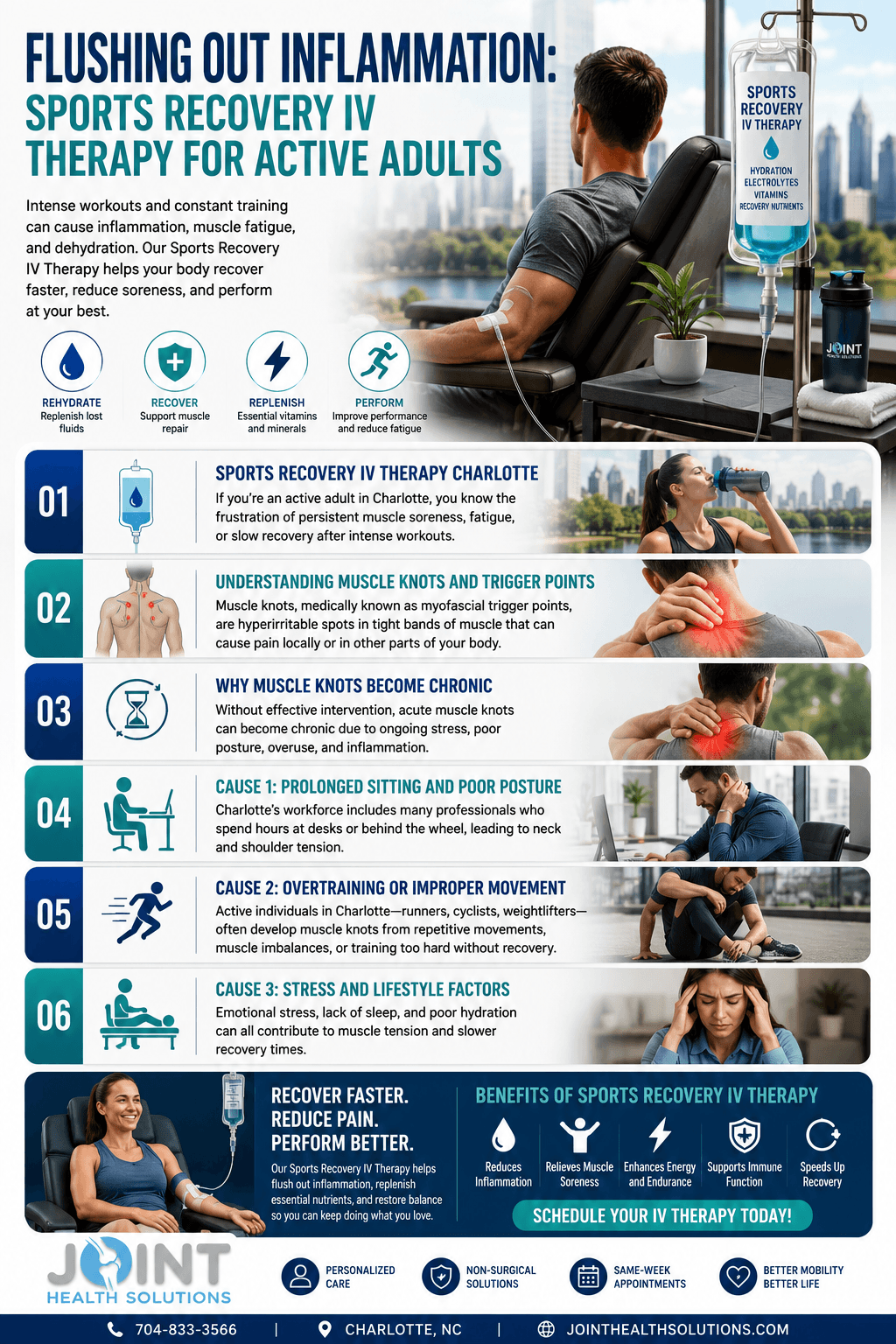
Sports Recovery IV Therapy for Muscle Knots in Charlotte — infographic
A muscle knot forms when muscle fibers contract continuously and fail to relax. This sustained contraction compresses local capillaries and restricts blood flow. Without adequate blood flow, two problems can occur simultaneously:
This buildup may irritate local nerve endings, sending pain signals to the brain. The brain can respond by increasing muscle tone to protect the area, which further restricts blood flow and maintains the knot. In the gluteal and lumbar regions, tight bands may also compress nearby nerves, producing referred pain that can mimic sciatica or disc irritation.1
Without targeted intervention, an acute muscle strain can transition into a longer-term issue. When inflammation becomes chronic, the body continuously releases pro-inflammatory markers such as tumor necrosis factor-alpha (TNF-α) and interleukin-6 (IL-6). Over time, this chemical irritation may alter how local nerves process pain, increasing sensitivity so that ordinary pressure triggers significant discomfort.
Standard approaches like foam rolling or general massage often provide only temporary relief because they address physical tension without directly altering the biochemical environment of the muscle. IV therapy aims to supplement these approaches by delivering antioxidants and micronutrients that may help reduce oxidative stress and support improved local circulation — though the evidence for this specific mechanism in the context of chronic muscle knots remains limited (see evidence table below).
Extended sitting can keep hip flexors in a shortened state, which may reduce the activation of glute muscles. To compensate, lower back and deep gluteal structures like the piriformis can become overloaded — a pattern that commonly generates trigger points over time.
Repetitive training without adequate recovery creates microscopic tears in muscle tissue. When movement mechanics are off — such as running with weak glutes — adjacent muscles like the lower back may compensate, increasing the likelihood of trigger point formation.
A previous injury or repetitive movement pattern can cause an initial inflammatory response that, without adequate resolution, lingers and contributes to chronic muscle tightness and scar tissue formation.
If your back or glute pain has persisted for more than a few weeks without improvement, it is unlikely to resolve on its own. Common warning signs include:
Many patients try standard medical options before exploring non-surgical alternatives. Here is an honest comparison:
| Treatment | How It Works | Limitations | Key Risks |
|---|---|---|---|
| Oral Anti-Inflammatories (NSAIDs) | Reduces inflammation and pain systemically | Only masks symptoms temporarily; does not address trigger points directly | GI ulcers, kidney strain, cardiovascular risks with long-term use |
| Corticosteroid Injections | Delivers localized anti-inflammatory effect | Limited to a few injections per year; may mask underlying structural issues | Tissue breakdown, tendon weakening with repeated use |
| Surgical Decompression | Physically releases tight bands or compressed tissue | Highly invasive; significant recovery time; rarely indicated for trigger points alone | Scar tissue, infection, permanent nerve damage |
| Sports Recovery IV Therapy | Delivers high-dose micronutrients directly into the bloodstream | Requires in-office sessions; results vary; evidence is limited for trigger points specifically | Minimal — occasional light bruising at the IV site |
At Joint Health Solutions, we use a multimodal approach to address both the symptoms and contributing causes of muscle knots.
Our IV formulations deliver concentrations of micronutrients directly into your circulation — levels that are generally not achievable through oral supplementation due to digestive absorption limits. The goal is to reduce oxidative stress, support cellular hydration, and create an environment more conducive to muscle relaxation. Individual responses vary, and multiple sessions are typically needed. Learn more about IV therapy.
For dense, stubborn knots, we use a fine needle to target the core of the spasm. This can elicit a local twitch response (LTR) — a brief involuntary muscle contraction — which is associated with release of the taut band and reduction of pain in the clinical literature.2 Learn more about trigger point injections.
If your muscle knots are a secondary response to an underlying joint problem — such as sacroiliac joint dysfunction, knee osteoarthritis, or shoulder pathology — real-time imaging guidance (fluoroscopy) allows us to deliver targeted joint injections precisely where needed. Learn more about joint injections.
If chronic tightness is associated with a damaged tendon or muscle tear, Platelet-Rich Plasma (PRP) therapy uses growth factors concentrated from your own blood to support tissue healing. Note that PRP is not FDA-approved as a drug; the device used to prepare it has received FDA clearance. Evidence for PRP in musculoskeletal conditions is mixed and varies by indication. Learn more about PRP therapy.
Once inflammation is managed and pain is reduced, physical therapy addresses the underlying muscle imbalances and postural patterns that generated the trigger points in the first place. Offloading braces can help redistribute load away from affected joints when gait asymmetry is a contributing factor. Explore physical therapy options. Learn about offloading knee braces.
The rationale for using IV delivery rather than oral supplements comes down to absorption. When you swallow vitamins or magnesium, the digestive tract breaks them down, and only a fraction of the original dose enters systemic circulation — a phenomenon known as first-pass metabolism. IV delivery bypasses the gut entirely, allowing therapeutic blood levels of certain nutrients that cannot be achieved orally.
The three primary components used in sports recovery IV therapy are:
High-Dose Vitamin C: An antioxidant that may help reduce oxidative stress and modulate pro-inflammatory cytokine production. Most evidence for its role in muscle recovery comes from small or observational studies.3
Magnesium Sulfate: Magnesium plays a well-established role in muscle relaxation by competing with calcium at muscle fiber binding sites, reducing the sustained contraction associated with spasm. IV magnesium is FDA-approved for specific clinical indications (e.g., hypomagnesemia, eclampsia); its use for chronic muscle tension is off-label.4
Glutathione: The body’s primary endogenous antioxidant, involved in cellular detoxification. Evidence for IV glutathione as a treatment for muscle knots specifically is largely mechanistic; no large controlled trials have established its benefit for this indication.5
The evidence for IV micronutrient therapy in chronic musculoskeletal pain is primarily from small trials and mechanistic studies. The combination has not been evaluated in large randomized controlled trials for the specific indication of trigger points. For a full picture of what is and isn’t established, see the evidence table below.
| Component | FDA Status | Evidence Level | Key Findings |
|---|---|---|---|
| Trigger Point Injections | Not FDA-approved for this specific use; anesthetic components are FDA-approved | Established clinical evidence | Needling therapies produce clinically meaningful reductions in myofascial trigger point pain2 |
| IV Micronutrient Therapy (combined) | Individual components are FDA-recognized nutrients or approved for other indications; combined IV use is off-label | Limited human evidence | Small studies suggest potential benefit for chronic musculoskeletal pain; large RCTs are lacking; individual results vary |
| High-Dose Vitamin C (IV) | FDA-approved as a nutrient; high-dose IV use is off-label | Limited human evidence | May reduce oxidative stress and modulate inflammatory markers; more research needed for muscle knots specifically3 |
| Magnesium (IV) | FDA-approved for specific indications (deficiency, eclampsia); off-label for muscle tension | Established for magnesium deficiency; limited evidence for chronic trigger points | Supports muscle relaxation and nerve function; may reduce spasm frequency4 |
| Glutathione (IV) | Not FDA-approved as a drug; available as a supplement | Mechanistic / limited human evidence | Antioxidant properties established; no proven benefit for muscle knots in high-quality trials5 |
| PRP Therapy | Not FDA-approved as a drug; device clearance obtained for PRP preparation | Mixed evidence depending on indication | Some positive findings for tendinopathy; evidence for chronic muscle knots specifically is limited |
Important Note: Sports recovery IV therapy is an integrated, personalized approach rather than a separately FDA-approved protocol. While the physiological rationale is sound, large-scale randomized controlled trials evaluating this specific combination for muscle knots are lacking. Individual results vary, and not every patient is a candidate for every treatment.
Comprehensive Evaluation (Day 1): Our medical providers complete a full physical examination, map out your trigger points, and review your training or work habits to confirm whether IV therapy is appropriate for you.
Customized Formulation (Session Start): A blend of vitamins, hydration fluids, antioxidants, and magnesium is prepared based on your presentation and goals.
IV Placement (approx. 10 minutes): You relax in a comfortable treatment chair while a clinical nurse places a thin IV catheter into an arm vein.
Active Infusion (45 to 60 minutes): The nutrients infuse slowly. Most patients find the session relaxing and can read or rest during the infusion. Some patients notice a gentle warmth as the magnesium takes effect.
There is no required downtime. Most patients return to their normal routine immediately after the session, though we recommend avoiding intense exercise for 24 hours.
Joint Health Solutions serves the Charlotte community with non-surgical orthopedic care. Our clinical team includes board-certified practitioners who understand the physical demands of active adults. We pair evidence-informed medical therapies with individualized physical rehabilitation to support lasting relief rather than symptom management alone. Learn more about Joint Health Solutions.
Don’t let chronic muscle knots keep you from living fully. Call our Charlotte office at 704-833-3566 or use our Online Appointment Portal to schedule your evaluation.
A typical session lasts between 45 and 60 minutes. We recommend arriving a few minutes early to complete any necessary paperwork and allow your provider time to review your history.
Side effects are minimal. The most common are mild bruising at the IV site and a temporary cooling or warming sensation during infusion. Serious reactions are uncommon, and your provider will screen for contraindications before treatment.
Most patients are recommended a series of 4 to 6 sessions, scheduled weekly or biweekly. Your provider will adjust based on your response and clinical picture.
Yes — and combination is often more effective than any single treatment alone. We frequently pair IV therapy with trigger point injections, physical therapy, or joint injections depending on the underlying cause of your symptoms.
IV therapy for muscle recovery is typically considered elective and not covered by insurance. We offer transparent self-pay pricing. Contact our office for current rates and payment options.
Adults with chronic muscle knots, post-workout soreness, or inflammatory conditions who have not found lasting relief with oral medications or other conservative treatments. A provider evaluation is required to confirm candidacy.
We recommend waiting at least 24 hours before intense exercise. Light activity such as walking is generally fine immediately after your session.
Stay well-hydrated before your session. Avoid alcohol and heavy meals for a few hours prior. No other special preparation is typically required.
It may benefit patients with fibromyalgia, chronic fatigue, or generalized inflammation, though the evidence level varies by condition. Discuss your specific situation with your provider, who can help you understand what is and isn’t supported by clinical evidence.
Call 704-833-3566 or visit our contact page to book your consultation.