
Knee Pain After Sitting: Causes, Stiffness, and First-Step Pain
Those first steps after a meeting, a car ride, or an evening on the couch can reveal an uncomfortable pattern: your knee aches, feels stiff, or resists straightening before you start moving more comfortably.
Understanding when the pain begins, where you feel it, and what happens next can help you decide whether to adjust your routine, schedule an evaluation, or seek urgent care.

Quick Answer: Why Does My Knee Hurt After Sitting?
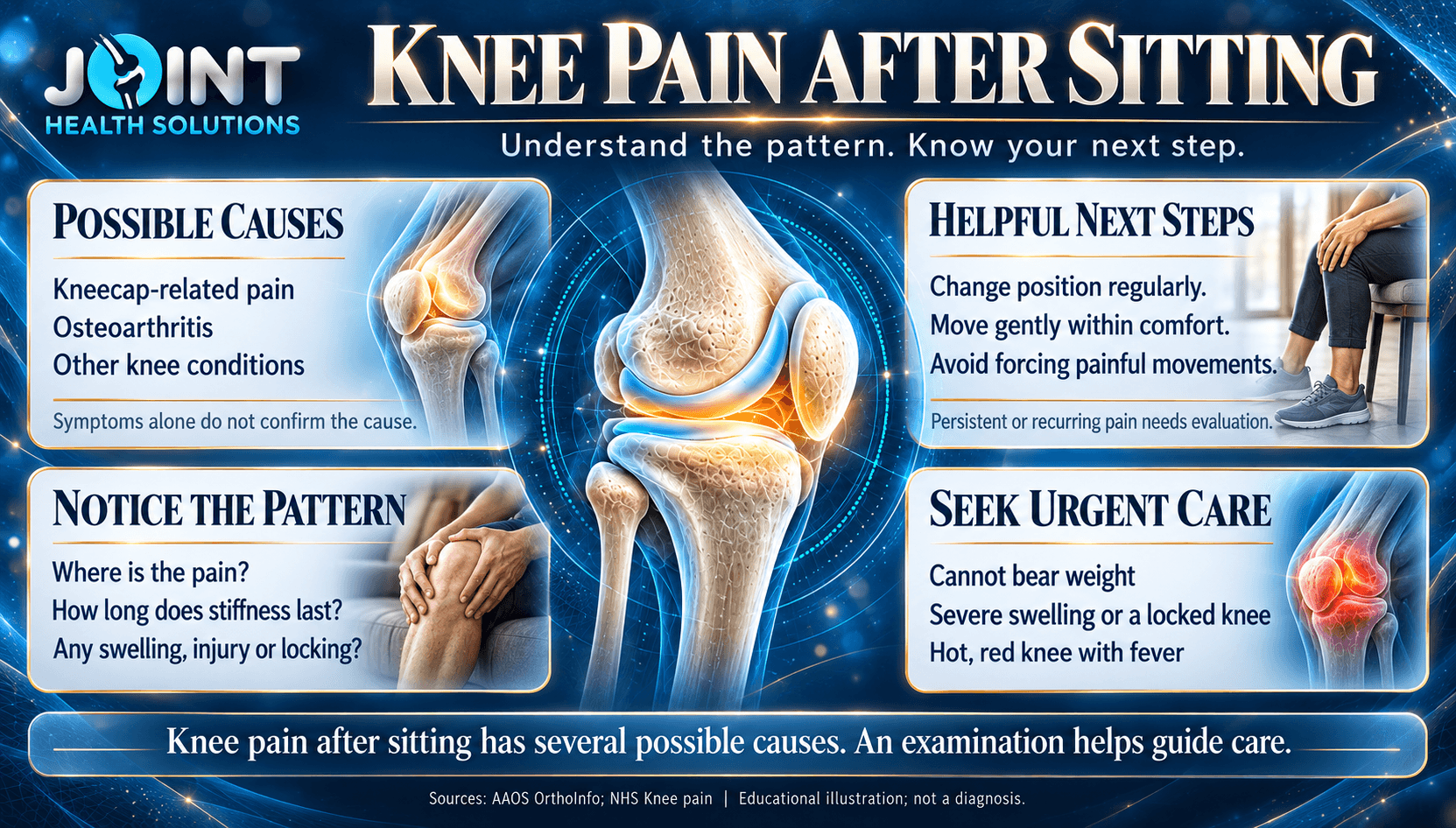
Knee pain after sitting may come from patellofemoral pain around the kneecap, osteoarthritis-related stiffness, or another knee condition. Pain while the knee stays bent and pain during the first steps after standing are related but different patterns. Neither identifies the cause by itself.
Changing position and moving gently may help mild symptoms. Repeated pain, swelling, loss of motion, or difficulty getting out of a chair deserves an evaluation. A hot, red knee with fever, inability to bear weight, or a newly locked knee needs urgent medical attention.
Does Your Knee Hurt While Sitting or Only When You Stand?
The timing matters because keeping the knee bent and rising from a chair place different demands on the joint. Start by separating the discomfort into three stages: while seated, during the act of standing, and during the first steps afterward.
Pain while the knee stays bent
An ache around or behind the kneecap during a movie, a flight, or desk work can fit a patellofemoral pain pattern. Notice whether gently straightening the knee changes the discomfort. That response is useful information, but it does not prove a kneecap diagnosis.
Pain when rising or starting to walk
Standing requires the muscles around the hip and knee to lift and control your body. Stiffness after rest, muscle weakness, or a painful joint may make this transition difficult. Record whether the problem settles, continues with walking, or causes the knee to give way.
Try describing the sequence rather than simply saying that sitting hurts. For example, “The knee is comfortable in the chair, but the first four steps hurt,” gives your clinician a different starting point from, “It starts aching after twenty minutes with the knee bent.”
Also distinguish stiffness from a true movement block. A stiff knee may gradually move more freely. A knee that suddenly becomes stuck and cannot straighten needs prompt assessment; forcing it straight can worsen pain or an underlying injury.
What Can Cause Knee Pain After Sitting?
Kneecap-related pain and osteoarthritis are important possibilities, but the symptom is not specific to either condition. Age, injury history, swelling, pain location, and examination findings help narrow the explanation.
Patellofemoral pain around the kneecap
Patellofemoral pain refers to discomfort around or behind the patella, or kneecap. Prolonged sitting with the knee bent can provoke symptoms. Stairs, squats, running, or a recent increase in training may also be uncomfortable.
This condition can occur in people who do not play sports. The label “runner’s knee” should not exclude it from consideration in someone whose main trigger is office work or driving. Assessment considers the wider movement pattern rather than assuming every painful kneecap is misaligned.
If the discomfort is primarily at the front of the knee across several activities, see our separate guide to pain in front of the knee.
Osteoarthritis and stiffness after rest
Knee osteoarthritis can cause stiffness after inactivity and discomfort when movement resumes. Osteoarthritis affects the joint as a whole; it is more complex than a simple explanation that the knee has “worn out.” Symptoms and functional limitations differ considerably between people.
NIAMS describes osteoarthritis stiffness as commonly lasting less than thirty minutes after rest or on waking. That is a typical pattern, not a diagnostic cutoff. Brief stiffness does not establish arthritis, and longer stiffness does not identify a different disease on its own.
Meniscus problems or a previous injury
A meniscus is one of the knee’s cushioning structures. A tear may produce pain, swelling, catching, or difficulty moving the joint, particularly after a twisting injury. Sitting-related pain alone is not enough to diagnose a tear or justify surgery.
Tell your clinician about a recent pivot, fall, pop, or change in function. A painful catch and a knee that is physically locked are different descriptions; explain exactly what the knee does and whether you can fully straighten it.
Inflammatory conditions and other sources
Inflammatory arthritis, gout, bursitis, and other conditions can also affect the knee. Persistent warmth, repeated swelling, symptoms in several joints, or a prolonged morning-stiffness pattern may change the evaluation. Pain can occasionally be referred from another area, including the hip.
A sudden hot, swollen knee should not be assumed to be an ordinary arthritis flare. Infection and other urgent causes can resemble familiar joint pain. The safest next step depends on the complete presentation, not on whether the person already carries an arthritis diagnosis.
What Do Your Symptoms Suggest?
Use symptom patterns to prepare for an evaluation, not to diagnose yourself. Several conditions can overlap, and the same diagnosis can feel different from one person to another.
| What you notice | What may be considered | Details to report |
|---|---|---|
| Ache around the kneecap while seated | Patellofemoral pain or patellofemoral arthritis | Time to onset, depth of bend, and response to changing position |
| Stiff first steps after rest | Osteoarthritis or another source of joint stiffness | How long stiffness lasts and whether walking becomes easier |
| Joint-line pain after a twist | Meniscus or another injury | Swelling, catching, injury mechanism, and loss of extension |
| Repeated swelling or prolonged stiffness | Inflammatory or other joint conditions | Other painful joints, warmth, morning symptoms, and medications |
| Hot, red knee with fever | Possible infection or another urgent condition | Seek urgent care rather than testing home exercises |
Does pain that improves with walking mean the knee is fine?
No. Improvement after the first few movements is useful to record, but it does not exclude a joint condition. Note how long the improvement lasts. A knee that loosens briefly and then becomes increasingly painful during a walk has a different functional pattern from one that remains comfortable.
What if there is clicking too?
Sound should be interpreted alongside pain, swelling, and function. Avoid repeatedly bending a painful knee just to reproduce a click for reassurance. Our guide to knee clicking and popping explains why the accompanying symptoms matter more than the noise alone.
What Can You Do Before Taking Those First Steps?
For mild symptoms without an injury or warning signs, use a comfortable, supported transition instead of forcing the knee through pain. The following approach is a practical way to organize movement; it is not a prescribed rehabilitation program.
- Pause and check the symptoms. Notice whether the knee feels mildly stiff, sharply painful, unstable, or physically stuck. Sharp pain or a new inability to move changes the next step.
- Adjust your sitting position. Move toward the front of a stable chair if you can do so comfortably. Make sure both feet have secure contact with the floor.
- Try a small, comfortable movement. Gently bend or straighten the knee within an easy range. Do not push through a catch, force a stretch, or repeatedly test a painful movement.
- Use a stable support when needed. Chair arms or an appropriate assistive device may help you stand safely. Avoid pulling on a rolling chair, an unstable table, or another object that can shift.
- Assess the first steps. Take your time. If weight-bearing is difficult, the knee gives way, or pain is severe, stop and seek appropriate care rather than trying to walk it off.
Pay attention to the response later in the day as well as during the movement. A routine that seems tolerable initially but consistently produces a larger flare deserves adjustment. Bring that observation to your clinician or physical therapist instead of escalating the exercise on your own.
Complete inactivity is not automatically the answer to recurring stiffness. For many established joint conditions, a clinician-guided plan includes movement and strengthening. A newly injured, hot, markedly swollen, or unstable knee needs assessment before you treat it as a routine stiffness problem.
How Can You Adjust Desk Work, Car Rides, and Low Chairs?
Look for practical ways to vary position and reduce movements that reliably provoke symptoms. There is no single perfect sitting angle or universal break schedule that treats every cause of knee pain.
During desk work
Notice whether your feet are supported, whether the chair forces a deep knee bend, and whether you habitually tuck one leg underneath you. Try one comfortable adjustment at a time so you can tell what changes the symptoms. Avoid making several major changes and assuming the last one caused improvement.
A reminder to change position can be useful when work makes you lose track of time. The goal is a sustainable routine, not a rigid timer that makes you repeatedly stand through pain. If standing breaks are uncomfortable, discuss alternatives rather than abandoning movement altogether.
During driving or travel
For a driver, safe control of the vehicle comes first. Do not change the seat position in a way that compromises pedal reach, steering, visibility, or restraint positioning. Make adjustments while parked and plan safe opportunities to stop when appropriate.
Record whether symptoms begin while the knee is bent or only when getting out of the vehicle. That distinction can be particularly helpful when driving is the main trigger. New one-sided calf pain and swelling after travel needs urgent assessment for a possible blood clot; chest pain or breathlessness requires emergency help.
When rising from a low couch or chair
Compare a low, soft seat with a firmer chair that has stable arms. Tell your clinician if one is consistently easier. This observation helps describe the task that is difficult; it should not be treated as a home test for a specific knee diagnosis.
If you need assistance to stand, make the environment safer while arranging care. Keep the route clear, avoid furniture that slides, and have an appropriately fitted walking aid assessed if needed. Repeated buckling or a recent fall makes safety planning especially important.
When Should Knee Pain After Sitting Be Evaluated?
Arrange an evaluation when the problem keeps returning, is worsening, or interferes with ordinary movement. You do not need to wait until pain is severe to discuss a persistent change in function.
Book sooner if you develop recurring swelling, a limp, repeated giving way, reduced ability to straighten the knee, or pain following an injury. Mild symptoms that do not improve over a few weeks also deserve assessment. Urgent warning signs override any plan to monitor at home.
What happens during the evaluation?
A clinician generally starts with the history and an examination. Be ready to explain whether pain occurs during sitting, during standing, or after you begin walking. Describe your usual activities, recent changes, previous injuries, medical conditions, and current medications.
The examination may include motion, tenderness, swelling, stability, strength, and walking. Depending on the findings, the clinician may also assess nearby regions. The aim is to identify a likely source and decide whether further testing would change care, rather than treating the phrase “pain after sitting” as a diagnosis.
Do you need an X-ray or MRI?
Not everyone needs the same imaging. X-rays can help assess bones and arthritis-related changes. MRI can provide information about soft tissues when the history and examination raise a relevant question. A meniscus does not appear directly on a standard X-ray.
Ask what the test is intended to answer and how the result would affect treatment. Imaging findings need to be interpreted alongside symptoms and function. An image should not be the sole reason to recommend a procedure when the clinical picture does not match.
What should you bring?
- A short timeline of symptoms and any injury or activity change.
- A list of medications, supplements, allergies, and previous knee treatments.
- Previous imaging reports and instructions for accessing the images, if available.
- A description of swelling, locking, giving way, or symptoms in other joints.
- Two or three practical goals, such as standing from a chair or driving comfortably.
A concise record is more useful than repeatedly provoking the knee to obtain a perfect description. Do not attempt deep squats, twisting maneuvers, or painful strength tests simply to prepare for the visit.
What Treatments May Help?
Treatment should follow the diagnosis, the severity of symptoms, and your functional goals. Knee pain after sitting is not, by itself, an indication for an injection, a brace, or surgery.
| Option | Potential role | Important limitation |
|---|---|---|
| Activity and sitting adjustments | Reduce specific triggers while maintaining appropriate activity. | Do not identify the diagnosis or replace assessment of persistent symptoms. |
| Exercise or physical therapy | Address relevant strength, mobility, and movement limitations. | The plan and progression must suit the condition and response. |
| Medication | Help selected patients manage pain or inflammation. | Suitability depends on medical history, interactions, and product instructions. |
| Braces or assistive devices | Support selected functional or safety needs. | Fit and indication matter; an unsuitable device may be unhelpful. |
| Joint injection | May be considered for a specific diagnosed condition. | Benefits vary; injections carry risks and do not guarantee lasting relief. |
| Specialist or surgical referral | Assess conditions needing additional expertise or procedural treatment. | Sitting-related pain alone does not establish a need for surgery. |
Exercise and rehabilitation
Exercise is an established part of osteoarthritis management, and targeted rehabilitation is commonly used for patellofemoral pain. The appropriate exercises depend on the findings. A plan may address the hip and thigh as well as knee motion, with gradual progression rather than an abrupt increase in loading.
Discuss your work routine and the exact chair-to-standing task that is difficult. A useful plan connects exercises with the activities you want to regain. Joint Health Solutions provides information about its physical therapy services in Charlotte; suitability should be determined during your assessment.
Medication and symptom relief
Before using an over-the-counter pain reliever, check the label and ask a pharmacist or clinician whether it is appropriate for you. Taking multiple products with the same active ingredient can cause harm. Nonsteroidal anti-inflammatory drugs can cause stomach bleeding and kidney problems in some people; they are not suitable for everyone.
Tell the clinician about blood thinners, previous ulcers, kidney disease, pregnancy, and other health conditions. Do not stop prescribed medication or combine pain products simply because knee discomfort has become more frequent.
Injections, evidence, and realistic expectations
A joint injection may be discussed for an appropriate condition, but it should have a clear purpose. Ask which diagnosis is being treated, what benefit is expected, how uncertainty is handled, and what alternatives remain. Infection and bleeding are among the risks that require discussion.
Corticosteroid injections may provide temporary symptom relief in selected patients. That is different from repairing the joint or curing arthritis. Before any procedure, review relevant medication risks, the follow-up plan, and whether the proposed treatment is covered by your specific insurance benefits.
How will you know whether the plan is helping?
Agree on a reassessment point and meaningful goals. Examples include standing from your usual chair more comfortably, needing less support, or tolerating a necessary car ride. Ask what should prompt an earlier call and what the next step will be if function does not improve.
A plan should be revised when the response does not fit expectations. Repeating an intervention without reviewing the diagnosis, adherence, side effects, and functional change can miss an opportunity to choose a more appropriate approach.
Knee Pain After Sitting: Getting Care in Charlotte
Joint Health Solutions evaluates knee concerns at its Charlotte clinic at 9350 Benfield Rd, #109, Charlotte, NC 28269. Whether your main difficulty is standing after desk work, getting out of a car, or taking the first steps after resting, describe that task when requesting your appointment.
For broader information about evaluation and available care, visit knee pain treatment in Charlotte. An appointment request starts the scheduling process; it does not confirm a diagnosis, a treatment recommendation, or an appointment time.
Ask the office to verify your specific plan, referral requirements, and potential out-of-pocket costs. Coverage for an evaluation does not automatically mean every test, device, or treatment will be covered. You can review the clinic’s insurance and financing information before contacting the team.
Make Those First Steps Part of the Conversation
If knee pain after sitting keeps returning, bring the pattern to a clinical evaluation. Understanding the cause can help you make informed choices about movement, treatment, and next steps.
Joint Health Solutions9350 Benfield Rd, #109
Charlotte, NC 28269
For severe or urgent symptoms, seek urgent or emergency care rather than waiting for a routine clinic appointment.
Frequently Asked Questions About Knee Pain After Sitting
Why does my knee hurt after sitting but improve once I move?
Stiffness after inactivity can ease as movement resumes, including in some people with osteoarthritis. Kneecap-related pain can also change when the knee moves out of a sustained bent position. Improvement with movement is a useful clue, but it does not establish a diagnosis or rule out a problem. Record how long the discomfort lasts, whether it returns with activity, and whether swelling or weakness occurs.
Is knee pain after sitting always arthritis?
No. Patellofemoral pain, injury-related problems, and other conditions can produce discomfort associated with sitting or standing. Arthritis is one possibility, especially when pain occurs with recurring stiffness or other joint symptoms. Neither age nor sitting-related pain confirms it. A clinician uses your history, examination, and testing when appropriate to distinguish the possibilities and recommend a plan suited to the findings.
What is the “movie theater sign”?
The phrase describes knee discomfort during prolonged sitting with the knee bent, such as watching a movie. It is often discussed in relation to patellofemoral pain around or behind the kneecap. It is a symptom description, not a definitive diagnostic test. Tell your clinician whether changing position helps and whether stairs, squats, or other activities produce similar pain.
Can sitting at a desk damage my knee cartilage?
Pain after desk work does not prove cartilage damage. A sustained position may provoke symptoms from an existing knee condition, but the timing alone cannot show which tissue is involved. Avoid assuming that pain means the joint is being damaged every time you sit. Persistent symptoms should be evaluated so that activity guidance and any treatment are based on the actual clinical picture.
Should I keep my knee completely straight while sitting?
There is no single position that works for every knee condition. Some people feel better after gently straightening the knee or changing position, while others find a different supported position more comfortable. Avoid forcing the joint into full extension or holding a painful posture. If the knee becomes physically stuck or you suddenly cannot straighten it, seek prompt care rather than stretching harder.
How often should I stand up if sitting hurts my knees?
A practical schedule depends on your symptoms, mobility, work demands, and clinical advice. Changing position regularly may be helpful, but a fixed interval is not a treatment for every cause. Do not repeatedly stand through sharp pain or instability just to follow a timer. Note when discomfort begins and discuss a manageable movement routine with your clinician or physical therapist.
Do I need an MRI for knee pain after sitting?
Not necessarily. The decision depends on the history, examination, and what question the imaging needs to answer. An X-ray may help assess bone and arthritis-related changes, while MRI can evaluate selected soft-tissue concerns. Ask how the result would change treatment. Sitting-related pain alone does not mean an MRI is required, and imaging should be interpreted alongside symptoms and function.
Are knee injections the first treatment for pain after sitting?
Not automatically. The symptom needs an explanation before a procedure is selected. Depending on the diagnosis, care may involve activity changes, rehabilitation, medication, or other options. An injection may be appropriate for selected conditions, but benefits and risks vary. Ask what the injection is intended to accomplish, how long benefit might last, what alternatives exist, and how the response will be assessed.
When is knee pain after sitting urgent?
Seek urgent assessment if you cannot bear weight or move the knee, have severe pain or swelling, develop a deformity, or the knee becomes locked. A hot, red knee with fever or feeling unwell is also urgent. New one-sided calf pain and swelling may indicate a blood clot. Call 911 for chest pain or shortness of breath with possible clot symptoms.
Can Joint Health Solutions evaluate this problem in Charlotte?
Joint Health Solutions provides knee pain evaluation and non-surgical care at its Charlotte clinic at 9350 Benfield Rd, #109, Charlotte, NC 28269. Call 704-833-3566 or use the appointment-request page to discuss scheduling. The appropriate next step depends on your symptoms and examination. Ask the office to verify your specific insurance benefits, referral requirements, and anticipated costs before proceeding with care.
Sources
This guide draws on patient education from orthopedic, arthritis, public-health, and medication-safety organizations. Recommendations must be individualized; the illustrations do not diagnose a particular condition.
- American Academy of Orthopaedic Surgeons: Patellofemoral Pain Syndrome
- American Academy of Orthopaedic Surgeons: Arthritis of the Knee
- NIAMS: Osteoarthritis—Symptoms and Causes
- NIAMS: Osteoarthritis—Diagnosis, Treatment, and Steps to Take
- American Academy of Orthopaedic Surgeons: Meniscus Tears
- NHS: Knee Pain and Urgent Warning Signs
- NHS: Deep Vein Thrombosis
- FDA: Safe Use of Over-the-Counter Pain Relievers
- American College of Rheumatology: Joint Injections and Joint Aspirations
Meet the Medical Care Team

Jeffrey Galvin, MD
Medical Director
Board-certified in Emergency Medicine and Obesity
Medicine. Learn about his background and clinical
role at Joint Health Solutions.

Ariel Curtis, FNP-C
Board-Certified Family Nurse Practitioner
Joint injection specialist with a background in
orthopedic trauma nursing. Learn about her experience
and approach to patient care.
This article provides general educational information and does not replace an individual medical evaluation, diagnosis, or treatment plan. For urgent symptoms, seek appropriate urgent or emergency care.
 English
  Spanish