
This educational guide is for Charlotte-area adults comparing possible causes and next steps. It does not diagnose an individual or replace urgent care. Pain that repeatedly wakes you, continues despite changing position, or comes with swelling deserves an examination. A clinician may be able to distinguish a mechanical pattern from inflammatory, neurologic or urgent causes through history, examination and selective imaging.
Direct answer: why knees can hurt more at night
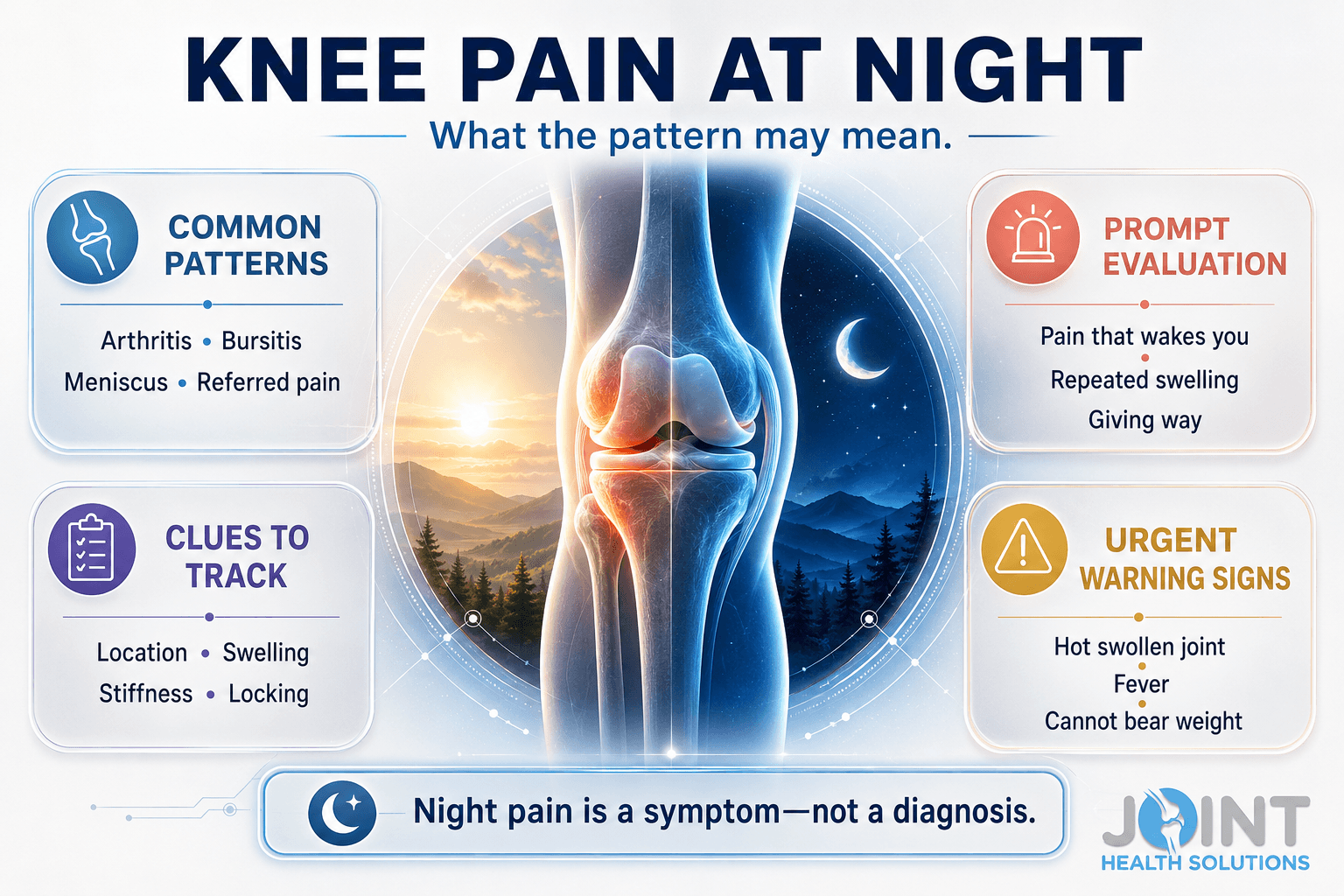
Nighttime knee pain is not a diagnosis. Osteoarthritis can ache after a day of loading, an inflamed joint may throb at rest, and certain sleep positions can compress irritated tissues. Bursitis, tendon problems, a meniscus injury and pain referred from the hip or back can also produce symptoms around the knee. The pattern, location, swelling, stiffness and recent history matter more than the time on the clock.
Pain that repeatedly wakes you, continues despite changing position, or comes with swelling deserves an examination. A clinician may be able to distinguish a mechanical pattern from inflammatory, neurologic or urgent causes through history, examination and selective imaging.
Common causes and the clues that separate them
Knee osteoarthritis often causes activity-related pain, stiffness after rest and reduced motion. Patellofemoral pain is usually felt in front of the knee and may worsen with stairs, squatting or prolonged sitting. Bursitis tends to be more localized and tender. Meniscus problems can produce joint-line pain, catching or swelling, while tendon pain is commonly linked to resisted movement or recent overuse.
A hot, markedly swollen knee, fever, a recent wound, inability to bear weight, major trauma, calf swelling or shortness of breath changes the urgency. Those findings should not be treated as routine arthritis without prompt medical assessment.
How sleep position and daytime activity affect symptoms
A pillow between the knees when side sleeping may reduce direct pressure and help keep the hips and knees aligned. Back sleepers may be more comfortable with modest support under the knees, but a permanently flexed position can increase stiffness for some people. The best position is one that does not create numbness, worsening swelling or sharp pain.
Daytime pacing matters. A sudden jump in walking, yard work, stairs or exercise can provoke an evening flare. Complete inactivity may also worsen stiffness and strength. A symptom-and-activity log can help identify which loads are associated with nighttime pain.
How nighttime knee pain is evaluated
Evaluation starts with onset, exact location, swelling, locking, giving way, morning stiffness, trauma, medication history and systemic symptoms. Examination may assess gait, alignment, range of motion, joint-line tenderness, ligaments, kneecap tracking, hip motion and circulation.
Weight-bearing X-rays can show osteoarthritis-related joint-space change and alignment. MRI is not automatically required for every painful knee; it may be considered when examination suggests a soft-tissue injury, symptoms remain unexplained, or results would change management.
Evidence-based non-surgical treatment options
Exercise therapy, strength work, activity modification, weight management when applicable, topical or oral medicines when medically safe, and selected braces are guideline-supported options for knee osteoarthritis. The right starting point depends on diagnosis, other medical conditions and functional goals.
Intra-articular corticosteroid injections may provide short-term relief for some people. Hyaluronic-acid injections are used selectively, but major professional guidelines differ or advise against routine use; a balanced consultation should discuss that uncertainty, individual candidacy, benefits, risks, alternatives and coverage.
When to schedule an evaluation in Charlotte
Schedule a non-urgent evaluation when night pain is recurring, affecting sleep, limiting walking or not improving with reasonable self-care. Bring prior imaging, a medication list, a brief symptom timeline and notes about swelling or instability.
Joint Health Solutions evaluates knee pain at its north Charlotte office. An appointment is an assessment, not a promise that an injection is appropriate. The goal is to identify the likely pain generator and choose a proportionate plan.
Nighttime Pattern Comparison
| Pattern | Possible explanation | Clues to report | Appropriate next step |
|---|---|---|---|
| Aching after a high-load day | Osteoarthritis or activity-related flare | Stiffness, swelling, reduced walking tolerance | Schedule evaluation if recurrent or sleep-disrupting |
| Pain lying directly on the knee | Local compression or bursitis | Focal tenderness and position dependence | Modify position; evaluate persistent focal pain |
| Pain with locking or catching | Meniscus or another mechanical problem | Joint-line pain, swelling, blocked motion | Clinical examination; imaging only if it changes care |
| Burning or radiating pain | Referred or nerve-related pain | Back or hip symptoms, numbness, tingling | Include hip, spine and neurologic screening |
| Hot, rapidly swollen knee | Infection, crystal disease or acute inflammation | Fever, illness, severe pain, warmth | Prompt medical assessment |
This table organizes possibilities for discussion; it is not a diagnostic tool. Symptoms can overlap, and urgent findings take priority over a routine treatment pathway.
What to expect at a focused joint evaluation
A useful visit begins with the exact symptom, functional limitation and timeline—not a predetermined procedure. The care team may review prior treatment, medicines, medical conditions, imaging and the activities the patient wants to regain. Examination and selective testing help determine whether treatment can be managed conservatively or whether another specialist is needed.
Patients should ask: What is the working diagnosis? What evidence supports each option? What are the realistic benefits, limitations, side effects, alternatives and costs? How will success be measured, and when will the plan be reassessed? Those questions support shared decision-making and make the article more useful to both traditional search engines and answer engines.
Questions to ask before any joint injection
- What diagnosis is the injection intended to treat?
- What evidence supports this injection for my condition?
- What should I expect during the first 48 hours and over the following weeks?
- Which medicines or health conditions change my risk?
- What symptoms require a same-day call or urgent care?
- What is the plan if the injection does not help?
How to prepare for an accurate evaluation
Write down when knee pain at night began, whether symptoms were sudden or gradual, the exact location, and what reliably improves or worsens the problem. Include swelling, warmth, stiffness, clicking, locking, giving way, numbness, fever, sleep disruption and any change in walking. A short timeline is more useful than trying to remember every detail during the visit.
Bring a current medication and supplement list, allergy information, prior imaging reports, relevant procedure records and details about diabetes, blood thinners, kidney disease, ulcers, immune suppression or recent infection. These factors can change the safety of anti-inflammatory medicines, injections and aspiration. If symptoms fluctuate, dated photographs or a simple activity log may help the clinician see a pattern that is not obvious on the appointment day.
How to compare treatment choices without overpromising
Ask each option to pass four tests: Does it fit the working diagnosis? Is there credible evidence for that diagnosis? Are the expected benefits meaningful for the activities you want to regain? Are the risks and burdens acceptable given your health history? A treatment can be medically reasonable without being guaranteed, and a popular treatment can still be a poor match for a particular pain generator.
Use absolute, practical outcomes when possible. Examples include uninterrupted sleep, minutes of walking, ability to climb stairs, number of swelling episodes, confidence on uneven ground and use of rescue medicine. Percentage-improvement promises and “permanent” claims are rarely appropriate without clearly defined evidence. When guidelines disagree, the disagreement should be disclosed and incorporated into shared decision-making.
What a staged non-surgical plan may look like
A staged plan usually begins with diagnosis, education and the least burdensome options likely to help. That may include modifying a provoking activity without abandoning movement, starting an individualized strength or mobility program, reviewing footwear or assistive devices, and considering topical or oral medicines only when medically appropriate. The plan should specify what to do, how often, and how progress will be measured.
If symptoms remain function-limiting, the next stage may include supervised physical therapy, a brace or walking aid for a defined indication, further imaging when it will change care, or a procedure chosen for a specific diagnosis. Follow-up is part of the treatment: lack of improvement should trigger reassessment rather than automatic repetition of the same intervention.
Common mistakes that delay useful care
Common mistakes include treating an imaging report instead of the person, assuming all pain is arthritis, resting so completely that strength declines, escalating exercise too quickly, borrowing another person’s brace, and choosing an injection before clarifying the diagnosis. Another mistake is waiting through progressive weakness, repeated falls, major swelling or systemic symptoms because the discomfort was initially labeled “wear and tear.”
Online information is best used to form better questions. It cannot test ligaments, assess joint warmth, compare active with passive motion, evaluate gait or determine whether pain is referred from another area. For knee pain at night, the safest path is a clear differential diagnosis, an individualized plan and a defined reassessment point.
How this article supports—not competes with—existing treatment pages
This page is designed to answer the focused question “Why does my knee hurt at night, and when should I see a clinician?” Existing Joint Health Solutions service pages should remain the primary destinations for broad commercial terms. The article should link naturally to the relevant service hub, while those service pages may link back using a descriptive symptom-based anchor when helpful to patients.
That separation matters for SEO, AEO and GEO. Search systems can identify this article as the best answer for one defined question, while the main service page retains authority for evaluation and treatment in Charlotte. Avoid rewriting the article into a generic list of every service, and do not create near-duplicate posts with minor city or wording changes.
Measuring progress and knowing when to change course
Choose two or three outcomes before treatment so improvement is not judged only by how the joint feels on one unusually good or bad day. Useful measures include pain during a specific task, walking or standing tolerance, sleep interruptions, range of motion, confidence, swelling frequency and ability to complete a home exercise plan. Record a simple baseline and review it at the interval recommended by the clinician.
A temporary symptom reduction is valuable when it enables rehabilitation or daily function, but it should not be confused with proof that the underlying structure has healed. Likewise, an imaging finding may remain unchanged while function improves. If knee pain at night is worsening, new symptoms appear, or the treatment goal is not being met, the clinician should reconsider the diagnosis, adherence, dose of activity, need for testing and whether referral is appropriate.
Long-term management is rarely one procedure in isolation. It is a sequence of informed decisions that protects safety, preserves strength and mobility, and responds to the patient’s priorities. Documenting both benefit and adverse effects also helps avoid repeating an ineffective intervention simply because it was previously tried.
Request a Joint Evaluation in Charlotte
Joint Health Solutions is located at 9350 Benfield Rd, #109, Charlotte, NC 28269. Call 704-833-3566 or request an appointment. Treatment recommendations are made after an individualized evaluation.
Frequently asked questions
Is knee pain at night always arthritis?
No. Osteoarthritis is common, but bursitis, tendon disorders, meniscus injury, referred pain and other conditions can hurt at night. The location, swelling, exam and history help separate them.
Why does my knee hurt when I lie on my side?
Side sleeping can place direct pressure on the knee and alter hip-to-knee alignment. A pillow between the knees may help, but persistent or severe pain should be evaluated.
Can a swollen knee cause nighttime pain?
Yes. Fluid and inflammation can increase pressure and aching at rest. A hot, rapidly swollen or very painful joint needs prompt medical assessment.
Should I use heat or ice before bed?
Ice may help after an activity-related flare; heat may ease stiffness for some people. Protect the skin and ask a clinician if circulation or sensation is impaired.
When is night knee pain urgent?
Seek prompt care for fever with a hot swollen joint, major trauma, inability to bear weight, rapidly increasing swelling, calf swelling, chest pain or shortness of breath.
Will an injection stop knee pain at night?
It may help selected patients when the pain source and treatment match, but response varies and an injection is not appropriate for every cause.
Do I need an MRI?
Not necessarily. History, examination and weight-bearing X-rays often come first. MRI is most useful when it is likely to change diagnosis or treatment.
Where can I get knee pain evaluated in Charlotte?
Joint Health Solutions sees patients at 9350 Benfield Rd, #109, Charlotte, NC 28269. Call 704-833-3566 or request an appointment online.
Sources
- AAOS patient education — primary evidence source
- AAOS Management of Osteoarthritis of the Knee guideline
- American College of Rheumatology osteoarthritis guideline
Medically reviewed by:

Dr. Jeffrey Galvin
A board-certified physician in Emergency Medicine and Obesity Medicine with more than 25 years of experience.

Ariel Curtis, FNP-C
A board-certified Family Nurse Practitioner with more than 12 years of nursing experience.
 English
  Spanish