
Knee pain when climbing stairs is a common problem that can make everyday movement feel difficult. Some people feel a sharp pain when stepping up. Others notice aching, stiffness, weakness, swelling, or discomfort around the kneecap when going upstairs or downstairs.
Stairs place extra pressure on the knee joint compared to walking on a flat surface. If the joint is irritated, inflamed, weak, or affected by arthritis, stair climbing can make the problem more noticeable. Knee pain may be caused by several issues, including injuries, mechanical problems, arthritis, cartilage damage, tendon irritation, or inflammation.
At Joint Health Solutions in Charlotte, NC, we help patients understand the cause of their knee pain and explore personalized treatment options designed to improve comfort, mobility, and daily function.
Climbing stairs requires your knee to bend, support body weight, and push through each step. This movement involves the kneecap, cartilage, tendons, ligaments, muscles, and surrounding joint structures.
If one part of the knee is not working properly, the extra pressure from stairs can trigger pain. This is why some patients feel fine while walking on flat ground but experience pain when using stairs.
Common symptoms may include:
Knee pain can also come with swelling, stiffness, redness, weakness, instability, popping or crunching sounds, and trouble fully straightening the knee.
There is not always one single cause of knee pain. The right treatment depends on identifying what is creating the discomfort.
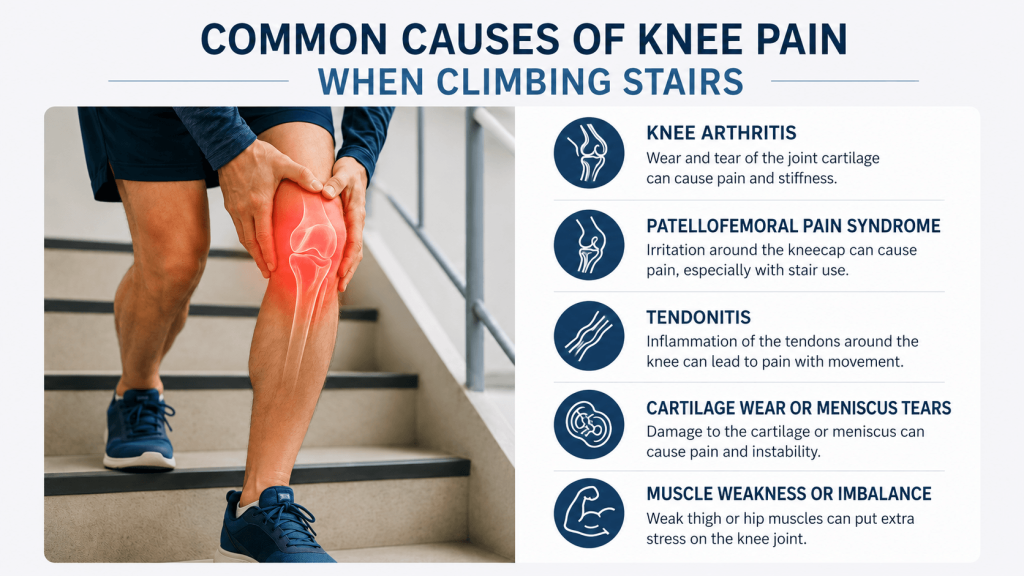
Knee osteoarthritis is one of the most common reasons people experience knee pain on stairs. It happens when the cartilage in the knee joint gradually breaks down. As the cartilage wears down, the joint can become painful, stiff, swollen, and inflamed.
Patients with knee osteoarthritis may notice:
Stairs can become especially uncomfortable because the knee bends while carrying extra body weight.
Patellofemoral pain syndrome, sometimes called runner’s knee, causes pain around or behind the kneecap. This pain is often worse with stairs, squatting, kneeling, running, or sitting for long periods.
This condition may be related to muscle imbalance, overuse, poor kneecap tracking, weak hips, or weak thigh muscles.
Cartilage helps the knee move smoothly. When cartilage becomes irritated or worn down, the joint may feel painful, stiff, or rough during movement.
Patients may notice:
Cartilage problems may develop from aging, arthritis, previous injuries, repetitive stress, or joint degeneration.
Tendons and ligaments support the knee and help control movement. Overuse, sudden activity changes, sports, or improper movement patterns can irritate these tissues.
This type of knee pain may feel sharp, sore, or localized. It may become worse when pushing off the leg, climbing stairs, or standing from a seated position.
Weak quadriceps, hamstrings, hips, or glute muscles can place more stress on the knee. When the surrounding muscles do not properly support the joint, the knee may absorb more pressure during stairs.
Lack of muscle strength and flexibility can increase the risk of knee problems, while stronger muscles help stabilize and protect the joint.
Mild knee pain may improve with rest, activity changes, and proper care. However, ongoing or worsening knee pain should not be ignored.
You should consider scheduling an appointment if you experience:
Medical evaluation is especially important if you cannot bear weight, have marked swelling, cannot fully bend or straighten the knee, see an obvious deformity, have fever with redness and swelling, or have severe knee pain after an injury.
For mild discomfort, simple changes may help reduce irritation. These may include:
However, if pain keeps returning, at-home care may only provide temporary relief. The underlying cause may still need professional evaluation.
Treatment depends on your symptoms, diagnosis, activity level, and long-term goals. At Joint Health Solutions, care is focused on identifying the cause of pain and recommending a personalized treatment plan.
Physical therapy can help strengthen the muscles around the knee, improve flexibility, and reduce pressure on the joint. It may focus on the quadriceps, hamstrings, hips, glutes, and balance control.
This can be helpful for patients whose stair pain is related to weakness, poor movement patterns, or patellofemoral pain.
A knee brace may help support the joint, improve stability, and reduce stress during movement. Some patients with arthritis, instability, or alignment-related knee pain may benefit from bracing.
Cortisone injections may help reduce inflammation and provide short-term pain relief for some patients with knee arthritis or joint irritation. AAOS notes that initial treatment for knee arthritis is often nonsurgical and may include options such as activity changes, exercise, weight loss, physical therapy, and other provider-guided treatments.
Hyaluronic acid injections, also called viscosupplementation, may be used for patients with knee osteoarthritis. These injections are designed to improve joint lubrication and may help reduce stiffness or discomfort for some patients.
Platelet-Rich Plasma, or PRP therapy, uses a patient’s own blood components to support the body’s natural healing response. PRP may be considered for certain patients with knee osteoarthritis, tendon irritation, or soft tissue-related joint pain.
Joint injections may help target pain and inflammation directly inside the knee joint. The best injection option depends on your diagnosis, symptoms, health history, and treatment goals.
These simple habits may help reduce pressure on your knees:
Extra body weight can increase stress on the knee joints during everyday activities such as walking or going up and down stairs.
If knee pain when climbing stairs is affecting your daily life, it may be time to schedule an evaluation. Pain that keeps returning, limits movement, or causes swelling should be checked before it becomes more difficult to manage.
At Joint Health Solutions, we provide personalized care for knee pain, knee arthritis, joint inflammation, and non-surgical treatment options in Charlotte, NC. Our goal is to help you understand what is causing your pain and guide you toward the right treatment plan.
Whether your knee pain is related to arthritis, cartilage wear, inflammation, weakness, or another joint condition, early evaluation can help you take the next step toward better mobility and comfort.
Depending on the cause of knee pain when climbing stairs, treatment may include knee injections, cortisone injections, hyaluronic acid injections, PRP therapy, physical therapy, or knee arthritis treatment.
Knee pain when climbing stairs may happen because stairs place extra pressure on the knee joint. Common causes include knee arthritis, cartilage wear, inflammation, patellofemoral pain syndrome, tendon irritation, or muscle weakness.
Knee pain when climbing stairs or going downstairs can happen because the knee needs more control during bending movements. If the joint is inflamed, weak, stiff, or irritated, the controlled motion can increase pain.
Yes, knee pain when climbing stairs can be a sign of knee arthritis, especially if the pain comes with stiffness, swelling, grinding, or reduced mobility. However, other conditions can also cause similar symptoms.
Mild knee pain when climbing stairs may improve with rest, activity changes, and strengthening. If the pain keeps returning, gets worse, or limits daily activity, it is best to schedule an evaluation.
The best treatment for knee pain when climbing stairs depends on the cause. Options may include physical therapy, knee bracing, cortisone injections, hyaluronic acid injections, PRP therapy, or other joint-focused treatments.
You may need to reduce stair use temporarily if knee pain when climbing stairs causes sharp pain, swelling, or instability. However, completely avoiding stairs may not solve the underlying problem.
You should see a provider if knee pain when climbing stairs lasts more than a few days, keeps returning, causes swelling, affects walking, or makes your knee feel unstable.
Yes. Physical therapy may help improve knee pain when climbing stairs by strengthening the muscles around the knee, improving movement control, and reducing pressure during stair movement.
For some patients, injections may help reduce knee pain when climbing stairs by lowering inflammation, improving joint comfort, or supporting knee function. The right injection depends on the diagnosis and severity of the condition.
You can contact Joint Health Solutions in Charlotte, NC to schedule a knee evaluation and discuss personalized treatment options for knee pain when climbing stairs, knee arthritis, and joint discomfort.