
Knee Pain When Kneeling: Causes, Warning Signs, and Next Steps
Knee pain when kneeling can turn gardening, cleaning, exercise, or reaching a low cabinet into an uncomfortable task. Sometimes the knee feels fine during walking but hurts immediately when it touches the floor. Other times, pain comes with bending, swelling, or getting back up.
The difference matters. Direct pressure on the front of the knee, a deeply bent position, and the effort of rising from the floor can aggravate different structures. Understanding the pattern helps guide a safer next step.

Quick Answer: Why Does My Knee Hurt When I Kneel?
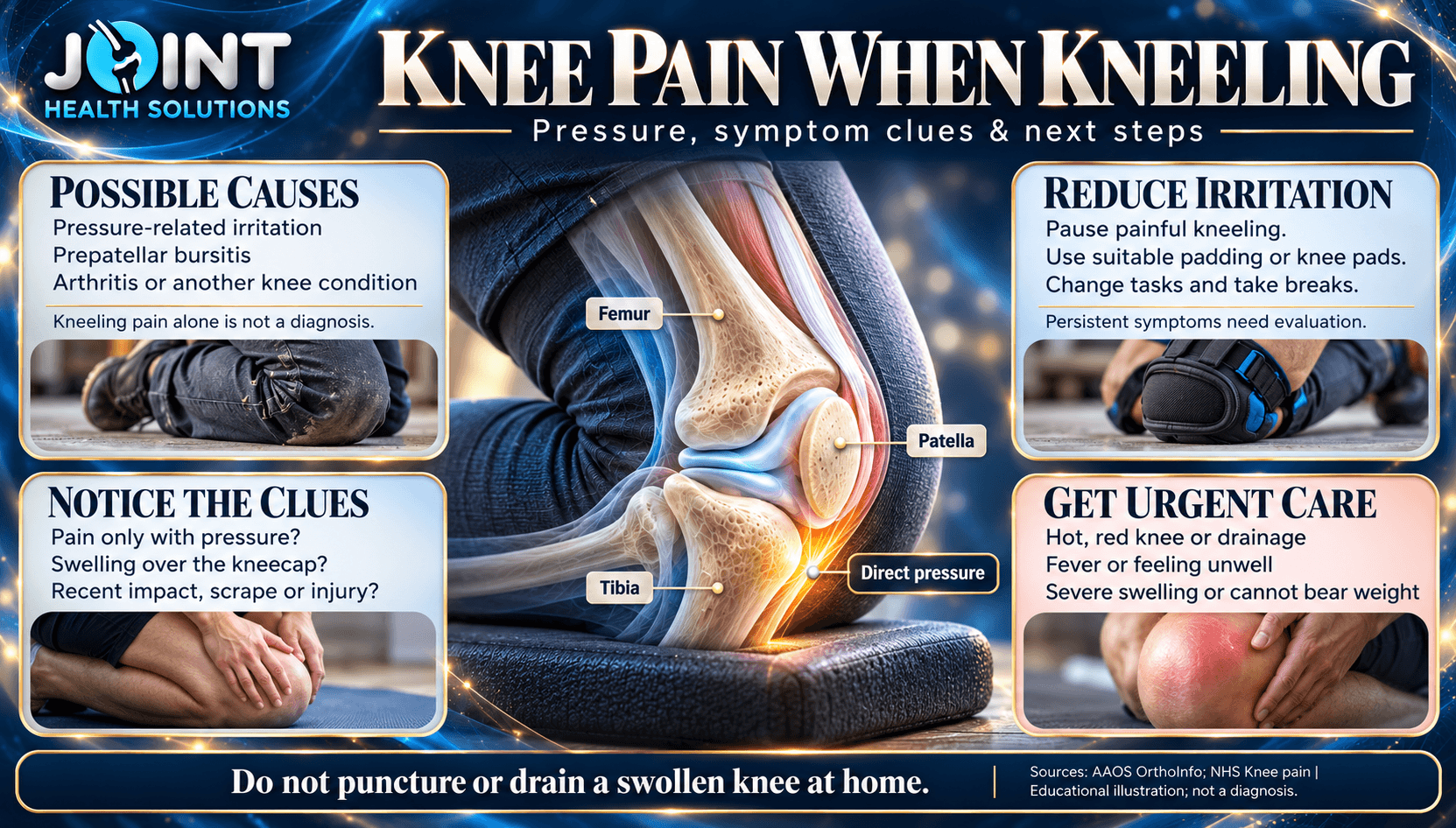
Knee pain when kneeling may involve pressure-sensitive tissues over the kneecap, prepatellar bursitis, arthritis, tendon problems, or an injury. Pain only when the knee contacts a surface is different from pain during bending or rising. The trigger provides a clue, but it cannot confirm a diagnosis.
Pause painful kneeling and consider a task adjustment or suitable padding for mild symptoms. Persistent pain, swelling, or reduced function needs evaluation. A hot, red or draining knee, sudden severe pain, or inability to bear weight requires urgent medical attention.
Does the Knee Hurt From Contact, Bending, or Getting Up?
Separate the kneeling task into its parts: lowering yourself, touching the surface, remaining kneeling, and standing back up. Each stage gives your clinician useful information about what is uncomfortable.
Pain when the knee touches the floor
Direct contact places pressure on the skin and tissues over the kneecap. A tender spot, recent bruise, or swelling at the front of the knee may become noticeable during contact even when ordinary walking is comfortable.
Pain during bending or rising
Pain before contact, during a deep bend, or while standing may involve a different movement demand. Describe whether the discomfort occurs without touching the knee to anything and whether stairs or chair rises also hurt.
Think about the difference between kneeling upright and sitting back toward your heels. These positions are often grouped together as “kneeling,” but they do not feel the same to every knee. Explain which position is difficult rather than repeatedly testing both until the knee becomes sore.
Also describe the surface. A hard floor, a firm kneeling pad, and a soft cushion may produce different symptoms. Relief with padding is useful information, but it does not establish that the problem is harmless or identify which tissue is involved.
If front-of-knee pain occurs across several activities, our broader guide to pain in front of the knee explains additional location and movement clues. This article focuses on kneeling and direct pressure.
What Can Cause Knee Pain When Kneeling?
Several conditions can produce a similar symptom, so the cause should be matched to the history and examination. Do not assume that every painful kneecap means arthritis or that every swollen area is bursitis.
Pressure-related tenderness or a recent bruise
A direct blow or repeated contact can make the front of the knee tender. Report a recent fall, bump, prolonged floor task, or change in work demands. A visible bruise can be helpful context, but its appearance does not show whether deeper structures were injured.
After an impact, important details include whether you could walk afterward, how quickly swelling appeared, and whether you can actively straighten the leg. Significant functional loss should not be managed simply by placing a thicker cushion under the knee.
Prepatellar bursitis
The prepatellar bursa is a small fluid-containing structure between the skin and the kneecap. It reduces friction. Repeated kneeling or a direct impact may irritate it, causing localized swelling and tenderness over the front of the knee.
The bursa is outside the main knee joint. That distinction matters because a swelling over the kneecap and fluid inside the joint are not necessarily the same problem. An examination helps determine which area is involved.
Infection involving the bursa, skin, or joint
A scrape or puncture near the knee can provide an entry point for bacteria. Infection can cause warmth, swelling, drainage, or skin-color change and may require a different treatment approach from noninfectious irritation.
Septic arthritis is an infection inside a joint and needs urgent treatment. Sudden severe joint pain, restricted movement, and a hot swollen knee require prompt assessment. Fever may be absent, so waiting for a temperature to rise is not a safe way to exclude infection.
Arthritis or kneecap-related joint pain
Osteoarthritis may cause pain, stiffness, swelling, and reduced motion. A deep kneeling position may expose a limitation that is less noticeable during a short walk. Symptoms alone cannot determine the degree of arthritis or prove that the bones are touching.
Patellofemoral pain occurs around or behind the kneecap and can overlap with discomfort during stairs, squatting, or prolonged sitting. A clinician considers this wider pattern rather than treating kneeling pain as a stand-alone diagnostic test.
Tendon or meniscus problems
Pain near the patellar tendon below the kneecap may need a different assessment from tenderness directly over the patella. After an injury, a pop followed by difficulty actively straightening the knee raises concern for an extensor-mechanism injury, including a tendon tear.
A meniscus problem may be considered when pain occurs with twisting, catching, swelling, or restricted movement. Neither a sharp sensation nor the word “catching” confirms a tear. Describe what happens and let the examination guide the interpretation.
Which Symptoms Change the Next Step?
The most useful details are pain location, swelling, skin changes, injury history, and function. These observations help determine urgency and guide evaluation; they should not be used to select a procedure yourself.
| What you notice | Why it matters | Useful next step |
|---|---|---|
| Pain only with direct contact | May point toward pressure-sensitive tissues at the contact area. | Reduce painful pressure and arrange assessment if it persists. |
| A pocket of swelling over the kneecap | A superficial bursa may be involved, but other causes need consideration. | Report warmth, skin injury, drainage, and how quickly it appeared. |
| Pain during deep bending without contact | The movement itself may be provoking symptoms. | Describe other painful tasks and any limitation in motion. |
| Twisting injury with catching or swelling | May require assessment for an internal knee injury. | Avoid repeatedly twisting to test the knee. |
| Hot, draining, or rapidly worsening swelling | Infection or another urgent condition must be considered. | Seek urgent care; do not drain or inject the area yourself. |
| Cannot bear weight or actively straighten after injury | A significant injury may be present. | Seek urgent assessment rather than forcing activity. |
What if the knee hurts only when kneeling, not walking?
Different activities load the knee differently. Comfortable walking does not make direct-pressure pain imaginary, and it does not rule out a condition that deserves care. Tell your clinician about the contrast and whether the pain remains after you lift the knee off the surface.
What if there is no visible swelling?
The absence of visible swelling does not identify the cause. Explain the exact location, onset, and triggers even if the knee looks normal. Avoid pressing repeatedly on the tender spot to check whether it still hurts; that can make it harder to judge your usual symptoms.
What Can You Do to Reduce Irritation?
For mild symptoms without warning signs, start by reducing the specific pressure or movement that hurts. Practical adjustments can make a task more manageable, but they do not replace assessment when symptoms persist or worsen.
- Pause painful kneeling. Change the task or position rather than repeatedly checking whether the knee can tolerate another attempt.
- Consider suitable padding. If kneeling is appropriate and comfortable, use a stable kneeling pad or properly fitted knee pads. Stop if pressure remains painful.
- Change activities. Alternate tasks so the knee is not exposed to prolonged pressure in one position.
- Check the skin. Notice scrapes, punctures, drainage, or a worsening skin change and seek care when appropriate.
- Use comfortable movement. Avoid forceful bending, twisting, or deep stretching through a sharp or catching sensation.
If you use a cold pack for mild soreness, place a cloth between the pack and skin and follow safe application instructions. Do not use cold or heat to postpone assessment of a hot, swollen, or rapidly worsening knee. Ask for individualized advice if you have reduced sensation or circulation problems.
Medication also needs a suitability check. Over-the-counter does not mean appropriate for everyone. Review the label, other medicines, and your medical history with a pharmacist or clinician rather than taking extra medication so you can continue kneeling through pain.
What should you avoid?
Do not puncture a swollen area, squeeze drainage from it, or attempt an injection. Avoid forceful massage over unexplained swelling. A pressure pad should not be used as permission to continue an activity that produces increasing pain, and pain relief should not be treated as proof that the underlying problem has resolved.
How Can You Modify Work, Gardening, and Floor Activities?
Choose a setup that reduces the need for painful kneeling while allowing you to complete the task safely. The best adjustment depends on the activity, environment, and your balance and mobility.
Jobs that require frequent kneeling
Explain the work task in concrete terms: the surface, time spent kneeling, use of tools, and whether you must repeatedly rise or pivot. “I kneel for work” leaves out details that can matter when planning restrictions or a return to activity.
Ask whether the task can be raised to a different working height, completed with a suitable tool, or rotated with another duty. Protective equipment must suit the work environment. A cushion that slips, catches on equipment, or interferes with balance can introduce another problem.
Gardening and household tasks
A stable seat or an alternative working height may help you avoid prolonged floor contact. Arrange tools within comfortable reach so you do not need to twist abruptly while the knee is planted. Test the setup for stability before relying on it.
Plan how you will stand up before lowering yourself. Avoid pulling on an unstable plant stand, cabinet door, or rolling object. If getting up has become difficult, discuss that limitation during your appointment even when the pain itself seems modest.
Exercise, stretching, and yoga
Tell an instructor or therapist which position hurts and whether the problem comes from contact or deep bending. A modification that removes pressure may help one person but leave another person’s painful movement unchanged. There is no need to force a kneeling pose to complete a routine.
Ask for a substitute that serves the intended training goal. If the purpose is hip strengthening, balance, or flexibility, a professional may be able to choose a position that avoids the painful task. New swelling or functional loss calls for assessment rather than a more aggressive exercise modification.
When Should Knee Pain When Kneeling Be Evaluated?
Schedule an evaluation when symptoms keep returning, do not improve with sensible adjustments, or interfere with work and daily activities. Seek help sooner for swelling, an injury, restricted movement, or a change in walking.
For suspected bursitis, the NHS advises assessment when symptoms are worsening or have not improved after one to two weeks of self-care. That is not a waiting period for urgent symptoms. Sudden severe pain, infection signs, or inability to use the knee should be checked promptly.
What will the clinician ask?
Expect questions about when symptoms started, the exact painful area, and what happens during each part of kneeling. Describe whether you can walk, climb stairs, bend the knee, and rise from a chair. Mention an impact, skin injury, previous surgery, injection, or known joint condition.
Bring a medication list, including blood thinners and medicines that affect the immune system. Report diabetes, immune-system problems, and any recent fever or infection. These details can influence testing and treatment decisions.
What may the examination involve?
The clinician may inspect the skin, locate swelling and tenderness, compare the knees, assess motion, and check relevant strength and stability. The history and examination help distinguish superficial pressure pain from a problem inside the joint or involving the tendon system.
Ask the clinician to explain the working diagnosis in plain language. Useful questions include, “Is the swelling in a bursa or the joint?” and, “What finding would make you reconsider this explanation?” Understanding the reasoning helps you follow the plan and recognize a meaningful change.
Will you need imaging or a fluid sample?
Testing depends on the concern. X-rays may help assess a fracture or arthritis-related changes. Ultrasound or MRI may be considered for selected questions about soft tissues or fluid. A scan is not automatically required simply because kneeling hurts.
If infection or another fluid-related diagnosis is suspected, a clinician may recommend aspiration and laboratory analysis. Sampling a superficial bursa and sampling the main joint are different procedures. Ask what area is being sampled, why the result matters, and what follow-up will occur.
Prepare a short symptom record
- When the problem began and whether there was an injury or skin break.
- Whether pain occurs during contact, bending, remaining kneeling, or rising.
- Any swelling, warmth, drainage, catching, or loss of motion.
- Which task adjustments helped and which did not.
- Your practical goal, such as gardening or completing a necessary work task.
What Treatment Options May Be Considered?
Treatment should address the diagnosed condition, not just the fact that kneeling hurts. The same symptom may call for pressure reduction, rehabilitation, treatment of an infection, or an injury-specific referral.
| Clinical finding | Possible approach | Important limitation |
|---|---|---|
| Pressure-related irritation | Task modification, protection, and reassessment. | Persistent symptoms require review of the explanation. |
| Noninfectious bursitis | Reduce aggravating pressure; consider other care according to severity. | Do not assume unexplained swelling is noninfectious. |
| Suspected infection | Urgent assessment, appropriate testing, and infection-directed treatment. | A steroid injection is not a treatment for an infected bursa. |
| Arthritis or movement-related limitations | Individualized exercise, symptom management, and selected supports. | Outcomes vary; treatment does not guarantee comfortable kneeling. |
| Significant tendon or other injury | Injury-specific evaluation and specialist referral when needed. | Some injuries require surgical care; padding cannot repair them. |
Rehabilitation and movement-based care
Exercise may be useful when the assessment identifies relevant strength, mobility, or movement limitations. It does not remove the need to protect an acutely irritated surface or evaluate possible infection. The plan should explain which activities to continue, modify, or pause.
For osteoarthritis, exercise is an established management option. This does not mean repeatedly kneeling is the right exercise for every painful knee. A clinician or physical therapist can connect the program to your goals and adjust loading based on your response.
Learn about physical therapy at Joint Health Solutions and discuss whether movement-based care is appropriate for your findings.
Medication and safety
Anti-inflammatory medicines may help selected patients, but they can cause problems including stomach bleeding and kidney injury. Medication choice depends on medical history and interactions. Do not combine products containing the same active ingredient or stop a prescribed blood thinner without medical advice.
Aspiration and injections
Aspiration may be used to investigate fluid or manage selected cases. A corticosteroid injection may be considered in some noninfectious situations, but it is not appropriate simply because kneeling hurts. The clinician must consider the structure involved, infection risk, alternatives, and expected benefit.
Procedures can involve bleeding, infection, and other complications. Relief is variable and does not guarantee lasting improvement or structural repair. Ask how the proposed procedure fits the diagnosis and what will happen if it does not help.
When might referral be appropriate?
A major injury, persistent functional loss, diagnostic uncertainty, or a problem requiring specialist treatment may prompt referral. The aim is appropriate care, including surgical assessment when indicated. A preference for non-surgical options should not delay treatment of a condition that needs another approach.
How Do You Return to Kneeling Safely?
Return should be guided by the cause, symptom response, and any clinical restrictions. There is no universal recovery time for all kneeling-related pain, and a calendar alone cannot establish readiness.
Ask what signs should be present before you try the task again and whether padding or a modified position is recommended. For a work requirement, discuss the actual surface and duration rather than using a brief home attempt as proof that a full shift will be tolerable.
Track function in practical terms: whether you can complete the task, whether discomfort settles, and whether swelling or pain increases afterward. A delayed flare is worth reporting. Avoid repeatedly increasing duration because the first attempt felt acceptable.
If pain returns, review the plan instead of concluding that you must push through it. The task may need further modification, the rehabilitation plan may need adjustment, or the diagnosis may need reassessment. Progress should be judged by sustainable function and safety.
Knee Pain Evaluation in Charlotte, NC
Joint Health Solutions evaluates knee concerns at its Charlotte clinic at 9350 Benfield Rd, #109, Charlotte, NC 28269. When you contact the office, explain whether kneeling pain involves direct pressure, bending, swelling, or difficulty rising.
The clinic’s knee pain treatment page provides an overview of evaluation and non-surgical care. Your appointment should focus on identifying the likely source and discussing options suited to your goals and medical history.
Bring relevant imaging reports, a medication list, and a short description of the task you want to regain. If you need a work accommodation or have difficulty getting off the floor safely, mention that before the visit so the concern is part of the conversation.
Ask the office to verify your specific insurance benefits, referral requirements, and expected costs. Coverage for an evaluation does not automatically cover every procedure, device, or treatment. Review the clinic’s insurance and financing information for additional guidance.
Get a Clearer Explanation for Your Kneeling Pain
If knee pain when kneeling keeps returning, an evaluation can help clarify the cause and guide an appropriate plan. Tell the team what hurts, what has changed, and which activity matters most to you.
Joint Health Solutions9350 Benfield Rd, #109
Charlotte, NC 28269
An appointment request starts the scheduling process. For urgent symptoms, seek urgent or emergency care rather than waiting for a routine appointment.
Frequently Asked Questions About Knee Pain When Kneeling
Why does my knee hurt when kneeling but not walking?
Kneeling applies direct pressure to tissues at the front of the knee, while walking creates a different loading pattern. A pressure-sensitive area may therefore hurt during floor contact even when walking is comfortable. This contrast is useful to describe during an evaluation, but it does not confirm bursitis or exclude another condition. Report swelling, an injury, and whether pain continues after contact ends.
Does pain when kneeling mean I have prepatellar bursitis?
Not necessarily. Prepatellar bursitis can cause tenderness and swelling over the kneecap, particularly after repeated kneeling or an impact. Other superficial tissues, the joint, or an injury may also produce pain during the task. An examination helps identify the involved area and assess whether infection is a concern. Avoid treating every tender or swollen kneecap as uncomplicated bursitis.
Can I have a knee problem without visible swelling?
Yes. A knee may hurt without obvious swelling, and appearance alone cannot identify the cause. Describe where the pain occurs, whether contact or bending triggers it, and whether there was a recent injury or activity change. Persistent symptoms or a change in function deserves assessment even when the knee looks normal. Avoid repeatedly pressing the area to test it.
Should I use a knee pad if kneeling hurts?
Suitable padding may reduce direct pressure when kneeling is otherwise appropriate and comfortable. It should be stable, fit the task, and avoid creating a fall or equipment hazard. Stop if kneeling remains painful or causes increasing symptoms. A knee pad does not diagnose the problem, treat an infection, or make it safe to continue through severe pain or unexplained swelling.
Does sharp knee pain when kneeling mean cartilage damage?
No. The word “sharp” describes the sensation but does not show which tissue is involved. Contact sensitivity, injury-related pain, and other conditions can feel sharp. Cartilage or meniscus damage cannot be confirmed from that description alone. Report the precise location, any twisting injury, swelling, catching, and loss of motion so the clinician can decide what assessment or testing is appropriate.
Can knee bursitis be infected without a fever?
The absence of fever should not be used to dismiss possible infection. A hot, increasingly swollen or draining area, worsening skin changes, severe pain, or feeling unwell needs prompt assessment. A serious joint infection may also occur without fever. Do not wait for a temperature to rise before seeking care when the knee is rapidly worsening or difficult to move.
Should I drain swelling over my kneecap at home?
No. Do not puncture, squeeze, or attempt to drain a swollen area yourself. A clinician must determine what structure contains the fluid and whether infection, bleeding, or another cause is involved. When aspiration is appropriate, it is performed using medical precautions and may include laboratory testing. Seek prompt care for warmth, drainage, worsening swelling, or other concerning symptoms.
Will a cortisone injection fix pain when kneeling?
There is no automatic injection treatment for kneeling pain. A corticosteroid may be considered for selected noninfectious conditions, but suitability depends on the diagnosis, involved structure, risks, and alternatives. Steroid injection is not a treatment for an infected bursa, and it does not repair a torn tendon. Any benefit may be temporary, and outcomes vary between patients.
How long does knee pain from kneeling take to improve?
The timeline depends on the cause, severity, continued exposure, and treatment. A mild pressure-related problem has a different outlook from infection or a significant injury. Ask for an individualized plan and reassessment point rather than relying on a universal recovery estimate. Worsening symptoms, new swelling, or reduced function should prompt earlier review instead of waiting for an expected deadline.
Where can I get knee pain when kneeling evaluated in Charlotte?
Joint Health Solutions evaluates knee concerns at 9350 Benfield Rd, #109, Charlotte, NC 28269. Call 704-833-3566 or submit an appointment request to discuss scheduling. Explain whether pain occurs with direct pressure, bending, or standing from the floor. Verify your insurance benefits and costs with the office. Urgent symptoms should be assessed promptly rather than awaiting a routine visit.
Sources
This guide uses orthopedic, arthritis, public-health, and medication-safety resources. Clinical recommendations depend on the individual diagnosis. The scientific images illustrate anatomy and symptom concepts; they do not show an individual patient’s findings.
- American Academy of Orthopaedic Surgeons: Prepatellar (Kneecap) Bursitis
- NHS: Bursitis
- NHS: Septic Arthritis
- NHS: Knee Pain and Urgent Warning Signs
- American Academy of Orthopaedic Surgeons: Patellofemoral Pain Syndrome
- NIAMS: Osteoarthritis—Symptoms and Causes
- NIAMS: Osteoarthritis—Diagnosis, Treatment, and Steps to Take
- American Academy of Orthopaedic Surgeons: Meniscus Tears
- American Academy of Orthopaedic Surgeons: Patellar Tendon Tear
- FDA: Safe Use of Over-the-Counter Pain Relievers
- American College of Rheumatology: Joint Injections and Joint Aspirations
Meet the Medical Care Team

Jeffrey Galvin, MD
Medical Director
Board-certified in Emergency Medicine and Obesity
Medicine. Learn about his background and clinical
role at Joint Health Solutions.

Ariel Curtis, FNP-C
Board-Certified Family Nurse Practitioner
Joint injection specialist with a background in
orthopedic trauma nursing. Learn about her experience
and approach to patient care.
This article provides general educational information and does not replace an individual medical evaluation, diagnosis, or treatment plan. For urgent symptoms, seek appropriate urgent or emergency care.
 English
  Spanish