

Medicare hyaluronic acid knee injections coverage
Quick Answer: Medicare hyaluronic acid knee injections may be covered for knee osteoarthritis when Medicare policy criteria are met and the required medical-record documentation supports medical necessity. CMS treats coverage as policy-based, not automatic from a diagnosis alone. Initial treatment and repeat series are evaluated differently, so timing, prior response, symptoms, function, and plan rules all matter.
If you are comparing coverage options before treatment, the most important point is this: coverage depends on the specific procedure, the clinical reason for it, the documentation in the medical record, and whether you have Original Medicare or a Medicare Advantage plan. For many patients, Medicare hyaluronic acid knee injections require both a clinical discussion and a coverage review before treatment begins.
At Joint Health Solutions, patients can learn more about hyaluronic acid injections, review general insurance information, or request an appointment for an individualized clinical assessment. This article is educational and does not promise coverage or payment.
| Situation | Typical Medicare coverage position | What the patient should do |
|---|---|---|
| Symptomatic knee osteoarthritis | CMS policy may consider intra-articular knee hyaluronan reasonable and necessary when all listed criteria are documented. | Ask whether your medical record supports the policy criteria, not just whether you have arthritis. |
| First series of viscosupplementation | Initial coverage depends on documented symptoms, functional impact, diagnosis, and prior care history as required by policy. | Bring prior records, imaging reports if available, and a list of treatments already tried or not tolerated. |
| Repeat series | A repeat series is treated separately and depends on prior response, recurrence of symptoms, and timing rules. | Keep track of prior injection dates and whether pain or function improved after the earlier series. |
| Medicare Advantage plan | Plans must cover Medicare Part A and Part B benefits, but network rules, authorization, and cost sharing can vary. | Request plan-specific confirmation before treatment, especially if prior authorization is required. |
| PRP or other injection category | PRP is not the same Medicare benefit as knee hyaluronan injections for osteoarthritis. | Do not assume coverage for one injection type applies to another. |
Medicare hyaluronic acid knee injections: coverage basics
Medicare hyaluronic acid knee injections are commonly discussed under the terms hyaluronan injections, hyaluronic acid injections, gel injections, or viscosupplementation. In Medicare policy, the key coverage question is whether the injection is reasonable and necessary for symptomatic knee osteoarthritis under the applicable CMS Local Coverage Determination and related billing guidance.
That distinction matters because Medicare does not cover a procedure simply because a patient has knee pain. The record generally needs to support the diagnosis, the symptoms, the functional limitations, and the reason this minimally invasive option is being considered. Medicare hyaluronic acid knee injections are also separate from platelet-rich plasma, steroid injections, and other treatments that may follow different coverage rules.
For patients researching knee arthritis, it can be helpful to separate three questions: whether viscosupplementation is medically appropriate, whether Medicare policy criteria are met, and what your personal cost-sharing or plan rules may be. A clinical assessment can address the first question. Coverage verification and plan communication help address the second and third.
The rest of this guide explains how the policy framework works in plain language. It does not replace Medicare, your plan, or a billing determination, and it should not be used as individual medical advice.
Viscosupplementation Medicare coverage depends on policy documentation
Viscosupplementation Medicare coverage is tied to documentation. CMS’s knee hyaluronan Local Coverage Determination states that hyaluronic acid injections for knee osteoarthritis are considered “reasonable and necessary” only when all listed criteria are documented in the medical record. In practical terms, that means the medical record should tell the story of why treatment is being considered.
Patients often ask, “If I have knee osteoarthritis, is that enough?” Usually, the clearer question is, “Does my record show the details Medicare policy expects?” A diagnosis name alone may not show symptom severity, functional impact, prior treatment history, or whether a repeat series meets timing and response requirements.
The CMS coverage policy describes the covered use as intra-articular knee hyaluronan for symptomatic knee osteoarthritis. It specifically addresses pain that interferes with function, such as walking or prolonged standing. That function-based wording is important because coverage is connected to the clinical impact of the condition, not only to imaging language or a diagnosis code.
CMS also publishes related article guidance for billing and coding. Those articles support the broader point that coverage is governed by the LCD’s medical-necessity and documentation rules. In other words, coding may help submit a claim correctly, but the underlying policy criteria still matter for Medicare hyaluronic acid knee injections.
CMS hyaluronic acid knee injections policy in plain English
The phrase CMS hyaluronic acid knee injections may sound technical, but the basic idea is straightforward: CMS sets coverage rules for when knee hyaluronan injections may be considered medically reasonable and necessary under Medicare. The policy focuses on knee osteoarthritis, symptoms, function, prior care, and whether a series is initial or repeat.
When a clinician evaluates whether Medicare hyaluronic acid knee injections may be appropriate, the clinical question is not only “Does the knee hurt?” The assessment typically looks at where the pain is coming from, whether knee osteoarthritis is the relevant diagnosis, how symptoms affect activities, and whether conservative care has been tried or is not appropriate for the individual situation.
Medicare policy also places importance on the documentation of the treatment series. Hyaluronic acid products may be administered as a series according to the product and clinical plan. The policy and article guidance help define how those services are evaluated for coverage. Patients should avoid assuming that every product, every repeat series, or every injection schedule will be handled the same way.
This is why accurate records matter. A clear record can help show what was assessed, what options were discussed, what prior care occurred, and why the treatment plan was chosen. It also helps distinguish Medicare hyaluronic acid knee injections from other joint injections that may follow different rules.
Why knee gel injections covered by Medicare still require review
Searches for knee gel injections covered by Medicare often lead patients to expect a simple yes-or-no answer. A more accurate answer is conditional: knee gel injections may be covered when the applicable Medicare criteria are met, the claim is submitted correctly, and the plan’s rules are followed. Coverage should not be presented as automatic.
“Gel injections” is a patient-friendly term, but Medicare policy language often uses “hyaluronan,” “hyaluronic acid,” or “viscosupplementation.” These terms refer to the same general category for knee osteoarthritis, but individual products, coding, documentation, and plan rules can still matter. A patient may hear the term “gel injection” in a clinic conversation while the claim uses more formal billing language.
For Original Medicare, many covered Part B services involve the annual Part B deductible and coinsurance, often described as Medicare paying a portion of the Medicare-approved amount and the beneficiary being responsible for the remaining share. However, that general cost-sharing framework applies only when the service is covered and processed as such. It should not be used to estimate responsibility for a service that is denied, excluded, or handled differently by a plan.
Medicare Advantage plans can add another layer. They must cover Medicare Part A and Part B benefits, but they may have plan-specific networks, prior authorization, referral rules, and cost-sharing structures. Patients should request plan-specific confirmation before treatment when possible. This is especially important because Medicare hyaluronic acid knee injections can involve both clinical policy criteria and plan administration steps.
What documentation Medicare typically expects

CMS policy centers on medical necessity. For Medicare hyaluronic acid knee injections, the medical record should generally support the diagnosis of knee osteoarthritis, symptoms that interfere with function, and the clinical rationale for viscosupplementation. The exact policy criteria should be checked against the current LCD and any applicable plan requirements.
Documentation may include history, physical examination findings, prior imaging or diagnostic information when relevant, prior treatments attempted, and the patient’s functional limitations. The goal is not to create extra paperwork for its own sake. The goal is to show why this specific treatment is being considered for this specific knee problem.
Functional impact can be especially important. Medicare policy discusses pain that interferes with activities such as ambulation or prolonged standing. In everyday terms, that means the record should capture how knee osteoarthritis affects movement and daily life. Examples may include difficulty walking distances, standing for routine tasks, using stairs, or participating in activities that matter to the patient.
The record may also need to show prior conservative care or why certain conservative options were not suitable. Conservative care can include non-surgical approaches such as activity changes, exercise or therapy-based care, medication-based approaches when appropriate, or other measures. Which details matter depends on the policy and the patient’s clinical situation.
At Joint Health Solutions, care is centered on clinical assessment and individualized treatment planning. For some patients, a plan may involve physical therapy, bracing, injections, or other conservative options. Whether viscosupplementation is appropriate depends on the assessment, and results vary.
Medical necessity is not the same as a coverage promise
Medical necessity is a coverage concept and a clinical documentation concept, but it is not a payment promise. A clinician may determine that a treatment is reasonable to consider, yet a payer may still require specific documentation, coding, authorization, or plan criteria. That is why patients should verify details with both the practice and the insurer or plan.
For Medicare hyaluronic acid knee injections, medical necessity should be supported before treatment begins. This is particularly important when a plan asks for prior authorization or when the patient is seeking a repeat series. If documentation is incomplete, the issue may be coverage support rather than whether knee pain is real.
Why the first injection series matters
The initial series matters because it establishes the clinical and coverage record. If a patient has not previously received hyaluronic acid injections for knee osteoarthritis, the medical record should support why the treatment is being started. That includes the diagnosis, symptoms, functional impact, and prior care history required by the policy.
From a patient perspective, the first series is also when expectations should be discussed carefully. Medicare hyaluronic acid knee injections may help some people with symptomatic knee osteoarthritis, but they do not work the same way for everyone. They are not a stand-alone fix, and they do not promise avoidance of future procedures or surgery. The goal is to consider a non-surgical option when it fits the clinical picture.
For coverage purposes, the first series can also become the reference point for later decisions. If symptoms improve after the series, that response may matter if the patient later seeks another series. If there is no meaningful improvement, that may affect whether a repeat series is supported under policy.
Patients can help by keeping track of dates, which knee was treated, whether daily activities changed, and whether symptoms returned later. This information should be shared during follow-up and may help the care team document response accurately. Those details can matter when Medicare hyaluronic acid knee injections are reviewed as an initial series and again if a repeat series is later requested.
Repeat series timing and prior response

CMS policy treats repeat viscosupplementation differently from an initial series. A prior-series responder may receive a “REPEAT” series only when the LCD’s repeat criteria are met. That typically means the record must support that symptoms recurred, the prior series improved pain and function, and the required time interval has passed.
Timing matters because Medicare does not evaluate repeat series as open-ended, on-demand injections. The LCD includes a waiting-period concept for repeat treatment. Patients who are unsure when their last series occurred should try to obtain prior records, including dates and the treated knee.
Because repeat timing rules are policy-specific and may affect coverage, patients should confirm the current LCD’s exact repeat-timing requirement with the practice and their plan before scheduling a repeat series.
Prior response matters because repeat coverage depends partly on whether the earlier series helped. The record should show more than “injections were done.” It should document whether the patient experienced improvement in pain, function, or both, and whether symptoms later returned. This is another reason follow-up notes can be important.
When repeat-series criteria are not clearly documented, coverage may be harder to support. That does not mean the patient’s symptoms are not real. It means Medicare policy requires specific evidence in the record before payment may be considered for another series. For Medicare hyaluronic acid knee injections, the repeat-series review is often where dates, response, and recurrence become central.
Questions to ask before a repeat series
Before a repeat series, patients may want to ask: What date did my last series end? Which knee was treated? Did my symptoms improve after the earlier series? Did function improve, such as walking or standing tolerance? Have symptoms recurred? Does my plan require prior authorization?
These questions are practical because they connect the clinical discussion to the policy requirements. They also help avoid confusion when records are split between different clinics, plans, or years. If prior records are incomplete, the care team may need more information before making a coverage-related determination.
How hyaluronic acid differs from cortisone and PRP
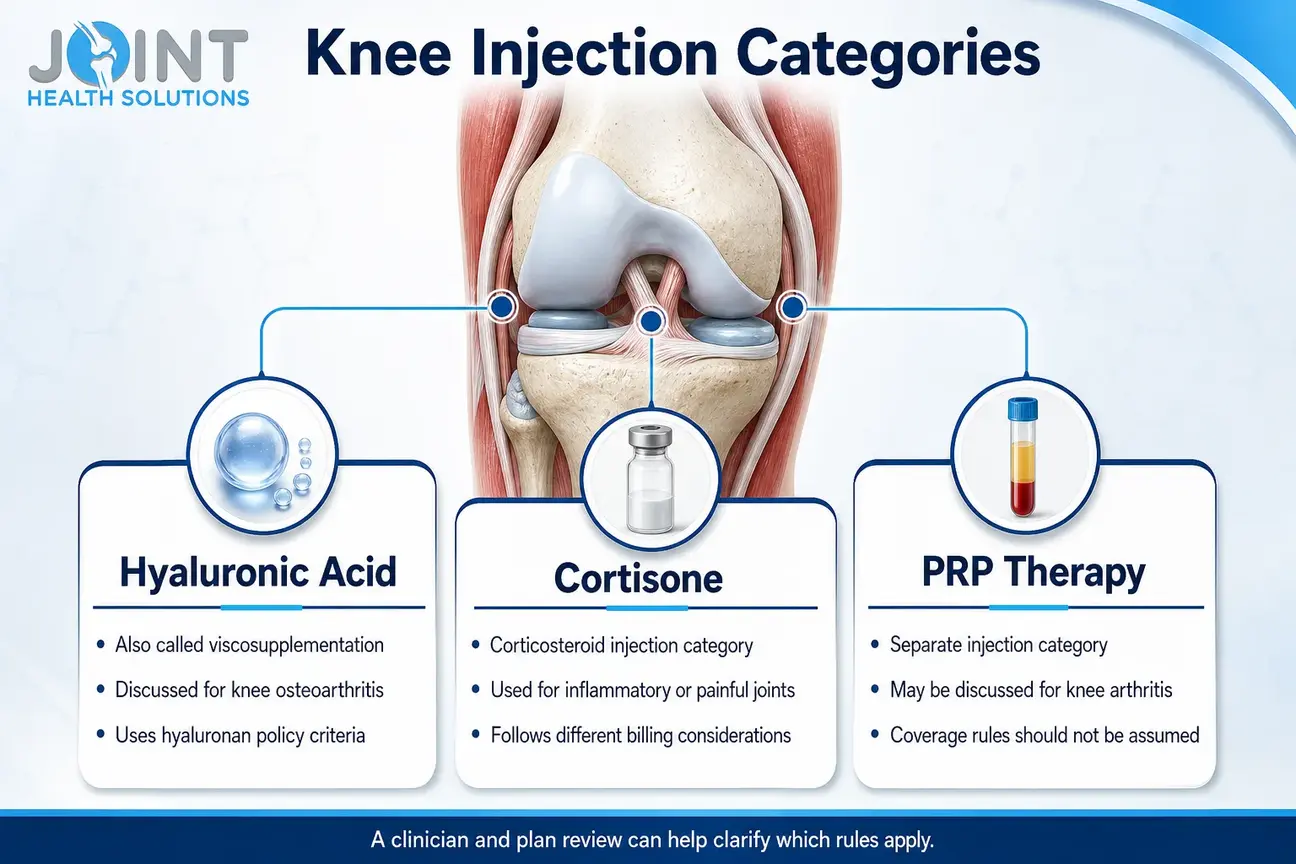
Hyaluronic acid injections, cortisone injections, and PRP therapy are different injection categories. They may all be discussed in the context of knee pain or arthritis, but Medicare coverage rules should not be assumed to be the same across them. This distinction is especially important for patients comparing options online.
Cortisone injections are corticosteroid injections. They are not viscosupplementation. They may be considered for certain inflammatory or painful joint conditions when clinically appropriate, but they follow different clinical reasoning and billing considerations than hyaluronic acid. A patient should not assume that Medicare’s hyaluronan policy tells the whole story for cortisone.
PRP therapy is also different. CMS has a separate PRP policy, and Medicare’s national PRP coverage is limited to a narrow wound-care use under specific requirements, not routine orthopedic PRP injections for knee osteoarthritis. That means PRP should not be described as the same Medicare-covered benefit as knee viscosupplementation.
Hyaluronic acid injections are specifically addressed in the CMS knee hyaluronan policy for knee osteoarthritis. PRP is addressed under a different policy framework. Cortisone is a different medication category. Keeping those categories separate helps patients ask better questions and avoid misunderstandings about coverage for Medicare hyaluronic acid knee injections.
| Injection type | Common reason patients ask about it | Coverage caution |
|---|---|---|
| Hyaluronic acid / viscosupplementation | Knee osteoarthritis symptoms and function limits | Medicare policy may apply when all knee hyaluronan criteria are documented. |
| Cortisone | Inflammation-related joint pain or arthritis symptoms | Different medication category; do not assume the same documentation rules as viscosupplementation. |
| PRP | Regenerative or biologic therapy questions | Not the same Medicare benefit as knee hyaluronan injections; orthopedic PRP coverage is limited under Medicare policy. |
Original Medicare, Medicare Advantage, and patient responsibility
Original Medicare and Medicare Advantage are not identical from a patient-administration standpoint. Original Medicare coverage is guided by Medicare policy, including applicable LCDs and articles. Medicare Advantage plans must cover Medicare Part A and Part B benefits, but plans can apply their own network, authorization, and cost-sharing rules within Medicare requirements.
For Medicare hyaluronic acid knee injections, this means a patient with a Medicare Advantage plan may need to confirm whether the clinic is in network, whether prior authorization is required, what documentation the plan requests, and what cost sharing applies. Approval processes can vary by plan, and approval is not the same as a final payment assurance in every situation.
Medigap is different from Medicare Advantage. A Medigap policy generally helps pay certain out-of-pocket costs for services Original Medicare already covers. It does not turn a noncovered service into a covered one. Patients with Medigap should still confirm whether the underlying service is covered by Original Medicare.
An Advance Beneficiary Notice of Noncoverage, often called an ABN, may apply in some Original Medicare situations when a provider expects Medicare may deny payment for a potentially covered service. An ABN is not a coverage decision and does not promise how Medicare will process a claim. Whether an ABN is appropriate depends on the situation.
What if prior authorization is requested?
Prior authorization means a plan wants information before the service is performed. It does not automatically mean the service will be approved, and approval does not remove all patient responsibility. Patients should ask for plan-specific information in writing when possible, including whether the authorization applies to the exact procedure, knee, product, and date range.
If a plan denies coverage, patients can ask the plan how appeals work. Appeal rights and timelines depend on the plan and type of decision. A denial should be reviewed carefully because it may involve missing documentation, plan criteria, coding issues, network rules, or a determination that the service was not covered under the circumstances.
When to request a clinical assessment
A clinical assessment is appropriate when knee pain, stiffness, swelling, or mobility limits are affecting daily life and you want to understand conservative care options. An assessment does not promise that Medicare hyaluronic acid knee injections are appropriate or covered. It helps determine whether knee osteoarthritis appears to be part of the problem and whether viscosupplementation should be discussed.
At Joint Health Solutions, patients able to visit the Charlotte clinic can call 704-833-3566 or schedule a consultation. The practice provides conservative, minimally invasive, non-surgical joint care, and individual plans may include assessment, injections, physical therapy, braces, IV therapies, or nutrition support when appropriate.
If you are preparing for a visit, bring your Medicare card or plan card, a list of medications, prior treatment records, imaging reports if available, and any details about previous injections. If you have had a prior hyaluronic acid series, try to bring the dates, the treated knee, and notes about whether symptoms improved and later returned.
Patients researching knee injections should also be ready to discuss goals. Some people want to walk longer, stand more comfortably, use stairs with less limitation, or remain active with less disruption. Treatment decisions should be personalized, evidence-informed, and based on clinical assessment.
Practical checklist before treatment
Before moving forward with viscosupplementation, it can help to organize the coverage and care questions in one place. This does not replace a plan verification process, but it can make conversations clearer.
- Confirm the diagnosis being treated. Medicare hyaluronic acid knee injections are addressed for knee osteoarthritis, not every cause of knee pain.
- Document functional impact. Be specific about walking, standing, stairs, work tasks, exercise, or other activities affected by symptoms.
- Review prior conservative care. Share what you have tried, what helped, what did not help, and what you could not tolerate.
- Clarify first series versus repeat series. Repeat treatment has additional documentation and timing considerations.
- Ask about plan rules. Medicare Advantage plans may require prior authorization, network review, or specific forms.
- Separate injection categories. Do not assume PRP, cortisone, and hyaluronic acid follow the same coverage pathway.
- Discuss costs before treatment. Covered and out-of-pocket costs should be reviewed before care begins, and patients should verify details with the practice and insurer.
Key takeaways for patients comparing coverage
Medicare hyaluronic acid knee injections are more accurately understood as a conditional coverage topic. CMS policy may support coverage for symptomatic knee osteoarthritis when all required criteria are documented, but diagnosis alone is not enough. The medical record should support why the injection series is reasonable and necessary.
Initial and repeat series are not evaluated the same way. A first series must be supported by the patient’s diagnosis, symptoms, function, and care history. A repeat series typically requires documentation of prior benefit, recurrent symptoms, and appropriate timing. Patients can help by keeping prior injection dates and response details organized.
PRP, cortisone, and hyaluronic acid injections should not be lumped together. Each category has different clinical uses and coverage considerations. Medicare’s narrow PRP wound-care policy should not be described as coverage for routine orthopedic PRP injections.
Finally, plan type matters. Original Medicare, Medicare Advantage, and Medigap can affect the administrative process and patient responsibility. A careful approach is to confirm details with the practice and the insurer before treatment, and to avoid relying on general internet statements as a coverage promise for Medicare hyaluronic acid knee injections.
For general education only; not a substitute for professional medical advice, diagnosis, or treatment. Suitability and results vary, and individual needs require clinical assessment.
Frequently Asked Questions
Does Medicare cover hyaluronic acid knee injections for osteoarthritis?
Medicare may cover Medicare hyaluronic acid knee injections for symptomatic knee osteoarthritis when the applicable CMS policy criteria are met and documented in the medical record. Coverage is not automatic from a diagnosis alone, and plan rules may still apply.
What does Medicare usually want documented before approving a series?
The record generally needs to support knee osteoarthritis, symptoms, functional impact, prior care history, and the clinical reason viscosupplementation is being considered. The exact documentation should be checked against the current CMS policy and any plan-specific requirements.
Why does Medicare care whether this is my first series or a repeat series?
A repeat series has additional policy considerations. Medicare policy looks at whether symptoms returned, whether the prior series improved pain or function, and whether the required timing criteria are met. Prior dates and response details can be important.
Is PRP covered the same way as hyaluronic acid injections?
No. PRP and hyaluronic acid injections are different categories. CMS has a separate PRP policy, and Medicare’s national PRP coverage is limited to a narrow wound-care use, not routine orthopedic PRP injections for knee osteoarthritis.
Are cortisone injections the same as viscosupplementation?
No. Cortisone injections are corticosteroid injections, while viscosupplementation uses hyaluronic acid or hyaluronan products. They may both be discussed for joint symptoms, but they are different treatments and should not be assumed to have the same coverage rules.
Does Medicare Advantage handle hyaluronic acid injections differently from Original Medicare?
Medicare Advantage plans must cover Medicare Part A and Part B benefits, but they can have plan-specific networks, prior authorization rules, and cost-sharing requirements. Patients should request plan-specific confirmation before treatment.
What if my plan asks for prior authorization?
Prior authorization means the plan wants information before treatment. Ask what documentation is required, whether the authorization applies to the exact procedure and date range, and what cost sharing may apply. Approval is not always a final payment assurance.
Can a Medigap plan make a noncovered injection covered?
Generally, no. Medigap usually helps pay certain costs for services Original Medicare covers. It does not usually convert a service Original Medicare excludes or denies into a covered benefit.
Sources
- CMS Local Coverage Determination: Hyaluronic Acid Injections for Knee Osteoarthritis
- CMS Article: Hyaluronic Acid Injections for Knee Osteoarthritis
- CMS Article: Intraarticular Knee Injections of Hyaluronan
- CMS Local Coverage Determination: Platelet Rich Plasma Injections for Non-Wound Injections
- CMS Medicare Advantage information
- CMS Advance Beneficiary Notice of Noncoverage information