
Living with chronic joint pain—whether it manifests as a deep ache in your knees, a restrictive pinch in your shoulders, or a sharp, localized gridlock within your hips—can be an exhausting and deeply isolating experience. For many individuals, daily life becomes a series of calculations designed to minimize movement. You may have already tried periods of extended rest, relied on over-the-counter anti-inflammatory medications, and perhaps even completed a standard round of physical therapy. When those efforts fail to provide lasting relief, it is easy to assume that major, invasive joint replacement surgery is the only remaining option on the table.
However, orthopedic medicine has advanced significantly over the past two decades. Major surgical interventions are no longer the automatic next step for chronic joint issues. Modern regenerative medicine, high-precision image-guided injections, advanced offloading bracing systems, and targeted intravenous anti-inflammatory therapies now offer effective, long-lasting pain relief. These evidence-based solutions allow many patients to safely restore their physical mobility without facing the inherent risks, extensive recovery periods, or high financial burdens associated with total joint arthroplasty.
At Joint Health Solutions, we focus on providing evidence-based, non-surgical treatment options for individuals dealing with osteoarthritis, chronic tendinopathies, and complex degenerative joint conditions. This comprehensive guide serves as an educational resource to help you understand the non-surgical options available, the scientific data supporting their use, and how our clinical team combines these treatments into a customized recovery pathway.
While advanced surgical procedures like arthroscopy, osteotomies, and total joint replacements are valuable tools for severe structural failure, they should be considered a final line of defense rather than an immediate answer. Opting for a comprehensive non-surgical path first offers several clear clinical benefits:
Elimination of Anesthesia Risks: Bypassing general or spinal anesthesia protects patients from potential cardiovascular strains, pulmonary complications, or temporary post-operative cognitive decline.
Preservation of Native Joint Anatomy: Non-surgical interventions involve no surgical incisions, preventing the formation of deep scar tissue or permanent alterations to your natural bone and ligament structures.
Minimized Recovery Downtime: The vast majority of image-guided injections and advanced cell therapies allow patients to safely return to light daily activities on the very same day, avoiding months of painful post-operative rehabilitation.
Favorable Economic Profile: Non-surgical treatment tracks involve a fraction of the total cost associated with major hospital-based operations, helping patients maximize their healthcare investments.
Long-Term Joint Preservation: Many patients successfully manage their arthritic or tendinopathy symptoms for years, or even decades, delaying or entirely avoiding major joint reconstructions.
Furthermore, even if a patient ultimately requires a joint replacement down the road due to advanced structural damage, participating in a comprehensive non-surgical care plan helps optimize outcomes. Controlling systemic joint inflammation, building muscular strength, and managing weight before an operation—a process known as pre-habilitation—directly supports a safer and faster post-surgical recovery.
Regenerative medicine focuses on restoring joint function by supporting cellular health and improving internal joint lubrication. Rather than simply masking symptoms, these advanced therapies alter the biological environment within a damaged joint capsule.
Platelet-Rich Plasma therapy utilizes your body’s native healing mechanisms to manage joint pain. The procedure begins with a standard, low-volume blood draw from your arm. The blood sample is then processed in a specialized centrifuge, which isolates and concentrates your platelets, growth factors, and active signaling proteins. This concentrated solution is then precisely injected directly into the damaged joint or tendon under image guidance.
Once introduced, the concentrated PRP solution works through several pathways:
Modulating Inflammatory Pathways: It helps down-regulate destructive pro-inflammatory cytokines, replacing a chronic inflammatory environment with a stable, healing environment.
Cellular Recruitment: It signals and attracts native mesenchymal stem cells and specialized healing cells to the site of injury.
Supporting Tissue Repair: It introduces growth factors that help cartilage cells (chondrocytes) and tendon fibers repair micro-damage.
Best Clinical Indications: PRP is highly effective for treating mild-to-moderate knee or shoulder osteoarthritis, chronic rotator cuff tendinopathies, lateral epicondylitis (tennis elbow), and select vascular-zone meniscus tears.
What the Clinical Evidence Shows: Multiple large-scale randomized controlled trials confirm that high-quality leukocyte-rich or leukocyte-poor PRP formulations consistently outperform traditional cortisone shots and basic lubricants, providing robust pain relief that lasts from 6 to 18 months. Learn more about this treatment on our PRP Therapy page.
Hyaluronic acid is a naturally occurring, viscous fluid produced by your synovial membrane to lubricate healthy joint structures. In a joint affected by progressive osteoarthritis, this natural fluid becomes diluted, fragmented, and loses its thick, shock-absorbing qualities. This fluid breakdown leads to increased friction, bone-on-bone grinding, and persistent inflammation.
Viscosupplementation involves injecting high-molecular-weight hyaluronic acid gel directly into the joint space. This treatment acts as a biological lubricant, coating worn cartilage surfaces, reducing mechanical friction, and supporting the shock-absorbing properties of your joint fluid.
Best Clinical Indications: This approach is FDA-approved and highly effective for managing mild-to-moderate knee osteoarthritis, and it is also utilized to relieve symptoms in hip and shoulder joints.
What the Clinical Evidence Shows: Comprehensive clinical meta-analyses confirm that a structured series of high-molecular-weight HA injections provides significant reductions in walking pain and joint stiffness for 6 to 12 months with an excellent patient safety profile. Explore these treatments further by visiting our Hyaluronic Acid Injections platform.
When acute pain spikes or deep joint structures become difficult to target, our providers utilize specialized interventional injections to restore comfort and function.
Corticosteroid injections are powerful anti-inflammatory medications designed to rapidly suppress intense, localized inflammation. They are an ideal treatment option for managing acute arthritis flare-ups—such as when a joint becomes suddenly swollen, warm, and highly painful.
While cortisone is exceptionally effective at providing rapid pain relief, it does have specific structural limitations. Repeated, high-frequency cortisone use can potentially weaken cartilage matrix structures and reduce the cellular integrity of nearby tendons over time. Because of this, we carefully limit these treatments to 2 to 3 applications per year per joint, using them strategically to establish a comfortable window for physical rehabilitation.
For deep, complex, or structurally narrow joint spaces—such as the ball-and-socket mechanism of the hip, the irregular pathways of the sacroiliac (SI) joint, or the small facet joints of the spine—anatomical precision is critical. Utilizing traditional, unguided landmark injections in these deep spaces can result in error rates between 20% and 40%.
To maximize patient safety, we perform these deep procedures under live fluoroscopic (real-time X-ray) guidance. This technology allows our providers to visualize the exact path of the needle on a high-definition monitor throughout the procedure. This image-guided approach increases injection accuracy to over 95%, ensuring the therapeutic medication is delivered exactly where it is needed. Explore this technology on our Fluoroscopy-Guided Injections page.
Chronic joint pain rarely exists in isolation; it frequently causes changes in the surrounding muscle tissue. When a joint is arthritic or structurally unstable, the surrounding muscles often contract defensively to protect the area. Over time, this chronic tension can lead to hyperirritable muscle knots known as myofascial trigger points. These knots can cause persistent referred pain that mimics or worsens your primary joint discomfort.
During a quick in-office trigger point injection, a very fine needle is introduced directly into the muscle knot to deliver a local anesthetic like lidocaine. This treatment mechanically disrupts the localized spasm, induces immediate muscle relaxation, and helps break the cycle of chronic muscle guarding. Read about this supportive therapy on our Trigger Point Injections resource center.
External orthopedic devices provide a safe, risk-free way to alter the mechanical forces moving through your joints during daily weight-bearing activities.
For individuals dealing with unicompartmental knee osteoarthritis—where cartilage wear is concentrated on just one side of the joint (most commonly the inner medial compartment)—an offloading knee brace can be a highly effective tool.
These specialized medical devices utilize a sophisticated three-point pressure system. By applying a continuous, corrective force across the joint axis, the brace physically widens the compressed, arthritic section of the knee during movement. This mechanical correction shifts your body weight away from the damaged, bone-on-bone cartilage and redistributes it onto the healthier, intact cartilage on the opposite side of the knee.
What the Clinical Evidence Shows: Comprehensive systematic reviews confirm that properly calibrated offloading braces significantly reduce walking pain, improve gait mechanics, and enable many patients to comfortably delay total joint surgery for several years.
Discover our custom options on our dedicated Offloading Knee Braces page.
Orthopedic support extends far beyond the knee complex. Our clinic provides a full range of custom-fitted and medical-grade off-the-shelf bracing options designed to stabilize various joints across the body:
Chronic joint pain can also be influenced by systemic factors within the body, including metabolic stress, chronic physiological tension, and elevated baseline inflammatory markers. Bypassing the digestive tract entirely, targeted Intravenous (IV) Therapies quickly deliver high-dose micronutrients and vital coenzymes directly into the bloodstream to help manage systemic inflammation.
Our custom Anti-Inflammatory IV therapies deliver a concentrated blend of high-dose Vitamin C, powerful antioxidants like Glutathione, and essential minerals including Zinc and Magnesium. This formulation neutralizes damaging free radicals, down-regulates inflammatory cytokines, and supports cellular repair pathways throughout the body. This treatment track is particularly helpful for individuals with elevated C-Reactive Protein (CRP) markers or those recovering from orthopedic procedures. Most patients notice a reduction in generalized joint aching and improved physical energy within 24 to 72 hours.
Nicotinamide Adenine Dinucleotide (NAD+) is an essential cellular coenzyme found within every living cell. It plays a foundational role in supporting mitochondrial energy production (ATP synthesis), driving DNA repair mechanisms, and activating sirtuin proteins that control inflammation.
Because managing chronic pain and enduring physiological stress actively depletes your body’s natural NAD+ reserves, restoring these coenzyme levels intravenously can help improve joint comfort. NAD+ therapy helps improve cellular energy production, reduce pain sensitivity, and support overall tissue recovery. It is especially recommended for individuals managing diffuse conditions like fibromyalgia, chronic fatigue syndrome, or persistent joint inflammation that has not responded fully to standard local treatments. Discover our complete infusion menu by visiting our Anti-Inflammatory IV Therapy page.
While advanced interventional injections, regenerative cell therapies, and customized orthotic bracing are highly effective tools, they are designed to support—rather than replace—the foundational benefits of physical therapy and lifestyle medicine. Long-term joint preservation relies on building a balanced musculoskeletal system.
Targeted Muscular Strengthening: Specialized exercise programs focus on building strength in the quadriceps, hamstrings, gluteal complexes, and rotator cuff groups. Developing strong, resilient muscle groups creates a supportive structure around your joints, absorbing daily impact forces and reducing physical stress on vulnerable cartilage.
Strategic Weight Management: The physics of human locomotion are direct: every single pound of excess body weight lost removes approximately four pounds of cumulative pressure from the knee joints during normal walking. Combining a structured weight management program with orthopedic care helps ease the mechanical load on lower extremity joints, preserving remaining cartilage.
Low-Impact Aerobic Conditioning: Engaging in regular low-impact activities—such as fitness walking, dedicated road cycling, elliptical training, or swimming—helps stimulate the production of lubricating synovial fluid within your joint capsules. This consistent movement supports joint mobility and helps naturally manage baseline inflammation.
Ergonomic and Postural Guidance: Correcting everyday movement patterns—including rounding of the shoulders, slumped sitting postures, and improper lifting mechanics—helps eliminate repetitive micro-stress on your tendons and ligaments.
At Joint Health Solutions, we work closely with a trusted network of specialized physical therapists throughout the Charlotte region. This collaborative approach ensures your in-office treatments are supported by a coordinated, home-based rehabilitation program.
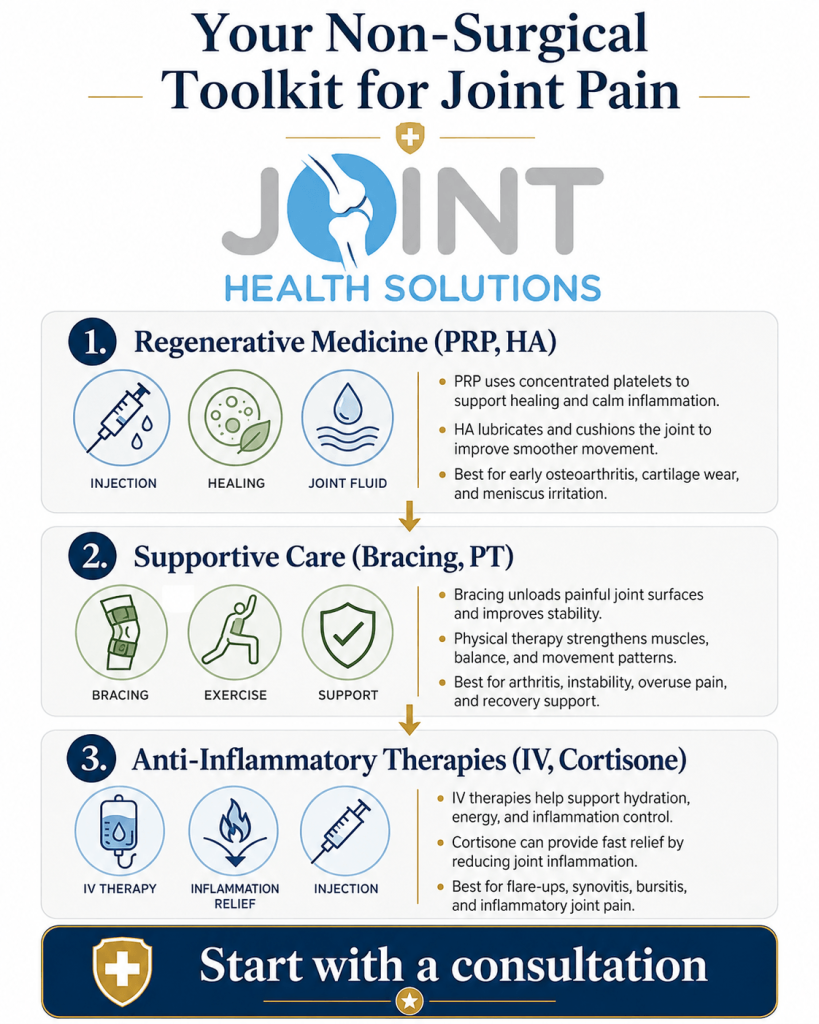
Every patient’s joint structure and lifestyle goals are completely unique, which is why we avoid a one-size-fits-all approach to care. Instead, we guide our patients through a logical, step-by-step treatment pathway designed to maximize relief while minimizing procedural intensity:
We believe in building a strong clinical foundation before moving to more advanced interventions. Here is how your long-term treatment plan unfolds:
Detailed medical history, comprehensive physical exam, and in-depth weight-bearing imaging review.
Structured physical therapy, metabolic weight management support, and custom orthopedic bracing.
Advanced Platelet-Rich Plasma (PRP) therapy or lubricating hyaluronic acid joint injections.
Strategic cortisone injections or intensive anti-inflammatory IV antioxidant drips to break severe pain cycles.
Annual treatment checks, ongoing customized exercise regimens, and continuous cartilage preservation strategies.
By combining these evidence-based non-surgical tools into a personalized, multi-modal care plan, many patients find they can comfortably protect their natural joints, maintain an active lifestyle, and safely avoid major joint replacement surgery for years or even decades.
There is no single “best” non-surgical treatment, as the ideal approach depends on your unique joint anatomy and goals. Early-stage, mild osteoarthritis often responds very well to lubricating hyaluronic acid injections paired with a supportive knee sleeve. Moderate-to-advanced joint changes, on the other hand, often achieve better results with advanced Platelet-Rich Plasma (PRP) therapy combined with a custom-molded offloading knee brace. Your care team will customize a plan based on your specific grade of arthritis, baseline activity levels, and personal treatment preferences.
Yes, absolutely. In fact, combining complementary treatments often yields better results than relying on a single therapy alone. For example, pairing a regenerative PRP injection with a custom offloading knee brace and a structured physical therapy program targets joint recovery from multiple angles—reducing inflammation, improving mechanical alignment, and building muscle support simultaneously. Our providers specialize in designing comprehensive, multi-modal care plans tailored to your needs.
For Platelet-Rich Plasma (PRP) therapy, our standard protocol usually begins with an initial series of 1 to 3 targeted injections, followed by single maintenance sessions as required, typically on an annual basis. For hyaluronic acid (HA) viscosupplementation, treatment can be delivered as a single high-molecular-weight injection or as a brief series of 3 to 5 weekly sessions, which can be repeated every 6 to 12 months depending on your symptoms.
Traditional non-surgical interventions—including targeted cortisone injections, diagnostic fluoroscopy guidance, medical-grade extremity bracing, and physical therapy referrals—are widely covered by most commercial health insurance providers and Medicare. Advanced treatments like regenerative PRP injections, hyaluronic acid gel alternatives, and anti-inflammatory IV nutrient therapies are typically categorized as elective wellness procedures and may not be covered by insurance. To help keep care accessible, our office provides transparent self-pay rates and convenient multi-session package pricing.
If you are dealing with advanced, bone-on-bone joint destruction, experience severe pain even while resting, or find that a comprehensive non-surgical care plan provides little to no improvement in your daily quality of life, a surgical evaluation may be the appropriate next step. Our medical team is committed to providing honest, transparent guidance during your evaluations, and we will let you know if a surgical referral is the best option for your joint health.
Yes, definitely. Many patients experience ongoing discomfort or dynamic instability after undergoing treatments like an arthroscopic meniscus trimming or a surgical ligament reconstruction. In these situations, non-surgical modalities like PRP injections, custom offloading braces, and targeted anti-inflammatory IV infusions can be highly effective tools to help stabilize the joint, lower tissue irritation, and manage residual pain.
The duration of your relief depends on the specific treatment and your lifestyle factors. Generally, a premium PRP injection series provides relief for 6 to 18 months, while hyaluronic acid gel treatments typically last between 6 to 12 months. Advanced offloading knee braces offer immediate and sustainable pain relief for as long as you wear the device during weight-bearing activities. The benefits of anti-inflammatory IV infusions can last for several weeks to months and tend to accumulate over a multi-session treatment plan.
All medical procedures involving an injection carry a very low risk of localized infection, minor bleeding, or brief bruising at the needle site. Regenerative options like PRP and natural HA lubricants carry a minimal risk of allergic response because they are biocompatible. Orthopedic bracing options are completely non-invasive and risk-free, though they do require an accurate, professional fitting to prevent skin rubbing or pressure points.
Yes. Managing common chronic health conditions like Type 2 diabetes, essential hypertension, or cardiovascular disease typically does not prevent you from receiving non-surgical joint care. Our medical team completes a thorough health screening before any procedure and coordinates directly with your primary care physicians or cardiologists to ensure your treatment plan is completely safe.
Getting started is simple. Contact our office line or log into our online patient scheduling portal to arrange an initial consultation. Our specialized team will thoroughly evaluate your joint health, review your existing diagnostic images, discuss your daily lifestyle goals, and design a personalized, non-surgical care plan tailored to your recovery.

A board-certified physician in Emergency Medicine and Obesity Medicine with over 25 years of experience

A board-certified Family Nurse Practitioner with over 12 years of nursing experience