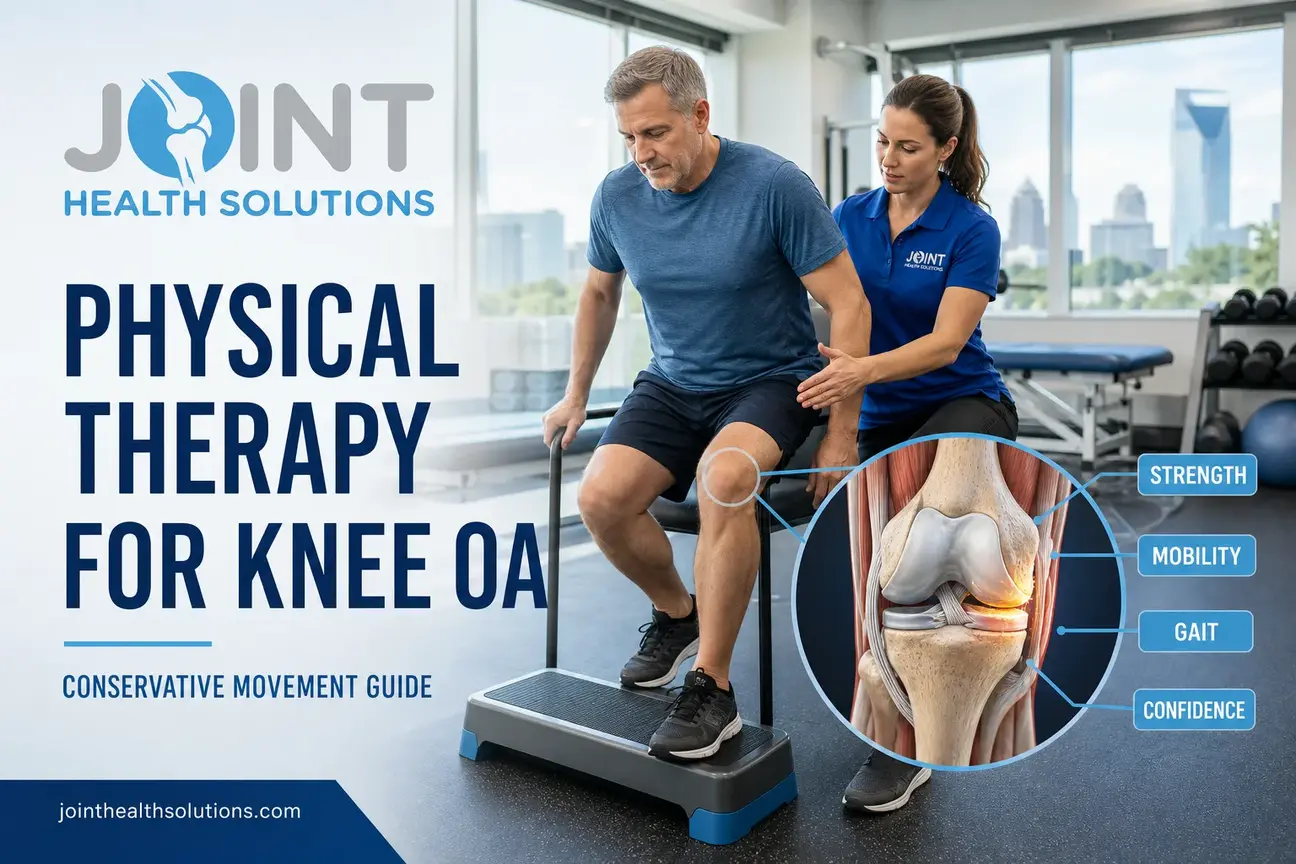
Physical Therapy for Knee Osteoarthritis: What Helps
Quick Answer: physical therapy for knee osteoarthritis is one of the most evidence-supported conservative options for adults with symptomatic knee arthritis. It may help improve pain, strength, walking tolerance, balance, and daily function, especially when exercise is progressive, realistic, and continued over time. It cannot promise to reverse arthritis, remove the need for future care, or work the same way for every person. If symptoms are worsening, unusual, or limiting everyday life, a clinical assessment can help match the plan to the knee and the person.
For adults in north Charlotte who want conservative care before considering injections or more invasive options, Joint Health Solutions offers individualized evaluation and physical therapy as part of a patient-centered care model. You can request an appointment if knee pain is keeping you from walking, stairs, work, exercise, or other daily activities.
Why physical therapy for knee osteoarthritis is often the first conservative step
Knee osteoarthritis is a joint condition, not simply a “wear and tear” problem. The knee may feel painful, stiff, swollen, weak, unstable, or hard to trust during stairs, standing, squatting, or walking. A good plan does not focus only on the joint surface. It also considers strength, flexibility, balance, gait, activity habits, body mechanics, confidence, and the daily tasks that matter to you.
That is why physical therapy for knee osteoarthritis is usually exercise-centered. Exercise can be adapted for different fitness levels and symptom patterns. It can start gently, progress gradually, and continue at home after supervised visits end. The goal is not to “push through” severe pain. The goal is to improve the knee’s capacity to handle activity while respecting symptoms and medical findings.
Guidelines are consistent on this point. The American Academy of Orthopaedic Surgeons 2021 guideline on osteoarthritis of the knee states that supervised exercise, unsupervised exercise, and aquatic exercise are recommended over no exercise to improve pain and function. The AAOS also notes that manual therapy in addition to exercise may be used to improve pain and function in knee osteoarthritis.
The American College of Rheumatology’s 2026 osteoarthritis guideline summary also uses strong exercise-focused language, including that clinicians “strongly recommend exercise” and “should refer to physical therapy” for osteoarthritis care when appropriate. The same 2026 ACR summary conditionally recommends tibiofemoral and patellofemoral knee braces, reinforcing that exercise, PT referral, and selected bracing can all have roles within individualized conservative care.
The practical message is reassuring: movement is not automatically harmful just because an X-ray shows arthritis. Many adults with knee osteoarthritis can benefit from a symptom-guided program that builds strength, restores tolerance for daily activities, and teaches ways to manage flares. The exact plan should depend on clinical assessment, current activity level, knee irritability, other health issues, and personal goals.
What physical therapy for knee osteoarthritis can realistically improve
Physical therapy for knee osteoarthritis is not designed to regrow cartilage or reverse all structural changes. It is designed to help the person function better with the knee they have. That distinction matters because it sets realistic expectations and helps reduce fear around movement.
Exercise-based care may help with:
- Pain control: not necessarily complete relief, but often a more manageable pain pattern during daily activity.
- Strength: especially in the quadriceps, hamstrings, hips, calves, and trunk, which can affect knee loading and control.
- Walking tolerance: including confidence with distance, uneven ground, or longer errands.
- Stair function: because step-down control and hip-knee alignment often improve with training.
- Balance and stability: which may reduce the feeling that the knee is unreliable.
- Mobility: including knee extension, flexion, calf flexibility, and hip motion when these are limited.
- Self-management: knowing how to pace activity, respond to flares, and continue exercise safely.
Improvements are usually gradual. Some people notice better confidence early because they understand what to do and what to avoid. Others need more time because pain, swelling, weakness, fear of movement, or long-standing inactivity make progress slower. Results vary, and the plan may need to be adjusted along the way.
The AAOS 2021 summary materials reinforce that exercise is recommended over no exercise for improving pain and function in knee osteoarthritis. The ACR 2026 summary similarly says clinicians “strongly recommend exercise” and “should refer to physical therapy,” which supports PT as a core conservative option. That does not mean every exercise is right for every knee. It means a properly chosen exercise plan is a core part of evidence-informed conservative care.
Exercise therapy for knee osteoarthritis: what the evidence supports
Exercise therapy for knee osteoarthritis is an umbrella term. It may include strengthening, aerobic conditioning, range-of-motion work, neuromuscular training, balance training, aquatic exercise, walking plans, and functional practice. Research and guidelines generally support exercise as a category, but they do not identify one perfect routine that is superior for every person. No single PT recipe has been proven to be ideal for every person with knee osteoarthritis, so the plan should be individualized and adjusted over time.
Within physical therapy for knee osteoarthritis, the exercise plan should connect evidence to the person’s actual limitations. A program for someone who struggles with stairs may look different from a program for someone whose main goal is longer walks, gym exercise, or returning to recreational activity.
The American Physical Therapy Association clinical practice guideline library points clinicians and patients toward evidence-based treatment guidance for knee osteoarthritis. In practical terms, that evidence supports a plan that is progressive, tolerable, and tied to meaningful function rather than a random list of exercises.
Strengthening is often central because stronger muscles can help control joint forces during walking, stairs, standing, and transfers. Quadriceps strengthening is commonly emphasized, but the hip muscles, hamstrings, calf muscles, and trunk may also matter. If the hip drops inward, the foot collapses, or the thigh rotates during movement, the knee may experience more strain. PT can identify those patterns and modify the program.
Aerobic exercise also matters. Walking, cycling, pool walking, low-impact cardio machines, and other tolerable activities may support endurance and general health. For some people, the limiting factor is not one painful step but the loss of confidence over longer activity. A graded aerobic plan can rebuild tolerance without making the knee feel overloaded.
Mobility and flexibility work may be included when stiffness changes the way the knee moves. For example, limited knee extension can affect walking mechanics, while limited flexion can affect stairs and sitting. Mobility work should be specific and symptom-guided rather than aggressive stretching that irritates the joint.
Manual therapy can be used as an add-on, not a replacement for active care. Hands-on techniques may help some people move more comfortably or tolerate exercise better, but long-term management usually depends on consistent movement, strength, education, and activity planning.
Supervised PT, home exercise, and aquatic exercise compared
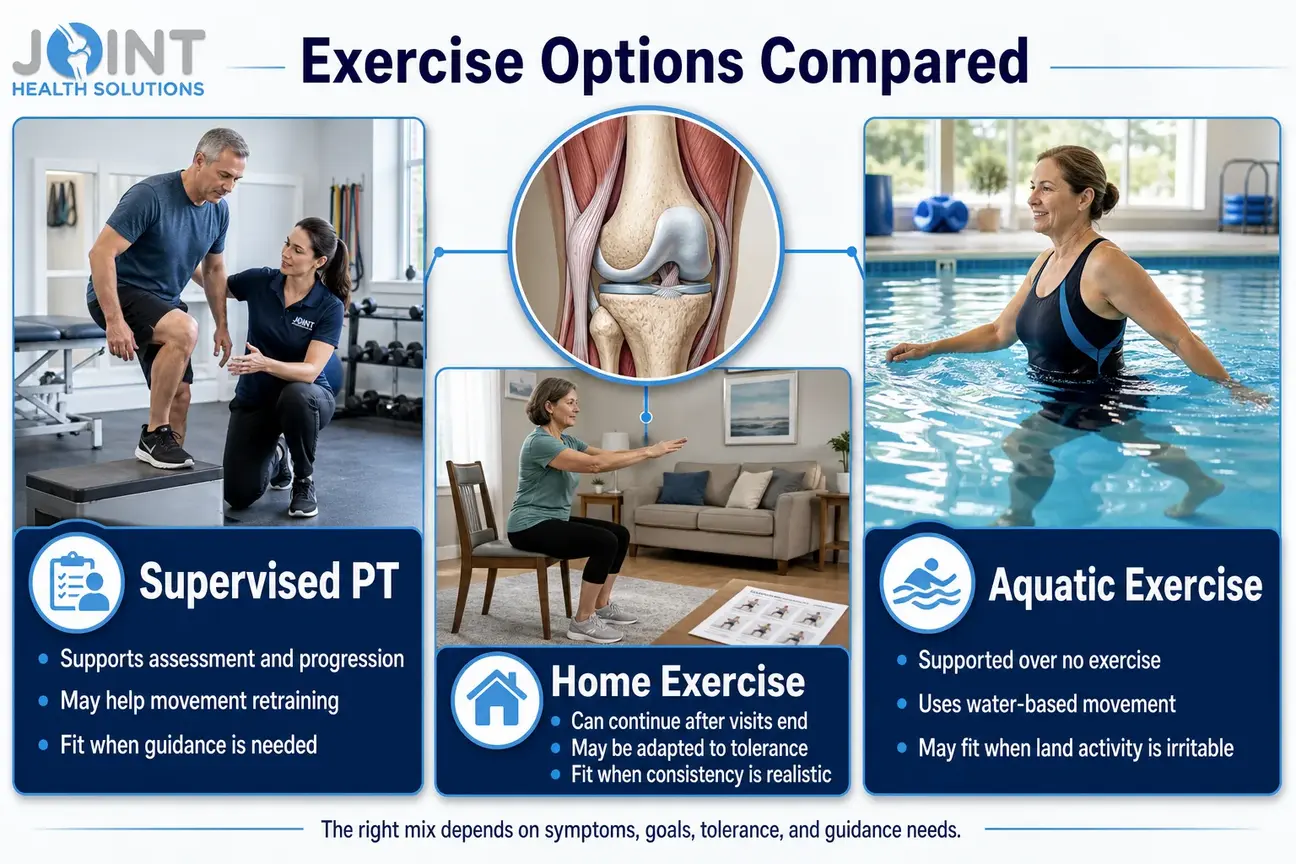
Many adults ask whether they need supervised physical therapy or whether they can simply do exercises at home. The honest answer is that both can help, and the right mix depends on the person. The AAOS 2021 guideline supports supervised exercise, unsupervised exercise, and aquatic exercise over no exercise for improving pain and function. That gives patients flexibility, but it also makes individualized selection important.
| Option | What it may help with | When it may fit | Important limitation |
|---|---|---|---|
| Supervised PT | Assessment, exercise selection, progression, movement retraining, confidence | Pain limits activity, prior attempts failed, symptoms are complex, or guidance is needed | Progress still depends on follow-through between visits |
| Home exercise | Consistency, long-term maintenance, convenient self-management | Symptoms are stable and the person knows which exercises are appropriate | Exercises may be too easy, too hard, or poorly matched without feedback |
| Aquatic exercise | Lower-impact movement, aerobic work, confidence with painful land activity | Land-based exercise is poorly tolerated or fear of loading is high | It may not fully replace land-based strength and function training for daily tasks |
Supervised PT can be especially useful when pain has changed the way someone moves. A clinician can watch walking, squatting, stair mechanics, knee motion, strength, balance, and symptom response. This helps the plan become more precise than a generic online routine.
Home exercise is still essential. Even when supervised visits are part of the plan, the improvements often come from repeated, tolerable practice over time. A home program should be simple enough to follow but complete enough to matter. Too many exercises can become overwhelming, while too few may not address the main impairments.
Aquatic exercise for knee osteoarthritis can be a helpful bridge when land-based movement is painful or intimidating. Water can reduce the feeling of body weight through the knee, making it easier to move, walk, or practice gentle conditioning. It should be framed as one useful option, not the only option or a promised shortcut.
For many people, physical therapy for knee osteoarthritis combines supervised guidance with a home plan. The clinic visit helps refine the program, while the home routine helps turn the program into a sustainable habit.
Building a knee osteoarthritis exercise program that is realistic
A knee osteoarthritis exercise program should be understandable, progressive, and matched to daily life. If the plan requires equipment you do not have, takes too long, or causes repeated flares, adherence will be difficult. A practical plan usually starts with a few high-value exercises and builds from there.
Common components include:
- Warm-up: gentle cycling, walking, marching, or range-of-motion work to prepare the knee.
- Quadriceps strengthening: exercises that improve knee control during standing, stairs, and transfers.
- Hip strengthening: especially gluteal and side-hip work that supports knee alignment.
- Hamstring and calf strengthening: to support gait, balance, and lower-leg control.
- Balance training: when instability, reduced confidence, or fall concern is present.
- Functional training: sit-to-stand, step-ups, controlled step-downs, lifting mechanics, or walking progression.
- Mobility work: when stiffness limits knee extension, flexion, or comfort with movement.
- Education: pacing, flare management, activity modification, and long-term continuation.
The starting level matters. A person who has severe pain after short walks may begin with seated strengthening, gentle range-of-motion work, pool activity, or short walking intervals. A more active adult may need progressive resistance training, sport-specific movement, or a plan for returning to hills, pickleball, golf, gym workouts, or longer walks.
A good program also has a way to progress. Progression may mean more repetitions, more resistance, longer walking intervals, better control, or more challenging functional tasks. It should not mean increasing everything at once. If pain and swelling increase sharply and stay elevated, the plan may need to be scaled back and reassessed.
Physical therapy for knee osteoarthritis can make this process more structured. Instead of guessing whether discomfort means “stop” or “keep going,” a clinician can help monitor response, adjust the exercise level, and connect the program to walking, stairs, and other daily goals.
Strength work that often matters
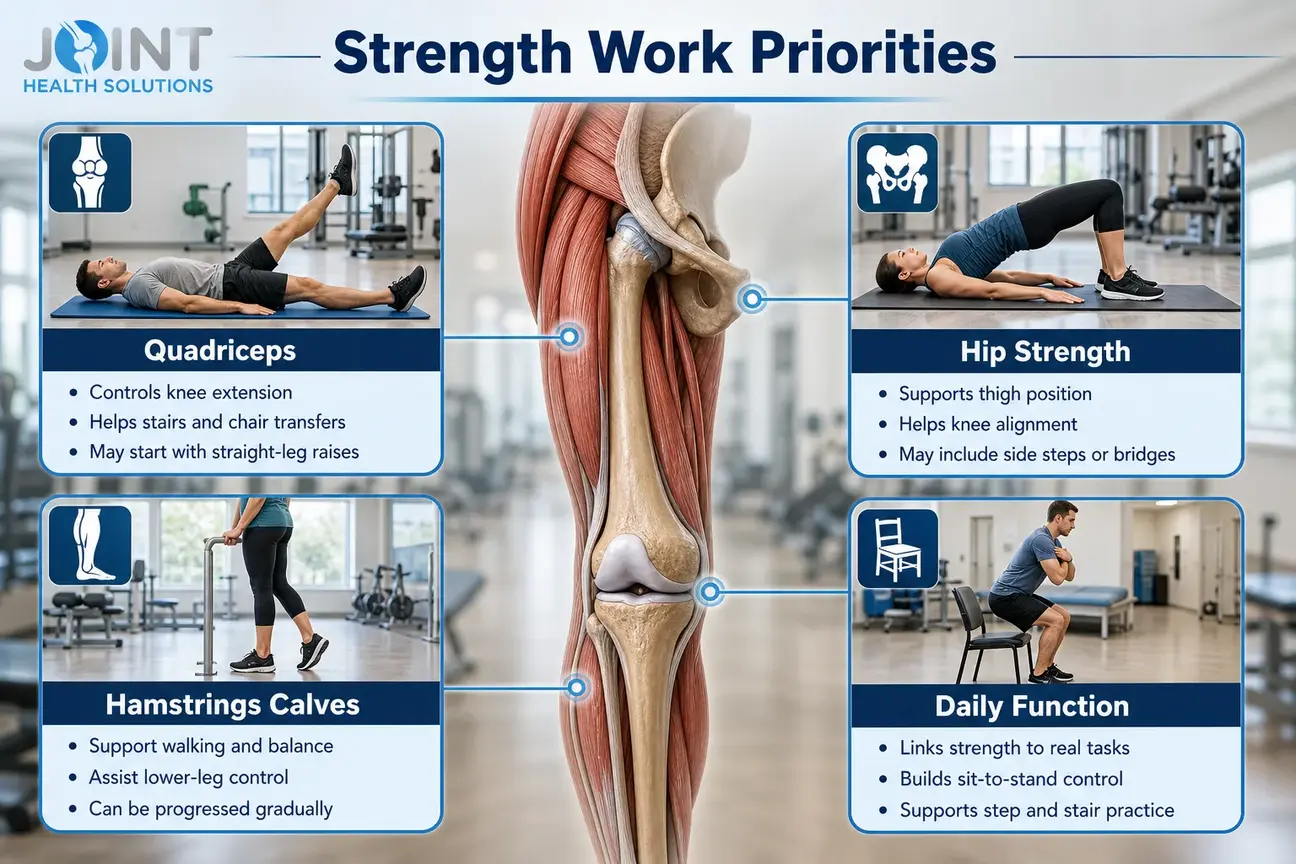
The quadriceps help control knee extension, absorb load, and stabilize the leg during daily movement. Weakness in this muscle group can make stairs, standing from a chair, or downhill walking more difficult. Strengthening may begin with straight-leg raises, short-arc movements, sit-to-stand practice, or leg press variations when appropriate.
Hip strength is also important. The hip abductors and external rotators help control thigh position. If the thigh collapses inward during stairs or squats, the knee may feel more stressed. Side steps, bridges, clamshell-type movements, and supported single-leg control may be used when appropriate.
Hamstrings and calves support walking and balance. They may be trained with bridges, heel raises, gentle curls, step patterns, or other functional drills. The exact exercises should match the person’s irritability, strength, balance, and goals.
Mobility and flexibility without overdoing it
Knee stiffness can make movement feel guarded. Gentle mobility may help, but forceful stretching into pain is not the goal. Many people do better with repeated comfortable movement, supported extension work, calf stretching, or hip mobility than with aggressive knee bending.
Mobility work should answer a functional question: does it help you walk better, straighten the knee more fully, use stairs more comfortably, or sit and stand with less guarding? If a stretch repeatedly causes swelling or pain that lasts into the next day, it may need to be changed.
Functional practice for real life
Exercise carries over more effectively when it connects to daily tasks. A person who struggles with stairs may need step-up and step-down training. Someone who has trouble rising from a low chair may need sit-to-stand practice. A walker who flares after errands may need pacing and walking intervals.
Functional training also helps build confidence. Many people with knee osteoarthritis become protective because they are afraid the knee will worsen. A gradual plan can show which movements are safe, which need modification, and which should wait until strength and control improve.
Aquatic exercise for knee osteoarthritis and when water helps
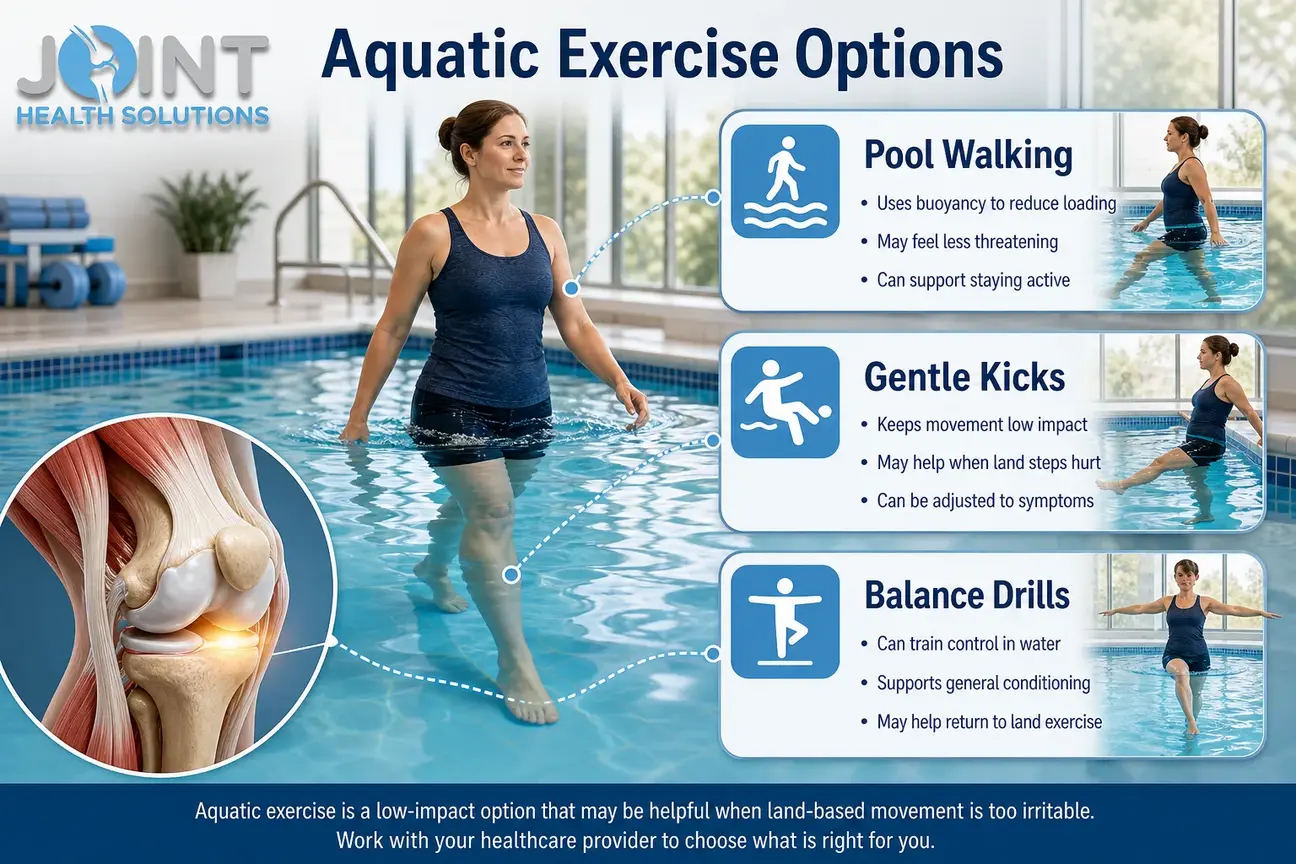
Aquatic exercise for knee osteoarthritis may be useful when the knee is too irritable for a full land-based program. The buoyancy of water can reduce loading and make movement feel less threatening. Pool walking, gentle kicks, step patterns, balance drills, and low-impact conditioning may help some people stay active while symptoms calm down.
Water-based exercise can be especially appealing when a person has pain with every step on land, difficulty starting an exercise habit, or fear that movement will worsen symptoms. It can also support general conditioning, which may make it easier to return to land-based exercise later.
However, aquatic exercise should not always replace land-based activity. Daily life happens on land. Stairs, curbs, chairs, sidewalks, and grocery aisles require strength and control against body weight. For many people, the most practical approach is to use water exercise as one part of a broader plan that gradually includes land-based strength and functional training.
In physical therapy for knee osteoarthritis, water-based activity may be used as a bridge rather than a final destination. The long-term plan often includes land-based strengthening when tolerated, because daily movement requires the knee to manage real-world loading.
What physical therapy for knee osteoarthritis cannot promise
It is important to be clear about limitations. Physical therapy for knee osteoarthritis can be a valuable conservative treatment, but it is not a fix for every symptom or every structural change. It cannot promise complete pain relief, cartilage restoration, permanent symptom control, surgery avoidance, or identical results for every person. Claims like that are not realistic or evidence-based.
Outcomes depend on several factors, including symptom severity, swelling, strength, body mechanics, other medical conditions, consistency with the plan, sleep, stress, weight-bearing demands, and the stage of the joint condition. Some people respond well to exercise and education alone. Others need a broader care plan that may include bracing, medications managed by an appropriate clinician, injections when appropriate, nutrition support, or further medical evaluation.
The goal is not to prove that one conservative option is enough for everyone. The goal is to build a sensible sequence of care. For many adults, that means starting with exercise-based self-management and PT, then considering other non-surgical options if pain and function remain limiting.
How physical therapy for knee osteoarthritis differs from general exercise
General exercise can be valuable, but physical therapy for knee osteoarthritis is more specific than simply telling someone to “move more.” It considers pain behavior, swelling, range of motion, strength deficits, balance, gait, confidence, and the activities that are most limited.
That specificity matters when symptoms are sensitive. A person may tolerate cycling but not hills, sit-to-stand work but not deep squats, or pool walking but not long errands. PT can help identify a useful starting point and decide which activities to pause, modify, or progress.
A thoughtful plan also helps prevent the all-or-nothing cycle. Many people alternate between avoiding activity and doing too much on a better day. A structured program can create a middle path: enough challenge to support adaptation, but not so much that the knee repeatedly flares.
Where knee braces may fit with conservative care
Knee bracing can be considered when symptoms suggest that support, alignment, or load modification may help. Bracing is not a substitute for strength, movement, or clinical evaluation, but it can be a useful add-on for some adults with knee osteoarthritis.
The American College of Rheumatology’s 2026 osteoarthritis guideline summary says clinicians “strongly recommend exercise,” “should refer to physical therapy,” and “conditionally recommend tibiofemoral and patellofemoral knee braces.” In practice, braces are usually considered when standing, walking, alignment, instability, or compartment loading appear to contribute to symptoms. The conditional recommendation language is important because it means bracing may fit some people and situations, not that every person with knee osteoarthritis needs a brace.
At Joint Health Solutions, offloading knee braces are a confirmed service for patients for whom a brace is appropriate. An offloading brace is not right for everyone. Fit, comfort, skin tolerance, knee alignment, and the specific pain pattern all matter. A clinical assessment can help determine whether bracing should be part of the plan.
Bracing may be most useful when it supports a larger goal: walking farther, participating in PT, standing longer, or reducing symptom spikes during necessary activities. If a brace is uncomfortable, poorly fitted, or used instead of movement, it may not provide the intended benefit.
Self-management habits that make PT more effective
Self-management is where physical therapy becomes part of everyday life. Education, pacing, behavior change, activity modification, and long-term exercise habits can help people manage osteoarthritis beyond the clinic visit. The NIH/NCBI 2022 overview of osteoarthritis care and management supports exercise, education, weight management when needed, and positive behavior changes as part of osteoarthritis care.
Useful self-management habits include:
- Use a tolerable starting point: begin below the level that repeatedly triggers flares.
- Track response: note how the knee feels during activity, later that day, and the next morning.
- Progress one variable at a time: increase resistance, time, or frequency gradually rather than all together.
- Plan recovery: alternate harder and easier days when symptoms are sensitive.
- Modify, do not abandon: swap hills for flat ground, shorten a walk, or use cycling or pool exercise temporarily.
- Keep the plan simple: a realistic routine done consistently is usually better than a complex routine done rarely.
- Address barriers early: pain fear, time, transportation, uncertainty, and low confidence can all be discussed during PT.
Self-management does not mean self-diagnosis. It means learning how to participate actively in care while knowing when symptoms need professional input. Physical therapy for knee osteoarthritis can support that process by helping people understand symptom patterns, choose realistic activity levels, and continue exercise between visits.
Common barriers to sticking with the plan
Many people know exercise is recommended but still struggle to do it. That is not a character flaw. Knee osteoarthritis can create real barriers: pain after activity, fear of worsening the joint, busy schedules, fatigue, uncertainty about what is safe, and discouragement when progress is slow.
One common barrier is doing too much too soon. A motivated person may start a demanding routine, feel worse for several days, and then stop. A better approach is to begin at a level the knee tolerates and progress gradually. The first goal may be consistency, not intensity.
Another barrier is doing exercises that do not connect to the problem. If stairs are the main issue, a plan should eventually address step control. If walking endurance is the goal, the program should include a graded walking or conditioning component. If instability is the concern, balance and control may be important.
Pain interpretation can also be difficult. Some mild discomfort during exercise may be acceptable for certain people, while sharp, escalating, or lingering pain may signal that the plan needs adjustment. A clinician can help interpret symptom response and modify exercises without stopping movement entirely.
For this reason, physical therapy for knee osteoarthritis should be practical rather than intimidating. The plan should fit the person’s schedule, home environment, fitness level, and goals, while still challenging the knee enough to support progress.
When self-treating is not enough
Some knee osteoarthritis symptoms can be managed with education, pacing, and a reasonable home program. Other symptoms deserve clinical assessment. Do not assume every knee symptom is “just arthritis,” especially when the pattern changes suddenly or includes concerning features.
Consider a clinical assessment when:
- Knee pain persists despite a reasonable period of modified activity and home exercise.
- Swelling is persistent, recurrent, or increasing.
- The knee feels hot, red, or unusually inflamed.
- Pain occurs at rest or at night in a way that is new or worsening.
- The knee locks, catches, gives way, or suddenly becomes much more painful.
- You have difficulty bearing weight or walking safely.
- Symptoms prevent work, sleep, exercise, stairs, or basic daily activities.
- You are unsure whether exercise, bracing, injections, or another option is appropriate.
If symptoms suggest an emergency, such as major trauma, severe sudden inability to bear weight, or other urgent medical concerns, call 911 or seek emergency care. Joint Health Solutions does not provide emergency or 24/7 urgent care.
For non-emergency knee pain, adults who can visit the Charlotte clinic can call 704-833-3566 or contact Joint Health Solutions to ask about evaluation. Patients may also travel from nearby service areas, but the physical clinic is in Charlotte.
How physical therapy for knee osteoarthritis fits before injections or more invasive care
Many adults researching physical therapy for knee osteoarthritis are also wondering whether they should try injections. There is no single answer for everyone. Conservative care often begins with education, exercise, activity modification, and self-management because these strategies can support pain and function without jumping immediately to more invasive care.
If symptoms remain limiting despite a reasonable conservative plan, a clinical evaluation can help discuss additional non-surgical options. Joint Health Solutions provides personalized, conservative joint care, and individual plans may include assessment, knee injections when appropriate, knee bracing, PT, nutrition support, or other confirmed services depending on the situation.
PT may also support other treatments. For example, if a patient receives an injection when appropriate, exercise and strengthening may still matter because the knee must continue to tolerate walking, stairs, and daily loading. An injection may address certain symptoms for some patients, but it does not replace strength, mobility, pacing, and long-term self-management.
For people with advanced arthritis or bone-on-bone joint changes, PT may still help improve function and confidence, but expectations should remain realistic. Severe structural changes may limit how much symptoms can improve. A careful assessment can help determine whether conservative care remains appropriate and what goals are reasonable.
A practical way to start without overloading the knee
If you are not currently under a clinician’s care and your symptoms are stable, a conservative starting mindset may be helpful: choose low-irritation movement, build consistency, and avoid sudden spikes in load. This is not a prescription, and it does not replace assessment. It is a general framework for thinking about activity.
A practical starting framework may include:
- Pick one strengthening focus: such as sit-to-stand practice or another tolerable lower-body strengthening exercise.
- Add one conditioning option: such as short walks, cycling, or pool activity if available and tolerated.
- Use a symptom check: monitor whether pain settles after activity or remains elevated into the next day.
- Adjust early: reduce range, resistance, speed, or duration if symptoms spike.
- Seek guidance: get assessed if you are unsure what is safe, if symptoms are worsening, or if progress stalls.
A personalized plan is especially important if you have multiple joint problems, a history of injury, significant swelling, balance concerns, or medical conditions that affect exercise tolerance. The purpose of physical therapy for knee osteoarthritis is not to force one routine on every knee. It is to find a safe, sustainable path forward.
What to expect from a clinical PT-focused assessment
A PT-focused assessment for knee osteoarthritis may include questions about pain location, symptom behavior, walking tolerance, stairs, swelling, prior injuries, daily demands, exercise history, and goals. It may also include observation of movement, strength, balance, knee range of motion, hip and ankle mobility, and functional tasks.
The assessment helps answer practical questions:
- Which movements are currently irritating the knee?
- Which muscles or movement patterns may need attention?
- Is a home program enough, or is supervised progression helpful?
- Would a brace, injection discussion, or broader joint evaluation be appropriate?
- What goals are realistic over the next several weeks or months?
At Joint Health Solutions, knee osteoarthritis is approached within a broader conservative care model. Patients can learn more about knee arthritis care, general osteoarthritis care, and the clinic’s non-surgical options. These links are educational and do not mean every option is appropriate for every person.
During assessment, physical therapy for knee osteoarthritis may be discussed alongside bracing, activity modification, injection options when appropriate, and long-term self-management. The care plan should reflect the person’s symptoms, exam findings, priorities, and tolerance for activity.
Key takeaways for adults considering conservative knee care
Physical therapy for knee osteoarthritis is one of the most practical first-line conservative approaches because it targets strength, mobility, function, and self-management. Supervised PT, home exercise, and aquatic exercise can all have a role, but the right plan depends on symptoms, goals, tolerance, and clinical findings.
Exercise therapy for knee osteoarthritis is not about ignoring pain. It is about choosing the right level of activity, progressing gradually, and learning how to respond when symptoms change. A knee osteoarthritis exercise program should be simple enough to follow, specific enough to matter, and flexible enough to adjust during flares.
Braces, injections, and other non-surgical options may be considered when appropriate, but they are usually most useful as part of a thoughtful care plan rather than isolated decisions. If knee pain is limiting walking, stairs, work, sleep, or activity, an assessment can help clarify next steps.
For general education only; not a substitute for professional medical advice, diagnosis, or treatment. Suitability and results vary, and individual needs require clinical assessment.
Frequently Asked Questions
Does PT really help knee osteoarthritis?
Yes, exercise-based PT may help many adults with knee osteoarthritis improve pain and function. Guideline-level evidence supports supervised exercise, home exercise, and aquatic exercise over no exercise. The American College of Rheumatology’s 2026 summary says clinicians “strongly recommend exercise” and “should refer to physical therapy” when appropriate. Results vary, and PT should be matched to symptoms, goals, and clinical assessment.
Is supervised PT better than doing knee exercises at home?
Supervised PT can be helpful when symptoms are limiting, exercises are confusing, movement patterns need feedback, or prior home exercise has not worked. Home exercise is still important because long-term progress usually depends on consistency between visits and after supervised care ends.
Can aquatic exercise replace land-based exercise?
Aquatic exercise for knee osteoarthritis can be a useful option when land-based movement is painful or difficult. It may help with confidence, conditioning, and gentle movement. Many people still need some land-based strengthening and functional practice because daily tasks happen on land.
Will physical therapy reverse knee osteoarthritis?
No. Physical therapy cannot reverse knee osteoarthritis or promise that symptoms will disappear. It may help reduce pain, improve strength, support walking and stairs, and improve daily function. The goal is better management and function, not a promised reversal of arthritis.
When should a knee brace be considered?
A knee brace may be considered when symptoms are related to alignment, compartment loading, standing tolerance, walking tolerance, or a feeling of instability. The American College of Rheumatology’s 2026 summary conditionally recommends tibiofemoral and patellofemoral knee braces, meaning bracing may fit some situations but not every person. Bracing should be fitted and selected based on assessment, and it is usually most useful when combined with exercise and self-management.
When should someone stop self-treating and get evaluated?
Seek clinical assessment if knee pain is worsening, swelling persists, the knee is hot or red, pain occurs at rest or at night, the knee locks or gives way, weight bearing becomes difficult, or home exercise is not improving daily function. For emergencies, call 911 or seek emergency care.
Sources
- American Academy of Orthopaedic Surgeons: Management of Osteoarthritis of the Knee Evidence-Based Clinical Practice Guideline, 2021
- American Academy of Orthopaedic Surgeons: Osteoarthritis of the Knee Guideline Infographic Summary, 2021
- American Physical Therapy Association: Treatment of Osteoarthritis of the Knee Evidence-Based Guideline, 3rd Edition
- PubMed: 2019 American College of Rheumatology/Arthritis Foundation Guideline for the Management of Osteoarthritis of the Hand, Hip, and Knee
- NIH/NCBI Bookshelf: Osteoarthritis in over 16s, diagnosis and management, 2022
- PubMed: Exercise for osteoarthritis of the knee, Cochrane review record, 2015