

PRP knee arthritis: Essential evidence summary
Quick Answer: For adults researching prp knee arthritis information, the evidence is promising in some areas but not settled. PRP is a biologic injection made from a person’s own blood, and some studies suggest it may help pain and function for selected people with knee osteoarthritis, especially when symptoms are not advanced. However, results vary, study methods differ, and major guidance remains cautious rather than definitive.
This article is designed as decision support, not a sales pitch. It explains what current research suggests, why expert recommendations remain mixed, and how PRP differs from standard injection-based treatment options such as corticosteroid and hyaluronic acid injections. If you are comparing options after conservative care, a clinical assessment can help clarify whether PRP is appropriate to discuss in your situation.
Joint Health Solutions provides conservative, minimally invasive, non-surgical joint care at its Charlotte clinic. To discuss knee arthritis care or whether PRP therapy may be worth considering, you can request an appointment or contact the Charlotte clinic at 704-833-3566. Suitability depends on individual assessment, and results vary.
Evidence at a glance: where PRP fits in knee arthritis decisions
PRP is usually discussed in the context of knee arthritis and osteoarthritis care when a person is comparing non-surgical approaches. It is not the starting point for everyone, and it should not be framed as a treatment that reverses arthritis or ensures surgery can be avoided. The decision is more practical: what has already been tried, how severe the joint changes are, what the patient’s goals are, and whether the uncertainty around PRP is acceptable.
| Question patients often ask | What current evidence generally suggests | What to do next |
|---|---|---|
| Is PRP a standard arthritis injection? | PRP is a biologic product prepared from the patient’s blood, which makes it different from medication- or gel-based injections. | Ask how the injection type fits your diagnosis, imaging, symptoms, and prior care. |
| Does the evidence support PRP? | Some reviews report short- to mid-term pain and function improvement, but structural benefit and long-term superiority remain uncertain. | Use an evidence review to compare likely goals, limitations, and alternatives. |
| Do guidelines agree? | No. Guidance is cautious because studies vary in preparation methods, dosing, comparators, and follow-up. | Look for balanced counseling rather than promises or one-size-fits-all claims. |
| How does PRP compare with common injections? | PRP, corticosteroid injections, and hyaluronic acid injections have different mechanisms, timelines, evidence questions, and coverage considerations. | Compare treatment options with a clinician before deciding what is appropriate. |
What platelet rich plasma is and how it differs from standard injections
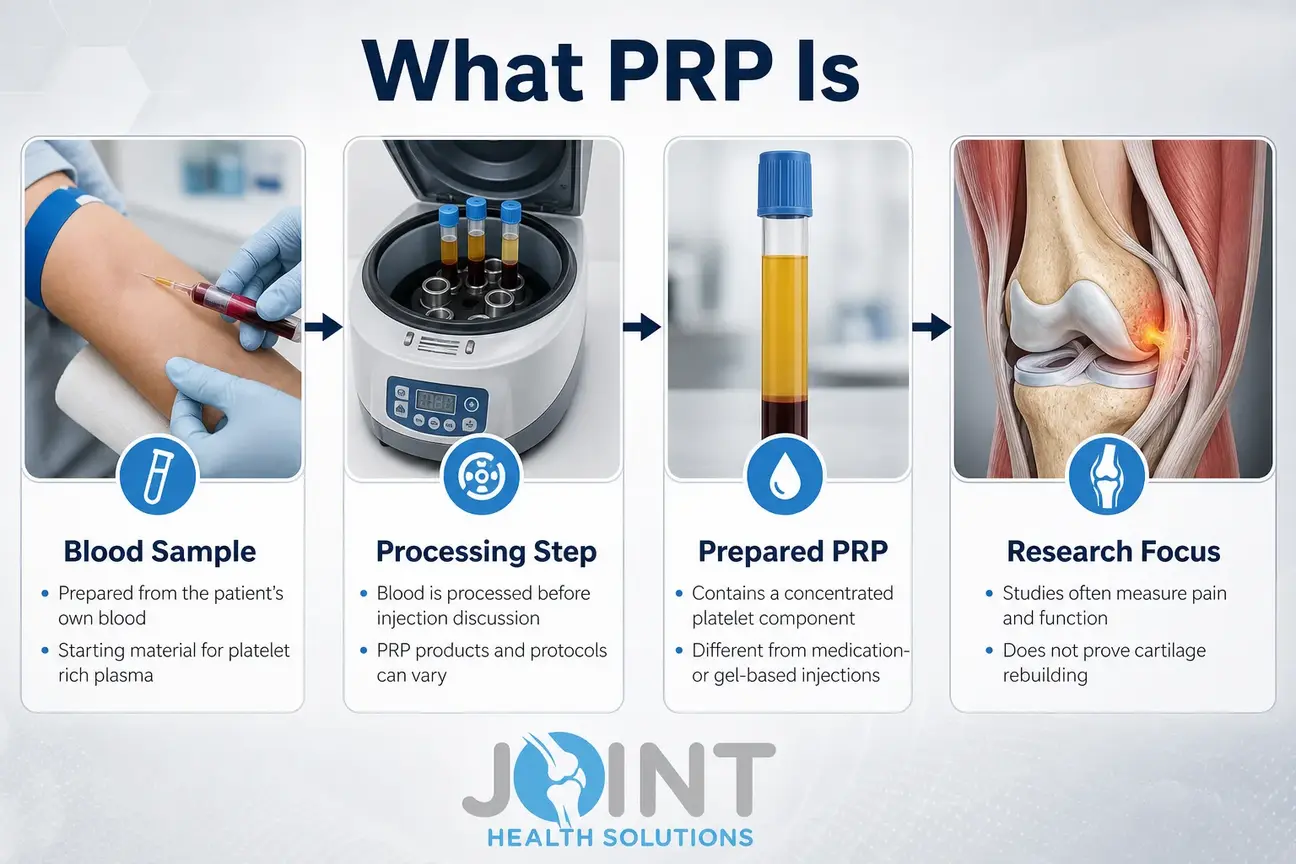
Platelet rich plasma is prepared from a person’s own blood. A blood sample is processed so the plasma contains a concentrated platelet component, then the prepared product is used for injection when clinically appropriate. Platelets are involved in normal healing processes, but that does not mean PRP reliably rebuilds cartilage or reverses arthritis. In knee osteoarthritis research, the main measured outcomes are usually pain, function, and patient-reported improvement rather than proven joint restoration.
The term platelet rich plasma can sound straightforward, but it covers a range of products and protocols. Studies may differ in how the blood is processed, whether the final preparation includes more or fewer white blood cells, how many injections are given, what comparison treatment is used, and how long participants are followed. This variability is one reason the evidence review is more complicated than simply asking whether PRP helps every patient.
PRP is also different from common joint injections because it is not a manufactured anti-inflammatory medication or a gel-like viscosupplement. Corticosteroid injections are medication-based and are often used to reduce inflammation in appropriate situations. Hyaluronic acid injections are gel-based viscosupplementation options used for selected knee osteoarthritis patients. PRP is a biologic preparation derived from the patient’s blood, so its evidence questions and insurance questions are different.
For people comparing knee injections, that distinction matters. A patient may hear that all injections are “non-surgical,” but non-surgical does not mean identical. The expected goal, evidence strength, coverage pathway, timing, and appropriateness can vary by injection type. An individual treatment plan should be based on diagnosis, prior response to conservative care, functional limitations, medical history, and shared decision-making.
Evidence review: what studies suggest for knee osteoarthritis
The most useful evidence review for PRP looks beyond single success stories and focuses on systematic reviews, meta-analyses, and professional guidance. PubMed Central-indexed reviews generally describe a mixed but developing evidence base. Some analyses suggest intra-articular PRP injections may provide short- to mid-term improvements in pain and function for knee osteoarthritis, while also noting limited evidence of structural benefit and inconsistent findings across trial designs.
One PubMed Central systematic review and meta-analysis states that intra-articular PRP injections “suggests” significant short- to mid-term improvements in pain and function, while also reporting that evidence of structural benefit remains limited; that balance is important when reading the systematic review on PRP injections for knee osteoarthritis. In plain language, some people in studies report symptom improvement, but the evidence does not prove that PRP reliably changes the underlying arthritis process.
Another PubMed Central review discusses the broader question of knee osteoarthritis and PRP, including inconsistent placebo-controlled results over longer follow-up. This is a key point for decision-making: a treatment can look encouraging in some comparisons and still remain uncertain when measured against placebo, different injection types, or longer timelines. The clinical conversation should be about possible symptom-focused benefit, not promised cartilage repair.
For many adults with knee arthritis, the most relevant question is not whether PRP is universally effective. It is whether PRP is reasonable to discuss after other treatment options have been considered and whether the person understands the uncertainty. People with mild-to-moderate arthritis may appear more often in positive study discussions, but that does not mean every person with those findings is a candidate or will respond.
It is also important to separate pain and function outcomes from structural outcomes. Pain scores, walking tolerance, stiffness, and daily function matter a great deal to patients. However, improvement in symptoms is not the same as proof that arthritis has been reversed. A careful evidence review should state that difference clearly so expectations remain realistic.
How to read PRP knee arthritis research without overpromising
When reading PRP research about knee arthritis, start with the type of study. Randomized trials, systematic reviews, and meta-analyses generally carry more weight than anecdotes or marketing claims. Even then, the details matter: what type of PRP was used, how many injections were given, what the comparison group received, and whether participants had similar arthritis severity.
Research summaries often use words such as “may,” “suggests,” or “under debate” for good reason. A treatment may show benefit in one analysis but produce less impressive findings in another. Differences in PRP preparation, injection protocols, rehabilitation advice, patient selection, and follow-up length can all affect the results. This is why responsible articles avoid saying PRP is appropriate for all patients or assures relief.
A balanced evidence review also avoids treating all knee pain as the same condition. Knee osteoarthritis is only one possible reason for pain, stiffness, swelling, or reduced mobility. Meniscus injuries, ligament issues, inflammatory conditions, bursitis, referred pain, and other concerns can overlap with arthritis symptoms. A clinical assessment helps distinguish the likely pain generator before any injection is considered.
Another issue is the comparator. PRP may be compared with saline placebo, corticosteroid injections, hyaluronic acid injections, exercise-based care, or other interventions. Results can look different depending on the comparison. A finding that PRP outperformed one option in a study does not automatically prove it is the right option for a specific patient.
Finally, look for the outcome measured. Some studies emphasize pain scores, others measure function, and others look at imaging or biomarkers. For most patients, meaningful improvement in activities is important, but research outcomes do not always map neatly onto everyday goals such as stairs, walking distance, kneeling, work demands, or recreational activity.
Why guidance remains mixed across organizations

Professional guidance remains cautious because the research is not uniform. The American Academy of Orthopaedic Surgeons technology overview says it “does not make recommendations for or against the use of platelet rich plasma,” a deliberately limited position that reflects evidence review rather than a blanket endorsement or rejection of PRP. You can see this wording in the AAOS technology overview on PRP for knee osteoarthritis.
AAPM&R takes a more structured evidence-informed and consensus-based educational approach. Its PM&R KnowledgeNow resource explains PRP through indications, evidence considerations, procedural context, and clinical judgment rather than presenting a simple universal recommendation. That kind of structured guidance is useful because it recognizes that PRP evidence differs by body region, diagnosis, preparation method, and patient selection; see the AAPM&R PM&R KnowledgeNow resource on platelet-rich plasma.
That kind of cautious guidance can feel frustrating for patients, but it is not unusual in emerging areas of musculoskeletal care. A review may find encouraging symptom outcomes yet still identify limitations that prevent a strong recommendation. In PRP research, those limitations include product variability, inconsistent protocols, heterogeneous patient groups, and different study comparators.
The phrase platelet rich plasma does not describe one identical product in every clinic or study. Some preparations contain different platelet concentrations. Some differ in white blood cell content. Some trials use one injection, while others use a series. These details may influence outcomes, and they make it harder for professional organizations to issue simple recommendations.
Guidance also differs because organizations may weigh evidence differently. Some groups emphasize the need for more placebo-controlled trials. Others give more weight to symptom improvements seen in comparative studies. Others focus on whether the intervention is standardized enough for broad recommendation. A patient-centered conversation should acknowledge these differences rather than pretending that all experts agree.
For adults comparing treatment options, mixed guidance does not mean PRP should never be discussed. It means PRP should be discussed carefully, with attention to uncertainty, individual goals, and alternatives. It also means a clinician should avoid suggesting that PRP is a first-line replacement for exercise, weight management when relevant, bracing, physical therapy, activity modification, or other conservative care.
Where PRP may fit after conservative care
PRP is often discussed after a person has already tried or considered foundational conservative care. For knee arthritis, conservative care may include activity modification, strengthening, mobility work, physical therapy, weight-related counseling when appropriate, anti-inflammatory strategies guided by a medical professional, and supportive devices such as offloading knee braces for selected patients. Not every patient needs every option, and a plan should be individualized.
Positioning PRP after conservative care is consistent with the cautious tone of the evidence review. If someone has mild symptoms that respond well to exercise-based care, an injection may not be necessary. If someone has persistent pain and function limits despite appropriate conservative measures, PRP may be one topic to discuss along with other treatment options. The point is not to “graduate” everyone to injections, but to match care to goals and clinical findings.
At Joint Health Solutions, knee arthritis evaluation may include discussion of symptoms, function, prior treatments, goals, and whether minimally invasive options are appropriate. The clinic’s focus is conservative, non-surgical joint care, but that does not mean every person is a candidate for every treatment. If your main concern is knee pain, the knee pain education page may also help you prepare for a discussion.
A useful appointment conversation may include questions such as: What is the likely source of my pain? How advanced is the arthritis? What conservative measures still make sense? What are the realistic goals of an injection? What evidence supports each option? What costs or coverage questions should be clarified before treatment? These questions help keep the decision centered on the patient rather than on any single procedure.
Treatment options compared: PRP, cortisone, and hyaluronic acid
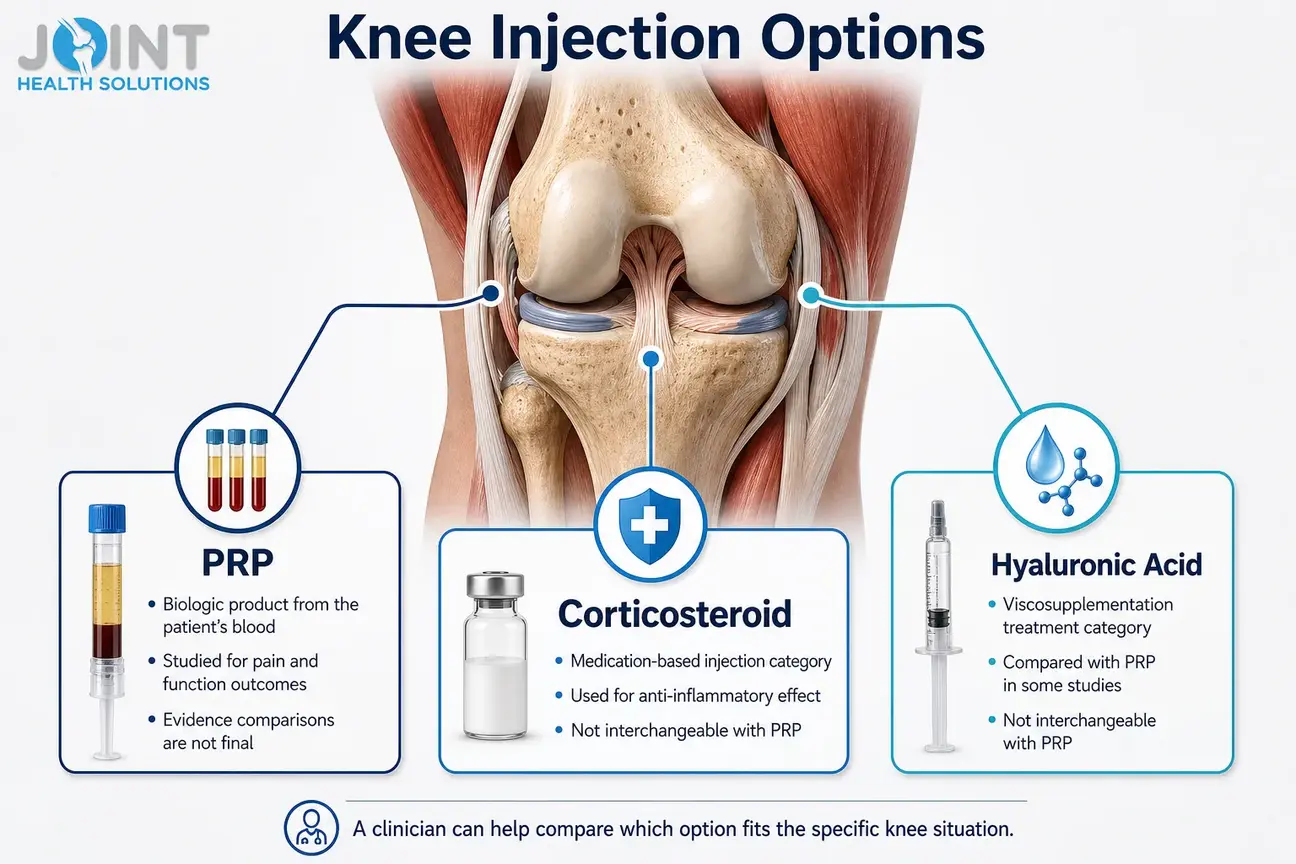
People often compare PRP with corticosteroid and hyaluronic acid injections because all may be discussed for knee symptoms in appropriate circumstances. However, these treatment options are not interchangeable. Corticosteroid injections are generally used for anti-inflammatory effect. Hyaluronic acid injections are viscosupplementation treatments. PRP is a biologic injection prepared from the patient’s blood.
The current evidence review suggests that PRP may compare favorably with some standard injections in certain studies, but the comparison is not final. A PubMed Central narrative review describes evidence supporting PRP over hyaluronic acid and corticosteroids in some settings while also noting inconsistent placebo-controlled results beyond 6 to 12 months; the review of PRP for knee osteoarthritis also emphasizes that official guidance remains cautious because of insufficient evidence or conflicting results.
For corticosteroid injections, the expected goal is often shorter-term reduction of inflammation and pain when appropriate. They may be useful in selected situations, but they are not the same as regenerative or biologic therapies. A person considering cortisone injections should discuss potential benefits, limitations, and fit with their overall care plan.
For hyaluronic acid injections, the goal is different again. These injections are sometimes considered for knee osteoarthritis when certain criteria and clinical factors are present. They are not the same as PRP, and their Medicare and insurance rules may differ. People comparing hyaluronic acid injections with PRP should avoid assuming that evidence, coverage, or treatment planning is identical.
For PRP, the decision often centers on whether a biologic injection is reasonable to discuss given the patient’s diagnosis, prior care, expectations, and comfort with uncertainty. The phrase platelet rich plasma should prompt questions about preparation, evidence, and follow-up rather than a simple yes-or-no decision. PRP may be part of a broader plan, not a stand-alone promise.
| Option | General category | Common decision question | Important limitation |
|---|---|---|---|
| PRP | Biologic injection derived from the patient’s blood | Could symptom-focused benefit be reasonable to discuss after conservative care? | Evidence is mixed, protocols vary, and results vary. |
| Corticosteroid injection | Medication-based anti-inflammatory injection | Is inflammation contributing to symptoms in a way that makes this appropriate? | Goals, timing, and repeat use should be clinically assessed. |
| Hyaluronic acid injection | Gel-based viscosupplementation injection | Does the person’s knee osteoarthritis fit the clinical and coverage context? | Evidence, eligibility, and payer rules differ from PRP. |
| Physical therapy and bracing | Conservative non-surgical care | Can strength, mechanics, support, or mobility be improved? | Requires individualized planning and patient participation. |
Coverage and cost questions should stay separate from clinical evidence
Clinical usefulness and insurance coverage are separate questions. A treatment may be worth discussing medically and still have limited or variable coverage. Conversely, a covered service is not automatically the right choice for every patient. This distinction is especially important for PRP because orthopedic PRP coverage is often handled differently from more established injection categories.
Original Medicare generally does not cover PRP injections used for osteoarthritis, knee pain, shoulder pain, or other musculoskeletal joint conditions. Medicare has a separate, limited national coverage policy for autologous PRP used for qualifying chronic non-healing diabetic wounds for up to 20 weeks when requirements are met, which is not the same as orthopedic PRP for knee arthritis; this distinction is described in CMS National Coverage Determination 270.3.
Medicare Advantage plans, employer plans, and commercial insurance plans can vary in networks, prior authorization, cost sharing, exclusions, and documentation requirements. A plan’s approval process does not necessarily turn an excluded service into a covered benefit. Patients should seek plan-specific confirmation before treatment and ask the practice and insurer what may be covered and what may be out-of-pocket.
Joint Health Solutions accepts Medicare, BlueCross BlueShield, Aetna, and Cigna as payers, but accepting a payer is not the same as saying that payer covers a specific procedure such as PRP. Coverage varies by treatment and plan. Covered and out-of-pocket costs should be reviewed before treatment begins, and patients should verify details with both the practice and their insurer.
Questions to ask before considering platelet rich plasma
If you are considering platelet rich plasma, it helps to bring structured questions to the visit. The goal is not to memorize research terms. The goal is to understand whether the discussion fits your diagnosis, goals, and prior care. A good conversation should leave room for uncertainty and should compare treatment options without pressure.
- What is the working diagnosis? Ask whether your symptoms are most consistent with knee osteoarthritis, another joint condition, or more than one issue.
- How severe are the joint changes? Imaging and examination findings may influence which options are reasonable to discuss.
- What conservative care has been tried? Physical therapy, strengthening, activity changes, and bracing may still matter even if injections are discussed.
- What outcome is realistic? Ask whether the goal is pain reduction, improved function, reduced stiffness, or another measurable change.
- What does the evidence review show? Ask how research findings apply, and where they do not apply, to your situation.
- How does PRP compare with other treatment options? Discuss corticosteroid injections, hyaluronic acid injections, bracing, PT, and other appropriate care.
- What coverage questions should be answered first? Ask what needs to be verified with your insurer before proceeding.
These questions can help avoid two common mistakes: assuming PRP is a certain solution or dismissing it solely because guidance is cautious. A careful discussion sits between those extremes. It recognizes that PRP may be a reasonable topic for some patients, while also respecting that evidence remains mixed and personal eligibility requires assessment.
When a clinical evaluation may be appropriate
A clinical evaluation may be appropriate when knee pain, stiffness, swelling, or reduced mobility affects daily activities or does not improve with basic self-care. Evaluation is also useful when symptoms change, function declines, or you are unsure whether arthritis is the main issue. This article cannot diagnose the cause of symptoms, and injection decisions should not be made from online information alone.
For people in the Charlotte area, Joint Health Solutions offers non-surgical joint care centered on assessment and individualized planning. Patients may travel from nearby service areas, but care occurs at the Charlotte clinic. If PRP is not a good fit, other conservative treatment options may still be discussed when appropriate.
Emergency symptoms are different. If you have symptoms that may represent a medical emergency, call 911 or seek emergency care. Joint Health Solutions does not provide emergency or 24/7 urgent care.
Practical takeaways from the evidence review
The practical takeaway is that PRP for knee arthritis is neither a certain answer nor an option that should be dismissed without context. The evidence review suggests possible short- to mid-term symptom benefit for some people with knee osteoarthritis, but the research is not uniform. Structural benefit remains uncertain, and professional guidance is cautious.
The second takeaway is that patient selection matters. A person with early or moderate knee osteoarthritis, persistent symptoms, and realistic goals may have a different discussion than someone with advanced joint destruction, unclear diagnosis, or symptoms coming from another source. Only a clinical assessment can help sort through those factors.
The third takeaway is that treatment options should be compared honestly. PRP, corticosteroid injections, hyaluronic acid injections, bracing, physical therapy, nutrition support, and other conservative approaches each raise different questions. The right conversation is not “Which single treatment is universally superior?” It is “Which plan fits this patient’s condition, priorities, evidence, and practical constraints?”
If you are reviewing prp knee arthritis information and want a balanced discussion, Joint Health Solutions can help you compare conservative options without promising outcomes. You can schedule a consultation to discuss your knee arthritis concerns and whether PRP or another non-surgical approach may be appropriate after assessment.
Medical disclaimer: For general education only; not a substitute for professional medical advice, diagnosis, or treatment. Suitability and results vary, and individual needs require clinical assessment.
Frequently Asked Questions
What is PRP in knee arthritis?
PRP is a biologic injection prepared from a patient’s own blood. In knee arthritis discussions, it is usually considered for possible symptom-focused improvement, not as a proven cartilage-restoring treatment. Whether it is appropriate depends on diagnosis, prior care, goals, and clinical assessment.
Does PRP work better than cortisone or hyaluronic acid?
Some studies suggest PRP may compare favorably with corticosteroid or hyaluronic acid injections in certain patients and follow-up periods, but the evidence is not uniform. These injections have different mechanisms, different goals, and should be compared with a clinician in the context of individual knee osteoarthritis findings.
Why do some guidelines not recommend PRP strongly?
Guidance remains cautious because studies vary in PRP preparation, injection schedules, comparison groups, patient selection, and follow-up length. Some reviews report improvements in pain and function, while others emphasize uncertainty, inconsistent placebo-controlled findings, and limited evidence of structural benefit.
Is PRP usually discussed after physical therapy, braces, or other conservative care?
Often, yes. PRP is commonly discussed after foundational conservative care has been considered, such as physical therapy, strengthening, activity modification, and bracing when appropriate. That does not mean every person must try the same sequence, but it does mean PRP should be part of an individualized plan.
Does Medicare cover PRP for knee arthritis?
Original Medicare generally does not cover PRP injections for osteoarthritis, knee pain, or other orthopedic joint conditions. Medicare has a narrow separate policy for qualifying chronic non-healing diabetic wounds, which is not the same as orthopedic PRP for knee arthritis. Patients should verify plan-specific details before treatment.
Who may be a better candidate for a PRP discussion?
A PRP discussion may be more relevant for someone with clinically assessed knee osteoarthritis, ongoing symptoms despite appropriate conservative care, realistic expectations, and willingness to consider an option with mixed evidence. Candidacy cannot be determined from symptoms alone and requires clinical assessment.
Sources
- PubMed Central systematic review and meta-analysis on intra-articular PRP injections for knee osteoarthritis
- PubMed Central review of PRP for knee osteoarthritis evidence and guideline considerations
- AAOS Technology Overview: Platelet-Rich Plasma for Knee Osteoarthritis
- AAPM&R PM&R KnowledgeNow: Platelet Rich Plasma
- PubMed Central review discussing PRP evidence variability and knee osteoarthritis considerations
- CMS National Coverage Determination 270.3: Blood-Derived Products for Chronic Non-Healing Wounds




 English
  Spanish