
If you have ever felt a hard, tender knot in your upper back or neck that seems to have a life of its own, you know how disruptive trapezius tightness can be. That knot—often called a trigger point—can cause local pain, refer pain into your head or arm, and limit your ability to turn your head comfortably. You may have tried stretching, massage, heat, and over-the-counter pain relievers, but the knot persists. If you are searching for a more direct approach, you might be wondering about trigger point injections Charlotte providers offer. The central question is simple: how fast do these injections actually work?
In this article, we will break down what trigger point injections are, how they work, what to expect during the procedure, and—most importantly—how quickly you might feel relief. We will also explore factors that influence onset, how long the effects last, potential side effects, and aftercare steps. By the end, you will have a clear picture of whether this non-surgical treatment might be a fit for your neck and trapezius tightness.
Trigger point injections are a minimally invasive procedure used to treat myofascial pain—pain that originates from hyperirritable spots in skeletal muscle, known as trigger points. These points are often described as “knots” that feel like small, tense bands within the muscle. When pressed, they can be extremely tender and may refer pain to other areas of the body. For example, a trigger point in the trapezius muscle (the large muscle that spans your upper back and neck) can cause headaches, jaw pain, or pain down the arm.
The injection itself involves inserting a thin needle directly into the trigger point. The needle may be used alone (a technique called dry needling) or with a small amount of anesthetic, such as lidocaine or procaine. The goal is to disrupt the abnormal muscle contraction and promote blood flow to the area, which can help break the cycle of pain and spasm.
Trigger point injections are typically performed in an outpatient setting, like a physician’s office or a pain clinic. They are considered a safe, cost-effective treatment for myofascial pain syndrome, and they are often used in combination with physical therapy, stretching, and other modalities. At Joint Health Solutions, trigger point injections are offered for muscle knots in the glutes, neck, traps, back, and shoulders.
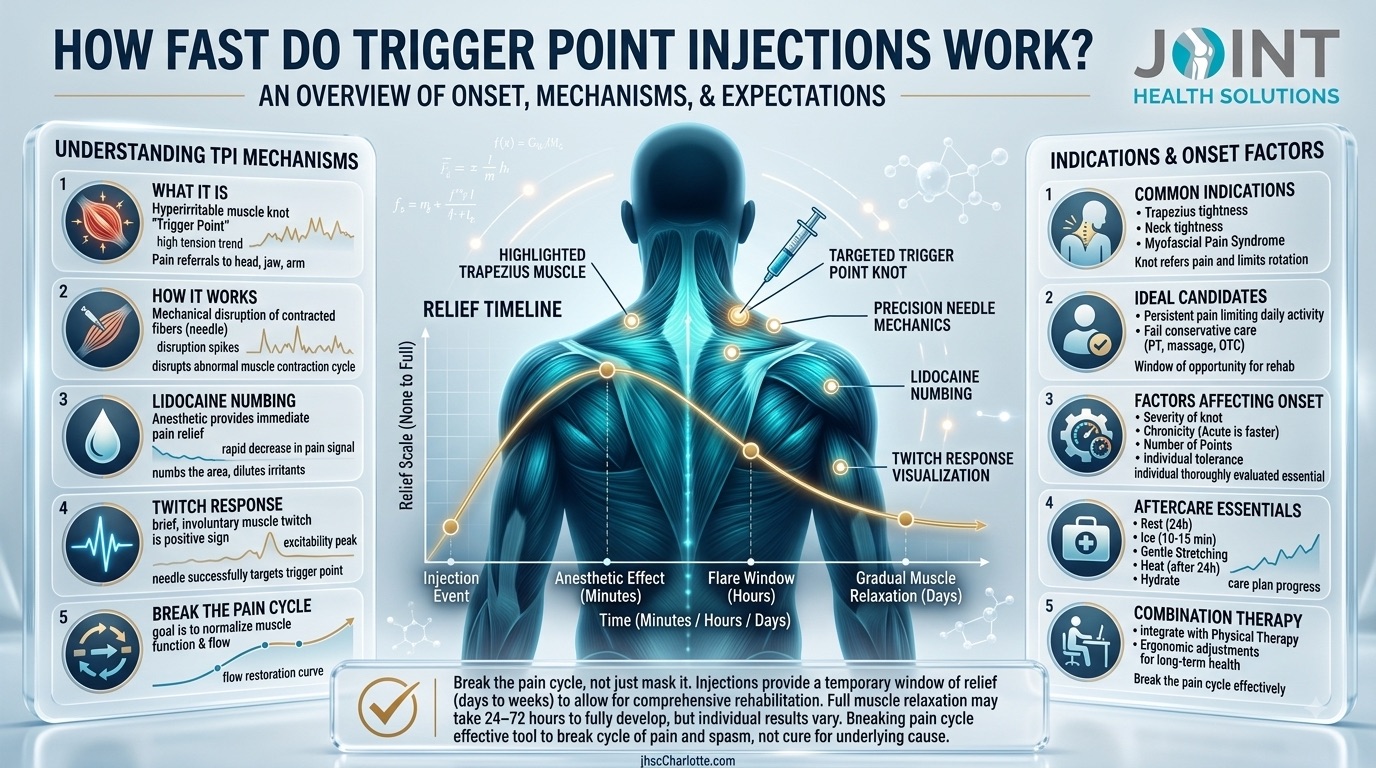
To understand how trigger point injections work, it helps to know a bit about the physiology of a trigger point. When a muscle is overused, injured, or subjected to chronic stress, the muscle fibers can become contracted and fail to relax. This creates a taut band that restricts blood flow and leads to the accumulation of metabolic waste products. The affected area becomes sensitive and painful, and it may refer pain to other parts of the body.
When a needle is inserted into the trigger point, it mechanically disrupts the contracted muscle fibers. This is sometimes called the “twitch response”—a brief, involuntary contraction of the muscle when the needle hits the knot. This twitch is thought to be a sign that the needle has successfully targeted the trigger point. The mechanical disruption helps to normalize the muscle’s electrical activity and restore normal blood flow.
If a local anesthetic is injected, it provides immediate pain relief by numbing the area. The anesthetic also dilutes any irritant chemicals that may have accumulated in the trigger point. The combination of mechanical disruption and chemical numbing can produce a rapid reduction in pain and muscle spasm.
It is important to note that while the immediate relief can be dramatic, trigger point injections are not a cure for the underlying cause of the trigger points. They are a tool to break the pain cycle, giving you a window of relief during which you can work on stretching, strengthening, and posture correction.
Before the injection: Your provider will first evaluate your symptoms and identify the specific trigger points contributing to your neck and trapezius tightness. They will palpate (feel) the area to locate the taut bands and tender nodules. You may be asked to sit or lie in a position that allows easy access to the muscle.
The injection process: The skin over the injection site is cleaned with an antiseptic. The provider will then insert a thin needle, often attached to a syringe containing a local anesthetic like lidocaine. The needle is advanced into the trigger point, and you may feel a brief, sharp sensation as it enters the knot. The provider may gently move the needle to elicit a twitch response, which can be uncomfortable but is usually brief.
Once the needle is in place, the anesthetic is injected. You may feel a burning or pressure sensation as the medication is delivered. The entire procedure typically takes less than five minutes per trigger point. If you have multiple trigger points, the provider may treat several in one session.
After the injection: The site may be sore for a few hours. You might also experience some temporary numbness or weakness in the injected muscle, which is normal. Most patients can resume normal activities immediately, though your provider may advise you to avoid strenuous exercise for 24 to 48 hours.
It is common to feel some immediate relief as the anesthetic takes effect, but this can wear off after a few hours. The more lasting relief comes from the muscle relaxation and improved blood flow, which may take a day or two to develop.
The most common question patients ask is, “How fast will I feel better?” The answer is: it depends. Some patients report significant relief within minutes of the injection, as the anesthetic numbs the area and the mechanical disruption of the needle releases the muscle spasm. This immediate relief can be very encouraging, especially for those who have been in pain for weeks or months.
However, the anesthetic effect is temporary, lasting only a few hours. The long-term benefit comes from the muscle relaxation and increased blood flow, which can take 24 to 72 hours to fully develop. Many patients notice a gradual improvement over the first few days, with the most significant relief occurring around the third day.
It is also important to understand that a single injection may not completely resolve your symptoms. Depending on the severity and chronicity of your trigger points, you may need a series of injections, often spaced a few weeks apart. Your provider will recommend a treatment plan tailored to your specific condition.
Several factors can influence how quickly you experience relief from trigger point injections. Understanding these can help you set realistic expectations.
| Treatment | How It Works | Limitations | Risks |
|---|---|---|---|
| Trigger point injections | Needle disrupts muscle spasm; anesthetic numbs pain | May require multiple sessions; not a cure for underlying cause | Bleeding, infection, nerve irritation (rare), temporary soreness |
| Physical therapy | Stretching, strengthening, posture correction | Requires time and commitment; may be uncomfortable initially | Minimal; muscle soreness possible |
| Oral NSAIDs | Reduce inflammation and pain systemically | May not target the specific trigger point; side effects with long-term use | GI bleeding, kidney issues, cardiovascular risks |
| Massage therapy | Manual pressure to release muscle tension | Relief may be temporary; requires repeated sessions | Bruising, soreness |
| Dry needling | Needle without medication to disrupt trigger points | Similar to injections but without the numbing effect of anesthetic | Similar to injections, but less risk of medication-related side effects |
The duration of relief from trigger point injections varies widely. For some patients, a single injection can provide relief for several weeks or even months. For others, the relief may only last a few days, especially if the underlying cause of the trigger points is not addressed.
In general, the immediate anesthetic effect wears off within a few hours, but the muscle relaxation can persist for days to weeks. The goal of treatment is not just to relieve pain temporarily, but to break the cycle of muscle spasm and pain so that you can engage in rehabilitative exercises and other therapies.
If your trigger points are related to chronic poor posture or repetitive strain, they are likely to recur unless you make changes to your daily habits. Your provider may recommend a combination of injections, physical therapy, and lifestyle modifications to achieve longer-lasting results.
It is also worth noting that some patients experience a flare of pain 24 to 48 hours after the injection, as the muscle reacts to the needle. This is normal and should subside within a few days. This post-injection soreness can be managed with ice and over-the-counter pain relievers, but be sure to follow your provider’s advice.
Trigger point injections are generally safe when performed by a trained provider, but like any medical procedure, they carry some risks. The most common side effects are minor and temporary:
To minimize risks, it is essential to choose a qualified provider who is experienced in trigger point injections. At Joint Health Solutions in Charlotte, our team follows strict safety protocols.
Immediately after the injection:
Over the next few days:
Long-term management:
If you have recurrent trigger points, your provider may recommend a series of injections combined with physical therapy.
Trigger point injections are not the first-line treatment for neck and trapezius tightness. They are typically considered after conservative measures like stretching, massage, and over-the-counter pain relievers have failed to provide adequate relief. You might be a candidate if:
However, trigger point injections are not suitable for everyone. They should be avoided if you have a bleeding disorder, are taking blood thinners, or have an active infection at the injection site. Pregnant women should also consult their obstetrician before undergoing the procedure.
It is crucial to have a thorough evaluation by a medical professional to determine if trigger point injections are appropriate for your specific condition. At Joint Health Solutions, we offer comprehensive assessments to identify the source of your pain and develop a personalized treatment plan.
If you are struggling with persistent neck and trapezius tightness and are curious about trigger point injections, the next step is to schedule a consultation with a qualified provider. At Joint Health Solutions in Charlotte, North Carolina, we specialize in non-surgical orthopedic care. Our team can evaluate your condition and discuss whether trigger point injections are right for you.
During your consultation, we will review your medical history, perform a physical examination, and palpate the specific trigger points contributing to your pain. We will also discuss your goals and expectations, and answer any questions you may have about the procedure, recovery, and potential outcomes.
If trigger point injections are recommended, we will explain the process, including how many sessions you might need and what to expect in terms of relief. We will also incorporate other evidence-based treatments, such as physical therapy and lifestyle modifications, to maximize your long-term success.
We understand that living with chronic neck pain can be frustrating, and we are here to help you find relief. Our goal is to provide compassionate, effective care that helps you return to the activities you enjoy.
To take the next step, call our office at 704-833-3566 to schedule a consultation. You can also explore our full treatments and services to learn more. Don’t let trapezius tightness control your life—reach out today and see how trigger point injections Charlotte may help you find the relief you’ve been seeking.
The injection procedure itself typically takes less than five minutes per trigger point. Including the initial evaluation and preparation, your appointment may last 15 to 30 minutes.
You may feel a brief, sharp sensation as the needle enters the skin and muscle. However, the anesthetic used in most injections numbs the area quickly, and the entire procedure is usually well-tolerated. Some patients experience soreness afterward, which can be managed with ice and over-the-counter pain relievers.
The number of injections varies depending on the severity and chronicity of your trigger points. Some patients experience relief after a single injection, while others may need a series of injections spaced a few weeks apart. Your provider will recommend a personalized treatment plan.
Most patients can return to work immediately after the procedure, unless your job involves heavy lifting or strenuous activity. Your provider may advise you to avoid intense exercise for 24 to 48 hours. It is best to discuss your specific work requirements with your provider.
Both techniques use a thin needle to disrupt trigger points. The main difference is that trigger point injections typically include a local anesthetic, which provides immediate pain relief. Dry needling uses a needle without medication. The choice between the two depends on your condition and provider’s recommendation.
Yes, trigger points in the trapezius and other neck muscles can refer pain to the head, contributing to tension-type headaches. By releasing these trigger points, injections may help reduce headache frequency and intensity, though results vary.
Long-term side effects are extremely rare. The most common issues are temporary soreness, bruising, or bleeding at the injection site. Serious complications like infection or nerve irritation are very uncommon when the procedure is performed by a qualified provider.
Joint Health Solutions operates on a self-pay basis with transparent, upfront pricing. Cost depends on the number of trigger points treated and whether a series of sessions is recommended. Our team can provide a quote during your consultation.
Absolutely. In fact, combining injections with physical therapy is often the most effective approach. The injection provides temporary pain relief, allowing you to participate more fully in stretching and strengthening exercises that address the underlying cause of the trigger points.
Common signs include a tender, tight band in the upper back or neck, pain that worsens with pressure, and referral pain into the head, jaw, or arm. A healthcare professional can perform a physical exam to confirm the presence of trigger points.
 English
  Spanish