
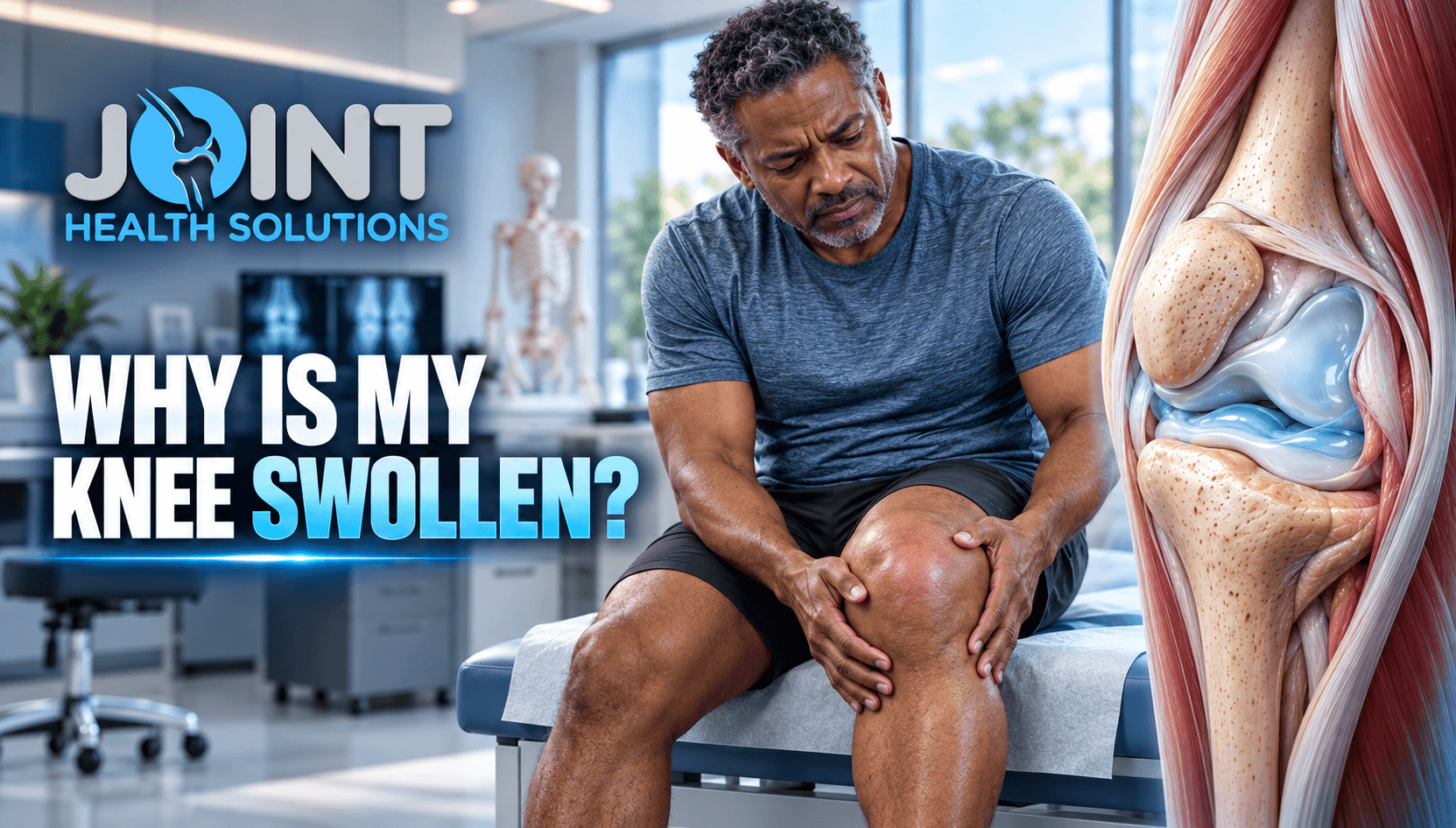
Why Is My Knee Swollen? Causes, Warning Signs, and Evaluation
Why is my knee swollen? A knee can enlarge when fluid collects inside the joint, when a nearby bursa becomes inflamed, when tissues bleed after an injury, or when swelling from the leg makes the knee region look puffy. Common possibilities include an injury, osteoarthritis, inflammatory arthritis, gout or pseudogout, bursitis, a Baker cyst, and infection—but appearance alone cannot identify the cause.
The timing, location, warmth, amount of pain, ability to bear weight, and symptoms elsewhere in the body all help narrow the possibilities. This guide explains what different swelling patterns may mean, which warning signs need urgent attention, how clinicians evaluate a swollen knee, and why treatment should match the underlying diagnosis.
Quick Answer: What Can Cause a Swollen Knee?
A swollen knee often reflects excess joint fluid, also called a knee effusion. Fluid can accumulate after a ligament or meniscus injury, with osteoarthritis or inflammatory arthritis, during a gout or pseudogout flare, or because of an infection. Swelling in front of the kneecap may come from an irritated bursa, while fullness behind the knee may relate to a Baker cyst. Whole-leg swelling can point away from the joint and toward a circulation or systemic problem.
Seek urgent care for a hot, red or discolored knee with fever or illness; severe swelling after major trauma; deformity; inability to bear weight; a cold, pale or numb foot; or rapidly worsening pain. New one-sided calf or leg swelling needs prompt assessment. If it occurs with chest pain, unexplained shortness of breath, coughing blood, fainting, or severe lightheadedness, call 911.
What Does a Swollen Knee Actually Mean?
“Swollen knee” is a symptom description, not a diagnosis. The knee contains a joint cavity lined by synovium, which normally produces a small amount of lubricating fluid. Irritation, inflammation, bleeding, crystals, or infection can increase the amount of fluid in that space. Clinicians call this an effusion. The knee may look rounded around the kneecap, feel tight, and lose some ability to bend or straighten.
Not every visible swelling is inside the joint. The knee also contains fluid-filled sacs called bursae that reduce friction. A bursa in front of the kneecap can enlarge without creating a true joint effusion. A Baker cyst can create fullness behind the knee when joint fluid extends into a sac at the back of the joint. Swelling from the calf, veins, lymphatic system, or generalized fluid retention may surround the knee while the joint itself is not the main source.
This distinction matters because the appropriate next step differs. A traumatic joint effusion may prompt an injury evaluation. A hot, intensely painful joint may require urgent testing for infection or crystals. A soft swelling directly over the kneecap can point toward bursitis. New swelling extending through one leg may require evaluation for a blood clot rather than an orthopedic procedure.
Effusion inside the joint
Often produces diffuse fullness around the kneecap, stiffness, and reduced bending or straightening. Injury, arthritis, crystals, and infection are among the possibilities.
Swelling around the joint
May be more focal over a bursa, behind the knee, or throughout the leg. The location and accompanying symptoms change what must be considered.
What the Location and Timing of Swelling May Suggest
The pattern helps organize the differential diagnosis, but it does not confirm one condition. Several problems can look similar, and more than one may be present at the same time.
| Pattern | Possibilities to consider | Details that matter |
|---|---|---|
| Rapid swelling after a twist, pop, fall or collision | Ligament injury, meniscus injury, kneecap injury, fracture, or bleeding into the joint | Ability to continue activity, instability, deformity, bruising, and weight-bearing tolerance |
| Swelling that develops over several hours | Meniscus injury, ligament sprain, joint irritation, or inflammatory response | Catching, locking, giving way, reduced range of motion, and joint-line tenderness |
| Gradual or recurring swelling with activity | Osteoarthritis, overuse, synovitis, or chronic mechanical irritation | Stiffness after rest, walking tolerance, previous episodes, and response to activity modification |
| Sudden hot, red or very painful swelling without injury | Gout, pseudogout, infection, or another inflammatory arthritis | Fever, chills, illness, immune status, recent procedure, skin infection, and prior crystal flares |
| Soft swelling directly over the kneecap | Prepatellar bursitis | Kneeling, direct pressure, skin break, warmth, and whether the whole joint is restricted |
| Fullness behind the knee | Baker cyst, joint effusion, tendon issue, or vascular condition | Calf swelling, sudden worsening, warmth, discoloration, and shortness of breath |
| Swelling through the calf or entire leg | Venous, lymphatic, systemic, or less commonly joint-related causes | One-sided versus both legs, chest symptoms, recent travel, surgery, immobility, medications, and medical history |
A photograph can document change, but it cannot show whether fluid is inside the joint, identify crystals or infection, or determine whether a ligament or meniscus is injured. Comparing both knees, noting when swelling appeared, and recording what happened immediately beforehand can make a clinical visit more informative.
Common Causes of Knee Swelling
The causes below are grouped by clinical pattern. They are not a self-diagnosis checklist. A clinician combines the history, examination, and selected tests to decide which explanation best fits.
Traumatic injuries
Ligament tears, meniscus injuries, fractures, kneecap dislocations, and significant contusions can cause fluid or blood to collect in the knee. A rapid large effusion after a pivot, landing, collision, or fall raises concern for a substantial internal injury. A person may also report a pop, instability, locking, or loss of motion.
The ability to walk does not rule out injury. Some people can bear weight despite a ligament or meniscus tear. Conversely, pain and swelling after trauma do not prove a tear. Examination may include palpation, range-of-motion testing, ligament stability tests, and an assessment of nerves and circulation. X-rays are often considered when fracture is possible; MRI may be useful when a soft-tissue diagnosis would change management.
Osteoarthritis and mechanical irritation
Knee osteoarthritis can produce episodic swelling, stiffness after rest, reduced movement, and pain with weight-bearing. The amount of pain and swelling does not always match the degree of change seen on an X-ray. Activity changes, a minor twist, or increased loading may aggravate an already sensitive joint without necessarily creating a new major injury.
New swelling should not automatically be attributed to arthritis, especially when it is unusually hot, rapid, severe, associated with fever, or different from prior episodes. Joint Health Solutions has separate resources on knee arthritis treatment and knee osteoarthritis pain management; this article remains focused on interpreting swelling as a symptom.
Gout and pseudogout
Crystal arthritis can cause an abrupt flare of intense pain, warmth, redness or discoloration, and swelling. Gout results from monosodium urate crystals. Pseudogout, also called calcium pyrophosphate deposition disease, involves a different type of crystal and commonly affects larger joints such as the knee.
These flares can resemble joint infection, and a history of gout does not make every hot swollen knee another gout attack. When the diagnosis is uncertain—especially during a first episode, an atypical flare, or illness with fever—joint fluid analysis may help look for crystals and infection. Finding crystals does not always exclude infection, so the full clinical picture matters.
Inflammatory arthritis
Rheumatoid arthritis, psoriatic arthritis, reactive arthritis, and other inflammatory diseases can involve the knee. Clues may include prolonged morning stiffness, swelling in multiple joints, recurring episodes, skin or eye symptoms, recent infection, or systemic fatigue. However, inflammatory arthritis can also begin in a limited pattern.
Persistent or unexplained swelling may lead to blood tests or referral depending on the history and examination. Laboratory results are interpreted in context; no single general “arthritis panel” can diagnose every inflammatory condition.
Septic arthritis and other infections
Septic arthritis is an infection within a joint and can damage tissue quickly. Intense pain, swelling, warmth, restricted motion, fever, chills, or feeling unwell can occur, although not every patient has every sign. Risk may be higher with immune suppression, diabetes, certain joint conditions, recent surgery or injection, skin infection, intravenous drug use, or a joint replacement, but infection can occur without an obvious risk factor.
A suspected infected joint requires urgent medical evaluation. Diagnosis may include joint-fluid testing and blood work, and treatment should not be delayed for home remedies. A warm joint with fever is not an appropriate situation for routine exercise, forceful massage, or waiting several days to see whether swelling settles.
Bursitis
Prepatellar bursitis causes focal swelling over the front of the kneecap and may follow repeated kneeling or direct pressure. Other bursae around the knee can also become irritated. The swelling may feel soft and superficial rather than deep within the joint. If a bursa becomes infected, redness, warmth, tenderness, fever, or drainage may occur.
Because a visibly swollen front of the knee can result from several problems, avoid puncturing or draining it yourself. Skin breaks can introduce bacteria, and medical management differs depending on whether the bursa is infected, inflamed, injured, or affected by crystals.
Baker cyst
A Baker cyst is a fluid-filled sac behind the knee that often develops because the knee is producing excess synovial fluid. Arthritis and meniscus problems are common underlying contributors. Some cysts create fullness or tightness without much pain; others limit bending or ache after activity.
If a cyst leaks or ruptures, fluid can track into the calf and mimic a blood clot. New calf pain, swelling, warmth, or discoloration therefore needs clinical assessment rather than assumption. The dedicated article on pain behind the knee explains posterior-knee causes in more depth.
Whole-leg swelling and conditions outside the knee
Deep vein thrombosis, venous insufficiency, lymphedema, medication effects, and heart, kidney, or liver conditions can cause swelling around the knee as part of a larger leg problem. DVT is especially important because a clot can travel to the lungs. Unexplained one-sided leg swelling, pain, warmth, or skin-color change deserves prompt medical evaluation. Chest pain or shortness of breath with those symptoms is an emergency.
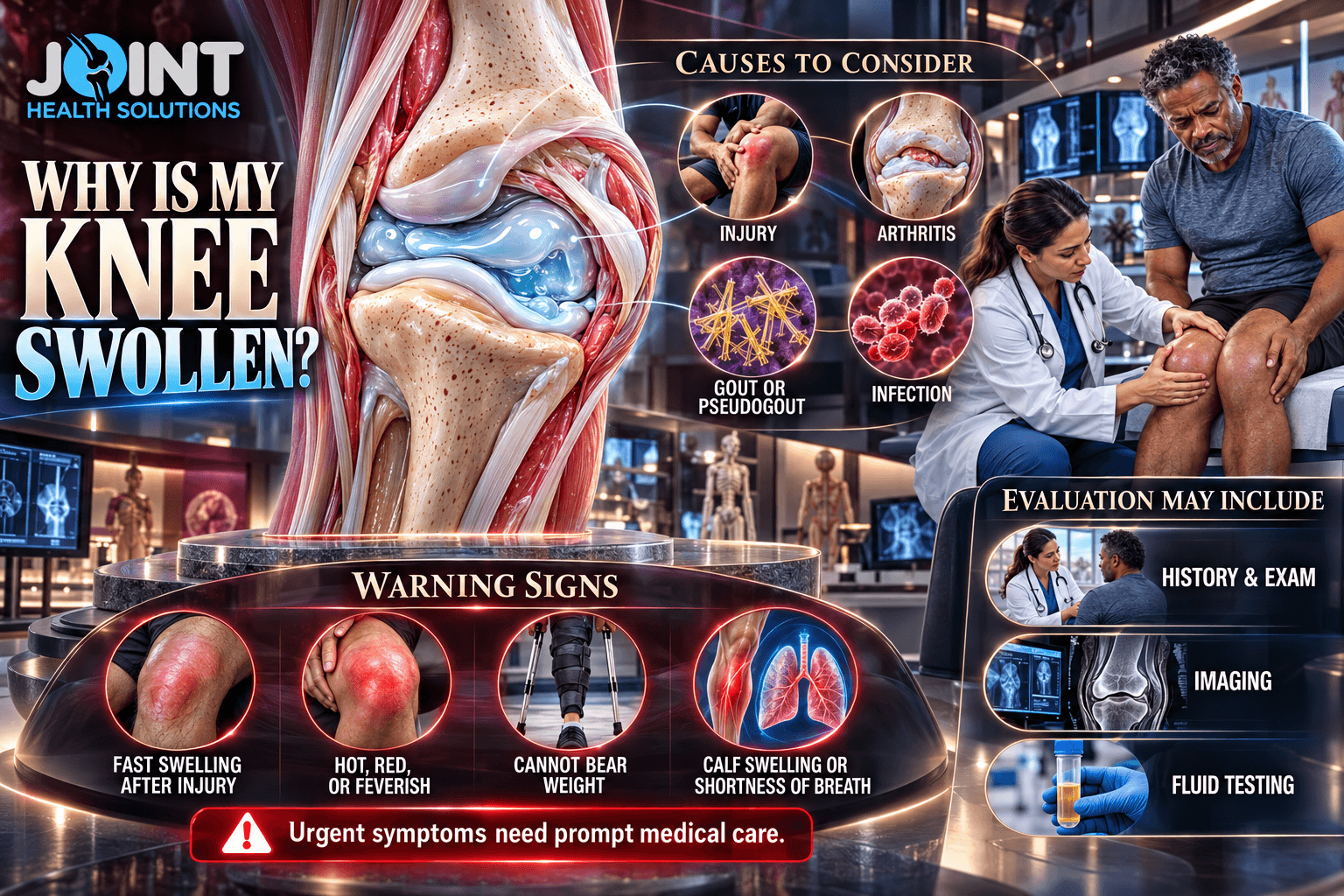
When Does a Swollen Knee Need Urgent Care?
Seek urgent or emergency assessment when knee swelling occurs with any of the following:
- A hot, red or noticeably discolored joint with fever, chills, or feeling ill
- A visibly deformed knee or kneecap after trauma
- Inability to bear weight after a significant injury
- Rapid, large swelling after a pop, pivot, fall, or collision
- A knee that is mechanically stuck and cannot bend or straighten
- A cold, pale, blue, numb, or weak foot after an injury
- New one-sided calf or leg swelling, warmth, tenderness, or discoloration
- Chest pain, unexplained shortness of breath, coughing blood, fainting, or severe lightheadedness—call 911
Urgency depends on the whole presentation, not on circumference alone. A mildly puffy knee that has recurred with arthritis differs from a suddenly tense joint after trauma or a hot joint with systemic illness. When uncertain, contact an appropriate medical professional for triage rather than relying on an online image comparison.
What Can You Do First for a Newly Swollen Knee?
If there are no urgent warning signs and the swelling followed a minor activity change or mild injury, short-term measures may improve comfort while you monitor the knee. Reduce the activity that clearly aggravates symptoms. Protect the knee from another twist or fall. A cold pack wrapped in cloth may be used for 15 to 20 minutes at a time, and elevating the leg may help some people. Gentle movement within a comfortable range can reduce stiffness, but do not force a locked or severely painful joint.
Compression can feel supportive, but it should not cause numbness, color change, increased pain, or swelling below the wrap. Remove it and seek advice if those occur. Medication choices are individualized. Nonsteroidal anti-inflammatory drugs are not appropriate for everyone, including some people with kidney disease, ulcers, bleeding risk, cardiovascular conditions, pregnancy, or interactions with other medicines. Ask a clinician or pharmacist what is safe for you.
Avoid trying to “push fluid out,” aggressively massage a hot or unexplained swelling, or perform strenuous strengthening through sharp pain. Do not attempt to drain the knee or a bursa at home. Make an appointment if swelling persists, recurs, worsens, restricts normal movement, follows a meaningful injury, or interferes with walking, sleep, work, or daily activities.
| Question | Why it helps |
|---|---|
| When did the swelling begin? | Minutes, hours, and days after onset can point toward different processes. |
| Was there a twist, impact, pop, fall, or activity increase? | This helps separate traumatic and overuse patterns from sudden atraumatic inflammation. |
| Where is the swelling most visible? | Inside the joint, over the kneecap, behind the knee, and throughout the leg have different implications. |
| Is the knee warm, red, or discolored? | These findings can increase concern for infection, crystals, or vascular problems. |
| Can you bear weight and fully move the knee? | Functional loss helps determine urgency and the need for imaging. |
| Are there fever, calf symptoms, chest symptoms, or illness? | Symptoms outside the knee can change the situation from routine to urgent. |
How Clinicians Evaluate a Swollen Knee
The evaluation begins with the story. A clinician may ask how quickly swelling developed, whether trauma occurred, what activities were possible afterward, whether the knee has swollen before, and whether there are fever, skin changes, other swollen joints, calf symptoms, or relevant medical conditions. Recent surgery, injections, illness, medications, travel, and periods of immobility can also matter.
During the examination, the clinician may compare both knees; assess warmth, skin, tenderness, and fluid; measure range of motion; test ligament stability; look for meniscus or kneecap findings; and check the hip, lower leg, pulses, sensation, and strength when indicated. The goal is not merely to confirm that swelling exists but to determine where it comes from and what diagnoses must not be missed.
When are X-rays useful?
X-rays can identify fractures, alignment changes, osteoarthritis features, and some bone abnormalities. They do not directly show every ligament, meniscus, tendon, or cause of inflammation. After injury, the decision to obtain X-rays depends on factors such as age, tenderness, range of motion, ability to bear weight, and the mechanism.
When might ultrasound or MRI be considered?
Ultrasound can help identify fluid, evaluate some superficial structures, assess a suspected Baker cyst, and guide certain procedures. It can also be used in vascular testing when a blood clot is a concern, although that is a different examination from musculoskeletal ultrasound. MRI provides more detail about menisci, ligaments, cartilage, bone marrow, and other soft tissues, but it is not automatically required for every swollen knee.
When are blood tests or joint-fluid tests considered?
Blood tests may be useful when infection, inflammatory disease, bleeding, or another systemic cause is suspected. Joint-fluid analysis can examine cell counts, crystals, bacteria, and other features. No single test is interpreted in isolation. Results must be matched with symptoms, examination findings, and sometimes imaging.
If this is your first non-surgical joint visit, bring a medication list, relevant medical history, prior imaging or reports, and a brief timeline. The JHS guide on preparing for a non-surgical joint evaluation provides a practical checklist.
Does Every Swollen Knee Need Aspiration?
No. Knee aspiration, also called arthrocentesis, removes fluid from the joint with a needle. It may be considered when fluid needs laboratory analysis, when infection or crystals are part of the differential diagnosis, or when a substantial effusion is contributing to pressure and restricted movement. The decision depends on the likely cause, the amount and location of fluid, risks, prior procedures, medications, and the clinician’s findings.
Aspiration can provide useful information, but it does not by itself cure arthritis, repair an injured ligament or meniscus, eliminate the cause of recurring fluid, or guarantee lasting relief. Fluid may return if the underlying problem remains active. Risks and aftercare should be discussed before the procedure.
This symptom guide intentionally does not duplicate the procedure-focused content. For more detail, read how knee aspiration fits into joint care or review the knee arthrocentesis service page.
How Is Knee Swelling Treated?
Treatment follows the diagnosis rather than the size of the knee alone. Two equally swollen knees may require entirely different plans.
After a minor injury
Short-term activity modification, protection, cold therapy, and gradual rehabilitation may be appropriate. Significant instability, mechanical locking, fracture, or major soft-tissue injury changes the plan.
With osteoarthritis
Education, exercise or physical therapy, load management, weight-related support when relevant, bracing, and selected medications or injections may be discussed based on goals and clinical findings.
With crystal arthritis
Management may include medication for the acute flare and a longer-term plan when attacks recur. The diagnosis should be distinguished from infection when the presentation is uncertain.
With infection
Urgent medical treatment is required and may involve drainage plus antimicrobial therapy. Routine home treatment is not an adequate substitute.
With bursitis or a Baker cyst
Care targets the cause and contributing activity. Infection must be ruled out when warmth, redness, drainage, or systemic symptoms are present.
With leg-wide swelling
Evaluation may focus on veins, lymphatic flow, medications, or systemic health rather than the knee joint itself. Suspected DVT requires prompt medical testing.
Injections are not automatically appropriate for an unexplained swollen joint. Infection, fracture, and other urgent causes must be considered first. When arthritis is confirmed and conservative measures are insufficient, a clinician can explain whether options such as bracing, physical therapy, or selected knee injections fit the individual situation. Benefits, limitations, risks, and insurance coverage vary.
Swollen Knee Evaluation in Charlotte, NC
Joint Health Solutions evaluates knee pain, stiffness, swelling, and mobility concerns at 9350 Benfield Rd, #109, Charlotte, NC 28269. The visit is designed to identify the likely source of symptoms and determine whether imaging, fluid testing, rehabilitation, bracing, injections, another medical referral, or urgent care is appropriate.
Not every swollen knee needs a procedure, and no single treatment fits every cause. The team uses an evidence-informed, non-surgical approach while recognizing when symptoms require care outside the clinic’s routine pathway.
Frequently Asked Questions About a Swollen Knee
Why is my knee swollen without an injury?
Knee swelling without a clear injury may be related to osteoarthritis, gout or pseudogout, inflammatory arthritis, bursitis, a Baker cyst, infection, or another medical condition. Sudden heat, marked pain, redness or discoloration, fever, or illness requires urgent assessment because infection and crystal arthritis can look similar.
What does fluid on the knee feel like?
A knee effusion may feel tight, full, stiff, or difficult to bend and straighten. Fullness may be visible around the kneecap. Pain varies widely: some effusions cause pressure with limited pain, while others are extremely painful because of injury, crystals, or infection.
Can knee osteoarthritis cause swelling?
Yes. Osteoarthritis can irritate the joint lining and contribute to intermittent effusion, stiffness, and reduced motion. However, a new hot, rapidly swollen, or unusually painful knee should not automatically be blamed on arthritis without considering infection, crystals, injury, and other causes.
How long should knee swelling last?
There is no universal timeline because duration depends on the cause and severity. Mild swelling after a minor activity change may improve over several days, while arthritis, a significant injury, crystals, infection, or a Baker cyst may persist or recur. Arrange an evaluation when swelling is worsening, recurrent, unexplained, or limiting normal function.
Can I walk on a swollen knee?
Light walking may be tolerable with some mild, non-urgent causes, but do not force weight-bearing after major trauma, with deformity, severe pain, instability, or inability to take normal steps. Use the symptoms and mechanism—not a blanket rule—to determine whether urgent assessment is needed.
Should I use heat or ice for knee swelling?
Cold therapy is commonly used for short-term comfort after a minor injury or activity-related flare. Heat may feel soothing for stiffness but can be uncomfortable when a joint is acutely hot and swollen. Neither method identifies the cause. Protect the skin, limit exposure time, and seek care for warning signs.
Can gout affect the knee?
Yes. Although gout often affects the big toe, it can involve the knee and cause sudden pain, warmth, swelling, and redness or discoloration. Pseudogout also commonly affects the knee. A first or atypical hot swollen joint may require fluid testing to distinguish crystals from infection.
Is swelling behind the knee always a Baker cyst?
No. A Baker cyst is common, but tendon problems, joint effusion, vascular conditions, and other causes can create posterior fullness. New calf swelling, warmth, discoloration, or pain—especially with chest symptoms or shortness of breath—needs prompt assessment for a possible blood clot.
Will draining a swollen knee make the fluid stay away?
Not necessarily. Aspiration may reduce pressure temporarily and may provide diagnostic fluid, but fluid can return if arthritis, inflammation, injury, or another underlying cause remains active. The procedure’s value and risks depend on the clinical situation.
When should I schedule an appointment for knee swelling?
Schedule an evaluation when swelling persists, recurs, worsens, follows an injury, reduces motion, changes your walking, disrupts sleep, or interferes with daily activities. Use urgent or emergency care instead when the warning signs described in this article are present.
Medical Sources
- Mayo Clinic: Swollen Knee—Symptoms and Causes
- Mayo Clinic: Swollen Knee—Diagnosis and Treatment
- National Institute of Arthritis and Musculoskeletal and Skin Diseases: Gout
- National Institute of Arthritis and Musculoskeletal and Skin Diseases: Arthritis
- MedlinePlus: Infectious Arthritis
- Centers for Disease Control and Prevention: Venous Thromboembolism
- American Academy of Orthopaedic Surgeons: ACL Injuries
Clinical review team
Medically Reviewed By
Meet the Joint Health Solutions clinicians responsible for reviewing this patient-education resource for clarity, clinical context, and medically responsible guidance.

|
Medical Director Jeffrey Galvin, MDEmergency MedicineObesity Medicine25+ Years Experience
Board-certified physician and Medical Director at Joint Health Solutions. Dr. Galvin brings extensive emergency, trauma, metabolic-health, and patient-centered clinical experience to joint-health education and care. |

|
Joint Injection Specialist Ariel Curtis, FNP-CBoard-Certified FNPOrthopedic Trauma Background12+ Years Nursing Experience
Board-certified family nurse practitioner and joint injection specialist. Ariel combines orthopedic trauma experience with individualized education and evidence-informed, non-surgical joint care. |
 English
  Spanish