
Shoulder Injections Huntersville NC care is available at Joint Health Solutions for adults dealing with shoulder pain, stiffness, inflammation, arthritis, frozen shoulder, rotator cuff irritation, or limited range of motion. Shoulder injections may help reduce discomfort, improve movement, and support daily function without immediately choosing surgery.
At Joint Health Solutions in Huntersville NC, we specialize in advanced, image-guided shoulder injections. Our team—led by Dr. Jeffrey Galvin and Ariel Curtis, FNP-C—uses state-of-the-art ultrasound guidance to deliver medication exactly where it is needed, ensuring safety, accuracy, and optimal outcomes. We offer a full range of injection therapies, from traditional corticosteroids to cutting-edge regenerative medicine such as PRP.
Medically reviewed by: Dr. Jeffrey Galvin & Ariel Curtis, FNP-C
Shoulder injections are non-surgical treatments used to place medication, lubrication support, or regenerative material near the painful area of the shoulder. They may be recommended for patients with arthritis, inflammation, bursitis, tendon irritation, frozen shoulder, or chronic shoulder discomfort.
For many adults searching for Shoulder Injections Huntersville NC, the goal is to reduce pain while improving movement and function. Injections may be used as part of a larger treatment plan that also includes movement support, lifestyle guidance, strengthening, stretching, and follow-up care.

Shoulder injections deliver treatment directly near the area causing pain, swelling, or inflammation.

Many patients choose injections because they want relief without surgery, long recovery times, or stronger medication.

When pain and inflammation improve, reaching, lifting, dressing, sleeping, and daily movement may feel easier.

For some patients, shoulder injections may help delay or avoid surgery depending on the condition, severity, and response to treatment.
Joint Health Solutions offers several shoulder injection options for pain, inflammation, and mobility concerns. Your provider will recommend the best option after reviewing your symptoms, diagnosis, and treatment goals.

Corticosteroid injections may help reduce inflammation and provide relief for painful shoulder flare-ups. They are commonly used for bursitis, arthritis, tendon irritation, and inflammation around the shoulder joint.
This option may be helpful when shoulder pain makes lifting, reaching, sleeping, exercising, or daily tasks difficult.

Hyaluronic acid injections may help support joint lubrication and comfort for selected patients with arthritis-related shoulder stiffness or joint wear.
Your provider will determine whether this option is appropriate based on your condition, symptoms, and treatment goals.

PRP therapy uses platelet-rich plasma from your own blood to support the body’s natural repair response. This option may be recommended for selected patients with chronic shoulder pain, soft tissue irritation, tendon inflammation, or ongoing discomfort.
Patients looking for Shoulder Injections Huntersville NC often ask about PRP therapy because it offers a regenerative, non-surgical approach.

Frozen shoulder can cause pain, tightness, and limited range of motion. In some cases, steroid injections may help reduce inflammation and make movement-based treatment more comfortable.

Some patients benefit from shoulder injections combined with stretching, strengthening, and movement support. This approach may help improve comfort, function, and long-term shoulder mobility.
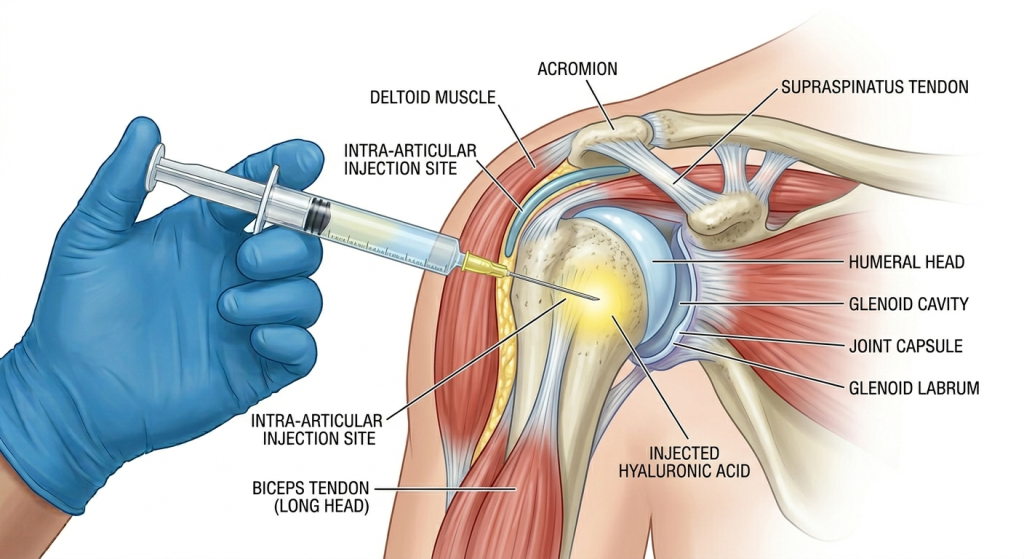
Ultrasound guidance may help improve accuracy during some shoulder injection procedures. Your provider may use ultrasound imaging to better locate the treatment area and guide the injection.
This can be especially helpful when treating deeper structures, inflamed tissue, bursitis, tendon irritation, or joint-related pain. Image-guided shoulder injections may also support better treatment planning and patient confidence.
Not every shoulder injection requires ultrasound guidance. Your provider will explain what is recommended for your specific condition.

Your visit begins with a review of your symptoms, medical history, pain level, and mobility concerns. Your provider may examine your shoulder and discuss your treatment goals.
The treatment area is cleaned, and your provider explains what to expect. You may feel brief pressure, pinching, or mild discomfort during the injection.
If ultrasound guidance is used, your provider will guide the injection toward the targeted area of the shoulder.
After treatment, you may be asked to avoid strenuous activity for a short time. Mild soreness can happen, but many patients return to normal daily activities quickly.

You should follow your provider’s aftercare instructions and contact the office if symptoms feel unusual or worsen.
For general shoulder and arthritis education, you can also review the Arthritis Foundation website.
| Injection Type | Typical Duration |
|---|---|
| Corticosteroids | Weeks to months |
| Hyaluronic Acid | 6–12 months |
| PRP | 6–12+ months |
| Hydrodilatation | Often long-lasting for frozen shoulder and may resolve the condition |
Duration depends on the severity of the underlying condition, the structure injected, and individual patient factors. Some patients achieve lasting relief, while others may benefit from periodic maintenance injections.
Expert Providers
Dr. Jeffrey Galvin and Ariel Curtis, FNP-C, have extensive training in interventional pain management, regenerative medicine, and ultrasound-guided procedures.
Non-Surgical Focus
We help patients explore conservative options before considering more invasive procedures whenever possible.
Advanced Injection Options
Treatment options may include corticosteroid injections, hyaluronic acid injections, PRP therapy, and customized shoulder care.
Clear Communication
Our team explains your condition, treatment options, and expected next steps in simple language.
Huntersville-Area Patient Care
Joint Health Solutions serves patients from Huntersville, Charlotte, and nearby North Carolina communities.
Most patients feel a brief pinch or pressure during the injection. The procedure is typically well tolerated. If needed, we can use local anesthetic to numb the area. After the injection, some patients experience mild soreness for a day or two.
Corticosteroids often begin working within 24–72 hours, though full effect may take up to a week. Hyaluronic acid may take 2–4 weeks. PRP often causes initial soreness followed by gradual improvement over several weeks to months. Hydrodilatation often improves frozen shoulder within days to weeks.
Yes. Joint Health Solutions provides Shoulder Injections Huntersville NC care for adults with shoulder pain, arthritis, stiffness, inflammation, frozen shoulder, and mobility concerns.
It depends on the type of injection and your condition. Corticosteroids are often used as needed for flare-ups. Hyaluronic acid is usually a series of 1–3 injections. PRP therapy typically involve 1–3 treatments, often spaced several weeks apart. Hydrodilatation is often a single procedure.
Corticosteroid injections for conditions such as bursitis, rotator cuff tendinopathy, and arthritis are often covered by insurance. Hyaluronic acid for the shoulder is typically not covered because it is off-label. PRP therapy are generally not covered as they are considered elective. We provide transparent pricing and can discuss financing options.
For corticosteroid injections, we usually recommend resting the shoulder for 24–48 hours. For PRP therapy, we may advise avoiding anti-inflammatory medications and limiting strenuous activity for a short period. For hydrodilatation, gentle range-of-motion exercises are often encouraged immediately to maximize results.
To minimize the risk of tendon weakening or skin changes, we typically limit corticosteroid injections to 3–4 times per year in the same area. The goal is to use them strategically for flare-ups while building a long-term plan with physical therapy and other modalities.
It depends. Cortisone provides rapid relief of acute inflammation but does not heal the tendon. PRP works more slowly but may help stimulate tendon repair and provide longer-lasting improvement. Some patients benefit from a combination approach, with cortisone for initial pain control and PRP later.
It depends on the type of blood thinner and the risk of bleeding. Some patients may need to temporarily hold their medication with approval from their prescribing physician, while others may be candidates for injection with special precautions. We review each case individually.
A subacromial injection targets the bursa above the rotator cuff and is used for impingement, bursitis, and rotator cuff tendinopathy. A glenohumeral injection targets the main ball-and-socket joint and is used for arthritis or frozen shoulder. Ultrasound guidance allows us to accurately inject the correct structure.
You may be a candidate for a shoulder injection if you have persistent shoulder pain that limits reaching, lifting, or sleeping; oral medications provide inadequate relief; you have rotator cuff tendinopathy or a partial tear not improving with physical therapy; you are experiencing an acute flare-up of arthritis or bursitis; you want to avoid or delay rotator cuff repair or shoulder replacement; or you need pain relief to participate in physical therapy.
Shoulder pain can affect how you sleep, work, exercise, lift, reach, and enjoy daily life. If arthritis, stiffness, inflammation, frozen shoulder, or tendon irritation is limiting your movement, Joint Health Solutions can help you explore non-surgical shoulder injection options.
Schedule your visit today for Shoulder Injections Huntersville NC and take the next step toward better comfort, improved mobility, and long-term shoulder support.