

Gluteal Trigger Point Injections for Knee Pain in Charlotte
If you have been dealing with persistent knee pain that does not quite match the typical pattern of arthritis or a torn meniscus, the source of your discomfort might not be in the joint at all. In many cases, the culprit is a group of muscles in the buttocks that have developed sensitive, taut bands known as trigger points. These muscular knots can refer pain to distant areas, including the knee, creating a confusing clinical picture that often leads to delayed diagnosis and frustration.
For residents of Charlotte, North Carolina, who are seeking an answer to this type of pain, gluteal trigger point injections offer a targeted, minimally invasive approach that may provide meaningful relief. This article explains what gluteal trigger points are, how they cause referred pain, what the injection procedure involves, and what the evidence says about effectiveness. We will also discuss diagnostic considerations, aftercare, and other non-surgical treatments available at Joint Health Solutions. Our goal is to help you understand whether this treatment might be right for you and to guide you toward a well-informed consultation with a qualified specialist.
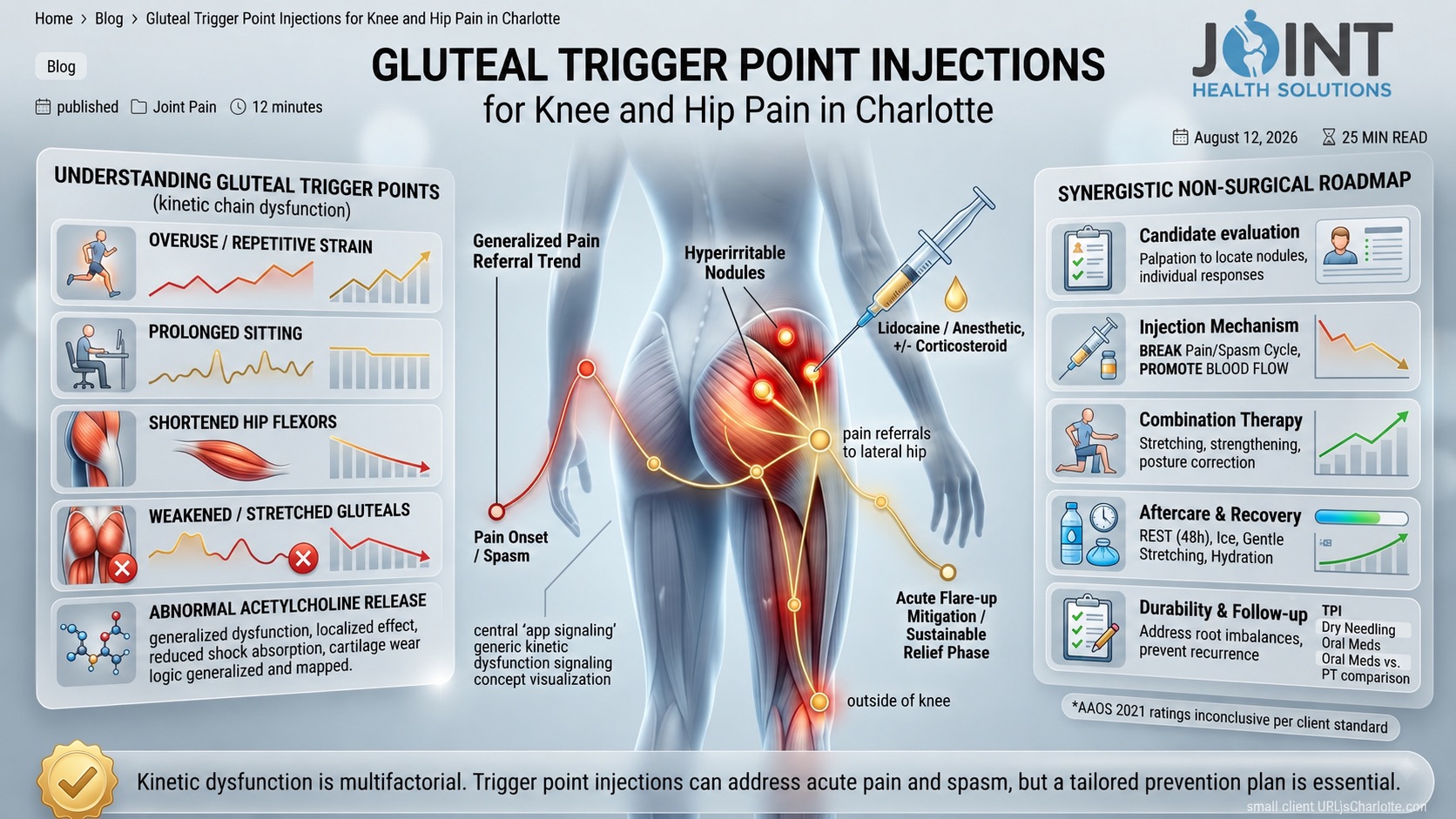
What Are Gluteal Trigger Points?
Trigger points are hyperirritable spots within a taut band of skeletal muscle. They are often described as muscle knots that feel like small, hard nodules when pressed. These points can be painful locally, but they also have a characteristic pattern of referred pain, meaning the discomfort is felt in a different area of the body. In the gluteal muscles, which include the gluteus maximus, medius, and minimus, trigger points are a common source of pain in the lower back, buttock, and down the leg, including the knee.
The exact cause of trigger points is not fully understood, but several factors are thought to contribute. These include muscle overuse, poor posture, prolonged sitting, repetitive strain, and direct trauma. In athletes, gluteal trigger points often develop from activities that involve repetitive hip movement, such as running, cycling, or squatting. In sedentary individuals, prolonged sitting can lead to shortened, tight hip flexors and weakened, overstretched gluteals, creating an environment where trigger points thrive.
From a physiological standpoint, a trigger point is believed to result from excessive release of acetylcholine at the neuromuscular junction, leading to sustained muscle fiber contraction. This contraction restricts local blood flow, which can deprive the muscle of oxygen and nutrients while allowing metabolic waste products to accumulate. The result is a painful, irritable nodule that can persist for months or years if not addressed.
Gluteal trigger points are particularly relevant to knee pain because of their anatomical location and their ability to refer pain along specific patterns. For example, trigger points in the gluteus medius often refer pain to the buttock and sometimes down the outside of the thigh to the knee. Trigger points in the gluteus minimus can refer pain to the posterior thigh and calf, mimicking sciatica. Understanding these referral patterns is essential for diagnosis, as they can easily be mistaken for joint pathology.
At Joint Health Solutions in Charlotte, we frequently see patients who have been told their knee pain is due to arthritis, yet imaging studies show only mild changes. In these cases, a careful physical examination often reveals gluteal trigger points as the primary pain generator. This is why a thorough evaluation by a skilled provider is so important.
How Trigger Points in the Gluteals Cause Referred Knee Pain
The concept of referred pain is central to understanding why gluteal trigger points can cause knee pain. Referred pain occurs when pain is perceived at a location other than the site of the painful stimulus. This phenomenon is thought to involve convergence of sensory inputs in the spinal cord, where signals from different body regions can overlap, leading the brain to misinterpret the source of the pain.
In the case of gluteal trigger points, the referred pain patterns have been mapped and are fairly predictable. For instance, trigger points in the gluteus medius, a muscle that helps stabilize the pelvis during walking, can refer pain to the buttock and along the iliotibial (IT) band to the outside of the knee. This pattern can easily be mistaken for IT band syndrome. Similarly, trigger points in the gluteus minimus, which lies beneath the gluteus medius, can refer pain to the posterior thigh and calf, closely resembling sciatica or lumbar radiculopathy.
The gluteus maximus, the largest of the gluteal muscles, can also harbor trigger points that refer pain to the coccyx and posterior thigh. Because this pain is often felt deep in the buttock, it is not uncommon for patients to assume the problem lies elsewhere, only to find that a gluteal trigger point is the actual source.
Why do these trigger points cause pain in the knee? One explanation is that the gluteal muscles play a crucial role in lower extremity biomechanics. When gluteal muscles are tight or contain trigger points, they can alter the way the leg moves during walking and other activities, placing abnormal stress on the knee joint. Over time, this abnormal biomechanical load can lead to pain in the knee, even though the knee itself is not the primary source of the problem. This is sometimes referred to as a “kinetic chain” dysfunction, where a problem in one part of the body affects another part.
In addition to biomechanical effects, the nervous system plays a role. Trigger points are known to sensitize nearby nerve endings, and the referred pain may be mediated by central sensitization, a process in which the spinal cord becomes hyperresponsive to incoming signals. This can make pain feel more widespread and intense than would be expected from the local muscle abnormality alone.
Understanding these mechanisms helps explain why gluteal trigger point injections may be effective. By injecting a small amount of anesthetic or corticosteroid directly into the trigger point, the goal is to break the cycle of pain and muscle spasm, allowing the muscle to relax and restoring more normal function. This may, in turn, reduce the referred pain felt in the knee.
Diagnosing Gluteal Trigger Points vs. Knee Joint Problems
Distinguishing gluteal trigger points from knee osteoarthritis or other knee joint problems requires a comprehensive clinical evaluation. There is no single test that can definitively diagnose a trigger point; rather, it is a clinical diagnosis based on history and physical examination. Imaging studies such as X-rays or MRI are often used to rule out other conditions, but they do not directly visualize trigger points.
A thorough history is the first step. Your provider will ask about the nature of your pain, when it started, what makes it better or worse, and whether you have any associated symptoms such as numbness, tingling, or weakness. They will also inquire about your activity level, occupation, and any history of trauma or repetitive strain. This information helps narrow down the possible sources of pain.
During the physical examination, the provider will palpate (press on) the gluteal muscles to identify tender, taut bands that reproduce your pain. This is a key finding for trigger points. They may also perform specific maneuvers, such as having you contract and relax the gluteal muscles, to see if that reproduces symptoms. In addition, they will assess your range of motion, strength, and gait to identify any biomechanical abnormalities.
Imaging studies are useful to rule out other conditions that could be causing your pain, such as knee osteoarthritis or lumbar spine pathology. However, it is important to note that many people have abnormal imaging findings that are unrelated to their pain. For example, a mild degree of joint space narrowing in the knee is common with aging and may not be the actual pain generator. Therefore, imaging findings must be correlated with the clinical picture.
At Joint Health Solutions in Charlotte, our providers take a comprehensive approach to diagnosis. They will not rely solely on imaging but will combine your history, physical exam, and imaging results to arrive at an accurate diagnosis. If gluteal trigger points are suspected, they may recommend a diagnostic injection, where a small amount of anesthetic is injected into the trigger point. If your pain is significantly relieved, even temporarily, this confirms that the trigger point is a major contributor to your symptoms.
It is also important to consider other causes of referred pain to the knee, such as lumbar radiculopathy from a herniated disc or spinal stenosis. These conditions can produce similar pain patterns, and a thorough neurological exam may be needed to rule them out.
In summary, diagnosis of gluteal trigger points is a process of exclusion and confirmation. It requires a skilled clinician who is familiar with the referral patterns of these muscles and who can differentiate them from joint pathology. If you are experiencing knee pain that has not been fully explained by imaging, a consultation at Joint Health Solutions could be a valuable step.
What to Expect During a Gluteal Trigger Point Injection
If you and your provider decide that a gluteal trigger point injection is appropriate, you will likely have questions about what the procedure entails. Here, we break down the steps so you know what to expect.
Before the procedure: Your provider will review your medical history, including any allergies, current medications, and any bleeding disorders. You may be advised to avoid blood-thinning medications for a few days before the injection, but you should never stop any medication without consulting your prescribing physician. You will also be asked to wear loose, comfortable clothing to allow easy access to the gluteal area.
The injection process: The procedure is typically performed in the clinic and takes only a few minutes. You will lie on your side or stomach, depending on which gluteal muscles are being treated. The provider will clean the skin with an antiseptic solution to reduce the risk of infection. They will then locate the trigger point by palpation, using their fingers to find the taut band and tender nodule.
Once the trigger point is identified, the provider will insert a thin needle directly into it. The needle is usually attached to a syringe containing a small amount of anesthetic, such as lidocaine, or a combination of anesthetic and corticosteroid. The injection may cause a brief, sharp sensation, but it is generally well-tolerated. Some providers use a technique called “dry needling,” where no medication is injected, but the mechanical disruption of the needle alone can help relieve the trigger point.
During the injection, you may feel a twitch in the muscle, known as a local twitch response. This is a normal and often desirable response, as it indicates that the needle has reached the trigger point. The entire procedure typically takes less than 15 minutes.
After the injection: You may experience some soreness at the injection site for a day or two. This is normal and usually resolves on its own. You can apply ice to the area to reduce any swelling or discomfort. Your provider may recommend gentle stretching or activity modification for the next 24-48 hours to allow the muscle to heal.
You should be able to return to most normal activities immediately, but it is advisable to avoid strenuous exercise or heavy lifting for a few days. Some patients notice improvement within a few days, while others may require a series of injections to achieve lasting relief. The number of injections needed varies depending on the severity of your trigger points and your individual response.
At Joint Health Solutions, our providers take the time to explain the procedure and answer any questions you may have. We use a gentle, patient-centered approach to ensure your comfort throughout the process. If you are considering gluteal trigger point injections in Charlotte, we encourage you to schedule a consultation to discuss whether this treatment is right for you.
Are Gluteal Trigger Point Injections Effective?
The effectiveness of gluteal trigger point injections is a topic of ongoing research. While many patients report significant pain relief, the scientific evidence is mixed, and results vary from person to person. It is important to have realistic expectations and to understand that this treatment is not a cure for all types of knee pain.
Clinical literature on trigger point injections for myofascial pain generally shows that injections with local anesthetics can provide short-term pain relief, but evidence for long-term benefit is more limited. Trigger point injections are considered a reasonable option for patients who do not respond to conservative measures, and they are typically most effective when combined with other treatments such as physical therapy to address underlying factors.
The table below summarizes the evidence for various treatments for gluteal trigger points:
| Treatment | How It Works | Limitations | Risks |
|---|---|---|---|
| Trigger point injections (local anesthetic) | Injects anesthetic to block pain signals and break spasm cycle | Short-term relief; may need repeated injections | Bleeding, infection, muscle soreness |
| Trigger point injections (corticosteroid) | Adds anti-inflammatory effect to anesthetic | Similar to anesthetic alone; steroid considerations with repeated use | Tissue thinning, skin changes, systemic effects |
| Dry needling | Mechanical disruption of trigger point without medication | May be less effective if no medication is used | Similar to injections, but lower risk of medication side effects |
| Physical therapy | Stretching, strengthening, and manual therapy to address muscle imbalances | Requires time and commitment; may not provide immediate relief | Minimal; soreness after sessions |
| Oral medications (NSAIDs, muscle relaxants) | Reduce inflammation and muscle spasm systemically | May cause gastrointestinal or renal side effects; not targeted | GI bleeding, kidney effects, drowsiness |
It is important to note that the evidence for trigger point injections is not as robust as for some other procedures. However, they are widely used in clinical practice, and many patients find them helpful. The key is to combine injections with a comprehensive treatment plan that includes physical therapy, activity modification, and ergonomic changes.
At Joint Health Solutions, we take an evidence-based approach. We will discuss the potential benefits and limitations of gluteal trigger point injections with you, and we will only recommend them if we believe they are appropriate for your specific condition. We also offer other non-surgical treatments, such as physical therapy and offloading knee braces, which may complement the effects of injections.
Potential Risks and Side Effects
Gluteal trigger point injections are generally safe when performed by a trained healthcare professional, but like any medical procedure, they carry some risks and potential side effects. Understanding these can help you make an informed decision.
Common side effects: The most common side effect is temporary soreness at the injection site. This is usually mild and resolves within a day or two. You may also experience slight bruising or swelling. Applying ice to the area can help reduce these symptoms. Some patients report a temporary increase in pain immediately after the injection, which is typically short-lived.
Less common risks: Less common but more serious risks include infection, bleeding, and nerve irritation. Infection is rare, especially with proper sterile technique. Bleeding is also uncommon, but it can occur if you are taking blood-thinning medications or have a bleeding disorder. Nerve irritation is extremely rare, but the needle could potentially contact a nerve, causing temporary numbness or tingling. To minimize these risks, it is important to disclose your full medical history to your provider.
Medication-specific risks: If the injection contains a corticosteroid, there are additional risks to consider. Corticosteroids can cause local tissue thinning at the injection site, and may cause temporary increases in blood sugar in diabetic patients. For this reason, steroid injections are usually limited in frequency.
Local anesthetics are generally very safe, but they can cause allergic reactions in rare cases. Your provider will ask about any previous allergic reactions to anesthetics before proceeding. If you have a known allergy to a specific anesthetic, an alternative can be used.
Who should avoid this procedure: Gluteal trigger point injections may not be appropriate for everyone. You should avoid this procedure if you have a known infection at the injection site, a bleeding disorder, or if you are taking anticoagulant medications that cannot be temporarily stopped. Pregnant women should also discuss the risks and benefits with their provider, as the safety of these injections during pregnancy is not well established.
It is also important to understand that trigger point injections are not a first-line treatment for all knee pain. They are most appropriate when there is a clear diagnosis of myofascial trigger points contributing to your symptoms. Your provider at Joint Health Solutions will conduct a thorough evaluation to determine if this treatment is right for you.
Aftercare and Recovery Tips
Proper aftercare can enhance the effectiveness of your gluteal trigger point injection and reduce the risk of complications. Here are some general guidelines to follow after your procedure.
Immediate aftercare: After the injection, you may be asked to rest for a few minutes in the clinic to ensure you do not feel dizzy or lightheaded. For the first 24 hours, apply ice to the injection site for 15-20 minutes at a time, several times a day, to reduce swelling and soreness. You may also take over-the-counter pain relievers such as acetaminophen if needed, but avoid aspirin or ibuprofen unless your provider has approved them, as they can increase bleeding.
Activity and exercise: You can usually resume normal activities immediately, but you should avoid strenuous exercise, heavy lifting, or prolonged sitting for the first 48 hours. Gentle stretching of the gluteal muscles may be beneficial, but avoid aggressive stretching that could aggravate the area. Your provider may give you specific stretching exercises to do at home.
After the initial 48 hours, you can gradually return to your normal exercise routine, but listen to your body. If you experience increased pain, scale back and rest. It is important to address any underlying muscle imbalances or postural issues that may have contributed to the trigger points, so consider incorporating a regular stretching and strengthening program.
Recovery timelines vary by individual: relief from the anesthetic is often immediate but temporary, while the longer-lasting benefit from muscle relaxation typically builds over the following days. Some patients may require a series of injections to achieve lasting relief, and the effects may last for several weeks to months. If your pain does not improve after the first injection, your provider may recommend a different approach.
It is also important to continue any prescribed physical therapy or other treatments. Trigger point injections are often most effective when combined with a comprehensive rehabilitation program that addresses the root causes of muscle tension.
Contact your provider if you experience any signs of infection, such as increasing redness, warmth, swelling, or discharge at the injection site, or if you develop a fever. You should also seek medical attention if you experience severe pain, numbness, or weakness in your leg that does not resolve.
Other Treatments for Gluteal Trigger Points
Gluteal trigger point injections are just one of several treatment options available for myofascial pain. Depending on your specific condition, your provider may recommend a combination of treatments to achieve the best results.
Physical therapy: A physical therapist can teach you specific stretching exercises to lengthen tight muscles, strengthening exercises to correct muscle imbalances, and manual therapy techniques such as myofascial release or massage to help relax trigger points. Physical therapy can also address any underlying biomechanical issues, such as poor gait or posture, that may be contributing to your pain.
Dry needling: Dry needling is a technique that uses thin needles to stimulate trigger points without injecting medication. It is similar to trigger point injections but does not involve any anesthetic or steroid. Some patients find it helpful, but the evidence is similar to that for injections, with mixed results.
Oral medications: Nonsteroidal anti-inflammatory drugs (NSAIDs) such as ibuprofen or naproxen can help reduce inflammation and pain, but they are not targeted to the trigger point. Muscle relaxants may also be prescribed to reduce muscle spasm, but they can cause drowsiness and are not a long-term solution. These medications are best used as an adjunct to other treatments.
Lifestyle and ergonomic modifications: Making changes to your daily habits can help prevent trigger points from recurring. If you sit for long periods, take frequent breaks to stand and stretch. Use a chair with good lumbar support, and consider a standing desk if possible. If you are an athlete, ensure you have proper form and gradually increase the intensity of your workouts to avoid overuse injuries.
At Joint Health Solutions, we offer a range of non-surgical treatments for joint and muscle pain, including trigger point injections, physical therapy, and offloading knee braces. Our providers will work with you to develop a personalized treatment plan that addresses your unique needs and goals.
When to See a Specialist in Charlotte
If you have been experiencing knee pain that has not improved with conservative measures such as rest, ice, over-the-counter pain relievers, or home stretching, it may be time to see a specialist. Gluteal trigger points can be stubborn, and without proper treatment, they can persist for months or even years, leading to chronic pain and disability.
You should also consider seeing a specialist if your pain is severe, if it interferes with your daily activities, or if you have difficulty walking or bearing weight on the affected leg. If you have any red flag symptoms such as numbness, tingling, weakness, or loss of bowel or bladder control, seek immediate medical attention, as these could indicate a more serious condition such as a herniated disc or spinal cord compression.
At Joint Health Solutions in Charlotte, our team has extensive experience in diagnosing and treating musculoskeletal pain, including gluteal trigger points. We take a comprehensive, non-surgical approach to care, focusing on identifying the root cause of your pain and developing a tailored treatment plan.
During your consultation, you will receive a thorough evaluation, including a detailed history, physical exam, and review of any imaging studies. We will discuss your symptoms, goals, and treatment options, and we will help you make an informed decision about whether gluteal trigger point injections are right for you. We also offer other treatments and services that may be beneficial, including physical therapy, offloading knee braces, and other injection therapies.
If you are ready to take the next step toward pain relief, we encourage you to learn more about our providers and to schedule a consultation. Our team is dedicated to helping you find relief from knee pain, and we are committed to providing compassionate, evidence-based care. You can also read reviews from other patients who have found relief at our clinic.
Don’t let gluteal trigger points keep you from enjoying life. Contact Joint Health Solutions today to discuss whether gluteal trigger point injections in Charlotte can help you get back to the activities you love. Call us at 704-833-3566 to schedule your appointment, or explore our treatments and services to learn more.
Institutional Sources
- NIAMS: Osteoarthritis
- Mayo Clinic: Trigger Point Injections
- Arthritis Foundation: Myofascial Pain Syndrome
- Cleveland Clinic: Myofascial Pain Syndrome
Frequently Asked Questions
How long do gluteal trigger point injections last?
The duration of pain relief from a gluteal trigger point injection varies from person to person. Some patients experience relief for several weeks, while others may need a series of injections to achieve longer-lasting results. The underlying cause of the trigger points, your activity level, and whether you also participate in physical therapy can all influence how long the effects last.
Can trigger points cause knee pain?
Yes, trigger points in the gluteal muscles can refer pain to the knee. For example, trigger points in the gluteus medius can refer pain along the outside of the thigh to the knee, mimicking IT band syndrome. This is why a thorough evaluation is important to differentiate between joint pain and referred muscular pain.
What does a gluteal trigger point injection cost?
Joint Health Solutions operates on a self-pay basis with transparent, upfront pricing. Cost depends on the number of trigger points treated and whether a series of sessions is recommended. Our team can provide a quote during your consultation.
What is the difference between trigger point and cortisone injections?
Trigger point injections typically contain a local anesthetic, such as lidocaine, and may or may not include a corticosteroid. They are designed to relieve muscle spasm and pain directly at the trigger point. Cortisone injections, on the other hand, are primarily anti-inflammatory and are often used for joint or bursa inflammation. The choice depends on the underlying cause of your pain.
How many injections will I need?
The number of injections needed varies. Some patients experience relief after a single injection, while others may require multiple injections spaced weeks apart. Your provider will monitor your response and adjust the treatment plan accordingly. It is important to combine injections with other therapies such as physical therapy for best results.
Is the procedure painful?
Most patients tolerate the injection well. You may feel a brief sting as the needle is inserted, and you may experience a muscle twitch, which is a normal response. The discomfort is usually minimal and short-lived. Your provider will use techniques to minimize pain, such as using a small needle and applying pressure after the injection.
Can I drive after the injection?
In most cases, you can drive immediately after the procedure, as it does not usually cause significant sedation or weakness. However, if you feel any weakness in your leg, you should arrange for someone to drive you home. Your provider will give you specific instructions.
What should I avoid after the injection?
Avoid strenuous exercise, heavy lifting, or prolonged sitting for the first 48 hours. You should also avoid applying heat to the injection site for the first day, as it may increase swelling. Gentle stretching and ice are generally recommended. Follow your provider’s aftercare instructions closely.
Are there any long-term side effects?
Long-term side effects are rare. Repeated corticosteroid injections could potentially cause local tissue thinning or other effects, but these are uncommon. Your provider will limit the frequency of injections to minimize risks. Trigger point injections with local anesthetic alone have very few long-term side effects.
When can I return to exercise?
You can usually resume light exercise after 48 hours, but you should gradually increase intensity. Listen to your body and avoid activities that exacerbate your pain. Your provider may recommend specific stretching and strengthening exercises to help prevent recurrence. It is important to address any underlying muscle imbalances to reduce the risk of future trigger points.




 English
  Spanish