

What to Expect During Your First IV Therapy Session in Charlotte
Published July 1, 2026 | Last reviewed: July 14, 2026 | Category: Patient Resources | Location: Charlotte, North Carolina
🕒 12 MIN READ
If you have been living with chronic joint pain, inflammation, or fatigue from an autoimmune condition or intense athletic training, you may have tried multiple treatments with mixed results. You may have taken oral medications that upset your stomach, received cortisone injections that wore off after a few weeks, or spent time in physical therapy with gradual progress. If you are now considering intravenous (IV) therapy, this guide explains what actually happens during a first session — from scheduling to post-session recovery — so you know what to expect.
At Joint Health Solutions, we offer anti-inflammatory IV therapy and sports recovery IV therapy as part of a broader non-surgical treatment approach. IV therapy is not a cure for osteoarthritis or chronic joint conditions, but for appropriate patients it may be a useful component of a comprehensive care plan.
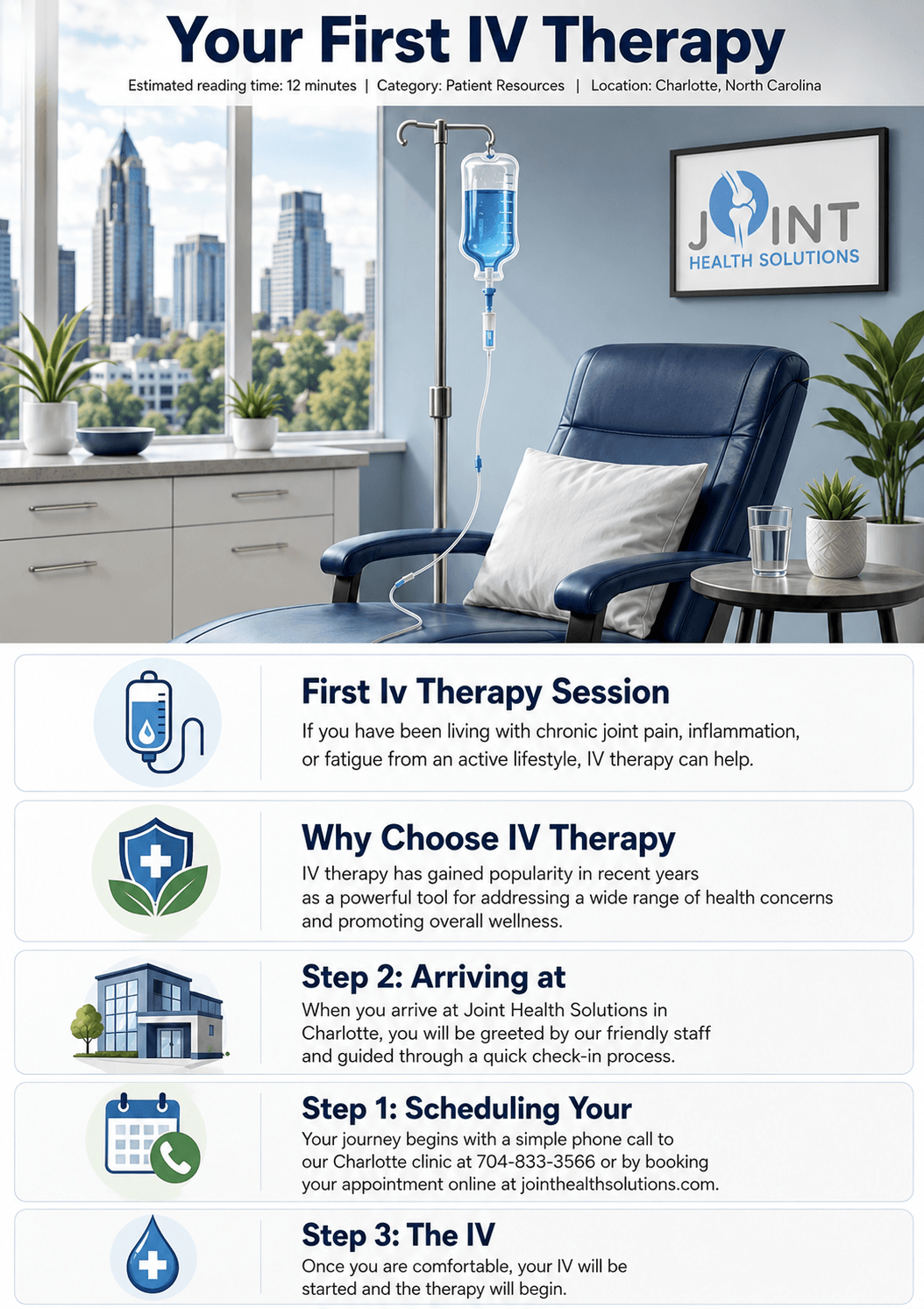
Why Consider IV Therapy for Joint Health?
IV therapy delivers fluids, vitamins, minerals, and medications directly into the bloodstream, bypassing the gastrointestinal tract. Because absorption does not depend on the digestive process, IV administration achieves higher serum concentrations than oral supplementation for the same dose — this is the principal pharmacological rationale for the IV route.
Whether that higher serum concentration translates into meaningful clinical benefit for joint conditions depends on the specific agent, dosage, and patient. Components like Toradol (ketorolac) have established evidence for short-term pain management. High-dose vitamin C, magnesium, and B-vitamins have established clinical use for specific deficiency states and have supportive mechanistic evidence for inflammation. The combination of these agents in a single IV formulation for osteoarthritis or chronic joint pain is considered investigational — see the evidence table below.
Athletes use sports recovery IV therapy to rehydrate, replenish electrolytes, and support recovery after intense training or competition, where the speed of fluid and electrolyte delivery is the primary rationale.
At Joint Health Solutions, we integrate IV therapy with other non-surgical treatments — including joint injections, PRP therapy, cortisone injections, hyaluronic acid injections, physical therapy, and nutrition planning — when a patient’s clinical picture supports a combined approach.
Step 1: Scheduling Your Appointment
Your journey begins with a phone call to our Charlotte clinic at 704-833-3566 or by scheduling online through our contact page. During this initial conversation, our patient coordinator will ask about your symptoms, medical history, current medications, and any previous treatments you have tried.
This information helps us determine whether IV therapy is appropriate for you and which formulation will best address your needs. We will also discuss insurance coverage and payment options. Most IV therapy sessions are considered elective and may not be covered by insurance, but we offer transparent pricing and can provide a cost estimate before your visit.
The entire appointment typically lasts 45 to 90 minutes, including consultation and the infusion itself. You will receive a confirmation email with directions to our clinic and a list of pre-appointment instructions.
Preparing for Your Appointment
- Stay hydrated: Drink plenty of water the day before and the morning of your appointment. Proper hydration makes vein access easier and helps the session go smoothly.
- Eat a light meal: Have a balanced meal about two hours before your session. Avoid heavy, greasy foods that may cause nausea.
- Wear comfortable clothing: Choose a short-sleeved shirt or a top with sleeves that can be easily rolled up above the elbow to allow vein access in the forearm or hand.
- Bring a complete medication and supplement list: Our medical team needs to know everything you are taking to avoid potential interactions.
- Arrive 10–15 minutes early to complete any remaining paperwork.
Step 2: Arriving at Our Charlotte Clinic
When you arrive at Joint Health Solutions, you will be greeted by our front desk staff and asked to complete a brief health questionnaire if you have not already done so online. This form covers your medical history, current symptoms, allergies, and any previous adverse reactions to IV therapy or medications.
Our licensed medical professional — a registered nurse or physician — will then review your forms and discuss your goals for treatment. This is the time to ask questions about what to expect. The clinician will explain the specific IV formulation recommended for you and check your vital signs (blood pressure, heart rate, temperature) to confirm you are ready for the infusion.
Step 3: The IV Therapy Procedure
Once you are comfortably seated in a recliner, the clinician will select a vein — usually in your forearm or hand — clean the area with an antiseptic wipe, and insert a small, flexible catheter (the IV line) into the vein. Most patients describe the sensation as a quick pinch similar to a blood draw.
After the IV is secured, the clinician will connect the tubing to a bag containing your personalized solution. The infusion rate is carefully controlled, and you can communicate any discomfort to your clinician, who can adjust accordingly.
During the infusion, which typically lasts 30 to 60 minutes, you can read, listen to music, use your phone, or simply rest. The clinician will check on you periodically to monitor for any reactions.
Common Sensations During the Infusion
| Sensation | Likely Cause | Duration |
|---|---|---|
| Cool feeling along the vein | IV fluid is at room temperature (~21°C / 70°F), cooler than body temperature (37°C / 98.6°F) | Temporary; resolves as fluid warms |
| Slight metallic taste | High-dose B-vitamins or glutathione circulating rapidly through highly vascularized taste-bud tissue | Minutes; resolves spontaneously |
| Wave of warmth or relaxation | Magnesium causes vasodilation and muscle relaxation | During and shortly after infusion |
| Mild fatigue or lightheadedness | Body adjusting to fluid and electrolyte shifts | Usually resolves within hours; inform clinician if persistent |
These sensations are normal and temporary. Your session will be closely supervised throughout.
Step 4: After Your Session
After the infusion is complete, the clinician will remove the IV line and apply a small bandage. You may notice a slight bruise at the insertion site, which is normal and will fade within a few days.
We recommend taking it easy for the rest of the day — avoid strenuous exercise, heavy lifting, and alcohol. Drink extra water to stay hydrated. Some patients notice effects within 24 to 48 hours; others notice little change. Individual responses vary depending on your baseline health, the formulation used, and your underlying condition.
Depending on your condition and goals, your clinician may recommend a series of sessions. If you do not respond meaningfully after an initial course, your provider will discuss alternative or complementary approaches rather than continuing indefinitely.
Evidence and Clinical Research
The following table summarizes the current evidence base for the IV therapy components we commonly use:
| Component | FDA Status | Evidence Level | Key Findings |
|---|---|---|---|
| Toradol (ketorolac) | FDA-approved for short-term management of moderate to severe acute pain (≤5 days) | Established clinical evidence | Reduces pain and inflammation; risk of GI bleeding and renal effects with prolonged use; not for long-term use |
| Vitamin C (high-dose IV) | FDA-approved as a nutrient; high-dose IV use is off-label for most indications | Mixed evidence; some human trials in inflammation and oxidative stress | May reduce oxidative stress markers; limited high-quality RCT evidence for joint-specific outcomes |
| Magnesium | FDA-approved as a nutrient; IV use for deficiency is standard care | Established for treating deficiency; limited evidence for joint pain specifically | Supports muscle relaxation and nerve function; may help with muscle spasms; muscle relaxation effect is well-documented |
| B-Complex Vitamins | FDA-approved as nutrients | Established evidence for treating deficiency | Support energy metabolism and nerve health; evidence for joint-specific benefit is limited |
| Glutathione (IV) | Not FDA-approved as a drug; available as supplement/compounded preparation | Limited human evidence; primarily mechanistic and animal studies | Antioxidant properties well established in laboratory models; benefit for joint pain in high-quality human trials not yet proven |
Evidence-Level Definitions:
- Established clinical evidence: Supported by multiple peer-reviewed human studies.
- Mixed evidence: Some supportive human studies, but inconsistency or methodological limitations across the body of literature.
- Limited human evidence: Small studies or evidence from deficiency populations that may not generalize.
- Mechanistic / animal studies: Findings from laboratory or animal research; do not prove patient benefit in humans.
Safety and Candidacy
Who May Be a Candidate for IV Therapy?
IV therapy may be appropriate for patients with chronic joint pain (osteoarthritis, tendinitis), athletic recovery needs, or documented nutrient depletion from chronic illness. It may also be considered as an adjunct to other treatment modalities. Candidacy depends on a complete clinical evaluation.
Who Should Avoid IV Therapy?
- Severe kidney disease (impaired fluid and electrolyte handling)
- Congestive heart failure (fluid overload risk)
- Known allergies to any components of the infusion
- Active infection or fever
- Uncontrolled hypertension
Always disclose your complete medical history and medication list to your clinician before your first IV therapy session.
Medication Interactions
Patients on blood thinners (warfarin, apixaban, rivaroxaban, clopidogrel, etc.) may have a higher risk of bruising or bleeding at the IV site. Please inform our team of all medications and supplements you are taking. We will evaluate your situation and may recommend alternative approaches if necessary.
Compounding Pharmacy Policy
At Joint Health Solutions, we use compounding pharmacies when clinically appropriate. Compounding involves preparing customized medication formulations to meet specific patient needs — for example, adjusting doses, combining ingredients, or creating preservative-free preparations.
| Category | Description | Safety Status |
|---|---|---|
| Physician-prescribed treatment from a licensed compounding pharmacy | Prepared by a state-licensed pharmacy following USP standards | Legitimate, regulated, and appropriate when clinically indicated |
| Online peptide labs / research-only vendors | Sell products “for research use only” without a prescription | Unregulated; identity, purity, sterility, and storage are uncertain |
| Direct-to-consumer sellers | Sell IV vitamins or peptides directly to consumers without medical oversight | Unsupervised; risk of adverse effects and contamination |
No compounded preparation is FDA-approved, and no pharmacy is “FDA-certified.” However, licensed compounding pharmacies operate under state regulations and USP compounding standards, which provide important quality and safety safeguards.
Frequently Asked Questions
How long does an IV therapy session take?
Your first session typically lasts 45 to 90 minutes total, including consultation, preparation, and the infusion itself. The infusion runs 30 to 60 minutes depending on the formulation and your individual pace.
Is IV therapy painful?
Most patients feel only a quick pinch when the catheter is inserted, similar to a blood draw. Once the line is in place, the infusion itself is painless. Some people experience a cool sensation along the vein or a mild metallic taste, which is normal and temporary.
How many sessions will I need?
This depends on your condition and goals. For chronic inflammation, a series of sessions spaced one to four weeks apart is common, with the frequency and duration determined by your clinical response. Your provider will create a plan based on your presentation and adjust it based on how you respond.
Can I eat before my appointment?
Yes. Eat a light meal about two hours before your session. Avoid heavy or greasy foods that could cause nausea, and stay well hydrated.
Are there any side effects?
Side effects are generally mild and uncommon. They may include bruising at the insertion site, temporary fatigue, lightheadedness, or a metallic taste. Serious allergic reactions are rare. Our team monitors you throughout the session. Inform us of any allergies or prior reactions to IV therapy or medications before starting.
What conditions may benefit from IV therapy?
IV therapy is used for chronic joint pain, tendinitis, athletic recovery, dehydration, and fatigue associated with chronic illness. Evidence strength varies by condition and by the specific agent used — see the evidence table above. Discuss your specific diagnosis with your provider to understand what the evidence suggests for your situation.
Can I receive IV therapy if I am on blood thinners?
Patients on blood thinners may have a higher risk of bruising or bleeding at the IV site. Please inform our team of all medications you are taking before your appointment. We will evaluate whether treatment is appropriate and may recommend modifications.
Is IV therapy covered by insurance?
Most IV therapy sessions are considered elective and are not covered by insurance. We offer transparent pricing and can provide a cost estimate before your appointment. Call us at 704-833-3566 to ask about specific costs.
What should I do after my session?
Take it easy for the rest of the day. Avoid strenuous exercise, alcohol, and heavy meals. Drink plenty of water. Most patients feel well enough to resume normal activities the next day. If you experience anything unusual — severe headache, difficulty breathing, chest pain, or significant swelling — contact your provider or seek medical care promptly.
How do I schedule my first IV therapy session in Charlotte?
Call us at 704-833-3566 or use our online contact form to book an appointment. Our patient coordinator will help you choose a convenient time and answer questions before your visit.
What is the evidence for IV therapy for joint pain specifically?
The evidence for IV nutrient therapy specifically targeting joint pain is limited. While individual components like Toradol have FDA approval for short-term acute pain management, the combination of vitamins and anti-inflammatory agents in a single IV formulation for osteoarthritis or chronic joint pain is considered investigational. Supportive evidence comes largely from mechanistic studies and small human trials. Discuss the available evidence with your clinician before starting treatment.
Is IV therapy safe for patients with kidney disease?
IV therapy may not be appropriate for patients with severe kidney disease due to the risk of fluid overload and electrolyte imbalances. Always disclose kidney conditions or reduced kidney function to your clinician before your first session. Your provider will determine whether treatment is appropriate and may recommend modifications or alternative therapies.
Schedule Your First IV Therapy Session in Charlotte
If you are considering IV therapy for chronic joint pain, inflammation, or athletic recovery, Joint Health Solutions can evaluate whether it is an appropriate part of your care plan.
📞 Call us: 704-833-3566
What to bring: A current medication and supplement list, any recent labs or imaging, your insurance card and photo ID, and questions for your provider.
Sources
Institutional and Regulatory Sources
- FDA — Registered Outsourcing Facilities (503B Compounding)
- Mayo Clinic — IV Vitamin Therapy: What You Should Know
- Medical News Today — IV Therapy: Uses, Benefits, and Risks
Key Clinical References
- Gaby AR. (2002). Intravenous nutrient therapy: the “Myers’ cocktail.” Alternative Medicine Review. PubMed: 12230799
- Padayatty SJ, et al. (2004). Vitamin C pharmacokinetics: implications for oral and intravenous use. Annals of Internal Medicine. PubMed: 15069351
- Rowe BH, et al. (1992). Magnesium sulfate is effective and safe in the treatment of acute severe asthma. Annals of Emergency Medicine (magnesium mechanism reference). PubMed: 1580529
- Carr AC, Maggini S. (2017). Vitamin C and immune function. Nutrients. PubMed: 29099763
- Maughan RJ, et al. (2018). IOC consensus statement: dietary supplements and the high-performance athlete. British Journal of Sports Medicine (hydration and athletic recovery). PubMed: 29540394
Disclaimer: This content is for informational purposes only and does not constitute medical advice. Always consult with a qualified healthcare provider to determine whether IV therapy is appropriate for your specific condition. Individual results vary. The combination of IV nutrients for joint pain is investigational and not FDA-approved as a combination treatment. Off-label use of individual components is legal and common in medicine when supported by clinical evidence and physician judgment.