
Pain Behind the Knee: Causes, Warning Signs, and When to Seek Care
Pain behind the knee can come from the joint, a tendon or muscle, a fluid-filled Baker cyst, or—in some cases—a blood vessel problem that needs urgent attention. The location alone cannot identify the cause. How the pain started, whether the calf or knee is swollen, which movements provoke it, and whether you have fever, chest symptoms, or a recent injury all help determine the safest next step.
This guide explains common patterns of back-of-knee pain, warning signs that should not wait, how clinicians evaluate the symptom, and which treatment options may be considered after the cause is identified.
Quick Answer: What Causes Pain Behind the Knee?
Common causes of pain behind the knee include a hamstring or calf strain, tendon irritation, a Baker cyst, osteoarthritis-related swelling, and a meniscus or ligament injury. Less commonly, pain and swelling in the leg may be related to deep vein thrombosis, infection, fracture, nerve irritation, or another condition requiring prompt care. A clinician may use the history, physical examination, and selected imaging or laboratory tests to distinguish among these possibilities.
Seek urgent medical care for new one-sided leg swelling, warmth, redness or discoloration; a hot swollen knee with fever; severe pain after an injury; inability to bear weight; or a cold, pale, numb foot. Call 911 for chest pain, sudden shortness of breath, coughing up blood, fainting, or other possible signs of a pulmonary embolism.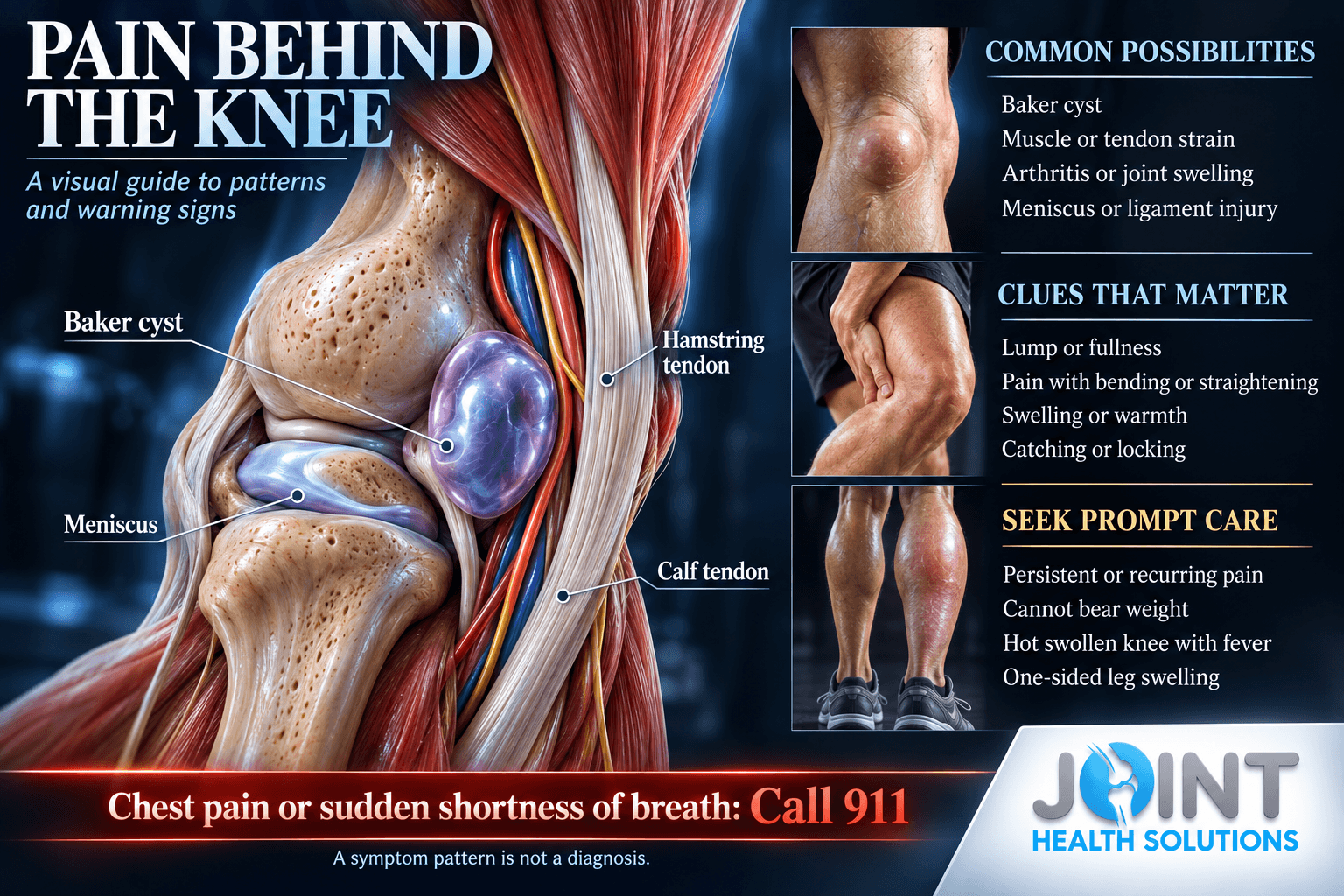
What Does Pain Behind the Knee Mean?
The back of the knee is called the posterior or popliteal region. It is a compact area containing the rear portion of the knee joint, the ends of the hamstring and calf muscles, tendons, ligaments, nerves, and major blood vessels. Pain felt there may originate in one of those structures or be referred from elsewhere.
People describe posterior knee pain in different ways. It may feel like a dull ache, a sharp catch, pulling, pressure, tightness, burning, or fullness. Some people notice a lump or swelling behind the knee. Others have pain only when bending, straightening, walking, running, or using stairs. Those details are more useful than the location by itself.
A symptom pattern can narrow the possibilities, but it cannot provide a diagnosis. For example, a Baker cyst and a blood clot can both cause discomfort and swelling behind the knee or in the calf. Because the consequences and treatments are very different, new unexplained swelling should be assessed rather than diagnosed at home.
Common Causes of Pain Behind the Knee
Several conditions can produce similar symptoms. The following are possibilities a clinician may consider—not conclusions that can be reached from an online checklist.
Baker cyst
A Baker cyst, also called a popliteal cyst, is a fluid-filled swelling behind the knee. It often develops when a problem inside the joint, such as osteoarthritis, inflammatory arthritis, or a cartilage injury, causes excess joint fluid. The fluid collects in a sac at the back of the knee.
A Baker cyst may cause fullness, stiffness, a visible or palpable lump, and pain that becomes more noticeable after activity or when the knee is fully bent or straightened. Some cysts cause few symptoms. Treating only the lump may not provide lasting relief if the underlying source of joint swelling remains active.
A cyst can occasionally rupture and cause sudden calf pain, swelling, or skin discoloration. Those findings can resemble a blood clot. Because appearance alone cannot reliably distinguish them, sudden calf swelling requires prompt medical evaluation.
Hamstring, calf, or tendon injury
The hamstring muscles cross the back of the knee from above, while the gastrocnemius muscle of the calf crosses from below. A strain may follow sprinting, forceful acceleration, jumping, overstretching, or an unexpected step. Pain is often linked to a specific activity and may be accompanied by localized tenderness, weakness, bruising, or discomfort when the involved muscle contracts or stretches.
Tendon irritation can develop more gradually with repetitive loading. Pain may be felt toward the inner or outer back of the knee rather than directly in the center. A careful examination helps separate tendon pain from symptoms arising inside the joint. A sudden snap, marked bruising, a visible defect, or major loss of strength suggests a more significant injury.
Meniscus injury or degeneration
The menisci are fibrocartilage structures that distribute load and contribute to knee stability. An acute tear may occur during a pivot, deep squat, or other twisting movement. Degenerative meniscal changes can become symptomatic after an ordinary movement, particularly as tissue changes with age.
Possible clues include pain along the inner or outer joint line, swelling, catching, locking, reduced motion, or a feeling that the knee gives way. Pain from the rear portion of a meniscus may be perceived behind the knee. However, meniscal changes are also common on imaging in people without symptoms, so an MRI finding must be interpreted in the context of the history and examination. Joint Health Solutions already has a separate guide to degenerative meniscus tears; this article retains its focus on the broader symptom of posterior knee pain.
Knee osteoarthritis and joint swelling
Knee osteoarthritis may cause aching, stiffness after rest, reduced motion, creaking, and intermittent swelling. Discomfort is not always limited to the front or sides of the joint. Excess fluid or changes in the tissues at the back of the knee can create posterior pressure or pain, and osteoarthritis may contribute to a Baker cyst.
Symptoms and imaging do not always match perfectly. An X-ray can show structural changes but cannot, by itself, prove which structure is causing a person’s pain. The evaluation should consider the entire pattern instead of assuming that all pain behind the knee is arthritis.
Ligament or other internal knee injury
The posterior cruciate ligament sits inside the knee and helps limit backward movement of the shinbone. It can be injured by a force directed to the front of a bent knee, such as striking the dashboard in a collision or falling onto a flexed knee. Other ligament injuries may also produce pain, swelling, or instability.
A pop at the time of injury, rapid swelling, bruising, difficulty bearing weight, or continued instability raises concern for a significant internal injury. Those findings deserve timely assessment rather than repeated self-testing.
Inflammatory arthritis, gout, or infection
Inflammatory arthritis and crystal-related disease such as gout can produce pain and swelling within the knee. Infection inside the joint is less common but time-sensitive. A hot, markedly swollen, very painful knee—especially with fever, chills, illness, immune suppression, recent surgery, or a recent injection—requires prompt evaluation.
These conditions cannot be distinguished reliably by pain location alone. In selected cases, knee arthrocentesis may be used to obtain fluid for laboratory analysis. Aspiration is not automatically appropriate for every painful knee, and suspected infection should not be delayed for a routine office appointment.
Deep vein thrombosis
Deep vein thrombosis, or DVT, is a blood clot in a deep vein, most commonly in the leg. Possible symptoms include one-sided swelling, pain or tenderness, warmth, and redness or discoloration. Some people with DVT have few or no symptoms. Risk may be higher after surgery or hospitalization, prolonged immobility or travel, significant injury, pregnancy or the postpartum period, estrogen-containing medication, active cancer, or a previous clot—but a clot can occur without an obvious trigger.
Neither the location of pain nor a home maneuver can safely rule a clot in or out. Do not massage a newly swollen painful calf or rely on an internet test. Seek prompt medical assessment. A pulmonary embolism can occur if clot material travels to the lungs; sudden breathing difficulty, chest pain, coughing up blood, fainting, or a very fast or irregular heartbeat requires emergency help.
Less common explanations
Fracture, a nerve problem, a mass, referred pain from the hip or lower back, and less common vascular conditions can also produce symptoms near the back of the knee. Numbness, progressive weakness, a cold or pale foot, unexplained weight loss, a growing mass, persistent night pain, or symptoms that do not behave like a routine strain should prompt medical assessment.
What Does Pain Behind the Knee During Movement Suggest?
The movement that provokes pain can guide the examination, but it is not a stand-alone diagnostic test.
Pain when bending the knee
Deep bending can compress tissues at the back of the joint and make a Baker cyst feel tight. It can also provoke symptoms from a meniscus injury, joint swelling, or osteoarthritis. Note whether the discomfort is central, toward the inner or outer joint line, or accompanied by catching or a block to motion.
Pain when straightening the knee
Full extension may stretch the hamstrings or calf and increase pressure from a Baker cyst. Painful inability to fully straighten the knee can also occur with substantial swelling or a mechanical obstruction. If the knee is truly locked rather than merely painful, arrange prompt assessment.
Pain while walking, running, or using stairs
Repetitive activity may aggravate a tendon or muscle problem. Arthritis-related symptoms often increase with load, while instability or catching can point toward an internal knee problem. Pain that begins during a long walk is different from sudden calf pain and swelling without a clear injury. Joint Health Solutions has a separate article devoted to knee pain when climbing stairs, so this page does not attempt to own that search intent.
Pain after sitting or at rest
Stiffness after inactivity can occur with osteoarthritis or joint swelling. A Baker cyst may feel more noticeable after prolonged standing or activity. Persistent rest pain or night pain is not specific to one diagnosis, but it should be discussed with a clinician—especially when it is progressive, unexplained, or accompanied by systemic symptoms.
When Is Pain Behind the Knee Urgent?
Use the following guidance as a safety screen, not a diagnosis.
For non-emergency symptoms, schedule an evaluation when pain lasts more than several days, keeps returning, limits walking or sleep, causes a limp, or occurs with a persistent lump, swelling, catching, locking, or instability.
How Is Back-of-Knee Pain Evaluated?
A useful evaluation begins with the history. The clinician may ask when symptoms began; whether there was a twist, impact, increase in activity, surgery, long trip, or period of immobility; where the pain is most intense; and whether swelling appeared suddenly or gradually. Medical conditions, medicines, prior clots, infections, injections, and previous knee problems can change the level of concern.
Physical examination
The examination may compare both legs for swelling, warmth, skin color, bruising, tenderness, and motion. The clinician may assess the knee joint lines, hamstring and calf attachments, stability, strength, gait, pulses, sensation, and whether a lump changes with knee position. No single maneuver can diagnose every cause or safely exclude DVT.
When imaging may be used
Imaging should answer a clinical question rather than be ordered automatically. X-rays can identify fractures, alignment changes, and features of osteoarthritis, but they do not directly show a meniscus tear or blood clot. Ultrasound may be used to evaluate a suspected cyst, fluid collection, or the veins when DVT is a concern. MRI provides more detail about menisci, ligaments, tendons, cartilage, and other soft tissues, but it is not necessary for every episode of pain behind the knee.
Laboratory testing and joint fluid analysis
If infection, gout, inflammatory arthritis, or DVT is suspected, laboratory testing may be appropriate. When a substantial knee effusion is present, a clinician may recommend aspiration to analyze joint fluid. The meaning of results depends on the entire clinical picture, and urgent conditions should be handled in a setting equipped for timely diagnosis and treatment.
How Is Pain Behind the Knee Treated?
Treatment depends on the cause. A plan for a mild muscle strain is not appropriate for a blood clot, infection, significant ligament injury, or unexplained mass. That is why evaluation comes before a procedure when symptoms are persistent, severe, recurrent, or accompanied by warning signs.
Activity modification and symptom control
For a mild overuse pattern or soft-tissue strain without warning signs, temporarily reducing the provoking activity may help. Ice can be used for short periods when swelling is present, with a cloth between the cold pack and skin. Avoid prolonged complete rest unless a clinician recommends it; movement and loading are usually reintroduced gradually as symptoms allow.
Topical or oral pain medicines may be considered when medically appropriate. Nonsteroidal anti-inflammatory drugs can be unsafe for some people with kidney disease, ulcers, bleeding risk, cardiovascular conditions, pregnancy, or interactions with other medicines. Ask a qualified clinician or pharmacist what is safe for you.
Physical therapy and progressive exercise
Physical therapy may address mobility, strength, balance, and movement patterns when the diagnosis supports rehabilitation. A program may include progressive work for the quadriceps, hamstrings, calf, and hip muscles, as well as gait or activity-specific training. Stretching aggressively into sharp posterior pain is not appropriate before a significant injury or urgent vascular problem has been excluded.
Managing a Baker cyst
Management often focuses on the underlying reason the knee is producing excess fluid. Depending on the cause and severity, options may include activity modification, rehabilitation, medicine, or treatment directed at arthritis or an internal knee problem. Aspiration or injection may be considered in selected cases, but fluid can return if the joint continues producing it. A suspected ruptured cyst should be evaluated because its symptoms may resemble DVT.
Braces, aspiration, and injections
A brace can be useful for selected arthritis or instability patterns, but brace type and fit should match the diagnosis. Offloading knee braces are primarily intended to redistribute load in selected cases of compartmental knee osteoarthritis; they are not a universal treatment for posterior knee pain.
Aspiration may help analyze an unexplained effusion or relieve pressure in selected patients. Joint injections may be discussed when a diagnosed condition is likely to respond and urgent causes have been excluded. Expected benefit, duration, uncertainty, risks, alternatives, and insurance or self-pay requirements should be reviewed before treatment.
An injection cannot treat DVT, repair every meniscus or ligament injury, or guarantee long-term relief. Platelet-rich plasma should not be presented as proven to regrow cartilage or reverse arthritis. The decision should be individualized rather than based on pain location alone.
Referral or surgery
Referral may be appropriate for a fracture, significant tendon or ligament injury, persistent locking, a concerning mass, recurrent symptoms despite appropriate conservative care, or another problem outside the scope of routine non-surgical management. Referral does not necessarily mean surgery will be recommended.
How to Prepare for an Evaluation
Write down when the pain began, what you were doing, and whether symptoms appeared suddenly or gradually. Note the exact location, swelling, warmth, a lump, bruising, catching, locking, instability, numbness, fever, chest symptoms, or changes in skin color. If swelling varies, a time-stamped photograph may help show the pattern.
Bring a current medication and supplement list, prior imaging reports, and information about previous knee injuries, operations, injections, arthritis, gout, infection, or blood clots. Tell the clinician about recent travel, hospitalization, surgery, immobilization, pregnancy, hormone medicines, cancer treatment, or anticoagulant use because these details can change the assessment.
Useful questions include:
- Which structure is most likely causing the pain behind my knee?
- Are there findings that require urgent testing?
- Would an X-ray, ultrasound, MRI, or joint-fluid test change the treatment plan?
- Which activities are safe while symptoms improve?
- What result should I expect from the recommended treatment, and when should we reassess?
- Which symptoms should send me to urgent or emergency care?
Evaluation for Pain Behind the Knee in Charlotte, NC
Joint Health Solutions evaluates knee pain, stiffness, swelling, and related mobility concerns at its physical clinic at 9350 Benfield Rd, #109, Charlotte, NC 28269. An appointment begins with an individualized assessment; it is not a promise that imaging, aspiration, a brace, or an injection will be appropriate.
The objective is to identify the likely source of symptoms, screen for findings that require a different level of care, and discuss proportionate non-surgical options or referral when needed. New leg swelling, possible clot symptoms, a hot swollen joint with fever, or other emergencies should be evaluated promptly rather than waiting for a routine clinic visit. Insurance benefits and treatment coverage vary and should be verified directly.
For an appropriate non-emergency knee evaluation, call 704-833-3566 or request an appointment with Joint Health Solutions.
Frequently Asked Questions About Pain Behind the Knee
What is the most common cause of pain behind the knee?
There is no single most common cause for every age and activity level. Muscle or tendon irritation, a Baker cyst, osteoarthritis-related swelling, and meniscus problems are frequent considerations. Recent injury, the exact pain location, swelling, a lump, locking, and vascular risk factors help narrow the possibilities. An examination is needed when symptoms persist, recur, or limit function.
Can a Baker cyst cause pain behind the knee?
Yes. A Baker cyst is a fluid-filled swelling that may cause tightness, stiffness, a lump, and pain behind the knee, especially after activity or with full bending or straightening. It often reflects another issue inside the knee that is producing excess fluid. Sudden calf swelling or discoloration needs prompt evaluation because a ruptured cyst and DVT can appear similar.
How can I tell a Baker cyst from a blood clot?
You cannot reliably distinguish them at home. Both may cause pain and swelling behind the knee or in the calf. New one-sided swelling, warmth, tenderness, or skin discoloration should be assessed promptly. Ultrasound and other medical testing may be needed. Call 911 if leg symptoms occur with chest pain, sudden shortness of breath, coughing blood, or fainting.
Why does the back of my knee hurt when I bend it?
Bending can increase pressure from a Baker cyst or joint swelling and may aggravate a meniscus, tendon, or arthritis-related problem. Report whether the pain is central or toward one joint line and whether you notice a lump, catching, locking, or swelling. Inability to bend after significant trauma or rapidly increasing swelling deserves timely assessment.
Why does the back of my knee hurt when I straighten my leg?
Straightening may stretch an irritated hamstring or calf structure or increase tightness from swelling or a Baker cyst. A mechanical problem inside the joint can also limit extension. A knee that is truly locked, severe pain after trauma, or sudden inability to actively straighten the leg should be evaluated promptly.
Can a meniscus tear cause pain at the back of the knee?
Yes. A tear involving the rear portion of a meniscus may produce posterior or joint-line pain, sometimes with swelling, catching, locking, or giving way. Those symptoms are not unique to a tear, and meniscal changes on MRI may be incidental. Diagnosis depends on whether the history, examination, and imaging findings agree.
Can arthritis cause back-of-knee pain?
Yes. Osteoarthritis or inflammatory arthritis can cause joint pain, stiffness, and excess fluid that is felt behind the knee. Arthritis can also contribute to a Baker cyst. However, sudden swelling, warmth, trauma, or calf symptoms should not automatically be attributed to arthritis because other conditions may require different or urgent treatment.
Should I massage pain behind my knee?
Avoid massaging a newly swollen, warm, tender, or discolored calf or leg until a blood clot and other urgent causes have been assessed. Massage is not a diagnostic test or treatment for DVT. For a confirmed musculoskeletal problem, ask the treating clinician or physical therapist whether soft-tissue work is appropriate for the specific diagnosis.
Do I need an MRI for pain behind the knee?
Not always. The history and examination usually guide testing. X-rays may be used for arthritis, alignment, or fracture; ultrasound may assess a cyst, fluid, or veins; and MRI may help evaluate menisci, ligaments, tendons, or other soft tissues when the result would change management. Imaging should address a specific clinical question.
When should I see a clinician for posterior knee pain?
Schedule an evaluation when pain persists for more than several days, recurs, limits walking or sleep, causes a limp, or occurs with a lump, swelling, catching, locking, or instability. Seek urgent care for new one-sided leg swelling, a hot swollen knee with fever, major trauma, inability to bear weight, or circulation or nerve changes. Call 911 for chest pain or sudden breathing difficulty.
Sources
- Cleveland Clinic: Back of Knee Pain (Posterior Knee Pain)
- Mayo Clinic: Baker Cyst—Symptoms and Causes
- Centers for Disease Control and Prevention: About Venous Thromboembolism
- American Academy of Orthopaedic Surgeons: Meniscus Tears
- American College of Radiology Appropriateness Criteria: Chronic Knee Pain
- National Institute of Arthritis and Musculoskeletal and Skin Diseases: Osteoarthritis
This article provides general education and does not diagnose an individual or replace personalized medical care.
 English
  Spanish