
Knee Clicking and Popping: When It Is Normal and When to Seek Care
Knee clicking and popping are common, and noise by itself does not prove that cartilage is damaged or that treatment is needed. A painless click during a squat may have a very different meaning from a sudden pop during a pivot followed by swelling, instability, or an inability to bear weight.
This guide explains what knee crepitus means, why knees may crack or pop, which accompanying symptoms matter, how clinicians evaluate a noisy knee, and what treatment options may be considered when the sound is associated with pain or loss of function.
Quick Answer: Should I Worry About Knee Clicking or Popping?
Knee clicking, cracking, or popping without pain, swelling, instability, locking, or reduced function is often not an emergency. Sounds may occur as joint pressure changes, soft tissues move, or the kneecap glides during bending and straightening. The sound alone cannot diagnose arthritis, a meniscus tear, or another structural problem.
Arrange an evaluation when knee noise is new or persistent and occurs with pain, swelling, catching, true locking, repeated giving way, reduced motion, or difficulty with daily activities. Seek urgent care after a major injury if the knee is deformed, rapidly swells, cannot bear weight, or cannot fully straighten. A hot, swollen knee with fever or a cold, pale, numb foot also requires urgent assessment.
What Is Knee Crepitus?
Crepitus is a descriptive term for a crackling, grinding, grating, popping, or crunching sensation or sound in or around a joint. It is a symptom, not a diagnosis. Some people hear a single distinct click. Others feel fine crackling under the kneecap or a coarse grinding sensation during a squat, stair use, or rising from a chair.
The knee contains bone, articular cartilage, two menisci, ligaments, tendons, synovial lining, joint fluid, and the patella, or kneecap. Any sound must be interpreted in the context of how the knee moves and what else is happening. A sound may come from pressure changes in joint fluid, a tendon or other soft tissue moving across a nearby structure, the patella moving in its groove, or irregular joint surfaces. The sound cannot identify its source with certainty.
Research also shows why context matters. A 2024 systematic review found that knee crepitus is common across populations, although prevalence estimates and testing methods varied substantially among studies. A 2026 cross-sectional study of runners found crepitus in people with and without prior knee surgery. These findings do not mean every noise is harmless; they do show that noise is not automatically evidence of serious damage.
Is Painless Knee Clicking Normal?
Painless knee clicking can occur in people with healthy, functional knees. The absence of pain does not prove that every structure is perfect, but an occasional sound without swelling, locking, instability, reduced motion, or activity limitation is usually less concerning than a sound accompanied by those findings.
Noise can also become more noticeable after a change in training, prolonged sitting, a growth spurt, prior injury, or surgery. A 2026 study of 214 runners reported objectively assessed crepitus in 67% of runners without prior knee surgery and 82% of runners with prior surgery. Because that study was cross-sectional and limited to runners, it cannot determine the cause of the sounds or predict what will happen to an individual knee. It does reinforce that crepitus can be present even in active people.
It is therefore more useful to ask, “What happens with the sound?” than simply, “Is there a sound?” Pain intensity, swelling, timing, injury mechanism, mechanical symptoms, and functional change are the features that help determine whether evaluation is appropriate.
What Causes Knee Clicking and Popping?
Several mechanisms and conditions can produce similar sounds. The following are possibilities a clinician may consider, not diagnoses that can be confirmed from sound alone.
Changes in joint pressure
Pressure changes within a synovial joint can form or alter gas cavities in joint fluid and may contribute to a pop. This explanation is often used for painless joint cracking. A sound caused by a pressure change typically is not accompanied by rapid swelling, significant pain, or loss of function. However, hearing a pop during an injury should not automatically be attributed to harmless joint pressure.
Tendons, ligaments, or other soft tissues moving
A tendon or other soft tissue may shift across a bony prominence during bending and straightening and create a snap or click. The location, reproducibility, and presence of tenderness help guide evaluation. Soft-tissue movement can be painless, but a painful snap after overuse or injury may suggest irritation that deserves assessment.
Patellofemoral movement and pain
The patellofemoral joint is where the kneecap moves along the groove at the end of the thighbone. Clicking or crackling around the kneecap may become noticeable with squatting, running, stair use, kneeling, or standing after prolonged sitting. If the sound occurs with pain at the front of the knee, clinicians may consider patellofemoral pain and other causes rather than diagnosing the problem by noise alone.
Training load, hip and thigh strength, flexibility, movement mechanics, and previous injury can all be relevant. The goal of evaluation is not merely to silence the knee; it is to identify whether there is a painful movement problem that can be addressed safely.
Meniscus injury or degeneration
The menisci are fibrocartilage structures that distribute load and contribute to knee stability. A meniscus injury can occur during a pivot or twist, while degenerative changes can develop gradually. Possible symptoms include joint-line pain, swelling, catching, locking, reduced motion, giving way, or a pop at the time of injury.
Clicking does not confirm a meniscus tear. Meniscal changes are also frequently seen on imaging in people who have no corresponding symptoms, so examination findings and the history must agree with imaging before a scan is treated as the explanation. Joint Health Solutions has a separate guide focused on degenerative meniscus tears and non-surgical care.
Knee osteoarthritis
Knee osteoarthritis can cause pain, stiffness, reduced motion, swelling, and grinding or crackling. Crepitus may be associated with osteoarthritis, but it is not a stand-alone test. A longitudinal Osteoarthritis Initiative analysis found an association between subjective crepitus and later symptomatic knee osteoarthritis in a studied population; an association does not mean that every noisy knee will develop arthritis or that the noise itself causes arthritis.
Age, symptoms, examination findings, function, and—when indicated—weight-bearing X-rays provide more useful context than sound alone. Treatment should target the diagnosed symptomatic condition, not an isolated noise.
Ligament, kneecap, tendon, or other acute injury
A distinct pop during a sudden pivot, awkward landing, forceful change of direction, or direct impact can occur with an ACL injury, meniscus injury, patellar dislocation or subluxation, tendon injury, or another traumatic problem. Rapid swelling, instability, deformity, inability to continue activity, or difficulty bearing weight makes prompt assessment more important.
A pop is not specific enough to identify which structure was injured. Avoid testing the knee repeatedly or attempting to “walk it off” when significant pain, swelling, instability, or loss of function follows trauma.
Synovial plica and other less common explanations
A fold in the joint lining called a plica can sometimes become irritated and produce a click near the front or inner knee. Loose bodies, scar tissue after surgery, alignment problems, and other conditions can also cause mechanical sensations. These explanations are less reliably separated without an examination, especially when several symptoms overlap.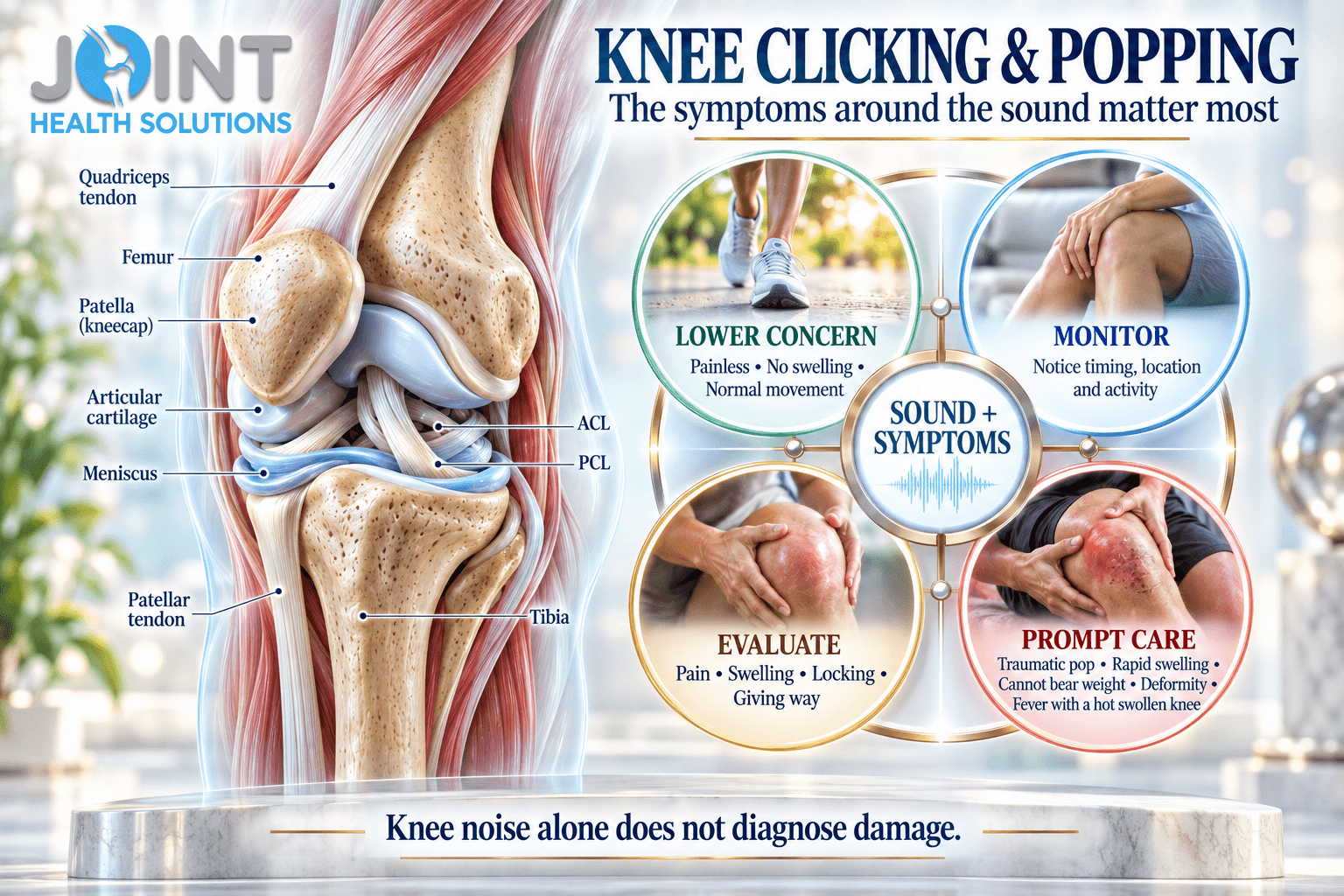
Why Does My Knee Click During Squats, Stairs, or Standing Up?
Squats, stairs, and rising from a chair increase the demand on the quadriceps and patellofemoral joint. The kneecap travels through its groove while the angle and load at the knee change. This can make normal joint sounds more noticeable, but it can also reproduce symptoms from patellofemoral pain, arthritis, tendon irritation, or another movement-related problem.
Clicking during squats
A painless sound during a controlled squat does not automatically require the exercise to stop. Pay attention to whether the sound comes with sharp pain, swelling, loss of control, a shift in the kneecap, or inability to reach the usual depth. Technique, load, recent training changes, and fatigue may influence symptoms. Persistent painful clicking should be evaluated before increasing resistance.
Popping on stairs
Stair ascent and descent require controlled knee bending under load. Patellofemoral symptoms and quadriceps weakness can be more noticeable on stairs, while catching or instability may suggest a different mechanical problem. A separate Joint Health Solutions guide explains the broader causes of knee pain when climbing stairs; this article remains focused on clicking, popping, and crepitus.
Cracking after sitting
A knee may feel stiff or sound noisier during the first few movements after sitting. If motion becomes comfortable and there is no swelling or functional loss, monitoring may be reasonable. Recurrent pain after rest, prolonged morning stiffness, swelling, or progressive loss of motion deserves an evaluation because arthritis and inflammatory conditions may need to be considered.
A click every time the knee bends
A reproducible click may reflect the same structure moving through the same point in the range of motion. Its significance depends on pain, tenderness, swelling, locking, and function. Do not force the movement repeatedly to reproduce a painful click. Record where it occurs and which activity triggers it so a clinician can assess the pattern.
When Is Knee Popping a Warning Sign?
Knee popping becomes more concerning when the sound is part of a broader symptom pattern. The following features warrant timely assessment:
- Pain that persists, worsens, or repeatedly limits walking, stairs, work, sleep, or exercise
- Swelling that appears rapidly after an injury or keeps returning
- True locking, meaning the knee becomes physically stuck and cannot fully bend or straighten
- Repeated giving way, shifting, or loss of confidence in the knee
- A pop during a pivot, landing, collision, or other clear injury
- Reduced range of motion, a limp, weakness, or inability to resume usual activity
- A visibly displaced kneecap, deformity, or a new mass
- Symptoms that persist despite reasonable activity modification
Catching is not always the same as true locking. A brief hesitation or painful click may still allow the knee to move, while a mechanically locked knee cannot complete its range. Either pattern can deserve evaluation, but a truly locked knee after injury should be assessed promptly.
How Is a Clicking or Popping Knee Evaluated?
Evaluation begins with the story, not the sound recording. A clinician may ask whether there was an injury, where the sensation is located, whether it happens at a consistent angle, and whether pain, swelling, locking, instability, stiffness, or weakness occurs. Prior surgery, sports, occupation, training changes, arthritis history, and medications may also be relevant.
Physical examination
The examination may assess walking, alignment, swelling, warmth, tenderness, range of motion, patellar movement, strength, stability, and whether a particular movement reproduces the click. Meniscus and ligament maneuvers may be used when the history supports them. No single maneuver or sound is perfect, so findings are interpreted together.
When X-rays may help
X-rays show bone alignment, joint-space changes, fractures, and features associated with arthritis. They do not directly show a meniscus tear. For chronic knee pain, professional imaging criteria generally place radiographs before MRI in many scenarios. Painless noise alone usually does not create an automatic need for imaging.
When MRI or ultrasound may help
MRI can show menisci, ligaments, cartilage, tendons, bone marrow, and other soft tissues. It may be considered after trauma or when persistent symptoms and examination findings suggest a structural problem and the result would change management. Ultrasound may help with selected superficial tendons, fluid collections, or dynamic soft-tissue questions. Imaging findings must still be matched to symptoms because abnormalities can exist without causing pain.
How Is Painful Knee Clicking Treated?
Treatment depends on the cause, symptom severity, examination, health history, and goals. There is no universal procedure, injection, brace, or exercise that treats every noisy knee. If the knee is painless and fully functional, education and monitoring may be all that is needed.
Activity modification without unnecessary avoidance
After a recent increase in running, squatting, kneeling, or stair volume, temporarily reducing the provoking load may help settle symptoms. That does not necessarily mean complete rest. Comfortable movement can often continue when there is no acute injury or red flag. Rebuild volume and resistance gradually rather than testing the painful movement repeatedly.
Physical therapy and progressive exercise
Physical therapy may address strength, mobility, balance, training load, and movement patterns when the diagnosis supports rehabilitation. Programs are individualized; they may include progressive quadriceps, hip, hamstring, and calf strengthening along with activity-specific practice. The objective is improved pain and function, not a promise that every harmless sound will disappear.
For knee osteoarthritis, evidence-based guidelines support exercise for pain and function. For patellofemoral pain, rehabilitation commonly emphasizes load management and hip and knee exercise. A generic online routine may be inappropriate immediately after trauma, with a locked knee, or when significant swelling or instability has not been assessed.
Medication and symptom management
Cold therapy may be used briefly after an activity-related flare or acute injury, with a cloth barrier to protect the skin. Heat may feel helpful for stiffness in selected chronic problems but should not be applied to a hot, acutely swollen, or insensate area. Over-the-counter pain medicines are not appropriate for everyone. Kidney disease, ulcers, bleeding risk, heart disease, pregnancy, medication interactions, and other factors can change what is safe, so ask a qualified clinician or pharmacist when uncertain.
Braces and injections
A brace may help selected instability, patellofemoral, or arthritis patterns, but the correct design depends on the diagnosis. Offloading knee braces are intended for selected compartmental osteoarthritis patterns and are not a universal solution for clicking.
Knee injections should not be used simply because a joint makes noise. Corticosteroid, hyaluronic acid, platelet-rich plasma, and other procedures have different indications, evidence, risks, limitations, costs, and insurance considerations. An injection does not correct every meniscus or ligament injury, cannot be promised to stop crepitus, and should not be described as regrowing cartilage or curing arthritis.
When referral or surgery may be considered
Surgery is not a routine treatment for painless crepitus. Referral may be appropriate for a displaced or repairable injury, persistent true locking, recurrent instability, a fracture, a tendon rupture, symptoms that remain disabling despite appropriate nonsurgical care, or another diagnosis requiring specialist management. The decision should be based on the entire clinical picture rather than a sound or scan finding in isolation.
Can I Exercise if My Knee Clicks?
If clicking is painless and the knee is not swollen, unstable, locked, or losing function, the sound alone is not necessarily a reason to stop all exercise. Begin with a comfortable range and manageable resistance, use controlled form, and monitor how the knee responds during the activity and over the next day.
Reduce or stop the activity if it produces sharp or escalating pain, new swelling, giving way, locking, or a meaningful decline in function. A traumatic pop is different from familiar painless crepitus and should be handled according to the injury and accompanying symptoms. People recovering from surgery or a diagnosed injury should follow their treating clinician’s restrictions rather than a general rule.
Fear of ordinary joint sounds can lead people to avoid useful movement. The safer goal is informed activity: do not ignore warning signs, but do not assume every click means the knee is being damaged.
Does Knee Crepitus Mean Arthritis Is Developing?
Crepitus and knee osteoarthritis are associated in some studies, but crepitus is not a diagnosis or a reliable prediction for an individual. A 2024 systematic review and meta-analysis reported that knee crepitus was common and associated with some symptomatic and structural features, while also identifying substantial variation among studies. A longitudinal Osteoarthritis Initiative study found that people reporting more frequent crepitus had a higher risk of developing symptomatic knee osteoarthritis in the studied group.
These results should be interpreted carefully. Association does not establish that sound causes cartilage loss, and many people with knee noise do not have disabling arthritis. Conversely, some people with arthritis may not notice much noise. Age, pain, stiffness, swelling, function, examination findings, and appropriate imaging carry more diagnostic value than the sound by itself.
No current treatment should be presented as proven to reverse arthritis merely because it reduces symptoms or changes how a knee feels. Evidence, preparation, candidacy, risks, costs, and outcomes vary across treatments.
Evaluation for Painful Knee Clicking in Charlotte, NC
Joint Health Solutions evaluates knee pain, swelling, stiffness, instability, and related mobility concerns at its physical clinic at 9350 Benfield Rd, #109, Charlotte, NC 28269. An appointment begins with an individualized assessment; it does not guarantee that imaging, a brace, physical therapy, aspiration, or an injection will be recommended.
The purpose of an evaluation is to determine whether the sound appears to be an incidental finding or part of a symptomatic condition, identify urgent or referral-level findings, and discuss proportionate next steps. Insurance benefits and coverage vary by plan and treatment and should be verified directly.
For a non-emergency knee evaluation, call 704-833-3566 or request an appointment with Joint Health Solutions.
Frequently Asked Questions About Knee Clicking and Popping
Why does my knee click when I bend it?
A knee may click as joint pressure changes, a tendon or other soft tissue moves, or the kneecap glides during bending. A painless click without swelling, locking, instability, or reduced function is usually less concerning. Persistent clicking with pain, tenderness, swelling, catching, or loss of motion should be evaluated because several conditions can produce similar sounds.
Is knee clicking without pain normal?
Painless knee clicking is common and can occur in otherwise functional knees. Noise alone does not confirm arthritis, cartilage damage, or a meniscus tear. Monitor for new pain, swelling, stiffness, locking, giving way, or activity limitation. An examination is reasonable if the sound is new after an injury, becomes progressively symptomatic, or causes concern about function.
Does cracking mean there is no cartilage left in my knee?
No. A cracking or grinding sound cannot measure cartilage thickness. Crepitus may occur with osteoarthritis, but it also occurs in people without symptomatic arthritis. Diagnosis relies on symptoms, examination, function, and selected imaging when clinically appropriate. Avoid assuming “bone on bone” disease from sound alone or choosing a treatment before the cause of symptoms is evaluated.
Why did my knee pop during a squat?
A painless pop during a squat may reflect joint-pressure or soft-tissue movement. A sudden pop accompanied by sharp pain, swelling, instability, loss of motion, or inability to bear weight is more concerning for an injury. Stop loading the knee and seek timely assessment when those symptoms occur rather than repeatedly squatting to test it.
Can a meniscus tear cause clicking?
Yes. A meniscus tear may cause clicking, joint-line pain, swelling, catching, locking, reduced motion, or giving way. However, clicking alone does not prove a tear, and meniscal changes on MRI can be unrelated to symptoms. The history, physical examination, and imaging findings must fit together before a meniscus finding is considered the cause.
Can arthritis make the knee crack or grind?
Yes. Knee osteoarthritis may produce crepitus along with pain, stiffness, swelling, and reduced motion. Crepitus is not specific to arthritis and does not show how severe the condition is. If symptoms affect walking, stairs, sleep, work, or exercise, a clinician can assess the knee and discuss evidence-based nonsurgical options based on the diagnosis.
Should I stop exercising if my knees crack?
Not necessarily. Familiar painless cracking without swelling, instability, locking, or functional decline is not automatically a reason to stop activity. Use controlled form and an appropriate load. Reduce or stop an exercise if it produces sharp or worsening pain, new swelling, giving way, or locking. A traumatic pop should be treated differently from ordinary painless crepitus.
Can physical therapy stop knee clicking?
Physical therapy may improve pain, strength, mobility, balance, and movement mechanics when a treatable problem is identified, but it cannot guarantee that every sound will disappear. Painless crepitus may persist even when the knee functions well. Rehabilitation should target the diagnosed condition and the person’s goals rather than treating sound as the only outcome.
Do I need an MRI for a clicking knee?
Usually not for noise alone. The history and physical examination come first. X-rays may be appropriate when arthritis, alignment, or fracture is suspected. MRI may help after trauma or when persistent pain, swelling, locking, or instability suggests a meniscus, ligament, cartilage, tendon, or other soft-tissue problem and the result would change treatment.
When should I see a clinician for knee popping?
Schedule an evaluation when popping is painful, follows an injury, keeps recurring with swelling, causes catching or instability, limits motion, or interferes with daily activity. Seek prompt care for rapid swelling, inability to bear weight, true locking, or deformity. A hot swollen knee with fever or a cold, pale, numb foot requires urgent assessment.
Sources
- British Journal of Sports Medicine: Noisy Knees—Knee Crepitus Prevalence and Association With Structural Pathology
- PubMed: Knee Crepitus in Runners With and Without a History of Knee Surgery
- Arthritis Care & Research: Subjective Crepitus and Incident Symptomatic Knee Osteoarthritis
- American Academy of Orthopaedic Surgeons: Meniscus Tears
- American Academy of Orthopaedic Surgeons: Patellofemoral Pain Syndrome
- National Institute of Arthritis and Musculoskeletal and Skin Diseases: Osteoarthritis
- American College of Radiology Appropriateness Criteria: Chronic Knee Pain
This article provides general education and does not diagnose an individual or replace personalized medical care.
 English
  Spanish