
Knee Osteoarthritis Self-Management Plan for Patients
Quick Answer: A practical knee osteoarthritis self-management plan starts with regular movement, strength work, education, pacing, and weight management when appropriate. Physical therapy and knee bracing may help personalize that plan when pain, instability, stiffness, or walking limits daily life. Injections may fit later for selected patients after clinical assessment, but they are symptom-management options, not disease-reversing treatments, and results vary.
For adults who can visit Joint Health Solutions in north Charlotte, a conservative knee osteoarthritis self-management plan may include assessment, physical therapy, offloading knee braces, and, when appropriate, knee injections in Charlotte. To discuss your symptoms and goals without pressure, you can request an appointment or call the Charlotte clinic at 704-833-3566.
Why knee osteoarthritis self-management matters
Knee osteoarthritis is a long-term joint condition, so the day-to-day plan often matters as much as any single office-based treatment. Knee osteoarthritis self-management means using repeatable habits to protect function, reduce flare triggers, maintain activity, and make treatment decisions with a care team when symptoms change.
Self-management does not mean “handle it alone.” It means you have a clear plan for what to do between visits, how to respond to symptom changes, and when to ask for clinical assessment. The 2019 American College of Rheumatology and Arthritis Foundation guideline strongly recommended self-efficacy and self-management programs for knee, hip, and hand osteoarthritis, alongside exercise and other conservative strategies. For many people, knee osteoarthritis self-management is the framework that keeps those pieces connected.
A useful plan should be specific enough to follow, but flexible enough to adjust. Some days may call for shorter walks, lighter strengthening, or aquatic exercise. Other days may allow longer activity. The goal is not to force the knee through pain; it is to build a consistent pattern that supports mobility and quality of life over time.
A practical plan at a glance
The table below summarizes how the main pieces of knee osteoarthritis self-management usually fit together. It is not a personal prescription, and it should be adapted after clinical assessment when symptoms are persistent, worsening, or limiting daily activity.
| Plan component | Typical role in knee OA | What patients can discuss with a clinician |
|---|---|---|
| Education and self-management | Helps you understand flares, pacing, activity choices, and realistic goals. | How to track symptoms, modify activities, and decide when reassessment is appropriate. |
| Exercise | Guidelines recommend exercise over no exercise to improve pain and function. | Which mix of strengthening, walking, cycling, aquatic exercise, and flexibility work is appropriate. |
| Weight management when appropriate | Recommended for people with knee OA who are overweight or obese. | Whether nutrition support or a coordinated plan fits your health needs and goals. |
| Physical therapy | Can personalize exercise, movement mechanics, progression, and adherence. | How PT can address strength, balance, gait, stiffness, and confidence with activity. |
| Bracing | May help selected patients with pain, walking limits, or instability. | Whether an offloading or other knee brace matches your symptoms and joint pattern. |
| Injections | May be considered after assessment when symptoms limit function or rehab participation. | Which injection options are appropriate, what benefits are realistic, and how coverage varies by plan. |
Set goals before choosing treatments
A knee osteoarthritis self-management plan works better when it starts with goals that are meaningful to the person using it. “Less pain” is understandable, but it is broad. More useful goals may include walking the grocery store with fewer stops, climbing stairs with more confidence, standing long enough to cook, returning to low-impact exercise, or sleeping with fewer knee-related interruptions.
Clear goals also help prevent over-treatment or under-treatment. A person with mild symptoms and good function may need education, a home exercise plan, and periodic reassessment. A person with swelling, instability, or major walking limits may need a more structured knee osteoarthritis self-management plan that includes physical therapy, bracing, or injections when appropriate.
It can help to track symptoms for one to two weeks before a visit. Note pain location, stiffness patterns, swelling, activities that aggravate symptoms, and activities that feel manageable. This does not diagnose the knee, but it gives your care team useful information for an individual treatment plan.
Build the daily knee osteoarthritis self-management foundation
Knee osteoarthritis self-management is often most effective when it includes several simple habits rather than one dramatic change. The foundation usually includes pacing, symptom tracking, planned movement, recovery time, footwear choices, and realistic activity modifications. These habits can help you stay active without repeatedly provoking large flares.
Pacing without becoming inactive
Pacing means adjusting activity so the knee can tolerate it. It may include taking shorter walks more often, alternating standing tasks with seated tasks, using handrails on stairs, or splitting heavy chores into smaller blocks. Pacing is not the same as avoiding movement. For many people with knee OA, too much rest can contribute to stiffness and loss of conditioning.
A simple pacing approach is to identify the amount of activity that usually feels manageable, then progress gradually. If symptoms flare significantly after a certain activity, the next attempt may need less time, slower speed, more rest, or a different surface. If symptoms remain stable, activity can often be advanced carefully.
Symptom tracking that supports decisions
Tracking should be practical, not burdensome. A brief note on pain level, swelling, stiffness, activity, and sleep can reveal patterns. For example, some people notice more stiffness after long sitting, more soreness after hills, or more confidence when using supportive footwear.
Bring this information to appointments. It may help a clinician decide whether your current knee osteoarthritis self-management plan is enough, whether physical therapy should be adjusted, whether a knee osteoarthritis brace is worth considering, or whether persistent symptoms need additional evaluation.
Activity modification without giving up valued routines
Activity modification means changing how you do an activity, not automatically removing it from your life. Examples include choosing flatter walking routes, using a stationary bike instead of running during flares, doing strength exercises from a chair, or using aquatic exercise when land-based activity is too uncomfortable.
Some pain during or after activity does not always mean harm, but sharp pain, progressive swelling, repeated giving way, or worsening function should not be ignored. Because symptoms alone do not confirm the cause, persistent or changing knee symptoms deserve clinical assessment.
Knee osteoarthritis exercise as the core treatment habit
Exercise is central to knee osteoarthritis self-management because it supports muscle strength, joint function, balance, and general health. Major guidelines consistently place exercise near the center of knee OA care. The AAOS osteoarthritis of the knee guideline states that supervised, unsupervised, and/or aquatic exercise are recommended over no exercise to improve pain and function. The 2019 ACR/Arthritis Foundation guideline also strongly recommended exercise for knee OA.
The important point is not that one exercise type is perfect for everyone. It is that an appropriate, sustainable exercise plan is usually better than avoiding activity altogether. The plan should match current symptoms, fitness level, balance, other health conditions, and personal goals.
Strengthening for support and confidence
Strength work is often used to improve the muscles that help control knee movement. This may include the quadriceps, hamstrings, hip muscles, calves, and core muscles. Stronger muscles can improve confidence with daily tasks, although individual response varies and exercise should be progressed thoughtfully.
People often picture strengthening as heavy gym training, but it can begin with simple movements. Examples may include sit-to-stand practice, step-ups, supported mini-squats, straight-leg raises, or resistance-band work when appropriate. A clinician or physical therapist can help adapt movements so they are tolerable and safe for the individual.
Low-impact aerobic activity
Low-impact aerobic activity can help maintain conditioning without excessive joint stress. Walking, cycling, elliptical training, and aquatic exercise are common examples. A practical option is usually one a person can perform consistently without repeated symptom spikes.
Walking is often reasonable for knee OA, but terrain, pace, footwear, and duration matter. A flat, shorter route may be more tolerable than hills or uneven ground. A stationary bike may be easier during a flare. Aquatic exercise can be useful when buoyancy makes movement more comfortable.
Flexibility and mobility
Stiffness is common in knee OA, especially after sitting or first thing in the morning. Gentle range-of-motion work can help some people feel more prepared for activity. This may include heel slides, gentle knee bends, calf stretching, or hip mobility work when appropriate.
Mobility work should not be forced. If a movement causes sharp pain, catching, new swelling, or significant worsening, it should be paused and discussed with a clinician. The aim is comfortable motion and gradual progress, not pushing through severe symptoms.
How to start without overdoing it
A realistic start might include short movement sessions most days, with strengthening two or three days per week if tolerated. However, frequency and intensity should be individualized. People who have been inactive, have balance concerns, or have multiple health conditions may benefit from supervised guidance before increasing activity.
One practical rule is to change only one variable at a time. Increase duration, resistance, or frequency gradually rather than all at once. This makes it easier to identify what helps and what triggers flares. A knee osteoarthritis self-management plan should leave room for gradual progress instead of sudden jumps.
Knee osteoarthritis weight loss when it is appropriate
Knee osteoarthritis weight loss is not relevant for every person, and it should be discussed respectfully. For patients with knee OA who are overweight or obese, multiple guidelines recommend weight loss as part of care. The 2019 ACR/Arthritis Foundation guideline strongly recommended weight loss for overweight or obese patients with knee or hip OA, and older ACR guidance stated that patients with symptomatic knee OA who are overweight should be encouraged to lose weight and maintain a lower weight.
This does not mean weight is the only reason a knee hurts. Knee OA is influenced by joint structure, previous injury, muscle strength, inflammation, movement patterns, genetics, and activity demands. Weight management is one possible lever in a broader knee osteoarthritis self-management plan, not a judgment or a stand-alone answer.
Why weight can matter for the knee
The knee is a weight-bearing joint. For some people, lowering body weight can reduce mechanical load during walking, stairs, and daily activities. Weight management may also support broader health goals that affect energy, conditioning, and participation in exercise.
Benefits vary, and no article can predict how much symptom change a specific person will feel. The most helpful approach is usually sustainable, health-centered, and coordinated with medical needs. Rapid or extreme plans are not necessary for this discussion and may not fit many patients.
Pair nutrition support with movement, not instead of it
When weight management is appropriate, it usually works well as part of a complete plan. Exercise supports strength, mobility, and health even when weight loss is slow. Nutrition changes can support weight goals and may help patients stay consistent with activity.
Joint Health Solutions offers nutrition plans for joint health when nutrition support is part of an individual plan. Suitability depends on clinical assessment and the person’s overall health needs, medications, goals, and preferences.
When weight loss is not the main focus
Some people with knee OA are not overweight. Others may have symptoms driven more by prior injury, alignment, weakness, inflammation, or advanced joint changes. In those cases, emphasizing weight loss may not be appropriate. Exercise, physical therapy, bracing, symptom management, and clinical follow-up may be more relevant.
If weight discussions have felt frustrating in the past, it is reasonable to ask for a plan that focuses on function, strength, and practical goals. Patient-centered care should support health without blame.
Physical therapy for knee osteoarthritis can personalize the plan
Physical therapy for knee osteoarthritis can help turn general advice into a plan that matches your knee, your fitness level, and your daily life. A physical therapist can assess movement patterns, strength, flexibility, balance, walking mechanics, and the activities that matter most to you.
At Joint Health Solutions, physical therapy is a confirmed service for patients with joint pain, osteoarthritis, mobility limitations, or musculoskeletal injuries when appropriate. PT may be part of a broader conservative care plan that also includes home exercise, bracing, injections, or nutrition support depending on clinical assessment.
What PT may add beyond a handout
A printed exercise sheet can be useful, but it cannot watch how your knee moves. PT may help identify whether an exercise is too easy, too hard, or being performed in a way that irritates symptoms. It may also help patients progress from basic movements to more functional tasks such as stairs, squats, or longer walks.
PT can also support adherence. Many people stop exercising because they are unsure what level of discomfort is acceptable or because a flare makes them lose confidence. A guided plan can help adjust the program rather than abandoning movement entirely.
Movement retraining and function
Knee OA symptoms often show up during tasks such as getting out of a chair, stepping down, turning, or walking on uneven ground. Physical therapy can focus on how those movements are performed. Small changes in hip control, step height, footwear, cadence, or assistive strategies may make daily activity more manageable for selected patients.
Physical therapy for knee osteoarthritis may also include balance work, education on pacing, range-of-motion exercises, strengthening, and strategies to transition from supervised sessions to independent self-management. The long-term goal is for patients to understand their plan well enough to keep using it.
When PT and other options are combined
Some patients use PT alone as the main structured treatment. Others may use PT with an offloading brace or with an injection intended to reduce symptoms enough to participate more comfortably in rehab. The sequence depends on pain level, swelling, function, health history, and the clinical assessment.
This is where an individual plan matters. Knee osteoarthritis self-management should not be a rigid checklist. It should be adjusted when progress stalls, symptoms flare, or goals change.
Knee osteoarthritis brace options and when they may help
A knee osteoarthritis brace may help selected patients when pain, stability, alignment, or walking tolerance are major concerns. Bracing is not needed for everyone, and the type of brace matters. Some braces are designed mainly for compression or support, while offloading braces are intended to shift load away from a more affected compartment of the knee.
The 2019 ACR/Arthritis Foundation guideline strongly recommended tibiofemoral bracing for knee OA when pain, stability, or walking are significantly affected and the patient can tolerate bracing. The AAOS osteoarthritis of the knee guideline states that brace treatment could be used to improve function, pain, and quality of life. These recommendations support bracing as an option, not a universal requirement within knee osteoarthritis self-management.
How offloading bracing fits conservative care
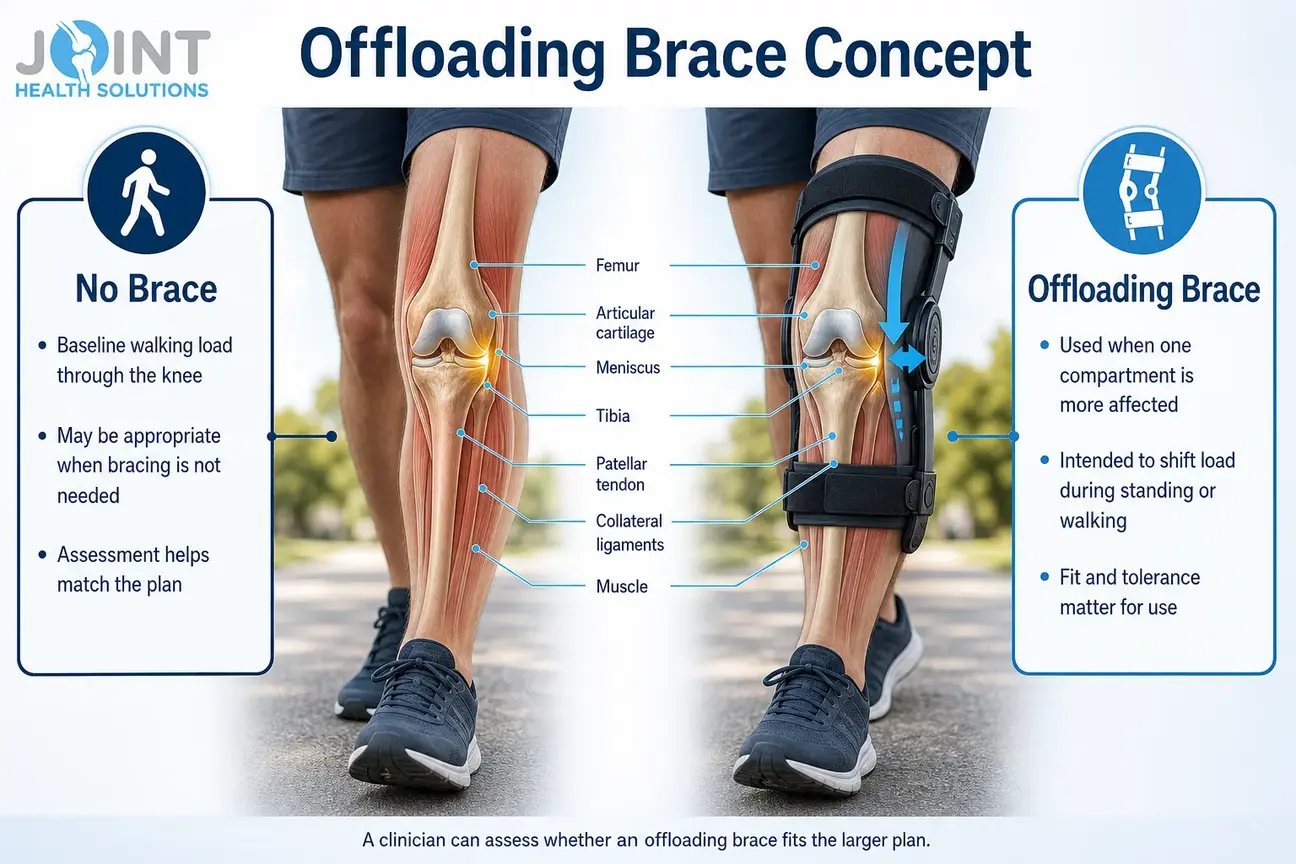
Offloading braces are commonly discussed when knee OA affects one side of the knee more than the other. The goal is to reduce load through the more irritated area during standing and walking. Whether that makes sense depends on the person’s symptoms, exam findings, imaging when available, body mechanics, and ability to tolerate the brace.
Joint Health Solutions offers offloading knee braces for patients for whom an offloading brace is appropriate. A brace should be fitted and discussed in the context of the whole plan, including exercise and daily function.
Comfort and consistency matter
A brace that looks appropriate but is uncomfortable, poorly fitted, or impractical may not help much because the person will not use it consistently. Patients should discuss fit, skin tolerance, how long to wear it, and which activities are most appropriate for brace use with their clinician.
Bracing may be more useful for walking, errands, standing tasks, or specific activities than for all-day wear. It may also be used alongside physical therapy to improve confidence while strength and mechanics are addressed.
Knee osteoarthritis injections after conservative steps
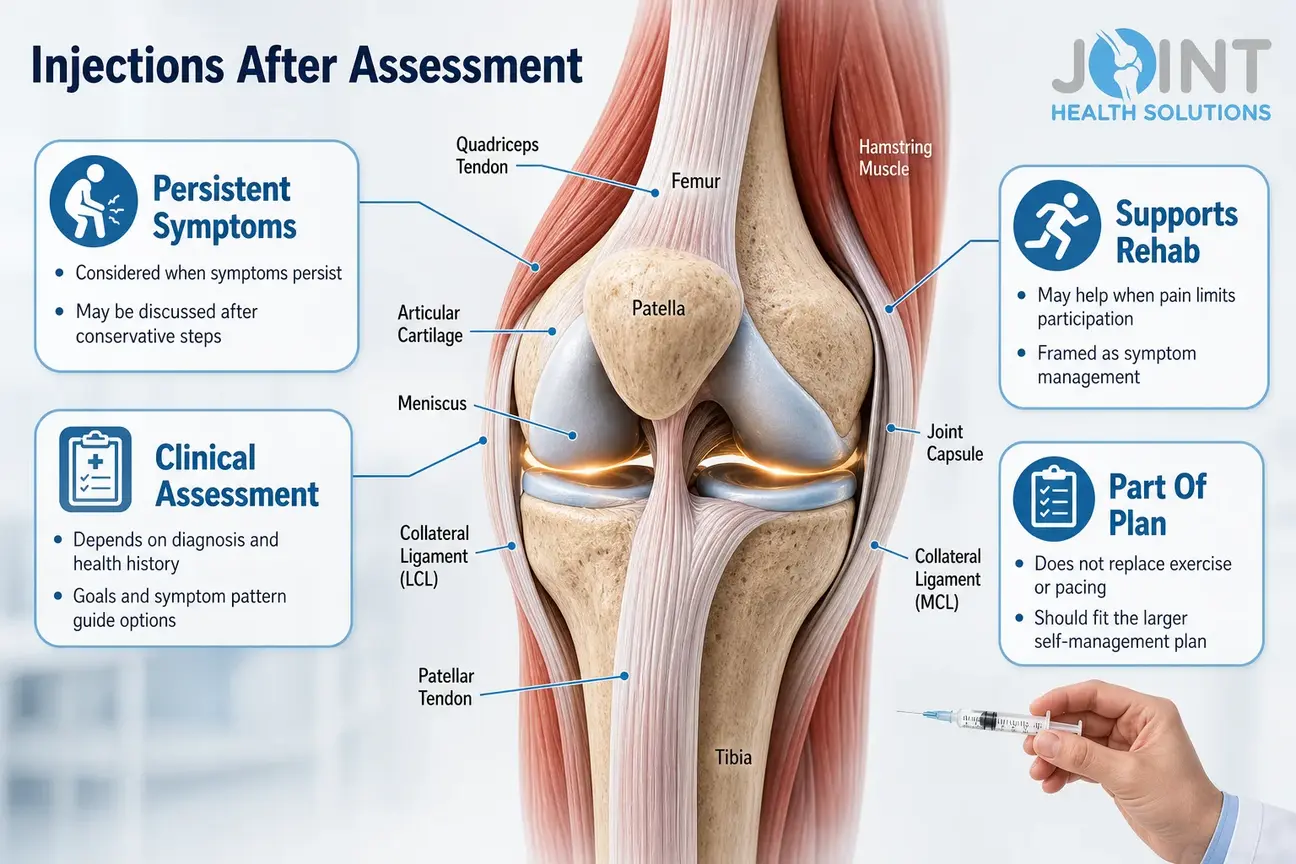
Knee osteoarthritis injections may be considered when symptoms persist despite exercise, pacing, physical therapy, weight management when appropriate, and bracing when appropriate. They may also be considered when pain is limiting participation in rehabilitation. However, injections should follow clinical assessment, and they should be framed as symptom-management tools within knee osteoarthritis self-management.
Joint Health Solutions offers knee injections in Charlotte for adults with clinically assessed knee pain or conditions. The right option depends on the diagnosis, health history, symptom pattern, goals, and whether the expected benefit is reasonable for that patient.
Corticosteroid injections for short-term symptom relief
The 2019 ACR/Arthritis Foundation guideline strongly recommended intra-articular glucocorticoid injections for knee OA. AAOS has also listed intra-articular corticosteroids as an option for short-term pain relief. This makes corticosteroid injections one of the more supported injection options for short-term symptom management in selected patients.
That support should not be overstated. A cortisone injection does not reverse osteoarthritis or guarantee improvement. It may be considered when inflammation-related pain or symptoms are interfering with function, but suitability and expected benefit require clinical assessment.
Hyaluronic acid injections require individualized discussion
Hyaluronic acid injections, also called viscosupplementation, are another option some patients ask about. The evidence and guideline support are more mixed than for corticosteroid injections, and hyaluronic acid should not be presented as a clearly supported universal standard for every person with knee OA.
Joint Health Solutions offers hyaluronic acid injections for patients for whom viscosupplementation is appropriate. A clinician can discuss whether this option fits your symptoms, exam findings, goals, and coverage situation. Coverage varies by treatment and plan, and patients should verify details with the practice and insurer before treatment.
Injections should support the larger plan
An injection may reduce symptoms enough for some patients to move more comfortably, sleep better, or participate in rehab, but it should not replace knee osteoarthritis exercise, pacing, strengthening, or other self-management habits. If symptoms return and the underlying plan has not changed, the same activity limits may continue.
This is why a conservative care path often starts with the basics, then layers in office-based options when appropriate. The question is not simply “Which injection should I get?” A more useful question is “What combination of self-management, PT, bracing, and symptom control matches my situation?”
How to respond to flare-ups without abandoning the plan
Flares can happen with knee OA. They may follow heavier activity, prolonged standing, uneven surfaces, travel, poor sleep, or no obvious trigger. A flare does not automatically mean the knee osteoarthritis self-management plan has failed. It may mean the plan needs a temporary adjustment.
During a flare, many patients benefit from reducing intensity rather than stopping all movement. That may mean shorter walks, gentler range-of-motion exercises, aquatic activity, or more rest breaks. If swelling, instability, severe pain, or function loss persists, clinical assessment is appropriate.
Use a “dial, not switch” approach
Think of activity as a dial rather than an on-off switch. Turning the dial down during a flare can preserve the habit of movement while respecting symptoms. Turning it back up gradually after symptoms settle can help avoid the cycle of overdoing activity, flaring, resting completely, and then losing conditioning.
A physical therapist or clinician can help you create a flare plan. That plan may include which exercises to continue, which to pause, when to use a brace, and when to schedule reassessment.
Know when symptoms deserve prompt attention
New major swelling, inability to bear weight, sudden deformity, fever, severe injury, chest pain, shortness of breath, or symptoms that feel emergent should not be handled through a routine clinic appointment. For emergencies, call 911 or go to an emergency department.
Joint Health Solutions does not provide emergency or 24/7 urgent care. For non-emergency knee OA concerns, persistent pain, worsening function, recurring swelling, or difficulty following a self-management plan are reasonable reasons to request a clinical assessment.
Common mistakes that make self-management harder
Many people are trying to manage symptoms thoughtfully but get stuck because the plan is too vague, too intense, or too focused on one treatment. Avoiding common mistakes can make knee osteoarthritis self-management more sustainable.
Waiting for pain to disappear before moving
If you wait until the knee feels perfect before exercising, movement may become less frequent over time. A more practical approach is to identify tolerable activity and progress gradually. This may require professional guidance if symptoms are unpredictable or confidence is low.
Doing only cardio and skipping strength
Walking and cycling can be helpful, but strength often matters for stairs, chairs, balance, and daily function. A knee osteoarthritis exercise plan usually works better when it includes both aerobic activity and strengthening, adjusted to tolerance.
Using a brace without addressing strength or mechanics
A brace may help selected patients, but it is not a complete plan by itself. Bracing is often more useful when paired with strengthening, pacing, and activity strategies. If a brace is uncomfortable or does not seem to help, reassessment of fit and purpose is important.
Expecting injections to replace self-management
Knee osteoarthritis injections may have a role, but they do not replace exercise, physical therapy, weight management when appropriate, or bracing when appropriate. If an injection is used, it should support the broader knee osteoarthritis self-management plan rather than become the whole plan.
When a clinical assessment may be appropriate
Self-management is valuable, but there are times when a clinician should evaluate the knee. Consider assessment when knee pain persists despite reasonable home measures, swelling keeps returning, stiffness is worsening, the knee feels unstable, walking distance is shrinking, sleep is affected, or you are unsure how to exercise safely.
Assessment may include a discussion of symptoms, function, prior injuries, medical history, medications, goals, physical exam findings, and imaging when appropriate. The purpose is not only to name the condition; it is to match the knee osteoarthritis self-management plan to the person.
For some patients, the next step may be a more structured home program. For others, it may be physical therapy, an offloading brace, joint aspiration when appropriate, or injection options after discussion. The plan should stay conservative and patient-centered while recognizing that needs vary.
Charlotte conservative care path at Joint Health Solutions
Joint Health Solutions is a medical clinic in Charlotte providing personalized, conservative, minimally invasive, non-surgical care for joint pain, arthritis, stiffness, mobility limitations, and related musculoskeletal concerns. The clinic is located at 9350 Benfield Rd, #109, Charlotte, NC 28269.
For knee OA, an individual knee osteoarthritis self-management plan may include education, physical therapy, bracing, nutrition support, or injections when appropriate. Patients traveling from nearby service areas such as Huntersville, Concord, Mint Hill, Mount Holly, Gastonia, Mooresville, Rock Hill, or Fort Mill visit the Charlotte clinic for care; those communities are not separate clinic locations.
If knee pain is limiting your walking, stairs, work, exercise, or daily routines, you can schedule a consultation to discuss a conservative care path. A visit does not guarantee that a specific treatment is appropriate, but it can help clarify which options fit your symptoms, goals, and clinical findings.
Putting your plan into action
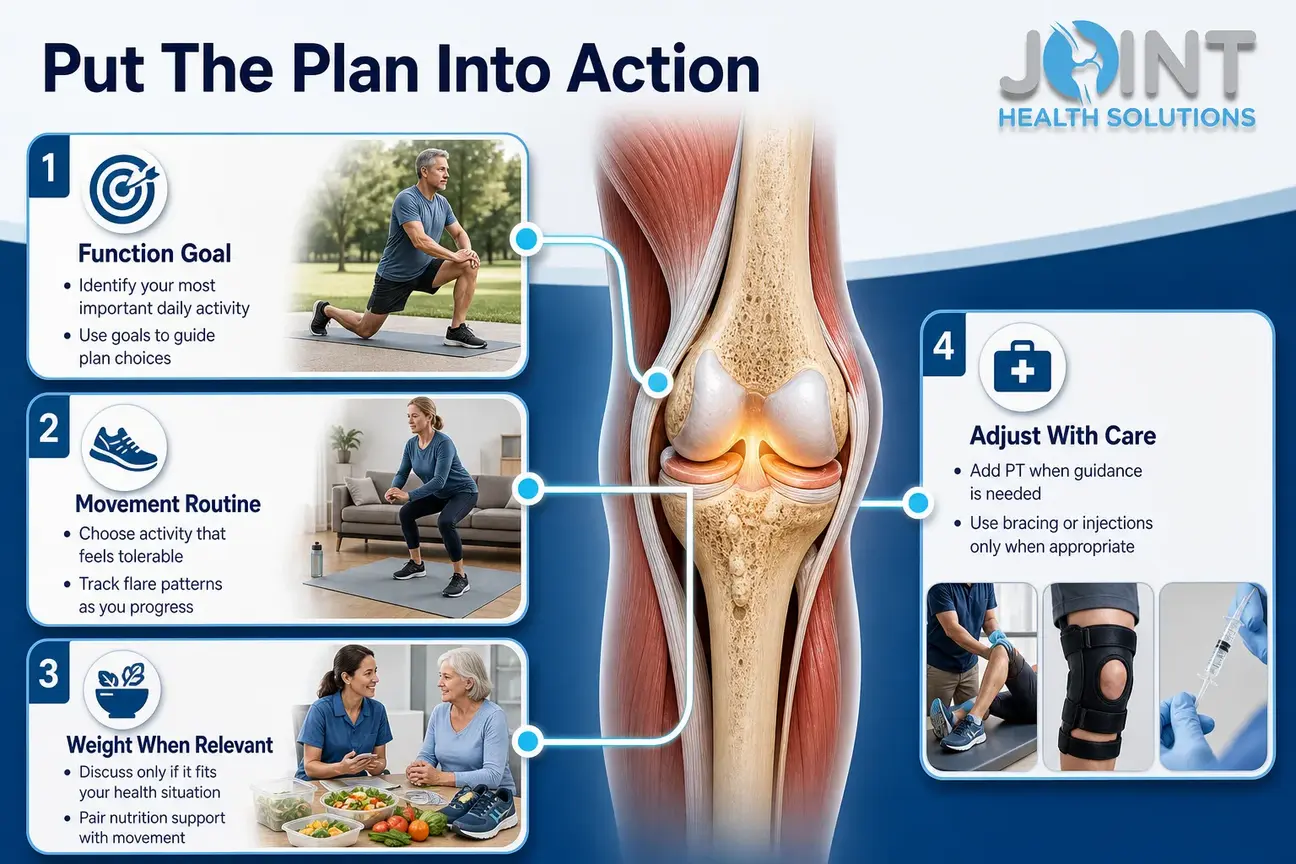
A workable knee osteoarthritis self-management plan does not need to be complicated. Start by identifying your most important function goal, choosing a tolerable movement routine, tracking flare patterns, and discussing weight management only if it is relevant to your health situation. Add physical therapy when you need guidance, bracing when symptoms and assessment support it, and injections only when they fit the larger plan.
Progress may be uneven. Some weeks will feel better than others. The purpose of conservative care is to help you make informed choices, stay as active as reasonably possible, and adjust the plan when symptoms or goals change.
Medical disclaimer: For general education only; not a substitute for professional medical advice, diagnosis, or treatment. Suitability and results vary, and individual needs require clinical assessment.
Frequently Asked Questions
What is the first treatment for knee osteoarthritis self-management?
For many adults, the first step is a practical plan built around education, activity pacing, regular exercise, and weight management when appropriate. Guidelines strongly support exercise and self-management programs for knee OA. The exact plan should be adjusted to symptoms, function, health history, and clinical assessment.
Is walking okay if I have knee OA?
Walking is often a reasonable low-impact activity for knee OA when it is tolerated. Distance, pace, terrain, footwear, and rest breaks matter. If walking causes significant swelling, instability, sharp pain, or worsening function, a clinician or physical therapist can help adjust the plan.
Do I need to lose weight for knee arthritis if I am not very overweight?
Weight loss is recommended in guidelines for patients with knee OA who are overweight or obese. If weight is not a relevant health factor for you, the plan may focus more on exercise, strength, pacing, bracing, physical therapy, or other symptom-management options after assessment.
Can a knee brace help with pain or instability?
A knee brace may help selected patients, especially when pain, walking, or stability are significantly affected. The type of brace and fit matter. Offloading bracing should be discussed with a clinician to determine whether it matches your knee pattern and daily activity needs.
Is physical therapy better than doing exercises on my own?
Some people do well with a home program, while others benefit from supervised physical therapy. PT can personalize exercises, watch movement patterns, adjust intensity, address balance or gait concerns, and help you progress safely when symptoms make self-guided exercise difficult.
When do injections make sense for knee OA?
Injections may be considered after clinical assessment when pain persists despite conservative steps or when symptoms limit participation in rehab. Corticosteroid injections are more supported for short-term symptom relief, while other injection options require individualized discussion. Injections are not disease-reversing treatments, and results vary.
Are corticosteroid injections the same as hyaluronic acid injections?
No. Corticosteroid injections and hyaluronic acid injections use different substances and have different evidence considerations. Corticosteroid injections are generally discussed for short-term symptom relief. Hyaluronic acid, or viscosupplementation, should be considered more cautiously and individually after assessment.
How do I know whether I need a brace, PT, or an injection first?
The right sequence depends on symptoms, function, swelling, stability, goals, health history, and exam findings. Many plans begin with exercise and self-management, then add physical therapy, bracing, or injections when appropriate. A clinical assessment can help match the option to the problem.
Sources
- American College of Rheumatology/Arthritis Foundation 2019 guideline for management of osteoarthritis of the hand, hip, and knee
- American Academy of Orthopaedic Surgeons osteoarthritis of the knee clinical practice guideline page
- American Academy of Orthopaedic Surgeons clinical practice guideline PDF, Management of Osteoarthritis of the Knee
- American Academy of Orthopaedic Surgeons knee osteoarthritis guideline update press release
- American Physical Therapy Association clinical practice guideline resource for osteoarthritis of the knee
- American College of Rheumatology 2009 recommendations for management of hip and knee osteoarthritis, Part I