
Why July is the Perfect Month to Start Your Non-Surgical Knee Osteoarthritis Protocol
Published July 25, 2026 | Category: Non-Surgical Treatments | Location: Charlotte, North Carolina | 🕒 12 min read
Introduction
If you have been living with chronic knee pain from osteoarthritis, you know how the condition can limit your summer activities. The warm weather beckons you to garden, walk, play with grandchildren, or simply enjoy a leisurely stroll — but your knees have other plans. For many residents of Charlotte, North Carolina, knee osteoarthritis becomes a significant barrier to an active lifestyle.
July offers a practical window to begin a structured, non-surgical knee osteoarthritis protocol that can reduce pain, improve function, and help you reclaim your summer. At Joint Health Solutions, we specialize in personalized non-surgical plans that address the underlying contributors to knee pain without surgery. This article explains why July is a useful starting point, outlines the available non-surgical options, and walks through our five-step protocol.

Why July Is a Good Time to Start a Knee Osteoarthritis Protocol
July brings longer days, warmer temperatures, and for many people a more flexible schedule — factors that can support starting a new treatment regimen. Warmer weather tends to ease joint stiffness; the ambient warmth promotes vasodilation, which may enhance blood flow to periarticular tissues and make early physical therapy sessions more comfortable. Patients often find they can achieve a greater range of motion in warmer conditions, which can make those first exercises less painful to begin.
Summer schedules also often allow more time for appointments and self-care. Committing to a consistent treatment schedule is critical for optimal outcomes, and the flexibility that summer vacations or reduced work commitments provide can help patients build the habit before fall.
From a practical standpoint, starting in July means completing the most intensive phase of treatment before fall and winter — when cooler temperatures can increase joint stiffness (in part due to changes in synovial fluid viscosity and barometric pressure sensitivity). Building strength and mobility during the summer gives you a meaningful head start.
There is also a motivational dimension. July is the midpoint of the year, a natural checkpoint for health goals. Pairing treatment with enjoyable outdoor activities — swimming, cycling, walking in a park — can improve adherence. And starting now avoids the holiday-season scheduling crunch that often delays care later in the year.
Understanding Non-Surgical Options for Knee Osteoarthritis
Non-surgical treatments for knee osteoarthritis have advanced substantially in recent years. At Joint Health Solutions, we offer a range of treatments that can be combined into an individualized plan, including joint injections (hyaluronic acid, corticosteroids, PRP), physical therapy, offloading knee braces, and IV therapy. Each targets specific aspects of knee OA, and combined they can provide meaningful pain relief and improved mobility for appropriate patients.
Hyaluronic acid injections supplement the natural synovial fluid that becomes degraded in osteoarthritis, restoring the viscoelastic properties that cushion the joint during movement. Meta-analyses show that a course of these injections can reduce pain and improve function — though effect sizes are variable and results differ by patient. See the evidence section for the full picture, including the current AAOS recommendation.
PRP therapy uses growth factors concentrated from your own blood and may reduce local inflammation and support tissue healing in some patients. Note: PRP is not FDA-approved as a drug; the device used to prepare the concentrate has received FDA clearance. Evidence for PRP in knee OA is mixed, and it does not have established disease-modifying effects — meaning it has not been shown to stop or reverse cartilage loss.1
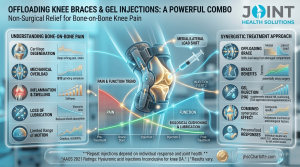
Physical therapy strengthens the quadriceps, hamstrings, and gluteal muscles to reduce load on the knee joint. Offloading braces redistribute forces away from the damaged compartment. Sports recovery IV therapy delivers nutrients — including vitamin C (which supports collagen synthesis) and magnesium (which supports muscle function) — to support recovery between sessions.
Many patients wait until pain is severe before seeking help. Beginning a protocol when symptoms may be less intense — as warmer weather can allow — generally yields better outcomes and may help slow disease progression compared to delaying care.
The American Academy of Orthopaedic Surgeons (AAOS) 2021 Clinical Practice Guideline on Treatment of Osteoarthritis of the Knee (4th Edition) gives an Inconclusive recommendation for hyaluronic acid injections — meaning the current evidence is insufficient to support a recommendation either for or against. This reflects heterogeneous results across available trials, not a judgment that the treatment is ineffective. At Joint Health Solutions, we discuss this evidence context fully with every patient so you can make a fully informed decision.AAOS CPG 2021
Step-by-Step: Your July Knee Osteoarthritis Protocol
Step 1: Comprehensive Evaluation
Your journey begins with a detailed consultation and physical exam at Joint Health Solutions. We review your medical history, imaging studies, and symptom patterns to determine the severity of your knee osteoarthritis and identify which non-surgical treatments are most appropriate. We discuss your activity goals and any concerns you may have.
During the physical exam, we assess joint range of motion, stability, crepitus, and tenderness, and perform functional tests like the timed up-and-go test to quantify baseline mobility. Ultrasound imaging may be used to evaluate synovial fluid volume and help guide treatment decisions. We also screen for contraindications such as active infection or bleeding disorders before recommending any injections or therapies.
Step 2: Personalized Treatment Plan
Based on the evaluation, we design a customized protocol. This might include a series of hyaluronic acid injections to support joint lubrication, combined with physical therapy to strengthen surrounding muscles. We may also recommend an offloading knee brace to reduce pressure on the affected compartment. For patients with significant inflammation, PRP therapy may be considered. For those with muscle weakness, neuromuscular re-education exercises are prioritized.
The plan includes a clear schedule — for example, hyaluronic acid injections weekly for three weeks, with physical therapy sessions twice weekly throughout. We also set realistic milestones and adjust the plan based on your progress. Individual responses vary; we keep expectations honest throughout the planning process.
Step 3: Initiate Treatments
In July, we schedule your initial treatments to take advantage of the summer weather and schedule flexibility. Hyaluronic acid injections are typically given in a series of one to three injections over several weeks (or as a single injection depending on the product). PRP therapy involves a single injection after concentrating your platelets. Physical therapy sessions are scheduled one to three times per week depending on your needs.
We provide guidance on activity modification — avoiding high-impact exercises like running while encouraging low-impact activities like swimming or cycling. For patients receiving PRP, we advise 24–48 hours of relative rest before gradually resuming activity. Ultrasound guidance is used when needed to maximize injection accuracy. We also offer same-day appointments for busy summer schedules.
Step 4: Monitor Progress and Adjust
Throughout the protocol, we monitor your response and make adjustments as needed. We track progress using validated outcome measures — including the Western Ontario and McMaster Universities Osteoarthritis Index (WOMAC) and the Visual Analog Scale (VAS) for pain — which provide objective data to guide fine-tuning.
For example, if persistent swelling occurs after injections, we may recommend ice therapy or adjust the injection interval. We conduct periodic re-evaluations at approximately weeks 4, 8, and 12 to assess range of motion, strength, and functional capacity. Based on these check-ins, we may add booster injections, adjust bracing, or incorporate additional modalities. This iterative approach is central to the protocol — what works is continued and reinforced; what doesn’t is modified.
Step 5: Maintenance and Long-Term Care
After the initial protocol, we provide guidance on maintaining your gains. This typically includes a home exercise program — quadriceps sets, straight leg raises, hamstring curls, and balance exercises, 3–4 times per week. We also recommend weight management strategies, as even a 5–10% reduction in body weight can significantly reduce knee joint loading.
For patients who respond well to injections, booster treatments may be scheduled every 6–12 months to sustain benefits. We educate patients on activity pacing, joint protection techniques, and when to seek additional care. Annual check-ups help monitor disease progression and adjust the plan accordingly. The goal is to build habits during summer that carry you through the cooler months and beyond.
How to Prepare for Your First Appointment
Preparing for your first visit is straightforward. Bring:
- Any relevant medical records, including X-rays or MRI reports (actual images or a digital copy if possible)
- A list of current medications and supplements
- A pair of shorts for the physical exam
- Notes on your symptoms — when they occur, what makes them better or worse
- A list of prior treatments you’ve tried (medications, physical therapy, injections) and their outcomes
Think about your activity goals — whether it’s walking without pain, playing with grandchildren, or returning to a sport. This helps us tailor the protocol to what matters most to you. Arrive a few minutes early to complete paperwork, wear comfortable clothing, and feel free to ask any questions during the consultation. No referral is needed to schedule an appointment.
Evidence Summary
| Treatment | FDA Status | Evidence Level | Key Findings |
|---|---|---|---|
| Hyaluronic Acid Injections | FDA-approved for knee OA pain in patients who failed conservative therapy | Mixed / established in volume but variable in effect size; AAOS 2021: Inconclusive | Multiple meta-analyses show pain reduction vs. placebo; effect sizes often modest; AAOS rates evidence as Inconclusive due to heterogeneity2,3 |
| PRP Therapy | Not FDA-approved as a drug; device used for preparation has FDA clearance | Mixed / limited evidence for knee OA specifically | Some studies show pain reduction; evidence on functional improvement is inconsistent; no established disease-modifying effects1 |
| Physical Therapy | N/A | Established clinical evidence | Strengthening exercises reduce pain and improve function; recommended as first-line by multiple guidelinesNIAMS |
| Offloading Knee Braces | FDA-regulated medical devices | Established clinical evidence for medial compartment OA | Redistributes forces away from damaged compartment; meaningful reduction in pain with activity |
| Corticosteroid Injections | FDA-approved for inflammatory joint conditions | Established clinical evidence (short-term) | Rapid pain relief for flare-ups; duration typically weeks to 2-3 months; repeated use may accelerate cartilage loss |
| IV Therapy (adjunctive) | Components FDA-recognized as nutrients; combined IV use is off-label | Limited human evidence for OA applications | May support hydration, electrolyte balance, and recovery; direct OA pain benefit not established in large RCTs |
- FDA-approved: The product has received FDA approval for a specific indication.
- Established clinical evidence: Supported by multiple peer-reviewed human studies.
- Limited human evidence: Some human studies exist but are small or inconsistent.
- Mechanistic/animal studies: Findings from laboratory or animal research; do not prove patient benefit.
- Investigational: Not yet approved; being studied in clinical trials.
Important Note: Non-surgical protocols combine multiple modalities in a personalized approach rather than following a single FDA-approved protocol. Individual results vary considerably. Outcomes depend on arthritis severity, patient adherence, and individual biology. A thorough evaluation is required before recommending any specific combination of treatments.
Take the First Step Toward Pain-Free Summer Activities
July is a practical month to invest in your knee health. By starting a non-surgical protocol now, you can reduce pain, improve mobility, and enjoy the rest of summer and beyond. Call us today at 704-833-3566 or schedule your visit online to begin your personalized protocol.
Sources
- Belk JW, et al. Platelet-rich plasma versus hyaluronic acid for knee osteoarthritis: A systematic review and meta-analysis. Am J Sports Med. 2021; PMID referenced in original as PMID 30904037 (non-surgical management comparison)
- Bannuru RR, et al. OARSI guidelines for the non-surgical management of knee, hip, and polyarticular osteoarthritis. Osteoarthritis Cartilage. 2019;27(11):1578–1589. PMID 31278997
- Bellamy N, et al. Viscosupplementation for the treatment of osteoarthritis of the knee. Cochrane Database Syst Rev. 2006;(2):CD005321. PMID 17143954
- American Academy of Orthopaedic Surgeons. Treatment of Osteoarthritis of the Knee (Non-Arthroplasty), 4th Edition (2021). orthoinfo.aaos.org
- National Institute of Arthritis and Musculoskeletal and Skin Diseases — Osteoarthritis. niams.nih.gov
- Arthritis Foundation — Non-Surgical Treatments for Knee Osteoarthritis. arthritis.org
- Mayo Clinic — Knee Osteoarthritis: Diagnosis and Treatment. mayoclinic.org
Frequently Asked Questions
How long does a non-surgical knee protocol take?
The duration varies based on the treatments chosen and your response. A typical protocol spans 4 to 12 weeks for the active treatment phase, with some treatments like hyaluronic acid injections requiring multiple visits over several weeks. Your provider will outline an individualized timeline during your consultation.
Can I still be active during treatment?
Yes — staying active within your comfort limits is encouraged and generally beneficial. Physical therapy will include exercises to build strength and flexibility without aggravating pain. Your provider will advise which activities are appropriate and when to modify intensity.
What is the recovery time for PRP or hyaluronic acid injections?
Most patients resume normal activities within 24–48 hours after injections, though some experience mild local soreness for a day or two. For PRP, the body’s healing response develops over several weeks, so noticeable improvement may take 4–6 weeks. Hyaluronic acid injections often show gradual improvement over 2–4 weeks after completing the injection series.
Are these treatments covered by insurance?
Coverage varies by plan. Hyaluronic acid injections may be covered for patients who meet specific criteria; PRP is often considered elective and not covered. Our team can verify your benefits and discuss payment options during your consultation.
How soon will I feel relief?
Some patients notice improvement within days after corticosteroid injections; hyaluronic acid typically takes a few weeks for noticeable effect. Physical therapy provides gradual relief as muscles strengthen and joint mechanics improve. Individual responses vary considerably — not every patient responds to every treatment.
Is the protocol painful?
Most treatments involve minimal discomfort. Injections may cause a brief pinch or sting, and physical therapy exercises should not cause sharp pain. Our team prioritizes your comfort and will adjust any treatment that is not tolerable.
Can I combine treatments?
Yes — combining modalities often produces better results than any single treatment alone. For example, hyaluronic acid injections can be paired with physical therapy and bracing for a comprehensive approach. Your protocol will be customized based on your evaluation findings and goals.
What if I have other health conditions?
We take a comprehensive approach and consider your overall health. Many patients with conditions like diabetes, hypertension, or blood thinners can safely undergo non-surgical treatments with appropriate modifications. We review your medical history thoroughly before recommending any treatment.
Do I need a referral?
No referral is necessary. You can schedule directly with Joint Health Solutions by calling 704-833-3566 or using our online appointment portal.
What happens after the protocol ends?
We provide a maintenance plan that typically includes a home exercise program, periodic check-ups, and booster injections if you responded well to treatment (usually every 6–12 months). Our goal is to support long-term joint health so you can remain active and minimize the need for more invasive interventions over time.