

How knee osteoarthritis coverage really works
Quick Answer: knee osteoarthritis coverage depends on your insurance plan, the specific injection being considered, and whether the documentation supports that procedure under the applicable policy. A knee osteoarthritis diagnosis alone does not mean every knee injection is covered. Hyaluronic acid, cortisone, and PRP may be treated very differently by Original Medicare, Medicare Advantage, and commercial plans, so patients should verify procedure-specific coverage before treatment.
At Joint Health Solutions, coverage questions are reviewed before treatment, but patients should also confirm details directly with their insurer. If you are comparing knee injections in Charlotte, a practical first step is to ask whether the exact injection being discussed is considered covered, noncovered, elective, or subject to authorization under your plan. That plan-specific answer is the foundation of knee osteoarthritis coverage.
As of September 24, 2026, Hyaluronic Acid Injections for Knee Osteoarthritis (L39260) applies to Medicare coverage for knee hyaluronic acid injections in North Carolina (Palmetto GBA). Medicare policies and plan requirements can change, so patients and providers should confirm the current policy before treatment.
If you would like help preparing the right coverage questions before a knee injection discussion, you can request an appointment with Joint Health Solutions. The clinic can help identify what to verify, but no appointment, benefits check, or plan conversation can guarantee coverage, approval, payment, or a particular treatment result.
A plain-English view of knee osteoarthritis coverage
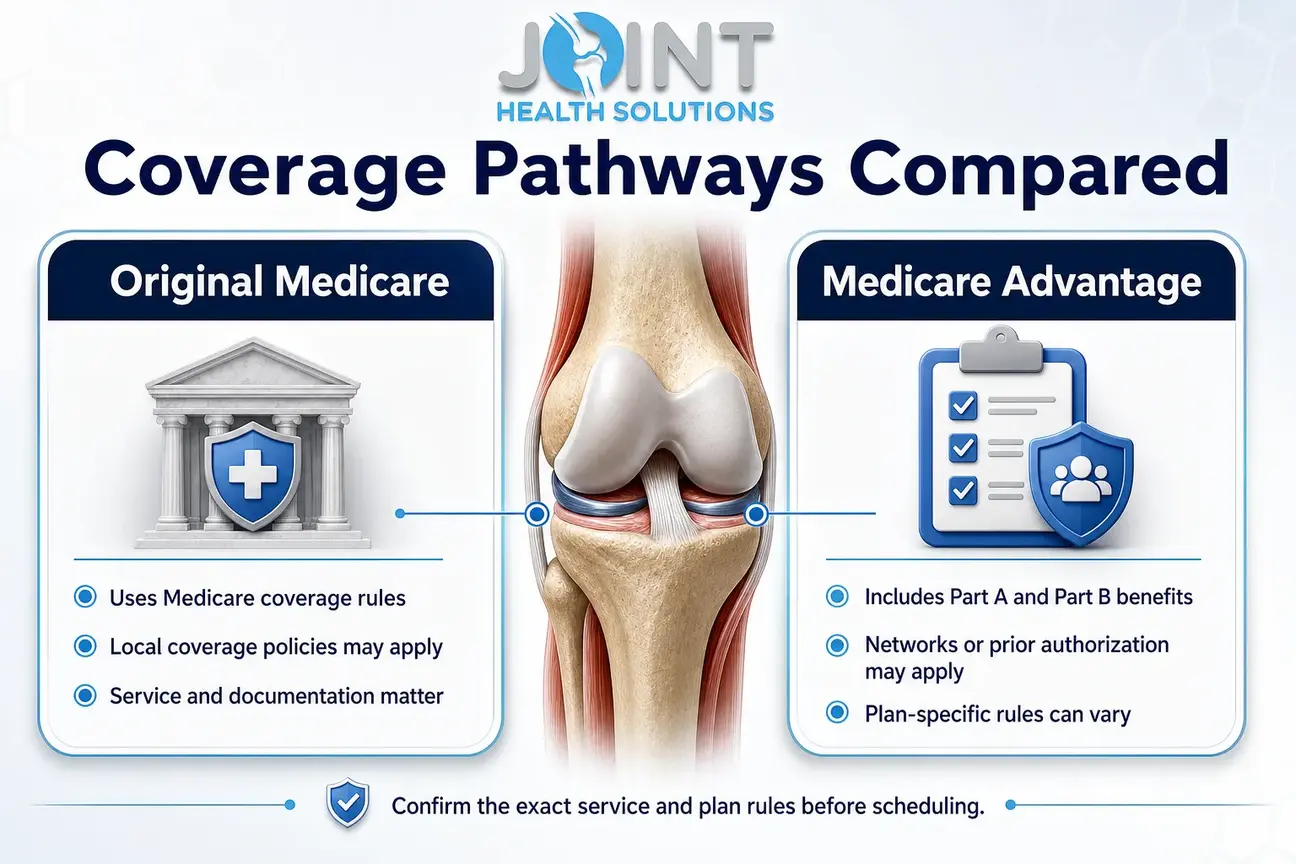
For many patients, knee osteoarthritis coverage feels confusing because the insurance question is not simply, “Do I have knee arthritis?” The more useful question is, “Does my plan cover this exact service for my specific situation, and what documentation does the plan require?” That distinction matters because one injection option may fit a coverage pathway while another may be considered noncovered or elective.
Coverage also depends on the type of insurance. Original Medicare uses Medicare coverage rules and local coverage policies where they apply. Medicare Advantage plans must include Medicare Part A and Part B benefits, but they may add plan networks, prior authorization requirements, and different cost-sharing rules. Commercial insurance plans can also have their own medical policies and documentation standards.
Joint Health Solutions accepts Medicare, BlueCross BlueShield, Aetna, and Cigna as payers, as noted on its insurance and financing page, but accepting an insurance payer is not the same as confirming that a specific knee procedure will be covered. Procedure-level benefits still need to be verified before treatment, and out-of-pocket responsibility can vary by plan. Knee osteoarthritis coverage should always be checked at the procedure level.
| Situation | Typical coverage position | What patients should verify |
|---|---|---|
| Original Medicare and hyaluronic acid for knee osteoarthritis | May be covered only when the applicable Medicare criteria are met. | Confirm the current LCD, documentation, prior conservative care, and whether repeat-series rules apply. |
| Original Medicare and cortisone injections | May be considered when medically necessary, but coverage depends on the service, documentation, and Medicare rules. | Ask whether your diagnosis, clinical assessment, and plan requirements support the injection being billed. |
| Original Medicare and PRP for knee osteoarthritis | Generally not covered for routine orthopedic knee osteoarthritis use; a narrow wound-care exception is separate. | Confirm whether PRP is treated as noncovered or elective for your knee condition before scheduling. |
| Medicare Advantage | Must include Part A and Part B benefits, but networks, prior authorization, cost sharing, and plan rules vary. | Request plan-specific confirmation, including whether written authorization is required and what it does or does not guarantee. |
| Commercial insurance | Coverage varies by carrier, plan, procedure, and medical policy. | Ask the practice and insurer to verify benefits for the exact injection and knee diagnosis. |
For general coverage preparation, Joint Health Solutions also provides insurance information to help patients understand coverage variability and verification steps. These resources can help you prepare questions, but they do not replace plan-specific confirmation from your insurer.
Original Medicare knee injections: coverage is procedure-specific
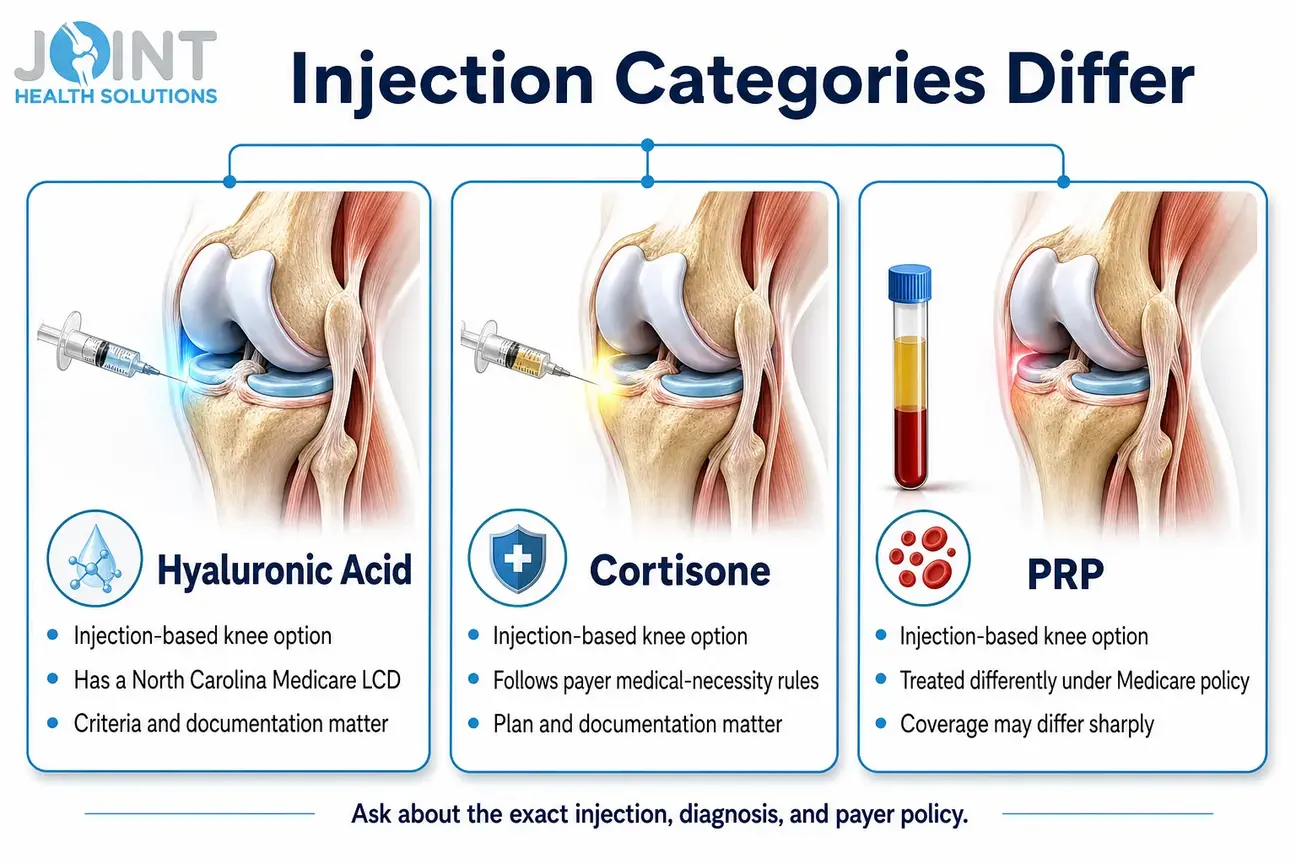
Original Medicare knee injections are not covered simply because a person has knee pain or because imaging shows arthritis. Medicare generally looks at whether the service is reasonable and necessary for the condition and whether any applicable national or local policy requirements are met. For knee osteoarthritis coverage, this means the type of injection matters.
Hyaluronic acid injections, cortisone injections, and PRP therapy are all injection-based options, but they do not follow the same payment logic. Hyaluronic acid for knee osteoarthritis has a specific Medicare Local Coverage Determination in North Carolina. PRP for orthopedic joint conditions is treated differently under Medicare policy. Cortisone injections may be considered under medical-necessity and billing rules, but patients still need to verify plan details.
That is why two patients with the same diagnosis may receive different coverage answers. One patient may have Original Medicare and meet a specific policy’s documentation criteria. Another may have a Medicare Advantage plan that requires prior authorization. A third may be considering PRP and learn that the plan treats it as noncovered for knee osteoarthritis. Knee osteoarthritis coverage is not one-size-fits-all.
How the hyaluronic acid LCD frames knee osteoarthritis coverage
The Medicare policy for hyaluronic acid injections for knee osteoarthritis is specific. The LCD states that hyaluronic acid injections are “considered reasonable and necessary when ALL of the following criteria … are met.” In plain language, the initial series criteria include all of these points:
- The patient has symptomatic knee osteoarthritis.
- The knee pain interferes with functional activities, such as walking or prolonged standing.
- There is radiographic evidence supporting knee osteoarthritis, such as joint-space narrowing, subchondral sclerosis, osteophytes, or subchondral cysts.
- At least three months of conservative therapy has failed or is contraindicated. The LCD lists nonpharmacologic and pharmacologic options.
- An intra-articular glucocorticoid injection has failed or is contraindicated.
This is an important knee osteoarthritis coverage distinction. Under this LCD, CMS states hyaluronic acid is “not covered as the initial treatment” for knee osteoarthritis. That means the policy expects documentation of earlier conservative care and, unless contraindicated, a prior glucocorticoid injection that did not adequately address the issue.
Joint Health Solutions offers hyaluronic acid injections when appropriate after clinical assessment. However, whether a patient is medically appropriate for a treatment and whether a plan covers that treatment are related but separate questions. Both should be addressed before treatment begins.
Repeat hyaluronic acid series have additional rules
Patients who previously had a hyaluronic acid series often ask whether another series will be covered. The Medicare LCD includes repeat-series criteria, not just initial-series criteria. In plain language, the repeat-series criteria include all of these points:
- The patient continues to meet the initial coverage criteria.
- Symptoms have returned.
- The prior series improved both pain and functional capacity.
- At least six months have elapsed since the prior series.
The timing point is especially important. The LCD says that when “at least 6 months have not elapsed” since the prior series, the repeat series “is considered not reasonable and necessary and not covered.” A repeat series is also not covered when the previous series did not improve knee pain and function.
For knee osteoarthritis coverage, repeat treatment is not automatic. Documentation must support the reason for another series, the return of symptoms, prior benefit in both pain and function, and the required timing. A Medicare Advantage plan may add authorization steps even when the underlying Medicare benefit category is present.
Other hyaluronic acid coverage limitations
The LCD also includes coverage limitations that patients should understand in plain language. Hyaluronic acid is not covered as the initial treatment for knee osteoarthritis under this policy. A repeat series before six months have elapsed is not considered reasonable and necessary. A repeat series is not covered if the prior series did not improve pain and function.
The policy also states that a diagnosis other than knee osteoarthritis does not meet this covered indication. The related Medicare billing and coding article says hyaluronan injections are covered for pain in osteoarthritis of the knee, with other uses denied as investigational. In addition, treatment is contraindicated under the LCD when infection or skin disease is present around the injection site or joint, and when the patient is allergic to hyaluronate products.
Dose and frequency must follow applicable FDA labeling under the LCD. Patients should not use this article to decide whether they personally meet these requirements. A clinical assessment and insurance verification are needed before any individual treatment decision, especially when knee osteoarthritis coverage depends on detailed documentation.
Hyaluronic acid vs PRP coverage: why the same knee diagnosis can lead to different answers
Hyaluronic acid vs PRP coverage is one of the most common knee injection insurance questions because both may be discussed in the context of knee osteoarthritis. From an insurance standpoint, however, they are not treated the same way. The difference is not just the diagnosis; it is the procedure and the policy attached to that procedure.
Hyaluronic acid has a Medicare LCD for knee osteoarthritis in North Carolina. That does not mean it is always covered, but it does provide a specific pathway when all criteria are met. PRP for routine orthopedic knee osteoarthritis does not follow that same pathway under Medicare program policy, so knee osteoarthritis coverage can differ sharply between these options.
CMS PRP policy language for platelet-rich plasma is cautious and restrictive for musculoskeletal use. The relevant Medicare LCD states that PRP is “considered not medically reasonable and necessary for any use outside of” the narrow wound-care exception. In practical terms, CMS PRP coverage policy distinguishes orthopedic PRP from a limited chronic wound context.
That narrow wound-care exception involves chronic non-healing diabetic wounds for a limited duration when requirements are met. It is not the same as PRP injections for knee osteoarthritis, knee pain, shoulder pain, or other routine orthopedic joint conditions. Patients should avoid assuming that the wound-care exception means PRP for knee osteoarthritis is covered.
Joint Health Solutions offers PRP therapy when appropriate after assessment, but coverage may be different from other knee injection options. Regenerative therapies such as PRP may be considered elective by certain carriers, and procedure-specific benefits should be verified before treatment.
Where cortisone injections fit into knee osteoarthritis coverage
Cortisone injections are another common option patients ask about when discussing knee osteoarthritis coverage. A cortisone injection, also called a corticosteroid injection, is different from hyaluronic acid and PRP. It is often discussed as an anti-inflammatory injection option, but coverage still depends on the patient’s plan, clinical documentation, medical necessity, and any applicable payer rules.
Joint Health Solutions offers cortisone injections when appropriate after clinical assessment. For insurance purposes, patients should ask whether the injection, medication, guidance method if used, diagnosis code, and visit components are all handled as covered benefits under their plan.
Cortisone also matters because the Medicare LCD for hyaluronic acid specifically looks at whether an intra-articular glucocorticoid injection has failed or is contraindicated before hyaluronic acid is covered. In other words, cortisone may be part of the documented pathway before hyaluronic acid coverage is considered under that LCD. That does not mean every patient must receive the same sequence; the policy also recognizes contraindication where applicable.
For patients, the practical point is simple: do not compare injections only by how they sound medically. Compare how your plan classifies them. One injection may be covered only after conservative therapy. Another may require prior authorization. Another may be treated as noncovered for knee osteoarthritis. Knee osteoarthritis coverage verification should be tied to the exact service being discussed.
Medicare Advantage prior authorization and plan-specific rules
Medicare Advantage prior authorization can change the patient experience even when a service is related to a Medicare-covered benefit. CMS explains that Medicare Advantage plans cover Medicare Part A and Part B benefits, but plan networks, prior authorization, cost sharing, and supplemental benefits can vary. That is why patients should not assume their Medicare Advantage plan handles knee injections exactly like Original Medicare.
Prior authorization means the plan may require information before treatment to decide whether the requested service meets plan rules. It can involve documentation from the clinic, diagnosis information, prior treatment history, imaging or clinical findings when required, and the specific procedure being requested. For knee osteoarthritis coverage, prior authorization may be especially relevant when a plan has detailed medical policy criteria.
CMS has also addressed prior authorization timelines for impacted payers. CMS states that affected payers must send prior authorization decisions within 72 hours for expedited requests and seven calendar days for standard requests. These timelines help frame the process, but they do not mean every requested service will be approved.
Most importantly, prior authorization approval is not the same as a guarantee that a claim will be paid. A plan may still apply eligibility rules, coding rules, documentation requirements, network rules, medical-necessity review, cost-sharing rules, or exclusions. Prior authorization also does not turn an otherwise excluded service into a covered benefit.
Patients with Medicare Advantage should ask for plan-specific written confirmation whenever possible. The plan’s Evidence of Coverage document can be useful, but it may not answer every procedure-level question. A direct benefits check tied to the exact injection can help reduce surprises and clarify knee osteoarthritis coverage before treatment.
Medigap and ABN considerations under Original Medicare
Some patients with Original Medicare also have a Medigap policy. A Medigap policy generally helps pay deductibles, coinsurance, and copayments for services Original Medicare already covers. It does not make a service covered if Original Medicare excludes it.
An Advance Beneficiary Notice of Noncoverage, often called an ABN, may apply in certain Original Medicare situations when a provider expects Medicare to deny payment for a potentially covered service. CMS explains ABN instructions for fee-for-service Medicare, but an ABN is not a coverage decision or a guarantee of how Medicare will process a claim. Whether one applies depends on the service, expected denial, exclusion status, billing method, and other details.
For many covered Medicare Part B services, after the applicable annual Part B deductible, Medicare generally pays 80% of the Medicare-approved amount and the beneficiary is responsible for the remaining 20%. Actual responsibility can vary by assignment, supplemental coverage, provider status, and the specific service. This 80/20 concept should not be applied to noncovered orthopedic PRP for knee osteoarthritis.
Knee injection insurance questions to ask before treatment
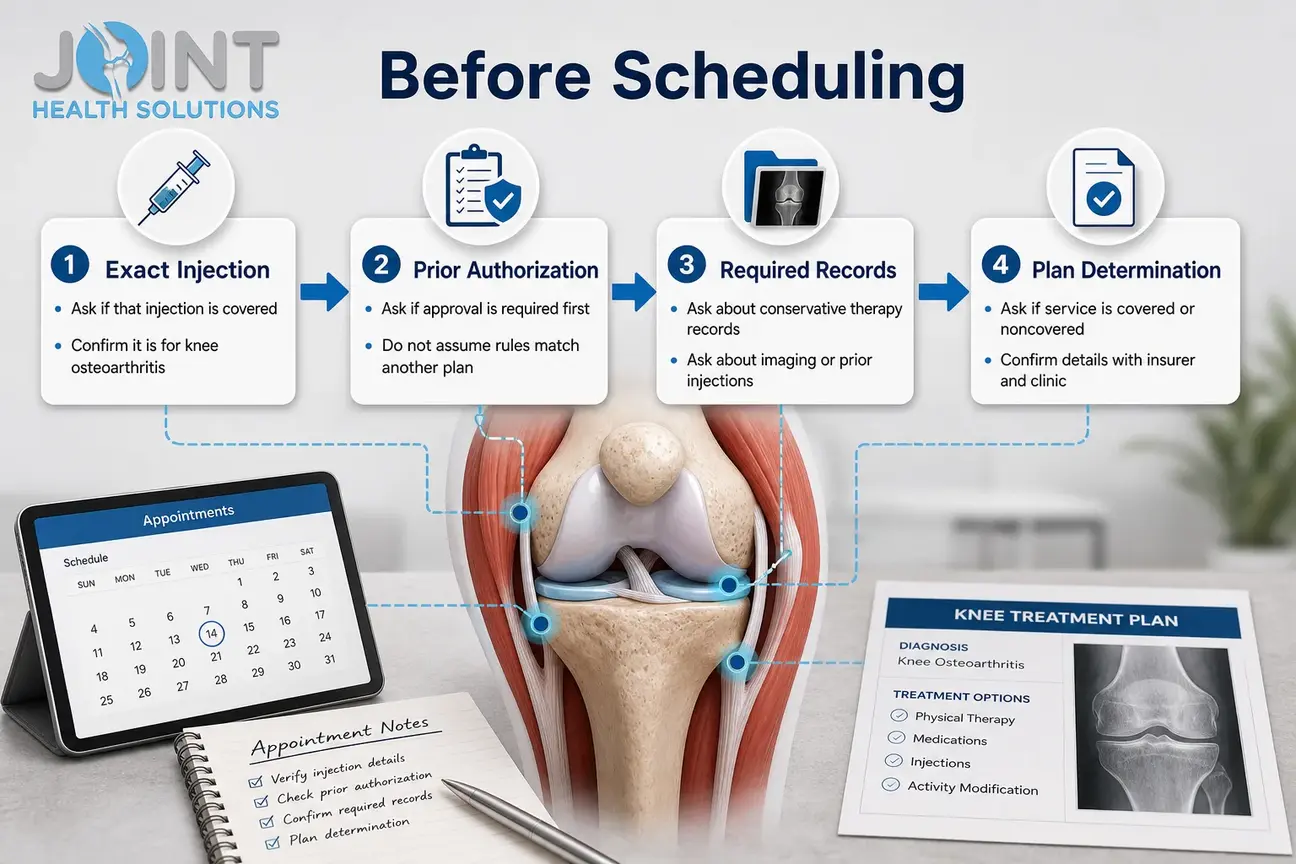
The most useful knee injection insurance questions are specific. Asking “Do you cover knee arthritis?” may lead to an incomplete answer. Asking about the exact injection, diagnosis, medical policy, prior authorization, and cost-sharing gives you clearer information about knee osteoarthritis coverage.
Before scheduling treatment, consider asking your insurer and the clinic these questions:
- Is the specific injection being discussed covered for knee osteoarthritis under my plan?
- Does my plan require prior authorization before treatment?
- Does my plan require documentation of conservative therapy, imaging findings, or prior injections?
- Is the treatment considered covered, noncovered, investigational, elective, or subject to a medical policy?
- If this is a repeat hyaluronic acid series, does the plan require documentation of prior improvement and timing?
- What are my deductible, coinsurance, copayment, or other out-of-pocket responsibilities?
- Does my plan require a referral or network-specific provider rules?
- If the claim is denied, what appeal options are available?
These questions are not meant to create pressure or delay care unnecessarily. They are meant to help patients understand the payment side before deciding whether to move forward. At a conservative, non-surgical joint care clinic, the goal is to match the medical discussion with a clear understanding of coverage uncertainty and plan-specific requirements.
How Joint Health Solutions helps patients verify next steps in Charlotte
Joint Health Solutions provides conservative, minimally invasive, non-surgical joint care at its verified Charlotte clinic. Patients may travel from nearby communities, but care is provided at the Charlotte location; this article does not imply any branch office outside Charlotte.
Before treatment, ask the team to help clarify whether your plan may require prior authorization, whether the specific injection appears to be covered or noncovered, and what documentation may be needed. You should also confirm details directly with your insurer because the plan makes the final coverage and payment determinations.
Joint Health Solutions offers joint injections and related non-surgical options when appropriate after clinical assessment. For knee osteoarthritis, the discussion may include conservative care, viscosupplementation, corticosteroid injections, platelet-rich plasma therapy, bracing, physical therapy, or other individualized options. Suitability depends on the assessment, and results vary.
If you are ready to discuss knee osteoarthritis coverage and treatment options, you can request an appointment or contact the Charlotte clinic. You may also call 704-833-3566. A conversation with the clinic can help you identify what to verify, but it cannot guarantee coverage, approval, payment, or a particular outcome.
Putting the coverage pieces together
Knee osteoarthritis coverage is most clearly understood as a combination of three factors: the diagnosis, the specific procedure, and the plan rules. A diagnosis of knee osteoarthritis may be necessary for certain coverage pathways, but it is not always sufficient. The plan still looks at what service is being requested and whether the policy requirements are met.
For hyaluronic acid, the Medicare LCD in North Carolina creates a detailed coverage pathway for knee osteoarthritis when all criteria are met. For cortisone, coverage questions depend on medical necessity, documentation, and payer rules. For PRP, Medicare generally treats routine orthopedic use for knee osteoarthritis differently from covered injection pathways, while recognizing a narrow wound-care context that should not be confused with knee OA treatment.
Medicare Advantage adds another layer because the plan may require prior authorization, network compliance, and plan-specific cost sharing. Commercial plans may have their own rules. For knee osteoarthritis coverage, the practical approach is to verify before treatment, keep a record of plan communications, and ask whether written confirmation is available.
For general education only; not a substitute for professional medical advice, diagnosis, or treatment. Suitability and results vary, and individual needs require clinical assessment.
Frequently Asked Questions
Does Medicare Advantage cover knee injections the same way as Original Medicare?
Not always in the day-to-day process. Medicare Advantage plans cover Medicare Part A and Part B benefits, but plan networks, prior authorization, cost sharing, and documentation requirements can vary. Patients should verify the exact injection and knee diagnosis with the plan before treatment.
Is PRP covered for knee osteoarthritis?
Original Medicare generally does not cover PRP injections for routine orthopedic knee osteoarthritis. Medicare recognizes a narrow PRP wound-care exception for qualifying chronic non-healing diabetic wounds, but that is separate from PRP for knee osteoarthritis. Commercial and Medicare Advantage plan rules may vary, so confirmation is still needed.
Why might hyaluronic acid be covered when PRP is not?
Hyaluronic acid for knee osteoarthritis has a specific Medicare coverage policy in North Carolina when all criteria are met. PRP for musculoskeletal joint conditions is treated differently under Medicare policy. The difference comes from procedure-specific coverage rules, not just the knee osteoarthritis diagnosis.
Does prior authorization guarantee payment?
No. Prior authorization may mean the plan reviewed the request before treatment, but it does not guarantee final claim payment. The plan may still apply eligibility, coding, documentation, network, medical-necessity, exclusion, or cost-sharing rules.
What should I confirm with Joint Health Solutions before treatment in Charlotte?
Ask whether your plan may require prior authorization, whether the specific injection is typically treated as covered or noncovered under your plan, what documentation may be needed, and what out-of-pocket responsibility may apply. You should also verify details directly with your insurer.
Can a Medigap policy make PRP covered?
Generally, no. A Medigap policy helps with certain out-of-pocket costs for services Original Medicare already covers. It does not turn a service that Original Medicare excludes into a covered benefit.
Are repeat hyaluronic acid injections automatically covered?
No. Under the Medicare LCD, repeat series rules include continued eligibility, returned symptoms, prior improvement in both pain and function, and at least six months since the prior series. Plans may also have their own documentation or authorization steps.
Sources
- CMS Medicare Coverage Database: LCD L39260, Hyaluronic Acid Injections for Knee Osteoarthritis
- CMS Medicare Coverage Database: Article A56157, Billing and Coding: Intraarticular Knee Injections of Hyaluronan
- CMS Medicare Coverage Database: LCD L39071, Platelet Rich Plasma
- CMS Medicare Coverage Database: LCD L39058, Wound Application of Cellular and/or Tissue Based Products
- CMS: Health Plans – General Information
- CMS Blog: Moving Prior Authorization Into the 21st Century
- CMS: Final Rule to Expand Access to Health Information and Improve the Prior Authorization Process
- CMS: Fee-for-Service Advance Beneficiary Notice of Noncoverage




 English
  Spanish