

How Shoulder Arthritis Care Usually Starts
Quick Answer: Shoulder arthritis care usually starts with conservative, non-surgical steps before procedures are considered. For many adults, that means a clinical assessment, rest or activity changes, a guided exercise or physical therapy plan, and medication discussions at a high level when appropriate. Injections, such as corticosteroid injections, may be discussed later if symptoms continue and the diagnosis supports that option.
This early path is meant to match shoulder arthritis care to the type of arthritis, the pattern of pain and stiffness, exam findings, imaging when needed, and the person’s daily goals. It is not a one-size-fits-all sequence. At Joint Health Solutions, adults who can visit the Charlotte clinic can ask about conservative shoulder arthritis care and related options by calling 704-833-3566 or using the request an appointment page.
Why shoulder arthritis care usually begins conservatively
Shoulder arthritis care often begins with lower-intensity steps because arthritis symptoms can fluctuate, and many people need a plan that protects mobility while avoiding unnecessary escalation. The American Academy of Orthopaedic Surgeons says the initial treatment of shoulder arthritis is nonsurgical. That does not mean every person improves with the same approach, and it does not mean procedures are never appropriate. It means the starting point is commonly education, activity choices, movement, and symptom management.
Shoulder arthritis is different from a sudden shoulder injury or a rotator cuff problem, although symptoms can overlap. Arthritis care focuses on how joint surfaces, inflammation, stiffness, and motion limits are affecting daily function. A conservative plan may include several pieces at once, or it may start with one or two priorities based on the assessment.
A typical early shoulder arthritis care pathway may look like this:
| Stage | Usual focus | What the patient should ask |
|---|---|---|
| First discussion | Clarify symptoms, activity limits, prior treatments, and goals | What type of shoulder problem seems most likely, and what needs to be ruled out? |
| Early conservative care | Activity modification, rest from aggravating movements, and home strategies | Which movements should be limited, adjusted, or practiced differently? |
| Movement plan | Exercise or physical therapy to support motion, strength, and function | What exercises are appropriate for my current mobility and pain level? |
| Medication conversation | Over-the-counter or prescribed options discussed at a high level | What medication risks or interactions should I review with my clinician? |
| Next-step options | Injections may be discussed if symptoms continue and assessment supports them | What is the goal of an injection, and how would we judge whether it helped? |
This framework helps keep the decision-making practical. The question is not simply “What treatment is strongest?” A more useful question is, “What is appropriate for this shoulder, this diagnosis, this level of function, and this person’s health history?”
What shoulder arthritis means in plain language
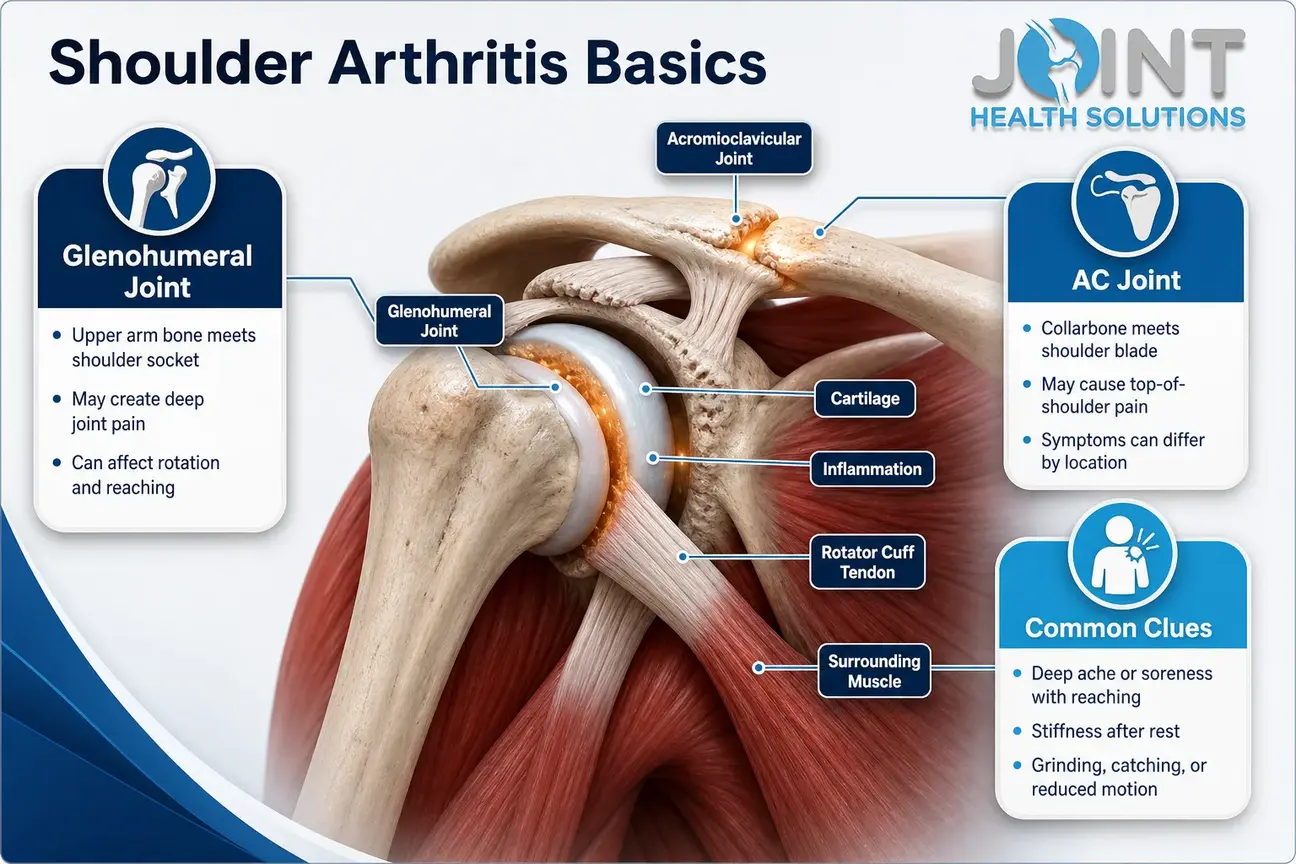
Arthritis in the shoulder generally refers to joint changes that can create pain, stiffness, inflammation, and reduced motion. The shoulder is not one simple joint. Arthritis may involve the glenohumeral joint, where the upper arm bone meets the shoulder socket, or the acromioclavicular joint, where the collarbone meets part of the shoulder blade. These areas can create different symptom patterns.
People often describe shoulder arthritis as a deep ache, soreness with reaching, stiffness after rest, or difficulty with overhead activity. Some notice grinding, catching, or a sense that the shoulder does not move as smoothly as it once did. Others mainly notice practical limitations, such as trouble dressing, lifting objects, sleeping on one side, or reaching into a cabinet.
Because shoulder pain can come from many sources, a clinical assessment matters. Tendon irritation, bursitis, muscle guarding, neck-related pain, and prior injuries can sometimes feel similar to arthritis. A person may also have more than one issue at the same time. That is why shoulder arthritis care usually starts with careful sorting rather than jumping directly to a procedure.
Joint Health Solutions provides education on shoulder arthritis and related conservative care options. That condition page can be a helpful starting point, but an individual treatment plan still depends on assessment and appropriateness.
Common shoulder arthritis symptoms and what they may mean
Common shoulder arthritis symptoms include pain, stiffness, loss of range of motion, and difficulty using the arm for daily tasks. Some people have symptoms that are mostly activity-related. Others notice symptoms at rest, at night, or after a period of not moving the shoulder. These patterns can help guide the conversation, but they do not diagnose the condition by themselves.
Location can also provide clues. Pain at the top of the shoulder may raise different questions than deeper joint pain in the front, side, or back of the shoulder. Stiffness with rotation may affect tasks like fastening clothing, tucking in a shirt, or reaching behind the body. Pain with overhead activity may affect work, exercise, household tasks, or caregiving responsibilities.
Shoulder arthritis symptoms are also important because they shape goals for shoulder arthritis care. A person who wants to sleep more comfortably may need a different early plan than someone whose main goal is lifting, returning to recreational activity, or improving basic dressing and bathing movements. Conservative care is most useful when it is tied to real-life limitations, not just a diagnosis label.
Symptoms also help decide when shoulder arthritis care should be reassessed. If the shoulder is not responding as expected, if function is declining, or if pain is preventing basic use of the arm, it may be reasonable to discuss whether the diagnosis needs to be revisited or whether next-step options should be considered.
How shoulder pain stiffness affects daily choices
Shoulder pain stiffness can change how someone moves long before they seek care. People may stop reaching overhead, avoid carrying groceries on one side, switch sleeping positions, or use the other arm more often. These adjustments can be helpful in the short term, but they can also lead to guarding and reduced confidence with movement if symptoms persist.
In early shoulder arthritis care, the goal is not usually to stop all activity. Total avoidance can sometimes make stiffness feel worse. Instead, the conversation often focuses on modifying activities that repeatedly provoke symptoms while keeping the shoulder moving in ways that are tolerable and appropriate.
For example, someone may need to change how they lift, shorten the time spent in overhead positions, break tasks into smaller parts, or adjust exercise choices. These changes should be individualized. A person with mild stiffness and high activity demands may need a different plan than someone with advanced motion limits and multiple health concerns.
It is also important to separate discomfort from unsafe advice. This article cannot tell an individual which movements are safe or unsafe for their shoulder. That decision depends on the clinical picture, including the likely source of pain, strength, range of motion, and any relevant imaging or medical history.
Rest and activity modification are often the first practical step

Rest in shoulder arthritis care usually means relative rest, not complete immobilization unless a clinician specifically advises it for a particular reason. Relative rest means reducing or changing the activities that reliably aggravate symptoms while maintaining tolerable motion and daily function. This can help calm irritated tissues and make it easier to participate in exercise or therapy.
AAOS lists rest or activity modification as an early nonsurgical measure and describes changing how the arm is used to avoid provoking pain. In everyday terms, this may mean temporarily limiting repeated overhead reaching, heavy pushing or pulling, awkward lifting, or long periods with the arm held away from the body.
Activity modification works well when it is specific. “Use your shoulder less” is rarely helpful by itself. A more useful approach is to identify the two or three tasks that consistently worsen symptoms and adjust those first. Examples might include moving frequently used items to a lower shelf, using both hands for heavier objects, changing a workout movement, or pacing yardwork.
At the same time, activity modification should not become fear of movement. Many people with arthritis can still benefit from appropriate strengthening, flexibility work, and functional practice. The right balance in shoulder arthritis care is usually found through assessment, gradual changes, and feedback from symptoms over time.
Physical therapy and exercise in early shoulder arthritis care

Physical therapy is often part of early shoulder arthritis care because movement, strength, and function are central to daily shoulder use. AAOS says physical therapy exercises may improve range of motion, strength, and function in the shoulder. The word “may” matters: response varies, and exercises should match the person’s diagnosis, irritability, and goals.
A shoulder arthritis exercise plan is usually not just a list of stretches. It may include gentle mobility work, strengthening for muscles around the shoulder blade and rotator cuff, posture and body mechanics education, and task-specific movement practice. The purpose is to support the shoulder’s ability to move and tolerate daily demands.
Some people worry that exercise will “wear out” the joint faster. That fear is understandable, but it can lead to too much avoidance. The more useful question is whether the exercise is appropriate for the person’s current condition. A well-matched plan usually starts with manageable movements and progresses only when tolerated.
Joint Health Solutions offers physical therapy for patients with joint pain, osteoarthritis, mobility limitations, or musculoskeletal injuries when it is appropriate for the individual plan. For shoulder arthritis, PT may be considered as part of conservative care, especially when stiffness, weakness, or movement limitations are major concerns.
What a shoulder-focused therapy plan may emphasize
A therapy plan for shoulder arthritis may emphasize comfortable range of motion, shoulder blade control, gradual strengthening, and strategies for daily tasks. It may also include education about pacing, warm-up routines, and how to respond when symptoms flare. The plan should be adjusted if exercises consistently increase pain or reduce function.
Therapy can also help clarify what is driving limitation. If motion improves with guided exercise, that may support continued conservative shoulder arthritis care. If motion remains very restricted or pain remains high despite appropriate adjustments, the care team may discuss whether additional evaluation or next-step treatment options make sense.
It is important not to compare progress too closely with another person’s experience. Shoulder arthritis can differ by joint involved, severity, activity demands, and overall health. A realistic plan focuses on measurable function, such as reaching, sleeping, dressing, lifting, or returning to specific activities.
Non surgical shoulder arthritis treatment before procedures
Non surgical shoulder arthritis treatment usually includes education, activity modification, physical therapy or exercise, and medication discussions before injections or other procedures are considered. This order is not a rigid rule, but it reflects the common principle of starting with conservative care when the situation allows.
For some people, conservative shoulder arthritis care is enough to manage symptoms for a period of time. For others, it helps clarify which symptoms are most persistent and whether a procedure should be discussed. The purpose is not to delay necessary care. It is to make decisions based on diagnosis, response to initial steps, and the person’s goals.
Non-surgical care also gives patients time to learn what influences their symptoms. Many people discover that certain combinations of activity, rest, sleep position, and strengthening make a meaningful difference. Others learn that symptoms remain limiting despite reasonable effort, which can guide the next conversation.
The phrase “non-surgical” should not be taken as a promise that surgery will never be discussed. Some people with advanced arthritis or severe functional loss may eventually need to speak with an orthopedic surgeon. But for an informational starting point, AAOS patient guidance supports beginning with nonsurgical treatment for shoulder arthritis.
Medication conversations stay high level at first
Medication may be part of shoulder arthritis care, but this article cannot recommend a specific medicine, dose, or schedule. That decision belongs in a clinical conversation that accounts for medical history, other medications, allergies, kidney or stomach concerns, bleeding risk, and other individual factors.
AAOS states that nonsteroidal anti-inflammatory drugs, including examples such as aspirin, ibuprofen, or naproxen, may reduce inflammation and pain. AAOS also notes that these medicines can irritate the stomach lining and cause internal bleeding, and it advises consulting a doctor first if there is a history of ulcers or blood thinner use.
AAOS patient material on glenohumeral osteoarthritis also says over-the-counter medications such as acetaminophen and NSAIDs may be recommended. These are broad educational points, not personal instructions. People should ask a clinician or pharmacist how any medication fits with their health history and current medication list.
Medication discussions are often most useful when connected to function. Instead of only asking whether a medicine “works,” patients can ask whether it might help them participate in therapy, sleep more comfortably, or complete necessary activities. They can also ask what side effects or warning signs should prompt them to stop and seek medical guidance.
When injections may enter the shoulder arthritis care conversation
Injections are usually not the first topic in shoulder arthritis care unless the person’s symptoms, history, and assessment make that discussion appropriate. They may be considered when conservative steps have not provided enough relief, when inflammation appears to be a significant contributor, or when symptoms are interfering with therapy and daily function.
AAOS says corticosteroid injections in the shoulder can dramatically reduce inflammation and pain, but the effect is often temporary. That wording is important. A cortisone injection may be useful for some people, but it should not be presented as a promised result or a permanent fix.
At Joint Health Solutions, cortisone injections are a confirmed service for patients for whom corticosteroid injection is appropriate. For shoulder concerns, an injection conversation should follow clinical assessment. The care team would need to consider diagnosis, goals, medical history, prior response to treatment, and whether an injection fits the overall plan.
Some patients ask whether an injection replaces physical therapy. In many cases, that is not the right way to frame the decision. An injection, when appropriate, may be discussed as one part of a broader plan. Movement, strength, activity choices, and follow-up still matter because arthritis affects joint function as well as pain.
Questions to ask before a cortisone injection is considered
Before considering a cortisone injection, patients may want to ask what structure is being targeted, what diagnosis supports the injection, what the intended goal is, and how the response will be evaluated. They can also ask what alternatives are reasonable and what symptoms should prompt follow-up.
It is also reasonable to ask how an injection would fit with physical therapy, home exercise, and activity modification. A thoughtful plan should avoid treating the injection as a stand-alone answer. For many people, the practical goal is to make daily activity and guided movement more manageable, but results vary.
Coverage and out-of-pocket costs can vary by treatment and plan. Covered and out-of-pocket costs should be reviewed before treatment, and patients should verify details with the practice and their insurer. Participation with an insurer does not assure coverage for a specific procedure.
What about hyaluronic acid for shoulder arthritis?
Hyaluronic acid is sometimes discussed in arthritis care broadly, but shoulder arthritis evidence should not be assumed to match knee arthritis evidence. For glenohumeral joint osteoarthritis, the AAOS patient handout states that strong evidence supports that there is no benefit to the use of hyaluronic acid. That is a specific evidence statement for glenohumeral joint OA.
This matters because patients often research “arthritis injections” and find information that mixes different joints and different diagnoses. A treatment discussed for one joint may not have the same evidence base for another. Shoulder arthritis care should be diagnosis-specific, not copied from knee arthritis care or from general injection marketing.
If a patient has read about hyaluronic acid, PRP, or other injections, it is appropriate to ask how the evidence applies to the specific shoulder diagnosis. A clinician can explain whether an option is relevant, whether evidence is limited or mixed, and whether a different pathway is more appropriate.
How a Charlotte clinic visit may fit into the early pathway
For adults in the Charlotte area, a conservative-care visit is often about sorting through symptoms and building a practical plan. Joint Health Solutions is a north Charlotte medical clinic providing personalized, conservative, minimally invasive, non-surgical care for joint pain, arthritis, stiffness, mobility limitations, and related musculoskeletal concerns.
The verified clinic location is 9350 Benfield Rd, #109, Charlotte, NC 28269, and the phone number is 704-833-3566. People may travel from nearby communities, but care occurs at the Charlotte clinic. No other physical clinic location should be assumed from a service-area mention.
A shoulder arthritis visit may include discussion of symptoms, daily limitations, prior care, health history, and goals. The clinical team may assess movement and function and discuss whether conservative care, therapy, injections, or additional evaluation may be appropriate. The exact plan depends on the individual assessment.
If shoulder pain is your main concern but you are not sure whether arthritis is the cause, the shoulder pain resource may help you understand why evaluation matters. If arthritis has already been discussed, the shoulder arthritis resource may be more directly relevant.
How to prepare for a shoulder arthritis assessment
Preparation can make the first conversation more useful. Before a visit, it may help to write down when symptoms started, where pain is located, which movements are limited, what makes symptoms better or worse, and what daily activities matter most. This gives the care team a clearer picture of function, not just pain intensity.
Patients should also bring a list of current medications and supplements, prior injections or procedures, past shoulder injuries, and any relevant imaging or medical records if available. This is especially important before medication or injection discussions because medical history can affect appropriateness.
It may also help to identify goals in plain language. Examples include reaching overhead, dressing more easily, sleeping on the affected side, returning to a gym routine, carrying household items, or playing a recreational sport. Goals make the care plan more concrete.
For people who want to understand the visit process, Joint Health Solutions provides a what to expect resource. To discuss whether an assessment is appropriate, patients can contact the Charlotte clinic or request an appointment online.
Signs it may be time to revisit shoulder arthritis care
Conservative care is not passive. It should be monitored and adjusted. It may be time to revisit shoulder arthritis care if symptoms are not changing, if stiffness is worsening, if daily activities remain significantly limited, or if exercises are consistently aggravating symptoms despite modifications.
Reassessment does not automatically mean a procedure is needed. It may mean the exercise plan should be adjusted, the diagnosis should be reconsidered, imaging should be reviewed, or medication and injection options should be discussed. The point is to avoid staying on an ineffective plan without asking why.
It is also reasonable to revisit goals. A person’s priorities may change after learning what activities are most limited. Someone who initially wanted general pain relief may later identify sleep, reaching, or work tasks as the real priority. A patient-centered plan should be able to adapt.
When symptoms are severe, sudden, or associated with concerning changes, patients should seek appropriate medical evaluation rather than relying on general online education. For emergencies, call 911 or go to an emergency department.
How to keep expectations realistic
Realistic expectations are a key part of shoulder arthritis care. Conservative care may help some people improve function, reduce symptom irritability, or better manage daily activity. Others may have persistent limitations because arthritis can involve structural joint changes. Results vary, and no plan can promise a specific outcome.
It is also helpful to view early care as a decision-making process, not a single event. Rest and activity modification may reveal what provokes symptoms. Physical therapy may show whether motion and strength can improve. Medication discussions may clarify what is appropriate or not appropriate medically. Injection discussions may become more relevant if symptoms remain limiting.
Patients should be cautious with any message that promises relief, promises surgery avoidance, or presents one treatment as universally effective. Evidence-informed shoulder arthritis care is more nuanced. The right plan depends on the diagnosis, health history, preferences, response to care, and ongoing reassessment.
If you are considering non-surgical care for shoulder arthritis in Charlotte, Joint Health Solutions can help you discuss conservative options after clinical assessment. You can schedule a consultation without assuming that any one treatment is automatically right for you.
Key takeaways for early shoulder arthritis care
- Shoulder arthritis care usually starts with conservative, non-surgical steps when the situation allows.
- Common early steps include activity modification, relative rest from aggravating movements, physical therapy or guided exercise, and medication discussions at a high level.
- Shoulder arthritis symptoms such as pain, stiffness, and motion loss should be interpreted through clinical assessment, not self-diagnosis alone.
- Cortisone injections may be discussed after assessment when appropriate, but effects can vary and may be temporary.
- Evidence for injections differs by joint and diagnosis; AAOS patient material states strong evidence supports no benefit for hyaluronic acid in glenohumeral joint OA.
- Care at Joint Health Solutions occurs at the Charlotte clinic, and suitability for any option depends on individual assessment.
Medical disclaimer: For general education only; not a substitute for professional medical advice, diagnosis, or treatment. Suitability and results vary, and individual needs require clinical assessment.
Frequently Asked Questions
What usually comes first in shoulder arthritis care?
Shoulder arthritis care usually starts with conservative steps such as activity modification, rest from aggravating movements, physical therapy or guided exercise, and medication discussions when appropriate. The exact starting point depends on clinical assessment, symptoms, function, and health history.
Is physical therapy part of shoulder arthritis treatment?
Physical therapy may be part of shoulder arthritis treatment when stiffness, weakness, or function limits are present. A therapy plan may focus on range of motion, strengthening, shoulder mechanics, and activity strategies. It should be individualized and adjusted based on response.
Are medications always needed for shoulder arthritis?
No. Medications are not automatically needed for every person with shoulder arthritis. Some people discuss over-the-counter or prescribed options with a clinician, while others focus first on activity changes and therapy. Medication choices should account for medical history and possible risks.
When might a cortisone shot be discussed?
A cortisone shot may be discussed after clinical assessment if symptoms remain limiting and the diagnosis supports that option. It should be considered as part of a broader plan, not as a promised or permanent solution. Individual suitability and results vary.
Does shoulder arthritis treatment always lead to surgery?
No. Initial shoulder arthritis care is commonly nonsurgical. Some people manage symptoms with conservative care for a period of time, while others may eventually need a surgical opinion depending on severity, function, and response to treatment.
Is hyaluronic acid used for shoulder arthritis?
Evidence depends on the joint and diagnosis. For glenohumeral joint osteoarthritis, AAOS patient material states that strong evidence supports no benefit from hyaluronic acid. Patients should ask how any injection option applies to their specific shoulder diagnosis.




 English
  Spanish