
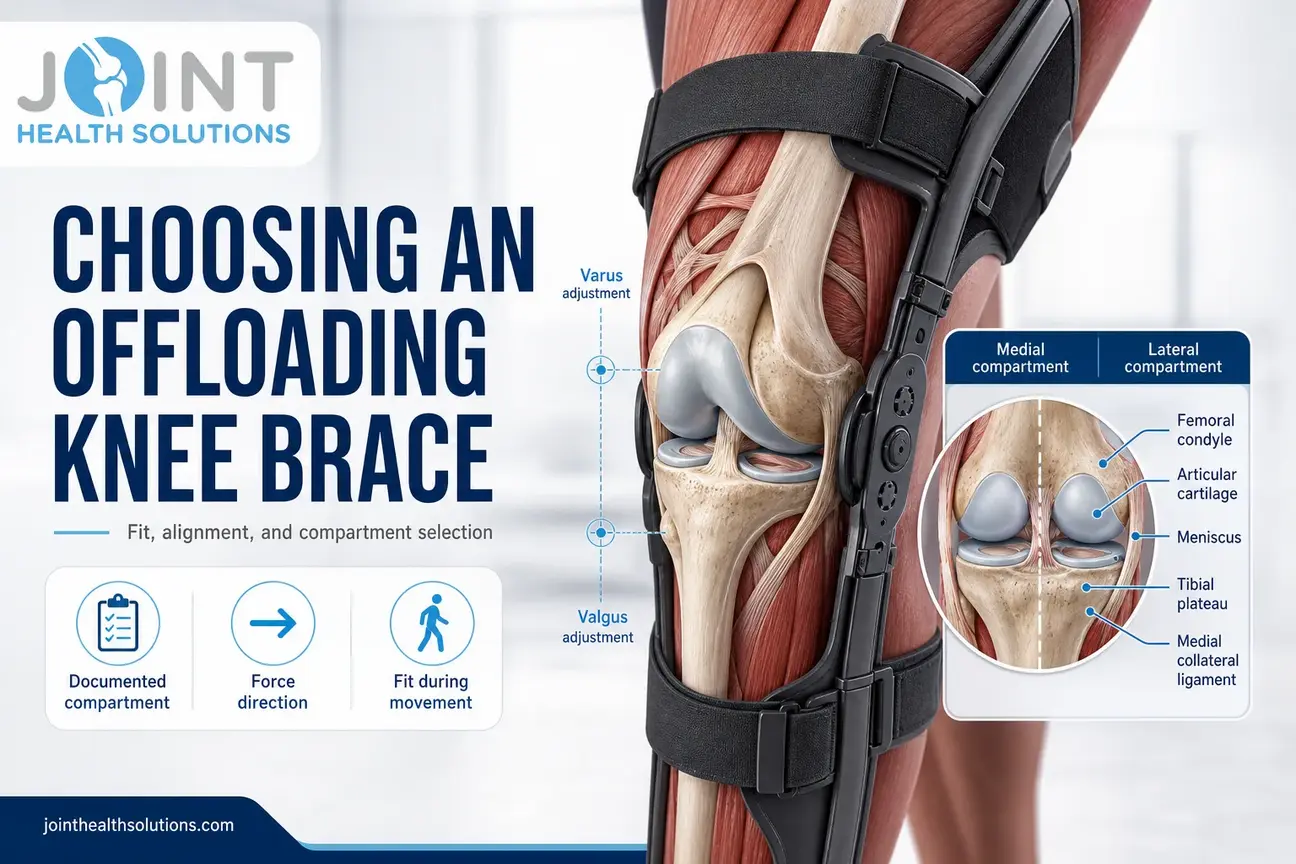
How to Choose an Offloading Knee Brace for Osteoarthritis
An offloading knee brace is a structured knee orthosis designed to shift force away from a specific tibiofemoral compartment of the knee. Choosing one should depend on documented compartment involvement, alignment, walking function, fit, comfort, skin tolerance, and coverage documentation—not symptoms alone.
| Quick Answer |
|---|
| Look for a brace matched to the documented medial or lateral compartment, with the appropriate varus or valgus adjustment, careful measurements, stable hinge placement, and a fit that remains tolerable during real movement. A clinical assessment can help determine whether an unloader-style brace is appropriate and what documentation may be needed before ordering or billing. |
Medicare policy note: As of October 30, 2026, Knee Orthoses (L33318) applies to Medicare coverage for knee offloading braces in North Carolina (CGS Administrators, DME MAC Jurisdiction C). Medicare policies and plan requirements can change, so patients and providers should confirm the current policy before treatment.
If you are exploring conservative care for knee arthritis in north Charlotte, Joint Health Solutions can discuss whether offloading knee braces may fit your individual treatment plan. You can also request an appointment for a clinical assessment; candidacy, coverage, and results vary.
Choosing an offloading knee brace: decision points at a glance
| Decision area | Why it matters | What to ask |
|---|---|---|
| Compartment involved | Unloader-style braces are typically designed around medial or lateral tibiofemoral loading. | Which compartment is documented, and how was that determined? |
| Alignment and force direction | A brace may use varus or valgus adjustment depending on the compartment being unloaded. | Is this brace intended to unload the medial or lateral side? |
| Fit and measurements | A brace that slides, pinches, or sits incorrectly may not be usable. | How will hinge position, straps, and leg shape be checked? |
| Walking function | Selection should be judged during movement, not only while sitting. | Can we compare walking, turning, sitting, and stairs with and without the brace? |
| Skin tolerance | Skin irritation and discomfort can limit brace use. | What should I do if redness, pressure, numbness, or slipping occurs? |
| Coverage documentation | Medicare and other plans may require specific records, orders, and supplier steps. | What documentation is needed before billing or ordering? |
What is an unloader knee brace?
An unloader knee brace is a brace designed to apply a corrective force across the knee to reduce load through one tibiofemoral compartment. The tibiofemoral joint is the main joint between the thigh bone and shin bone. In knee osteoarthritis, one side of that joint may be more affected than the other, although symptoms and imaging findings do not always line up neatly.
The goal is not to reverse arthritis or force the knee into a perfect position. Instead, a brace may be considered as part of conservative care when the clinical picture supports compartment-specific unloading and the person can use the device safely and consistently.
The AAOS knee osteoarthritis guideline states, “Brace treatment could be used to improve function, pain and quality of life in patients with knee osteoarthritis,” with a Moderate strength recommendation. That statement is helpful, but it does not mean every person with knee arthritis will benefit from, tolerate, or qualify for a brace. Evidence varies by patient group, brace design, adherence, and the type of arthritis pattern being treated.
In practical terms, a knee brace osteoarthritis discussion should move beyond “Do I need a brace?” and toward “What problem is the brace trying to address, and can it be fitted well enough to use?” That is especially important for adults comparing a structured brace with other non-surgical options such as physical therapy, injections, activity changes, or broader arthritis care.
How medial or lateral compartment involvement affects selection
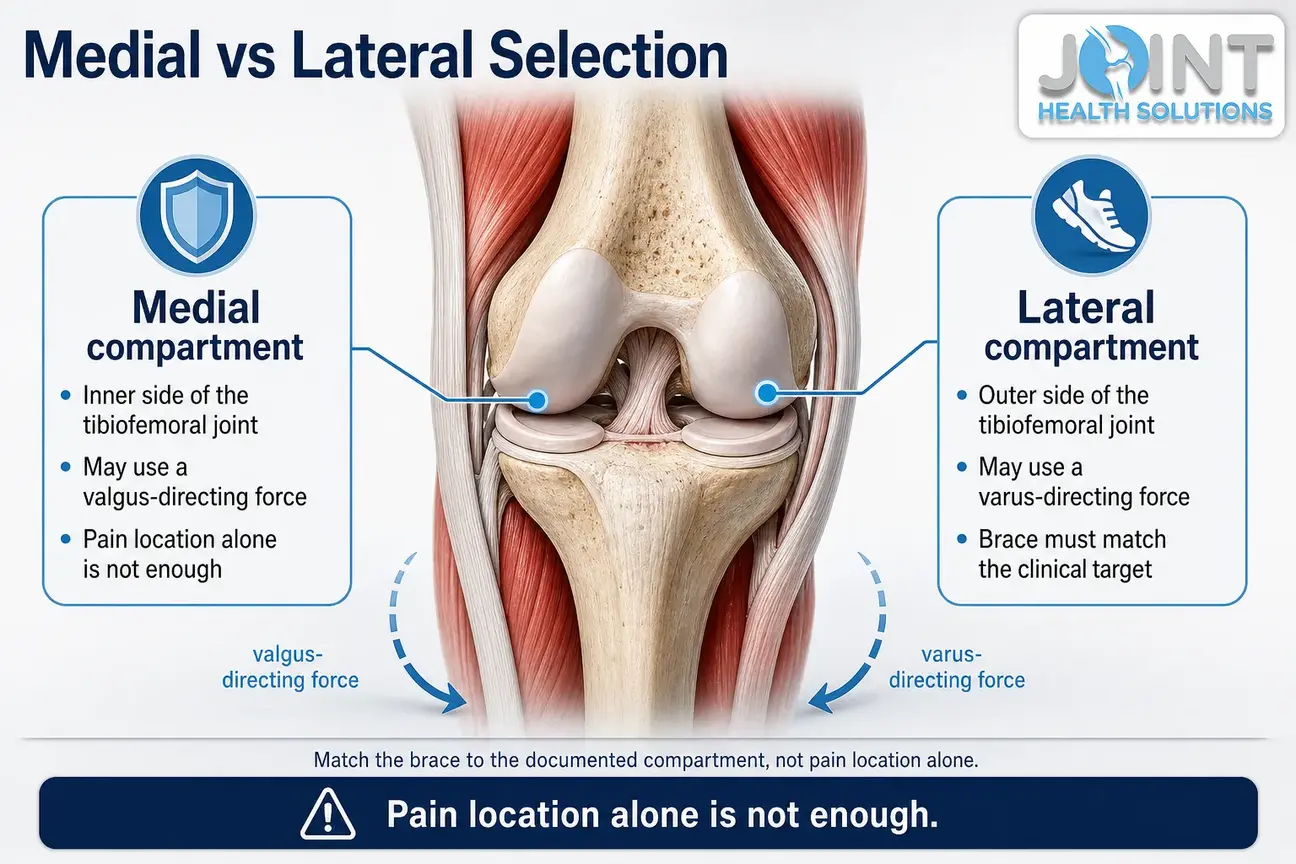
Brace selection usually begins with the affected compartment, not with a single symptom description. The medial compartment is the inner side of the tibiofemoral joint. The lateral compartment is the outer side. A brace designed for one side may not be appropriate for the other.
A medial-compartment unloading brace commonly applies a valgus-directing force, while a lateral-compartment unloading brace commonly applies a varus-directing force. These terms can feel technical, but the main point is simple: the brace must be matched to the clinical target.
Pain location alone is not enough to determine the involved compartment. A person may feel pain on one side because of joint-space narrowing, soft-tissue irritation, referred discomfort, patellofemoral involvement, or another source. That is why knee arthritis care often includes a history, physical exam, and review of imaging when appropriate rather than relying only on where pain is felt.
Patellofemoral symptoms also deserve separate consideration. The patellofemoral joint is the joint between the kneecap and thigh bone. A brace intended to unload the medial or lateral tibiofemoral compartment may not address kneecap-related symptoms. If stairs, squatting, or rising from a chair are the main concerns, a clinician may need to evaluate whether the symptoms are tibiofemoral, patellofemoral, or mixed.
How a varus valgus brace works in plain language
A varus valgus brace uses adjustable forces to influence knee alignment during standing and walking. Varus alignment generally describes the knee angling inward relative to the mechanical axis and is often associated with increased medial-compartment loading. Valgus alignment generally describes outward angulation and may be associated with increased lateral-compartment loading.
Those definitions are not self-fitting instructions. A varus valgus brace should be selected and adjusted based on clinical findings, the intended compartment, and the person’s response during movement. Overcorrecting, undercorrecting, or placing the brace incorrectly may lead to poor tolerance or altered walking mechanics.
The AAOS evidence review for knee osteoarthritis notes that available brace evidence is heterogeneous and is particularly informed by studies involving unicompartmental osteoarthritis and varus deformity. That matters because a person with multi-compartment arthritis, unclear alignment, or primarily patellofemoral symptoms may not fit the same evidence pattern.
Some biomechanical research supports the idea that corrective bracing can alter joint loading in selected settings, but mechanics are not the same as a predictable clinical result. Comfort, skin tolerance, confidence, gait, and the ability to put the brace on correctly all influence whether a brace is usable in daily life.
What clinical assessment may include before brace selection
A clinical assessment is the bridge between general brace information and an individual decision. It helps clarify whether an unloader knee brace is being considered for the right reason and whether the person is likely to tolerate the device. It should not be replaced by an online symptom checklist.
Assessment may include a symptom history: where discomfort is felt, what activities aggravate symptoms, whether the knee feels unstable, how far the person can walk, and what happens with stairs, standing, turning, or sitting. The clinician may ask about previous treatments, activity goals, footwear, assistive devices, and the person’s willingness and ability to use a brace.
A physical exam may look at alignment, gait, range of motion, tenderness, swelling, and ligament stability. The goal is not simply to confirm arthritis; it is to understand how the knee behaves during movement and whether a compartment-targeted device makes sense.
Imaging may be reviewed when needed to evaluate joint-space narrowing, alignment, or other structural findings. Imaging is not a substitute for function, and function is not a substitute for imaging when structural clarification is needed. The right workup depends on the individual situation and the clinician’s judgment.
Measurement and brace-position assessment are also important. A knee brace fitting may include thigh and calf circumference, leg shape, hinge alignment, strap placement, and observation for brace migration. A brace that looks correct while standing still may shift during walking, turning, or stair use.
Skin inspection may be part of the visit, especially when a person has sensitivity, swelling, prominent bony areas, or previous irritation from braces. The AAOS guideline summary identifies skin irritation and discomfort as potential harms of a brace trial, so tolerance is not a minor detail.
Questions to ask before choosing an unloader knee brace
Before choosing an unloader knee brace, patients can prepare by asking clear, practical questions. These questions do not replace medical judgment, but they help make the decision more transparent.
- Which compartment is being addressed? Ask whether the brace is intended for the medial or lateral tibiofemoral compartment and what findings support that choice.
- Is the adjustment varus or valgus? Ask how the force direction relates to the documented compartment and alignment.
- What is the clinical basis? Ask whether the reason is osteoarthritis, instability, recent injury or surgery, or another documented basis.
- Is a prefabricated brace suitable? If a custom-fabricated device is discussed, ask what physical reason makes a prefabricated brace unsuitable.
- How will the brace be measured? Ask about circumference measurements, hinge location, strap placement, and how slipping will be checked.
- How will function be evaluated? Ask whether walking, turning, sitting, stairs, or another meaningful activity will be observed.
- What should I do if the brace slips? Ask whom to contact for refitting, strap adjustment, or troubleshooting.
- What coverage documents are needed? Ask what the payer, supplier, and clinician may need before ordering or billing.
These questions are especially useful when comparing a knee brace osteoarthritis option with other conservative care. A brace may be part of a broader plan, but it should not be chosen simply because arthritis is present somewhere in the knee.
Knee brace fitting details that affect comfort and use
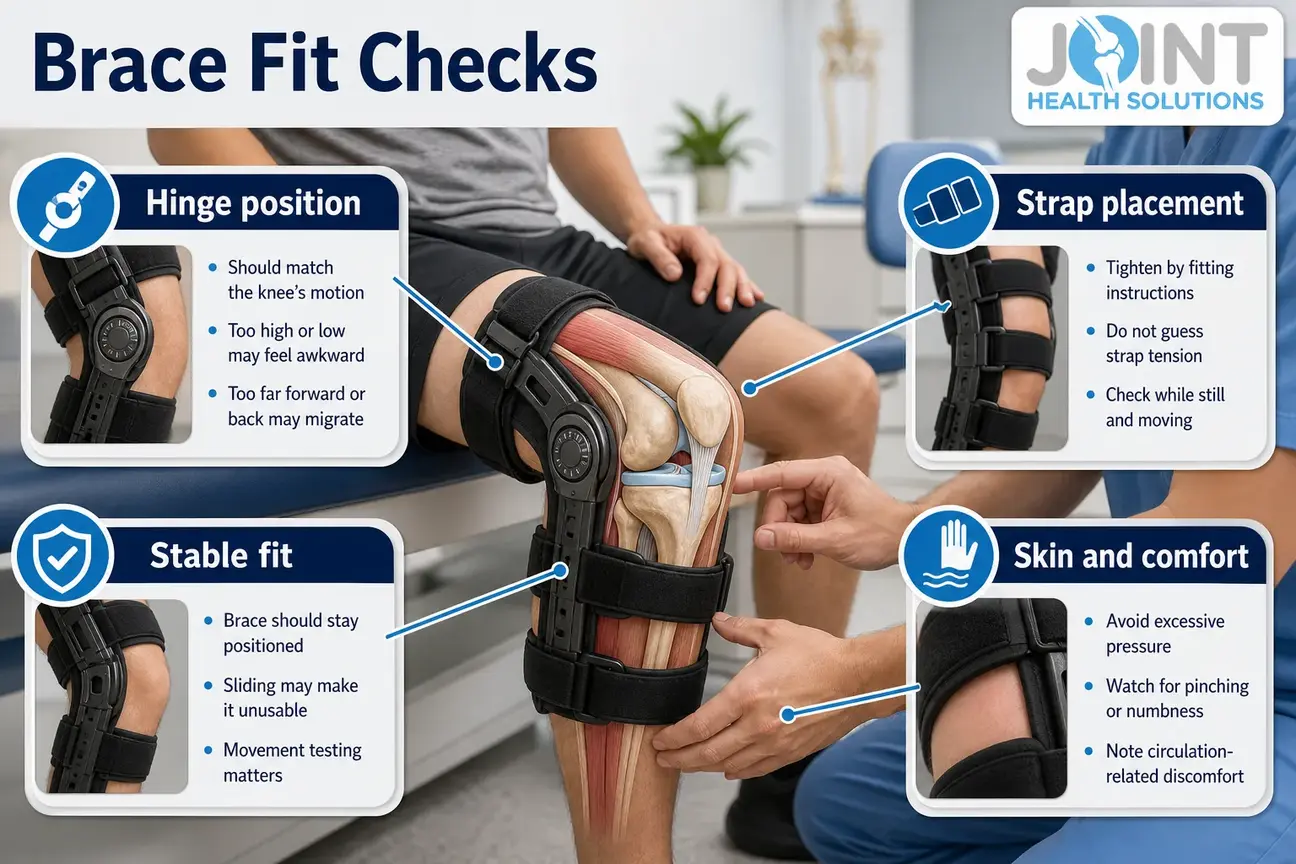
A careful knee brace fitting can make the difference between a brace that is usable and one that sits in a closet. Fit should be assessed both while the person is still and while the person moves. The brace should be stable enough to stay positioned but not so tight that it causes excessive pressure, pinching, numbness, or circulation-related discomfort.
Hinge position matters. The hinge should sit in a position that matches the knee’s motion as closely as possible. If the hinge is too high, too low, too far forward, or too far back, the brace may migrate or feel awkward during bending.
Strap placement also matters. Straps should be tightened according to fitting instructions, not guessed. A common concern is sliding, especially with certain leg shapes, clothing fabrics, or activity demands. Repeated slipping is a reason to seek fitting guidance rather than simply tightening the brace harder.
A knee brace fitting should include practical use: putting the brace on, taking it off, sitting, standing, walking, and checking whether clothing and footwear interfere. If the person cannot apply the brace correctly at home, the theoretical brace choice may not translate into daily use.
Skin tolerance should be checked after initial wear and over time. Persistent redness, blisters, abrasions, numbness, or pressure injury should prompt reassessment. A short adjustment period may be discussed by a clinician or fitter, but patients should not be told to ignore worsening pain, skin breakdown, or loss of sensation.
How to assess walking function with the brace
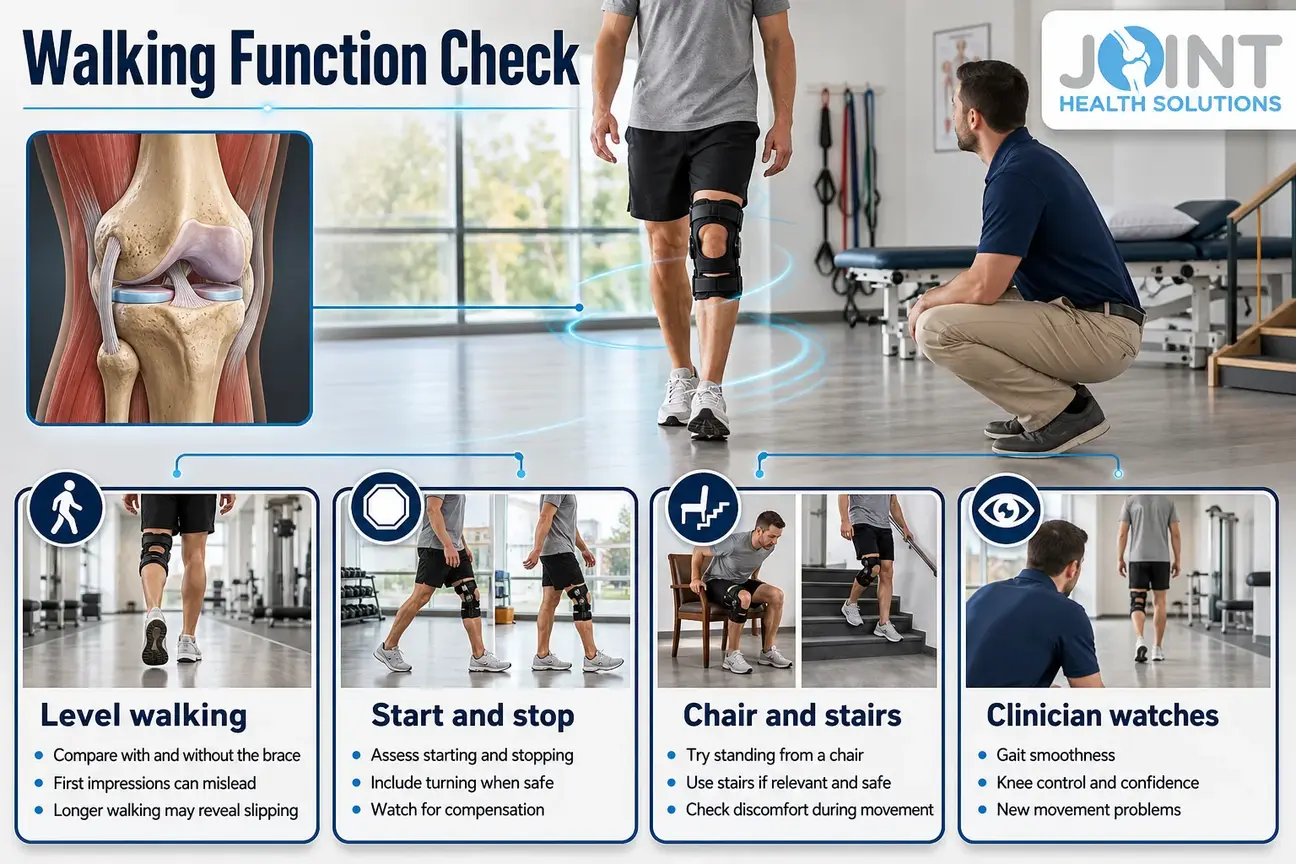
Walking function should be assessed with and without the brace whenever it is safe and appropriate. First impressions can be misleading. A brace may feel supportive for a few steps but slip during longer walking, turning, or stairs. Another brace may feel unfamiliar at first but become more manageable after proper instruction.
A useful evaluation may include level walking, starting and stopping, turning, standing from a chair, and stairs if stairs are relevant and safe. The clinician may look for gait smoothness, knee control, confidence, discomfort, and whether the person compensates in a way that could create new problems.
Patients can also describe activity tolerance in plain language: “I can walk through the grocery store,” “I feel less confident on stairs,” or “the brace slides after ten minutes.” These observations help the clinician or fitter decide whether the brace is helping, needs adjustment, or is not being tolerated.
Function should never be forced. A person should not push through sharp pain, worsening instability, skin breakdown, or new neurological symptoms because they believe the brace is supposed to help. If walking becomes worse, the brace should be reassessed.
Knee brace osteoarthritis decisions when arthritis is advanced
A knee brace osteoarthritis plan can be considered at different stages of arthritis, but advanced imaging language does not automatically determine candidacy. Phrases such as “bone-on-bone” can describe severe joint-space loss, but they do not tell the whole story about compartment location, alignment, walking function, tolerance, or coverage.
Some people with advanced arthritis may still explore conservative options, while others may need a different discussion. A brace might be considered when it has a clear mechanical target and the person can use it. It may be less useful when symptoms are not compartment-specific, when the brace worsens gait, or when the person cannot tolerate the device.
For readers researching severe arthritis language, Joint Health Solutions offers additional education on bone-on-bone arthritis and joint issues. That information should be viewed as educational, not as proof that a brace is or is not appropriate for a specific person.
Knee orthosis coverage and Medicare documentation
Knee orthosis coverage is a payment and documentation issue, not a personal promise of medical suitability or payment. A brace may be clinically considered without payment being approved, and a payer may require documentation before a supplier can bill. Patients should verify benefits, prior authorization requirements, supplier rules, and cost-sharing with their plan and the relevant provider or supplier.
The CMS Knee Orthoses LCD L33318 identifies coverage for an unloader brace with varus or valgus adjustment when one of the listed pathways applies. The policy record includes: objective knee instability documented on exam, including the laxity tests performed, in a patient who walks; a recent knee injury or knee surgery; or an osteoarthritis pathway.
For the osteoarthritis pathway, the policy record lists documented medial or lateral tibiofemoral knee osteoarthritis, the patient walks, the osteoarthritis causes pain or reduced mobility or function, the brace provides varus or valgus adjustment, and the patient is willing to use it. The supplied policy record also notes that joint laxity is no longer required for this osteoarthritis path after the 2026-01-25 revision effective date.
The policy’s coverage limitations matter. Claims that do not meet these criteria are denied as not reasonable and necessary. A written order must reach the supplier before billing, and proof of delivery must be kept. The CMS Knee Orthoses Policy Article A52465 also states that a custom-fabricated brace requires a documented physical reason a prefabricated brace will not work.
For practical purposes, knee orthosis coverage questions often involve several parties: the clinician documenting the medical basis, the supplier providing the device, and the insurance plan applying its rules. Patients can review Joint Health Solutions’ general insurance information, but individual coverage details should still be verified before treatment or ordering.
Coverage questions to ask before ordering
Because knee orthosis coverage depends on documentation and plan circumstances, it is reasonable to ask coverage questions early. This is especially important for Medicare Advantage plans or other insurance plans that may have network, supplier, prior authorization, and cost-sharing rules.
- Does the plan require a specific supplier or network pathway?
- Is prior authorization required before the brace is provided?
- What documentation must be in the medical record?
- Does the order need to be received by the supplier before billing?
- How will the brace type, measurements, and delivery be documented?
- If a custom brace is proposed, what physical reason is documented for why a prefabricated brace will not work?
- What portion, if any, may be out of pocket?
- Whom should the patient contact if a claim is denied or more documentation is requested?
These questions cannot assure approval, but they can reduce surprises. They also reinforce the difference between a clinical brace discussion and a payer’s coverage decision.
When a brace may not be the right next step
A brace may not be the right next step when the compartment or alignment is unclear, symptoms may be coming from another structure, or the primary issue is not one a medial or lateral unloader is designed to address. It may also be a poor fit when the brace repeatedly slips, causes persistent irritation, worsens walking, or cannot be applied correctly.
Some people stop using a brace because it feels bulky or inconvenient. That does not mean they failed; it means the plan may need reassessment. The fit may need adjustment, a different conservative option may be more appropriate, or the overall treatment plan may need to be revisited.
New severe symptoms, sudden inability to bear weight, major injury, signs of infection, chest pain, shortness of breath, or other emergency concerns should be evaluated urgently. Joint Health Solutions does not provide emergency or 24/7 urgent care. For emergencies, call 911 or go to an emergency department.
Discussing brace options at the Charlotte clinic
Joint Health Solutions provides offloading knee braces for patients for whom an offloading brace is appropriate. Care is centered at the verified Charlotte clinic, and patients can use the contact page or call 704-833-3566 with practice-related questions. Patients may travel from nearby communities, but Joint Health Solutions does not have physical clinics outside the Charlotte address and does not provide mobile or in-home treatment.
A visit may help clarify whether an unloader knee brace fits your clinical picture, what documentation may be needed, and how bracing might fit alongside conservative care. The discussion should remain individualized: suitability, comfort, walking response, and coverage all vary.
If you are comparing brace options for knee arthritis, you can learn more about offloading knee braces or schedule a consultation. An appointment request cannot promise candidacy, coverage, or results, but it can start a careful assessment.
Putting the decision together
The most useful brace decision starts with the right question. Instead of asking only whether a brace is “good for arthritis,” ask whether the brace is designed for the documented compartment, whether the force direction matches the alignment goal, whether the fit is stable during real movement, and whether the skin and walking response are acceptable.
A practical decision also includes documentation. For Medicare and many insurance plans, the record may need to show the affected knee, compartment, clinical basis, walking status, pain or reduced mobility, brace type, varus or valgus adjustment, measurements, willingness to use the device, and required supplier documents. Coverage can still vary by policy and plan.
An offloading knee brace can be one conservative, non-surgical option for selected adults with knee osteoarthritis, but it is not a universal solution. The safest path is a clinical assessment, careful fitting, realistic expectations, and prompt reassessment if the brace slips, irritates the skin, or worsens function.
For general education only; not a substitute for professional medical advice, diagnosis, or treatment. Suitability and results vary, and individual needs require clinical assessment.
Frequently Asked Questions
What is the difference between an offloading brace and a regular knee sleeve?
An offloading brace is designed to apply a directional force to reduce loading through a specified tibiofemoral compartment. A sleeve generally provides compression and support without the same compartment-specific adjustment. The appropriate choice depends on assessment, goals, fit, and tolerance.
How do I know whether I need a medial or lateral unloader brace?
Compartment involvement should be established through clinical assessment and, when appropriate, imaging. Pain location alone is not enough to select medial versus lateral unloading, because symptoms can come from more than one knee structure.
What do varus and valgus mean on a knee brace?
They describe alignment and the direction of corrective force. A clinician or qualified fitter should determine whether varus or valgus adjustment is appropriate rather than relying on self-selection.
What should an offloading knee brace feel like when it fits correctly?
It should remain positioned during intended movement without excessive pressure, pinching, numbness, repeated slipping, or persistent skin irritation. Fit problems should be reassessed rather than tolerated indefinitely.
Can I walk normally in an unloader brace?
Some people report improved function, while others find a brace bulky or difficult to tolerate. Walking should be evaluated safely and individually, and no outcome can be promised.
Does Medicare cover an offloading knee brace?
Coverage depends on the applicable CMS policy requirements, documentation, supplier rules, and individual plan circumstances. The current policy record includes an osteoarthritis pathway for certain varus/valgus-adjustable braces, but a diagnosis alone does not assure payment.
What documentation may Medicare require?
Documentation may include a qualifying clinical pathway, walking status, pain or reduced function, the brace’s varus or valgus adjustment, willingness to use the brace, a written order before billing, and proof of delivery. Custom fabrication requires additional documentation explaining why a prefabricated brace will not work.
What should I do if the brace causes redness or pain?
Stop using it as directed by the fitting clinician and contact the appropriate clinician or supplier for guidance, especially if irritation persists, the skin breaks down, sensation changes, or walking becomes worse.
Sources
- American Academy of Orthopaedic Surgeons: Management of Osteoarthritis of the Knee (Non-Arthroplasty)
- American Academy of Orthopaedic Surgeons: Osteoarthritis of the Knee Clinical Practice Guideline PDF (brace evidence, harms, and tolerance notes)
- CMS Medicare Coverage Database: Knee Orthoses LCD L33318
- CMS Medicare Coverage Database: Knee Orthoses Policy Article A52465




 English
 Spanish