
If you are living with knee osteoarthritis (OA), you know that the condition is rarely a quiet one. It announces itself with every flight of stairs, every morning walk, and every attempt to get out of a low car seat. For many individuals, this chronic discomfort is concentrated on just one side of the knee joint—most commonly the medial, or inner, compartment. This localized breakdown of cartilage leads to sharp, activity-related pain that progressively narrows your world, forcing you to give up the hobbies, sports, and daily activities you love.
When facing advanced localized knee pain, a common misconception is that total joint replacement surgery is the only definitive option left on the table. However, an elegant, non-invasive, and highly engineered device can make a dramatic difference in your mobility and daily comfort level: the offloading knee brace (frequently referred to in clinical settings as an unloader brace).
Unlike standard elastic compression sleeves or generic neoprene supports found at local pharmacies, an offloading brace relies on a sophisticated mechanical design. It physically shifts your body weight away from damaged, bone-on-bone cartilage and redistributes it onto the healthier, intact compartments of your knee.
At Joint Health Solutions, we provide comprehensive clinical evaluations, custom-molded fabrications, and premium off-the-shelf offloading bracing systems designed specifically to help patients alleviate pain, restore functional independence, and safely delay or altogether avoid invasive knee replacement surgery. This comprehensive guide breaks down the science behind how these devices work, who qualifies as an optimal candidate, what to expect during a professional clinical fitting, and how to leverage bracing as part of a holistic recovery plan.
An offloading knee brace is a medical-grade, rigid or semi-rigid orthosis engineered to apply a continuous, corrective mechanical force to the knee joint during weight-bearing activities. The core medical objective of the device is simple yet profoundly effective: to reduce the biomechanical load placed on the arthritic compartment, thereby alleviating pain caused by friction and joint friction.
To appreciate how these braces function, it helps to understand their structural anatomy. A high-quality unloader brace typically consists of several integrated components:
A Rigid Thigh Cuff: Formed from lightweight aircraft-grade aluminum, carbon fiber, or high-tensile polymers, this upper frame secures firmly to the femur (thigh bone).
A Rigid Calf Cuff: Mirroring the upper cuff, this lower frame secures tightly to the tibia and fibula (shin bones), creating a stable anchor point below the joint.
A Dynamic Hinge Mechanism: Aligned precisely with the anatomical axis of the knee joint, this hinge dictates the natural flexion and extension pathways of your leg.
Adjustable Tension Straps and Conditional Load Pads: These components allow a trained clinician to dial in specific, controlled pressure vectors that alter the alignment of the knee under load.
It is critical to note that an offloading brace is not designed to immobilize your knee. Unlike post-surgical braces that lock your leg in a straight position, an unloader brace allows you to freely walk, bend, sit, and participate in low-impact sports. It works dynamically, meaning its corrective capabilities actively engage the moment your foot strikes the ground and your body weight transfers through the leg.
The magic of an unloader brace lies entirely in Newtonian physics—specifically, the application of a three-point pressure system. When a specific compartment of the knee loses its protective cartilage cushion, the joint space collapses. In medial compartment osteoarthritis, this collapse creates a “bow-legged” alignment (varus deformity), which further accelerates the wear-and-tear on the inner knee.
An offloading brace corrects this pathological alignment by generating a subtle, therapeutic bending moment across the joint axis. Here is how the three forces interact simultaneously to achieve this:
Point 1 – The Base Lever (Above the Joint): The rigid thigh cuff applies a steady stabilizing force on the upper leg.
Point 2 – The Base Lever (Below the Joint): The rigid calf cuff applies a matching stabilizing force on the lower leg.
Point 3 – The Corrective Fulcrum (Opposite the Pain): A specialized condenser pad or dynamic tension strap applies an inward or outward force directly across from the damaged compartment.
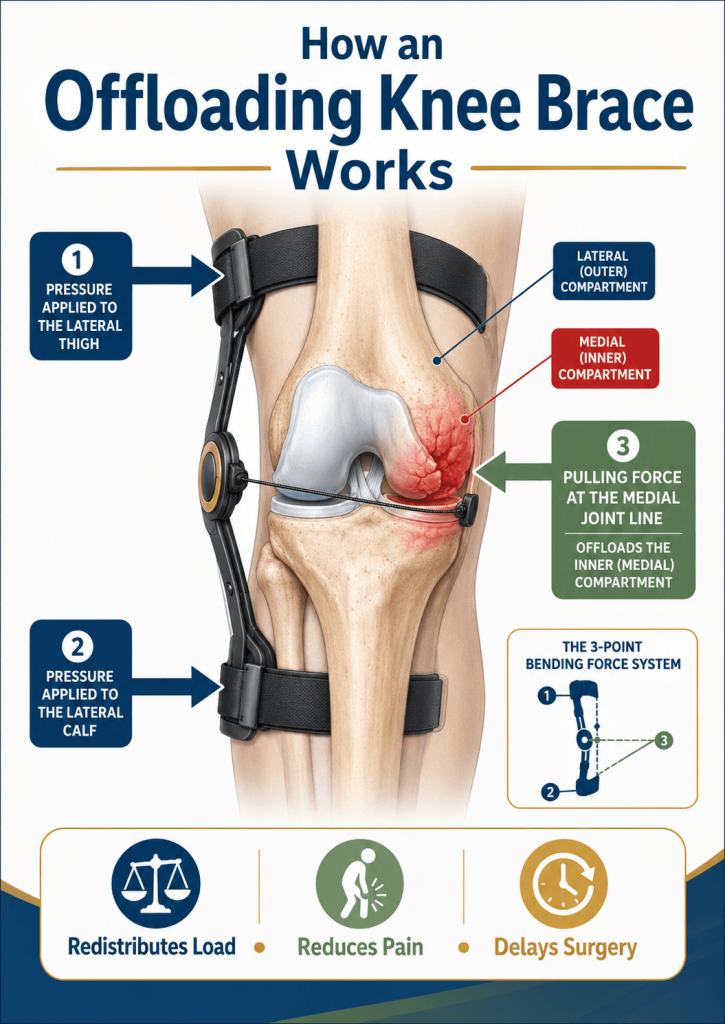
Consider a patient experiencing severe inner knee pain due to medial compartment wear. When this patient stands up:
The brace’s specialized condyle pad pushes gently outward against the lateral (outer) side of the knee joint.
Concurrently, the upper and lower straps pull the medial (inner) side of the joint slightly open.
The Biomechanical Result: The structural gap between the femur and tibia on the inner side is physically widened. This shifts the primary weight-bearing load away from the worn, inflamed medial cartilage and transfers it directly onto the healthy, resilient cartilage of the lateral compartment.
Clinical data compiled by the Journal of Orthopaedic & Sports Physical Therapy demonstrates that a properly prescribed and calibrated offloading brace can reduce the absolute load placed on a damaged knee compartment by 50% to 80% during normal gait cycles. This profound reduction in mechanical pressure leads directly to less inflammation, decreased bone bruising, and immediate pain relief.
| Type of Brace | Primary Clinical Indication | Core Advantages | Potential Limitations |
| Valgus Unloader | Medial (inner) compartment osteoarthritis | Most widely utilized; exceptionally high success rate for bow-legged alignment. | Can feel bulky under tighter styles of clothing. |
| Varus Unloader | Lateral (outer) compartment osteoarthritis | Highly effective at correcting knock-kneed alignment; restores structural symmetry. | Less frequently stocked; requires precise hinge alignment. |
| Custom-Fitted Orthosis | Severe OA (Grade 3–4); asymmetrical leg anatomy; failed off-the-shelf trials | Perfect structural contouring; optimized torque generation; maximum comfort. | Higher upfront cost; typically requires a 2-to-4-week manufacturing period. |
| Off-the-Shelf (OTS) Unloader | Mild-to-moderate OA; temporary use; diagnostic testing trials | Immediately available for same-day fitting; lower initial financial investment. | May slip or migrate on highly contoured legs; less long-term durability. |
| Dynamic / Rebound Brace | Highly active individuals; recreational athletes; early-stage OA | Exceptionally low-profile design; real-time tension adjustments during sports. | Not structurally strong enough to manage severe, bone-on-bone deformities. |
To discover which specific model aligns with your everyday needs, physical constraints, and insurance coverage metrics, we invite you to view our complete structural overview on the Joint Health Solutions Treatments & Services page.
An offloading knee brace is a specialized medical tool rather than a generic comfort accessory. To experience the full therapeutic potential of an unloader brace, a patient must present with specific clinical indicators.
You are generally considered an excellent candidate for this intervention if you meet the following criteria:
Uni-compartmental Osteoarthritis: Your joint degradation is primarily limited to one distinct side of the knee (medial or lateral), as confirmed by diagnostic weight-bearing X-rays or MRI scans displaying a Kellgren-Lawrence grading scale of Grade 2 or Grade 3.
Load-Dependent Discomfort: Your knee pain flares sharply during weight-bearing movements—such as walking extended distances, standing on hard surfaces, or descending staircases—and subsides significantly when you sit down or rest.
Surgical Avoidance Goals: You are either medically ineligible for major orthopedic surgery due to secondary health conditions, or you actively desire to delay a total knee arthroplasty (TKA) for several years to prolong the life of your natural joint.
Conservative Treatment Failures: You have previously completed standard conservative protocols—including dedicated physical therapy, over-the-counter anti-inflammatory medications (NSAIDs), or weight-reduction programs—and still require additional structural support to manage your daily symptoms.
Desire for an Active Lifestyle: You require an external mechanical aid to keep you moving safely during demanding work shifts, household gardening, or recreational sports like golf, tennis, or hiking.
Conversely, there are certain medical scenarios where an offloading knee brace is either ineffective or clinically contraindicated:
Severe Tricompartmental OA: If your arthritis has progressed to advanced, bone-on-bone degradation across all three structural compartments of the knee (medial, lateral, and patellofemoral), shifting the weight around will not provide relief.
Systemic Inflammatory Arthritis: Conditions such as active Rheumatoid Arthritis (RA) or Psoriatic Arthritis involve widespread, generalized joint lining inflammation that cannot be bypassed by localized mechanical offloading.
Vascular Insufficiency or Severe Lymphedema: Patients dealing with acute peripheral vascular disease, deep vein thrombosis (DVT) risks, or severe lower extremity swelling (edema) cannot tolerate the localized compression straps required to anchor the brace safely.
Cognitive or Physical Limitations: If severe hand arthritis, advanced tremors, or cognitive decline prevents a patient from understanding how to correctly align, strap, and tension the brace daily, the risk of tissue damage outweighs the potential biomechanical benefits.
Acquiring an effective offloading brace is vastly different from ordering a standard support sleeve online. Because these devices alter the structural forces moving through your skeletal frame, an improper fit can lead to skin breakdown, ligament strain, worsened joint pain, or accelerated cartilage wear.
At Joint Health Solutions, our clinical fitting protocol is structured into precise, patient-centric phases to ensure maximum therapeutic efficacy and long-term comfort:
Our specialized providers start by conducting a comprehensive physical assessment. We review your complete medical history, inspect existing weight-bearing imaging studies to chart your precise joint space narrowness, and map out your gait cycle. This step confirms that your pain is truly mechanical and localized to a single compartment.
If you are approved for an unloader brace, we utilize specialized orthopedic instruments, including digital goniometers and caliper devices, to record exact circumferential measurements of your mid-thigh, knee center, and upper calf.
We also map out your leg length and measure the exact varus or valgus angular deviation of your knee joint to determine whether a custom-molded configuration or a premium off-the-shelf option is best suited for your anatomy.
Once your brace arrives at our facility, you will join us for a dedicated fitting session. We apply the frame to your leg and meticulously calibrate the integrated unloader hinge mechanism. By fine-tuning the dynamic pressure pads, we ensure the device generates optimal joint clearance forces without creating localized pressure points, skin chaffing, or arterial constriction.
We don’t just hand you your brace and send you on your way. Our clinical staff provides hands-on instructions detailing how to independently don (put on), doff (take off), and manually adjust the tensioning straps throughout the day.
We supply all patients with a standardized, progressive schedule to allow their soft tissues to adapt safely to the structural forces:
Clinical Note: Always remove your offloading brace prior to going to sleep at night or during prolonged periods of sitting down to rest.
While an offloading knee brace is an extraordinary standalone mechanical intervention, it delivers its most transformative results when paired with a multi-modal, comprehensive osteoarthritis care plan. Think of the brace as a tool that creates a protective physical window, allowing other advanced biological and physiological treatments to work much more effectively.
At Joint Health Solutions, we routinely design integrated recovery regimens that pair customized bracing with the following clinical modalities:
Hyaluronic Acid (HA) Viscosupplementation Injections: While the offloading brace works from the outside to pull your collapsed joint space open, HA injections work from the inside out. By replenishing the thick, shock-absorbing synovial fluid within the knee joint capsule, HA dramatically reduces internal friction and maximizes smooth articulation. Learn more about this dual-action approach on our dedicated Hyaluronic Acid Injections platform.
Platelet-Rich Plasma (PRP) Therapy: For patients seeking to harness their body’s innate healing mechanisms, autologous PRP therapies can help soothe chronic joint lining inflammation and support soft tissue health. Wearing an unloader brace post-injection shields the healing tissues from harsh, repetitive micro-trauma. Explore the cellular science behind this by visiting our PRP Therapy resource center.
Anti-Inflammatory IV Therapy: Chronic osteoarthritis often triggers localized and systemic inflammatory loops that leave the surrounding tendons and skin highly sensitive to external bracing pressure. Administering targeted, micronutrient-rich intravenous infusions helps down-regulate systemic inflammation, enhancing your overall comfort and brace compliance. Read more on our comprehensive Anti-Inflammatory IV Therapy page.
Targeted Physical Therapy: A common fear among patients is that wearing a rigid brace will cause their leg muscles to waste away. Clinical realities prove the exact opposite. By safely dampening your baseline pain triggers, an unloader brace enables you to perform targeted quadriceps, hamstring, and gluteal strengthening exercises with much greater intensity and comfort.
Medical Weight Management: The biomechanics of human locomotion are unforgiving: every single pound of body weight lost removes approximately four pounds of cumulative pressure from the knee joint during normal walking. Combining a structured weight management plan with an offloading brace compounds your relief, structurally multiplying the lifespan of your remaining cartilage.
A premium medical offloading brace is a sophisticated piece of orthopedic engineering. To ensure it continues to deliver consistent, accurate corrective forces day after day, you must commit to a routine maintenance regimen. Treat your brace with the same care you would accord a high-end bicycle or an expensive pair of prescription orthotics.
Follow these proven preservation guidelines to maximize the lifespan of your device:
Frame and Hinge Care: Regularly wipe down the rigid outer frame and mechanical hinges using a clean, damp microfiber cloth. Never submerge the entire brace in water, and avoid exposing the hinges to abrasive outdoor elements like sand, mud, or saltwater.
Fabric Liner Laundering: The soft inner fabric liners, moisture-wicking pads, and velcro straps actively absorb sweat, skin oils, and dead skin cells. Detach these components weekly and wash them by hand using a mild, hypoallergenic soap and cool water. Always allow them to air dry completely inside; never place them in a mechanical clothes dryer, as high heat will warp the synthetic fibers and degrade the structural velcro.
Hardware Inspections: Once a month, perform a brief structural check on your brace. Ensure that all connection screws, strap rivets, and hinge pins are securely tightened. If you notice any loose hardware or frayed straps, contact your provider immediately to secure genuine manufacturer replacements.
Avoid Extreme Temperatures: Do not store your brace in areas prone to extreme heat or intense, direct UV sunlight, such as the trunk of your car during hot summer months. Excessive thermal exposure can warp composite polymer frames and compromise the integrity of internal padding adhesives.
Annual Clinical Check-ins: Bring your brace with you to all clinical follow-up consultations. Over time, your leg shape may change due to muscle gain or weight loss, and your brace hinge may require recalibration to maintain its optimal offloading performance.
With diligent care and routine maintenance, a high-quality offloading brace will reliably support your mobility goals for 1 to 3 years of continuous everyday use.
When first receiving your brace, you should begin gradually with 1 to 2 hours of daily wear during light household movements. As your skin and underlying muscles adjust to the corrective forces, you can ramp up your usage. Most patients find optimal relief by wearing the brace for 8 to 12 hours a day—specifically during their most physically demanding weight-bearing windows—and removing it entirely during periods of extended rest or sleep.
No, there is currently no medical intervention capable of truly reversing or curing the cartilage loss associated with osteoarthritis. However, an offloading brace acts as a powerful structural management tool. By mechanically altering your joint alignment, it dramatically minimizes pain, controls chronic inflammation, improves daily function, and allows you to lead a highly active lifestyle, effectively delaying or preventing the need for total joint surgery. For additional information on managing joint disease progression, explore the comprehensive resources provided by the Arthritis Foundation.
Yes, absolutely. While some low-profile unloader models can be worn directly against the skin beneath wide-leg trousers, the majority of modern braces are optimized to be worn over lightweight, form-fitting clothing. Excellent options include thin athletic leggings, compression pants, or performance shorts. To prevent skin irritation, simply ensure there are no thick denim seams or bulky fabric folds trapped directly underneath the upper or lower compression cuffs.
In a large majority of cases, yes. Because an offloading brace is classified as Durable Medical Equipment (DME), it is frequently covered by commercial health insurance plans as well as Medicare, provided it is prescribed by a licensed medical professional to treat radiographically confirmed, symptomatic unicompartmental knee osteoarthritis. Our administrative team at Joint Health Solutions works closely with insurance carriers to quickly verify your exact plan benefits and manage any necessary prior authorization workflows. For general industry overviews regarding orthotic coverage metrics, you can reference the American Academy of Orthopaedic Surgeons.
If your diagnostic evaluation reveals that a premium off-the-shelf unloader brace suits your skeletal alignment, you can often be measured, fitted, and walk out of our office with your device on the very same day. If your specific anatomy or advanced grade of arthritis requires a custom-fabricated orthosis, we will capture comprehensive 3D digital scans or physical molds of your leg. The manufacturing and clinical delivery timeline for these custom-built devices typically ranges from 2 to 4 weeks.
Yes, expanding your physical activity boundaries is one of the primary reasons to utilize an unloader brace! These devices are highly compatible with low-impact cardiovascular exercises, including fitness walking, road cycling, stationary elliptical training, swimming (with specialized water-safe models), and recreational sports like golf or doubles tennis. However, unless you have received direct medical clearance from your treating physician, you should avoid high-impact, repetitive loading activities such as distance running, aggressive jumping, or heavy powerlifting.
This is one of the most common myths surrounding orthopedic bracing. While complete joint immobilization braces (like post-fracture casts) absolutely induce rapid muscle atrophy, a functional offloading brace does not limit your muscle engagement. Because the brace successfully eliminates severe pain barriers, it allows you to walk further, climb stairs naturally, and engage in therapeutic exercises that you previously avoided. Consequently, most patients actually experience an increase in quadriceps and gluteal strength over time.
When your offloading brace is properly calibrated and tensioned, you should perceive a firm, supportive, yet comfortable lateral pressure against the healthy side of your knee joint, accompanied by an immediate sense of lightness or pain reduction on the arthritic side. You should never experience sharp pain, raw skin blistering, localized numbness, a “pins-and-needles” sensation, or noticeable circulatory changes in your foot. If any of these signs develop, loosen the straps and schedule a prompt adjustment appointment. For safety indicators regarding brace usage, you can review the patient safety logs hosted by the Mayo Clinic.
No. Offloading braces are structurally engineered to solve mechanical alignment problems within natural knee joints that still retain some native cartilage. They are not compatible with, nor are they safe to use on, an artificial knee replacement implant. If you are experiencing structural instability, localized discomfort, or soft tissue pain following a total knee arthroplasty, please schedule an evaluation with your orthopedic provider to discuss specialized post-arthroplasty stabilizing braces.
Taking control of your knee pain is simple. The first step is to contact our office to schedule an initial non-surgical orthopedic consultation. During this visit, our clinical team will thoroughly analyze your gait, evaluate your latest imaging, discuss your daily lifestyle goals, and match you with the precise bracing and regenerative medical tools required to get you moving confidently again.

A board-certified physician in Emergency Medicine and Obesity Medicine with over 25 years of experience

A board-certified Family Nurse Practitioner with over 12 years of nursing experience