

If you have ever reached back to rub a tight, tender “knot” in your shoulder blade and felt a sharp ache shoot up into your neck, or pressed a sore spot in your lower back that radiated discomfort down into your hip, you have firsthand experience with a myofascial trigger point. These hypersensitive, localized spots within your skeletal muscle tissue are incredibly common. Left untreated, they do far more than cause a dull ache; they actively contribute to chronic pain cycles, severely restrict your global range of motion, and can even alter your posture enough to accelerate underlying joint dysfunction.
When these stubborn muscle spasms fail to respond to traditional stretching, massage therapy, or standard physical therapy protocols, trigger point injections (TPIs) provide a safe, highly targeted, and minimally invasive solution. By introducing a precise medical needle directly into the core of the spasm, an interventional specialist can instantly disrupt the locked muscle fibers. The delivery of a local anesthetic directly into the knot coaxes the muscle into immediate relaxation, neutralizes hyperactive nerve pathways, and provides rapid pain relief.
At Joint Health Solutions, we utilize trigger point injections as a core element of our comprehensive, non-surgical pain management services. This evidence-based guide breaks down the biological science of myofascial trigger points, outlines the distinct conditions that benefit from TPIs, details exactly what to expect during a quick in-office procedure, and explains how releasing muscle knots accelerates your response to other joint and regenerative therapies.
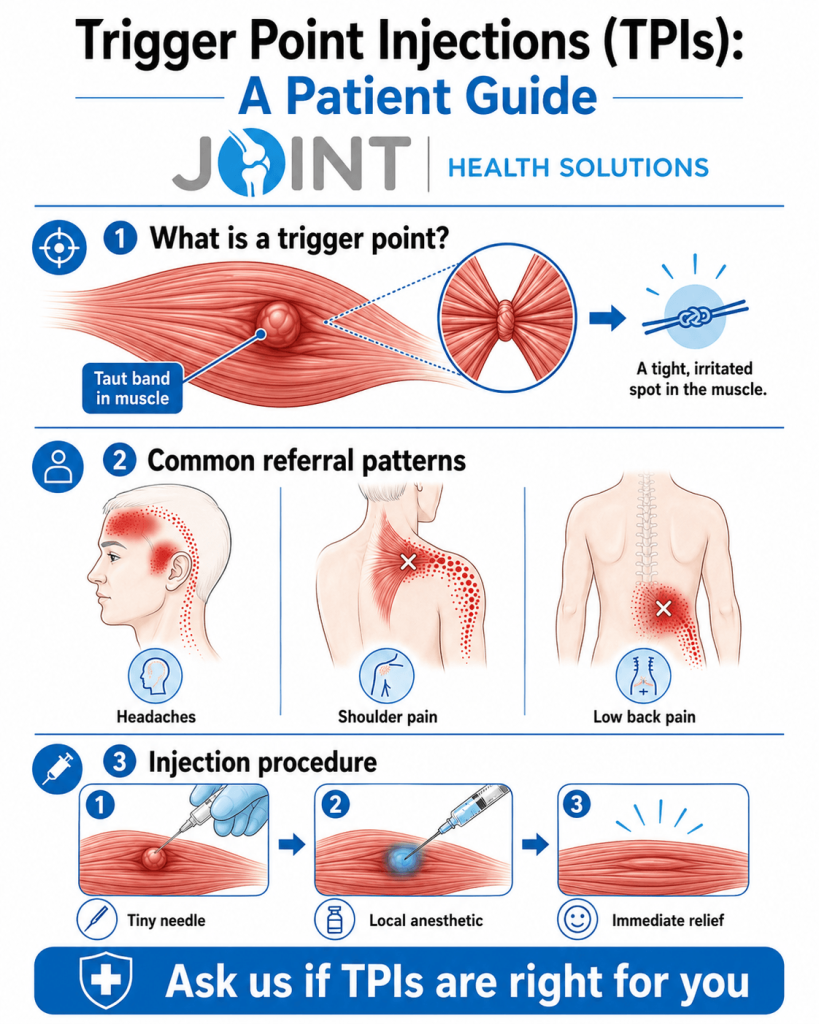
In a healthy state, skeletal muscles constantly contract and relax smoothly to allow fluid movement. However, when a muscle is subjected to repetitive strain, sudden trauma, or structural overload, the local microscopic fibers can lock into a continuous state of contraction. This localized, non-resolving spasm forms a distinct, hyperirritable spot inside a taut band of muscle tissue—structurally known as a myofascial trigger point.
These knots limit local blood circulation, creating a small zone of metabolic distress. The resulting lack of oxygen and accumulation of cellular waste products irritate nearby nerve endings, sending continuous pain signals to the brain.
In a clinical setting, trigger points are categorized into two primary types:
Active Trigger Points: These spots cause spontaneous, persistent pain even when you are resting completely. When a clinician applies gentle pressure to an active knot, it reproduces the patient’s familiar pain and reliably radiates or “refers” that discomfort to a completely different part of the body.
Latent Trigger Points: These knots remain quiet and do not cause spontaneous pain during normal rest. However, they are highly tender when physically pressed, can cause subtle muscle weakness, and silently restrict your joint range of motion or alter healthy movement patterns.
Myofascial pain is uniquely challenging because the location where you feel the pain is often quite distant from the actual muscle knot causing the issue. This phenomenon is known as referred pain. Understanding these established anatomical pathways is essential for an accurate clinical diagnosis:
| Target Muscle Group | Typical Anatomical Location | Established Referred Pain Pathways |
| Upper Trapezius | The base of the neck, running across the top ridge of the shoulder. | Classic tension headaches wrapping around the temples, deep neck aching, and localized jaw tension. |
| Levator Scapulae | The upper, inside angle of the shoulder blade. | Sharp pain at the crook of the neck and intense aching across the shoulder blade, often making it painful to turn the head. |
| Infraspinatus | Located within the rotator cuff on the back of the shoulder blade. | Deep pain in the front of the shoulder joint that can radiate down the outer arm into the hand. |
| Quadratus Lumborum (QL) | Deep within the lower back, spanning between the lower ribs and the pelvis. | Severe lower back pain that radiates into the buttocks, outer hip, and occasionally forward into the groin. |
| Gluteus Medius | The upper, outer portion of the buttock muscle. | Continuous aching across the lower back, deep pelvic discomfort, and pain extending down the lateral thigh. |
Muscle knots do not appear at random; they develop as a direct physiological adaptation to various physical stressors:
Acute Muscle Overuse or Structural Strain: Lifting an unexpectedly heavy object, sustaining a sports injury, or experiencing a sudden whiplash deceleration forces a muscle into a protective spasm.
Repetitive Micro-Trauma: Spending hours daily performing repetitive tasks, such as typing on an un-ergonomic computer keyboard, assembling components on a production line, or driving long distances.
Postural Deficiencies: Chronic postural habits, such as rounded shoulders, forward head posture, or a slouched spine, place a continuous load on neck and back muscles.
Underlying Joint Dysfunction: Structural issues like advanced knee osteoarthritis or a degenerative meniscus tear alter your natural gait cycle. This causes your body to shift weight unevenly, overloading pelvic and lower back muscles to compensate for the unstable joint.
Psychological Stress and Physical Tension: High stress levels cause many individuals to unconsciously shrug their shoulders or clench their jaw for hours at a time, creating persistent tension in the upper trapezius and cervical muscles.
A trigger point injection is a quick, highly targeted in-office procedure designed to break the cycle of chronic muscle spasm. Using a very fine, small-gauge needle, a trained interventional specialist navigates through the skin and introduces the tip directly into the core of the hyperirritable muscle knot.
The primary mechanical action relies on the physical presence of the needle tip, which mechanically disrupts the locked, dysfunctional motor endplates within the taut band of muscle. Once this mechanical release is achieved, a small volume of therapeutic medication is delivered directly into the tissue to complete the treatment:
Local Anesthetic Agents: Typically utilizing lidocaine or bupivacaine, the anesthetic blocks local pain receptors, calms hyperactive nerves, and induces immediate relaxation of the surrounding muscle fibers. It also helps minimize any post-procedure soreness.
Targeted Corticosteroids (Optional): For exceptionally stubborn, long-standing, or severely inflamed muscle knots, a small dose of an anti-inflammatory corticosteroid may be added to help soothe nearby tissue structures. However, many patients achieve excellent, lasting results using a local anesthetic alone.
💡 Quick Anatomy of a C-Arm Fluoroscope
To understand how this real-time imaging system functions during your procedure, think of it as a vertical loop working in perfect synchronization:
The X-Ray Beam Source (Bottom): Positioned safely beneath the examination table, this component emits a precise, low-dose pulsed beam upward through the targeted joint.
The Patient on the Table (Center): You rest comfortably in a stabilized position while the pulsed radiation safely passes through the precise anatomical window being treated.
The X-Ray Intensifier Screen (Top): Positioned directly above you, this high-tech detector captures the upward beams and instantly converts them into a high-definition image.
The Continuous Live Video Feed (Output): The captured data is sent in real time to a medical monitor, allowing your specialist to guide the needle with millimeter-level accuracy.
Because muscles form the largest interconnected system in the human body, trigger point injections can help relieve a wide variety of painful conditions:
Myofascial Pain Syndrome (MPS): A chronic pain condition characterized by widespread, persistent trigger points across multiple muscle groups, independent of joint disease.
Chronic Tension Headaches: Frequently driven by active trigger points in the neck and upper shoulder muscles that refer pain upward into the scalp and forehead.
Cervicogenic Headaches: Headaches that originate from structural muscle knots located in the upper trapezius or deep suboccipital muscles at the base of the skull.
Neck Pain and Whiplash Injuries: Addressing the persistent muscle guarding and spasms that often develop after car accidents or sports-related neck extensions.
Shoulder Impingement Syndrome: Helpful when active knots in the infraspinatus or subscapularis muscles restrict the rotator cuff’s motion, causing subacromial crowding. Explore more on our dedicated Shoulder Pain Charlotte page.
Chronic Lower Back Pain: Targeting painful spasms in the gluteal complexes, paraspinal muscle columns, or the quadratus lumborum.
Deep Hip and Pelvic Pain: Releasing knots that mimic the symptoms of trochanteric bursitis or early-stage hip osteoarthritis.
Temporomandibular Joint (TMJ) Discomfort: Relieving facial pain and jaw tightness caused by trigger points in the masseter and temporalis muscles.
Post-Surgical Guarding: Managing compensatory muscle spasms or scar-related trigger points that can develop after major joint operations, such as a total knee or shoulder reconstruction.
In clinical practice, TPIs are particularly useful when a patient’s progress in physical therapy has plateaued due to persistent, involuntary muscle guarding, or when targeted joint injections have resolved internal joint pain but left surrounding muscle tightness unaddressed.
A trigger point injection is a straightforward, outpatient treatment that requires minimal preparation, allowing it to fit easily into a busy schedule.
Your provider will begin by carefully palpating your muscle tissue, feeling across the muscle fibers to locate the precise taut bands responsible for your pain. When pressing an active knot, your provider will look for a “local twitch response”—a quick, involuntary contraction of the muscle fibers that confirms the exact target. We will also review your medical history, check for allergies to local anesthetics, and note any blood-thinning medications. No special fasting or preparation is required; you can eat normally leading up to your session.
Comfortable Positioning: You will sit upright or lie down on a cushioned table in a position that completely relaxes the targeted muscle groups.
Sterile Cleaning: The skin over the treatment area is thoroughly cleansed with a medical antiseptic solution to ensure safety.
Targeted Needle Insertion: Your specialist uses a very thin needle to access the trigger point. As the needle enters the knot, you may feel a brief cramp or localized muscle twitch. This twitch is a normal, desirable response indicating the physical spasm is being disrupted.
Anesthetic Injection: The local anesthetic is gently delivered into the tissue, causing the muscle knot to soften and relax almost immediately.
Treating Multiple Points: If your symptoms are driven by multiple knots, several trigger points can be treated during a single session (often 5 to 15 points, depending on the area and your comfort level). The entire procedure is quick, typically taking only 2 to 5 minutes to complete a few points.
Once the injections are finished, a small dressing is applied to the site. You may experience some mild, temporary soreness or bruising at the injection site for a few hours, which responds well to a cold pack. However, most patients notice an immediate release of muscle tension and a significant reduction in their familiar referred pain.
You can drive yourself home safely and resume light daily activities immediately. We simply recommend avoiding strenuous workouts or heavy lifting for the first 24 hours. While some patients achieve lasting relief after a single treatment session, those managing long-standing chronic myofascial pain may benefit from a brief series of 2 to 4 sessions spaced over a few weeks.
Integrating trigger point injections into your recovery plan offers several distinct advantages for pain management:
Rapid Pain Relief: Bypassing digestive pathways allows the medication to work immediately, often releasing muscle tension within minutes.
Improved Mobility and Range of Motion: Releasing tight muscle knots allows your joints to move freely through their natural pathways without being pulled out of alignment.
Breaking the Pain-Spasm Cycle: Chronic pain causes muscles to contract defensively to protect the area (muscle guarding), which unfortunately leads to more pain. TPIs interrupt this cycle, making it easier to participate in other treatments like physical therapy.
Favorable Safety Profile: Because these injections are superficial—typically penetrating just 1 to 3 centimeters into muscle tissue—the risk of complications is very low.
Zero Recovery Downtime: The treatment does not require sedation or surgical recovery, allowing you to return to work and daily activities on the same day.
A comprehensive clinical systematic review published in the Pain Medicine Journal concluded that trigger point injections using local anesthetics provide superior pain reduction and functional improvement compared to dry needling or placebo treatments for myofascial pain syndrome, especially when combined with a program of structured stretching and physical therapy.
At Joint Health Solutions, we treat the musculoskeletal system as an interconnected network. Trigger point injections are highly effective when paired with our other non-surgical therapies:
Customized Physical Therapy: Releasing painful muscle spasms creates a comfortable window that allows you to perform therapeutic stretching and core strengthening exercises more effectively.
Advanced Joint Injections: Lowering surrounding muscle tension reduces structural pressure on your joints. This can complement the therapeutic outcomes of treatments like Platelet-Rich Plasma (PRP) or hyaluronic acid viscosupplementation. Learn more on our PRP Therapy page.
Offloading Knee Bracing: Easing defensive muscle guarding around the thigh and hip can help you adapt more comfortably to a supportive unloader knee brace. Explore options on our Offloading Knee Braces platform.
Anti-Inflammatory IV Therapy: Combining local trigger point releases with nutrient-rich IV therapy helps manage systemic inflammation, reducing baseline muscle tension across the entire body. Learn more on our Anti‑Inflammatory IV Therapy page.
For patients dealing with both internal joint changes and severe surrounding muscle spasms, we can often perform trigger point injections and targeted joint treatments during the very same office visit.
The procedure is generally very well-tolerated. You will feel a quick pinch as the needle enters the skin, followed by a brief, temporary cramping sensation during the muscle’s involuntary twitch response. This discomfort lasts for only a few seconds before the local numbing agent takes effect, leaving the muscle feeling relaxed.
For acute muscle knots caused by a recent strain, the relief can be permanent, provided any underlying issues like poor workstation ergonomics or posture are corrected. For chronic myofascial pain syndromes, a session typically provides relief for several weeks to months, and treatment can be repeated safely if symptoms return.
No, TPIs are designed to treat muscle tissue rather than repair internal joint structures like bone, cartilage, or ligaments. If your joint pain is worsened by defensive muscle guarding, TPIs can provide significant relief. However, for structural issues like advanced arthritis, they are used as a supportive, complementary treatment alongside joint therapies.
The risks are exceptionally low. Minor side effects can include temporary local soreness, light bruising, or trace bleeding at the injection site. While rare complications like a pneumothorax (lung puncture) are technically possible when treating the upper back, our providers avoid this risk completely by using precise parallel needle techniques.
Because these injections are superficial and target muscle tissue rather than deep joints, they are often safe for patients on blood thinners. However, our clinical team will review your medications and coordinate with your prescribing physician before the procedure. You should never stop taking prescribed blood thinners without direct medical approval.
We typically treat between 5 to 15 trigger points during a single session, depending on the size of the area and your individual preferences. Our providers carefully monitor the total volume of local anesthetic used to stay well within established safety guidelines.
Yes, absolutely. The superficial application of local anesthetic numbs pain receptors without affecting global motor function or leg strength, allowing you to drive safely after your visit.
Yes, a large majority of commercial health insurance plans, as well as Medicare, cover trigger point injections for myofascial pain syndrome when they are deemed medically necessary. Our team will verify your specific benefits and insurance authorizations before your treatment session.
Musculoskeletal pain often involves both systems. If a specific spot in your muscle feels like a tight knot and reproduces your familiar pain when pressed, trigger points are likely contributing to your symptoms. We will perform a thorough physical exam during your visit to help map out the precise sources of your discomfort.
Getting started is simple. Call our office or use our online patient scheduling portal to arrange an initial consultation. Our team will thoroughly evaluate your muscle and joint symptoms and design a non-surgical care plan tailored to your needs.

A board-certified physician in Emergency Medicine and Obesity Medicine with over 25 years of experience

A board-certified Family Nurse Practitioner with over 12 years of nursing experience