PRP Therapy for Knee Pain: A Non-Surgical Solution in Charlotte
Prp Therapy Knee Pain Charlotte is the focus of this guide. Estimated reading time: 12 minutes | Category: Regenerative Medicine | Location: Charlotte, North Carolina
Knee pain can sideline even the most active individuals, turning simple activities like walking, climbing stairs, or playing with grandchildren into painful challenges. For many, the fear of surgery—with its long recovery, risks, and uncertain outcomes—leads them to endure pain rather than seek help. But there is a powerful non-surgical option: PRP therapy for knee pain in Charlotte. Platelet-rich plasma (PRP) therapy harnesses your body’s own healing factors to reduce inflammation, stimulate tissue repair, and alleviate pain. At Joint Health Solutions, we specialize in this advanced regenerative treatment, helping patients in Charlotte, North Carolina, return to the activities they love without going under the knife. In this comprehensive guide, we’ll explain what PRP therapy is, how it works, how it compares to other injections, what to expect during your procedure, and whether it’s right for you.
If you’ve been told that knee replacement or arthroscopic surgery is your only option, we encourage you to read on. PRP therapy offers a minimally invasive alternative that can delay or even prevent the need for surgery. Our team at Joint Health Solutions has over 10 years of experience in non-surgical orthopedic care, and we are dedicated to providing evidence-based treatments that prioritize your long-term joint health. Let’s explore how prp therapy knee pain charlotte can help you find relief.
learn more about our approach to knee pain.
Prp Therapy Knee Pain Charlotte: What Is PRP Therapy?
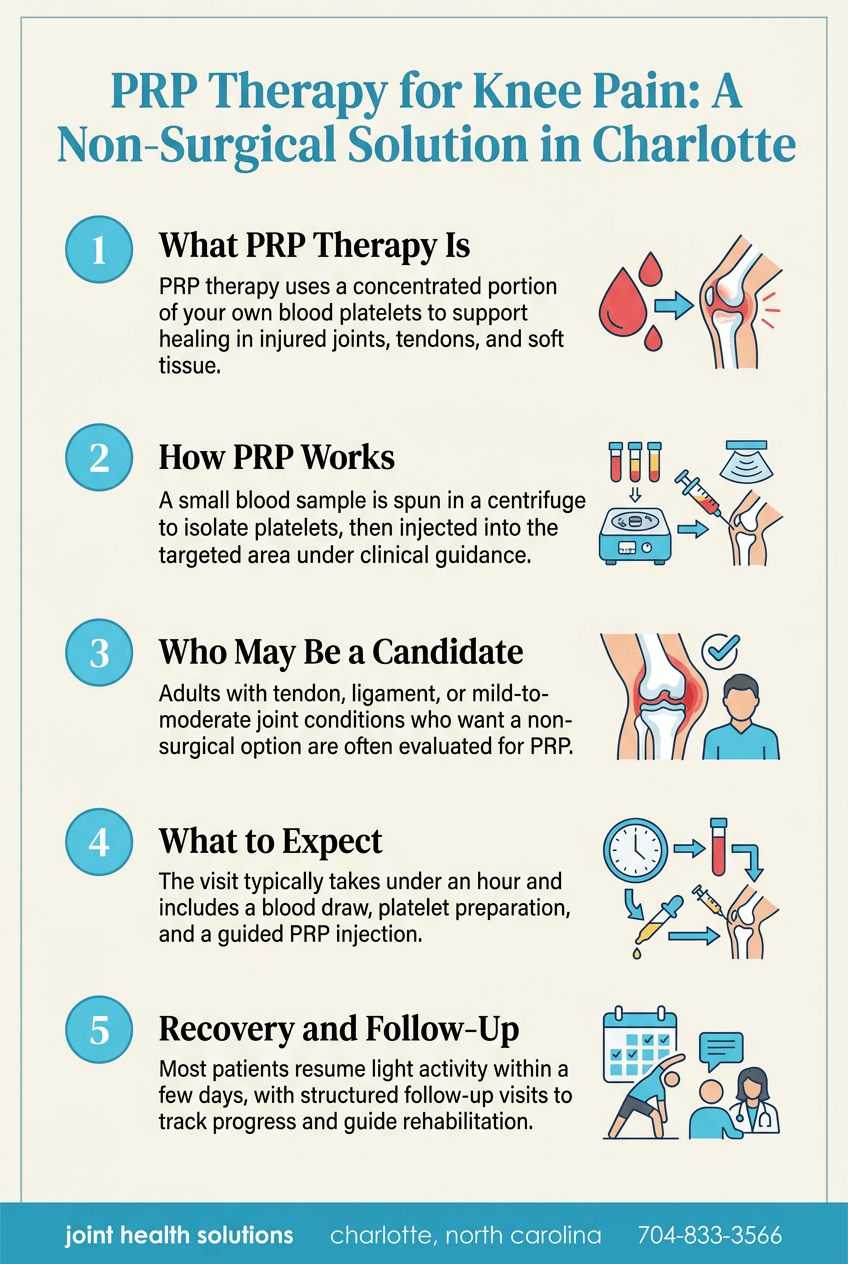
Platelet-rich plasma (PRP) therapy is a regenerative medicine technique that uses a concentrated sample of your own blood to promote healing. Blood contains platelets, which are rich in growth factors and proteins that play a crucial role in tissue repair and inflammation modulation. By isolating and concentrating these platelets, then injecting them into the injured area—such as a knee joint affected by arthritis or a tendon tear—PRP therapy delivers a potent dose of natural healing factors directly to the site of damage.
The procedure begins with a simple blood draw, similar to a routine lab test. The blood is then placed in a centrifuge, which spins at high speed to separate the platelet-rich plasma from other blood components. The resulting PRP concentrate is then injected into the knee under ultrasound guidance to ensure precise placement. Because the PRP is derived from your own body, there is virtually no risk of allergic reaction or disease transmission. This makes PRP an extremely safe option for patients seeking non-surgical knee pain relief.
PRP therapy has been used for decades in sports medicine to treat athletes with knee injuries, and a growing body of research supports its effectiveness for osteoarthritis, tendinopathy, and ligament injuries. For example, a 2019 meta-analysis published in the British Journal of Sports Medicine found that PRP injections significantly reduced pain and improved function in patients with knee osteoarthritis compared to placebo or hyaluronic acid injections. At Joint Health Solutions, we tailor each PRP treatment to the individual patient, considering the severity of their condition, overall health, and goals.
It’s important to understand that PRP is not a one-size-fits-all solution. The concentration of platelets can vary based on the centrifuge used and the patient’s baseline platelet count. At our clinic, we use a double-spin centrifugation method to achieve a higher platelet concentration, typically 5 to 7 times the normal level, which has been shown in studies to yield better outcomes for knee osteoarthritis. Additionally, we may add a small amount of calcium chloride or thrombin to activate the platelets before injection, triggering the release of growth factors immediately upon placement.
How PRP Therapy Works for Knee Pain
When PRP is injected into the knee, the concentrated platelets release growth factors that stimulate the body’s natural healing response. These growth factors attract stem cells and other reparative cells to the area, promote collagen production, and reduce inflammation. Over time, this can lead to improved tissue structure, reduced pain, and enhanced joint function.
The healing process is gradual. Most patients begin to notice improvement within 2 to 4 weeks after the injection, with continued benefit over the following months. The full effect of PRP therapy may take up to 6 months as the body rebuilds and repairs damaged tissue. It is important to note that PRP is not a quick fix; it works by supporting your body’s own healing mechanisms, which takes time. However, the results can be long-lasting, especially when combined with a comprehensive rehabilitation program.
At Joint Health Solutions, we often recommend a series of PRP injections—typically 1 to 3 treatments spaced 4 to 6 weeks apart—depending on the extent of the knee damage. Our team will develop a personalized treatment plan based on your specific condition and response to therapy.
To understand the biological mechanism more deeply, consider that platelets contain alpha granules that store over 300 different bioactive proteins, including platelet-derived growth factor (PDGF), transforming growth factor-beta (TGF-β), vascular endothelial growth factor (VEGF), and insulin-like growth factor (IGF-1). These factors work synergistically to promote angiogenesis (new blood vessel formation), chemotaxis (attracting healing cells), and extracellular matrix remodeling. In the context of knee osteoarthritis, PRP can help reduce the catabolic (tissue-destroying) environment of the arthritic joint while promoting anabolic (tissue-building) activity. For tendinopathy, such as patellar tendinitis, PRP stimulates tenocyte proliferation and collagen synthesis, which can restore tendon integrity over several months.
PRP Preparation and Injection Process
To ensure the best outcomes, we follow a meticulous protocol. First, we perform a thorough evaluation, including a physical exam and review of imaging studies (X-rays or MRI). On the day of the procedure, we draw a small amount of blood (about 30-60 mL) and process it in a centrifuge for approximately 10-15 minutes. The PRP is then drawn into a syringe and injected into the knee joint or surrounding soft tissues using ultrasound guidance for accuracy. The entire procedure typically takes less than an hour, and you can go home immediately afterward.
Ultrasound guidance is a critical component of our protocol. It allows us to visualize the needle tip in real time, ensuring that the PRP is delivered precisely to the target area—whether it’s the intra-articular space for osteoarthritis, the patellar tendon for tendinopathy, or the medial collateral ligament for a sprain. This precision maximizes the therapeutic effect and minimizes the risk of inadvertent injection into blood vessels or nerves. Studies have shown that ultrasound-guided PRP injections result in better pain relief and functional outcomes compared to blind injections, particularly for knee conditions.
Before the injection, we may apply a topical numbing cream or use a cold spray to minimize discomfort. Some patients also receive a small amount of lidocaine (a local anesthetic) without epinephrine, as epinephrine can constrict blood vessels and potentially interfere with the healing response. The injection itself takes only a few minutes, and we monitor you for any immediate reactions before discharging you.
PRP Therapy vs. Other Knee Injections
Several types of injections are used to treat knee pain, but they work in fundamentally different ways. The table below compares PRP therapy with common alternatives.
| Treatment | How It Works | Limitations | Risks |
|---|---|---|---|
| Corticosteroid (Cortisone) Injections | Powerful anti-inflammatory that reduces swelling and pain quickly | Does not repair tissue; repeated use can damage cartilage; temporary relief (weeks to months) | Joint infection, cartilage damage, tendon rupture, elevated blood sugar |
| Hyaluronic Acid (Viscosupplementation) | Injects a gel-like substance to lubricate the joint and cushion the bones | Best for mild to moderate arthritis; not effective for all patients; may require multiple injections | Local pain or swelling, rare allergic reactions |
| PRP Therapy | Uses your own growth factors to stimulate tissue repair and reduce inflammation | Results take weeks to months; may require multiple sessions; not covered by insurance for most plans | Minimal: injection site pain, swelling; very low risk of infection |
| Surgery (Arthroscopy, Replacement) | Removes damaged tissue or replaces the joint | Long recovery, significant risks, may not be suitable for all patients | Infection, blood clots, nerve damage, implant failure, prolonged pain |
As the table shows, PRP therapy offers a unique advantage: it actively promotes healing rather than simply masking symptoms or providing temporary lubrication. For patients with knee osteoarthritis or chronic tendon issues, PRP can address the underlying biology of the condition.
To expand on the comparison, consider the specific case of knee osteoarthritis. Corticosteroid injections can provide rapid pain relief for 2 to 4 weeks, but repeated use (more than 3-4 times per year) has been associated with accelerated cartilage loss and joint destruction, as documented in a 2019 study in Radiology. Hyaluronic acid injections, while safer for cartilage, primarily work by improving joint lubrication and may take 2-4 weeks to show benefit; their effects typically last 6 months or less. In contrast, PRP therapy targets the inflammatory and degenerative pathways directly, with some studies showing structural improvements on MRI, such as increased cartilage thickness or reduced bone marrow lesions, after 12 months. For tendinopathy, PRP has been shown to be superior to both corticosteroid injections and eccentric exercise alone in randomized controlled trials, with success rates of 70-80% for conditions like patellar tendinitis and chronic Achilles tendinopathy.
It’s also worth noting that PRP can be used in combination with other treatments. For example, some patients benefit from a “triple therapy” approach that includes PRP, hyaluronic acid, and physical therapy. However, this should be discussed with your provider, as the evidence for combination therapy is still emerging.
What to Expect During a PRP Procedure at Joint Health Solutions
Your first step is a consultation with one of our specialists. During this visit, we will review your medical history, perform a physical examination, and discuss your pain and functional limitations. We may also order imaging studies if not already available. If you are a candidate for PRP, we will explain the procedure in detail and answer any questions.
On the day of the injection, you will be comfortable in our clinic. The blood draw is quick, and the centrifugation process takes about 15 minutes. The injection itself is performed with a thin needle, and we may use a local anesthetic to numb the skin. Most patients report only mild discomfort during the injection. After the procedure, you will be given specific aftercare instructions, including activity modifications and when to resume normal activities.
You may experience some soreness or swelling in the knee for a few days after the injection. This is normal and indicates that the healing process has begun. We recommend avoiding anti-inflammatory medications (like ibuprofen or naproxen) for at least 2 weeks after PRP, as they can interfere with the healing response. Instead, you can use ice and acetaminophen for pain if needed.
Follow-up appointments are scheduled to monitor your progress and determine if additional PRP injections are needed. Our goal is to help you achieve lasting pain relief and improved function.
During the consultation, we will also discuss potential contraindications. For example, patients with platelet dysfunction syndromes (e.g., thrombocytopenia), active infections (especially septic arthritis), or those on anticoagulant therapy (like warfarin or apixaban) may not be suitable candidates. We also screen for systemic conditions like rheumatoid arthritis or uncontrolled diabetes, which can affect healing. If you have a history of cancer, particularly in the knee area, PRP is generally avoided due to theoretical concerns about growth factors stimulating malignant cells, though this is rare. Our evaluation is comprehensive to ensure your safety and optimize outcomes.
Recovery and Results After PRP Therapy
Recovery from PRP therapy is generally straightforward, but it requires patience. In the first few days, you should rest the knee and avoid high-impact activities. Gradual return to normal activities is encouraged, but we advise against running, jumping, or heavy lifting for at least 2-3 weeks. Physical therapy may be recommended to strengthen the muscles around the knee and optimize the healing process.
Results vary by individual. Some patients experience significant improvement after a single injection, while others benefit from a series of treatments. Studies have shown that PRP therapy can reduce pain and improve function for up to 2 years or more in many patients with knee osteoarthritis. It is important to maintain a healthy lifestyle, including weight management and appropriate exercise, to prolong the benefits.
To provide more specific data, a 2021 systematic review and meta-analysis in Orthopaedic Journal of Sports Medicine pooled results from 18 randomized controlled trials involving over 1,500 patients with knee osteoarthritis. The analysis found that PRP injections led to a 60-80% reduction in pain scores (on the Visual Analog Scale) and a 50-70% improvement in functional outcomes (on the Western Ontario and McMaster Universities Osteoarthritis Index, or WOMAC) at 6 to 12 months. Benefits were most pronounced in patients with mild to moderate osteoarthritis (Kellgren-Lawrence grades I-III) and in those under 65 years of age. For patellar tendinopathy, a 2018 study in American Journal of Sports Medicine reported that 72% of athletes who received PRP were able to return to their pre-injury level of sport within 6 months, compared to 44% in the control group.
During recovery, we emphasize the importance of a structured rehabilitation program. This typically includes: (1) a rest and ice phase for the first 48-72 hours to manage acute inflammation; (2) a gentle range-of-motion phase starting at day 3, with activities like ankle pumps and heel slides; (3) a strengthening phase beginning at week 2, focusing on quadriceps, hamstrings, and gluteal exercises; and (4) a functional phase at week 4-6, incorporating balance training, low-impact cardio (e.g., stationary bike, swimming), and gradual return to sport-specific movements. We work closely with local physical therapists in Charlotte to ensure continuity of care.
Is PRP Therapy Right for You?
PRP therapy is most effective for patients with mild to moderate knee osteoarthritis, patellar tendinopathy, or ligament injuries (such as MCL sprains). It is also used for meniscal tears in select cases. Ideal candidates are those who have not responded to conservative treatments like physical therapy or bracing and wish to avoid surgery.
However, PRP may not be suitable for everyone. Patients with severe end-stage arthritis (Kellgren-Lawrence grade IV, where bone-on-bone contact is present), active infections, blood disorders, or those taking certain medications (e.g., blood thinners) may not be candidates. A thorough evaluation at Joint Health Solutions will determine if PRP is right for you.
To help you self-assess, consider the following signs that PRP might be a good option: you have chronic knee pain that has persisted for more than 3 months despite physical therapy or bracing; your pain is worse with activity but improves with rest; you have morning stiffness lasting less than 30 minutes (typical of osteoarthritis); you have a confirmed diagnosis of mild to moderate arthritis on X-ray or MRI; or you have a specific tendon or ligament injury (like patellar tendinitis or an MCL sprain) that hasn’t healed with conservative care. Conversely, if you have severe bone-on-bone arthritis, a complete ACL tear (which often requires surgical reconstruction), or a joint infection, PRP alone may not be sufficient, and surgery or other interventions may be needed.
At Joint Health Solutions, we also consider your overall health goals. For example, if you are a runner hoping to return to marathon training, PRP combined with gait analysis and targeted strengthening may be an excellent strategy. If you are older and primarily want to reduce pain for daily activities, PRP can help improve quality of life without the risks of surgery. We take the time to listen to your story and tailor our recommendations accordingly.
Frequently Asked Questions
How long does PRP therapy take?
The entire procedure, including blood draw, centrifugation, and injection, typically takes 45 minutes to an hour. You can return home immediately afterward.
How many PRP sessions are needed?
Most patients receive 1 to 3 injections, spaced 4 to 6 weeks apart. The exact number depends on the severity of your condition and your response to treatment.
Is PRP therapy painful?
Most patients report mild discomfort during the injection. We use a numbing agent to minimize pain. Afterward, you may experience soreness for a few days, which is normal.
What is the success rate of PRP for knee pain?
Studies show that PRP therapy significantly reduces pain and improves function in 60-80% of patients with knee osteoarthritis, with benefits lasting up to 2 years or more.
Does insurance cover PRP therapy?
Most insurance plans do not cover PRP therapy as it is considered experimental or elective. However, we offer transparent pricing and payment options. Contact us for details.
Can PRP help with arthritis?
Yes, PRP is particularly effective for mild to moderate knee osteoarthritis. It can reduce inflammation and stimulate cartilage repair, delaying the need for joint replacement.
What should I avoid after PRP?
Avoid anti-inflammatory medications (ibuprofen, naproxen, aspirin) for at least 2 weeks. Also avoid high-impact activities for 2-3 weeks. Follow your doctor’s specific instructions.
How soon can I return to work?
Most patients can return to desk work the next day. If your job involves heavy lifting or prolonged standing, you may need 1-2 weeks off.
Is PRP better than cortisone?
PRP addresses the underlying cause of pain by promoting healing, while cortisone only reduces inflammation temporarily. PRP has fewer risks and longer-lasting results.
Can I have PRP if I’ve had knee surgery?
Yes, PRP can be used after surgery to enhance healing or for persistent pain. However, we will evaluate your specific situation during consultation.
Sources
- Mayo Clinic: Platelet-rich plasma (PRP) injections
- Cleveland Clinic: PRP Therapy
- Harvard Health Publishing: Platelet-rich plasma for knee osteoarthritis
- NIH National Institute of Arthritis and Musculoskeletal and Skin Diseases: Osteoarthritis
-
Mass General Brigham – Platelet-rich Plasma (PRP) Injections