
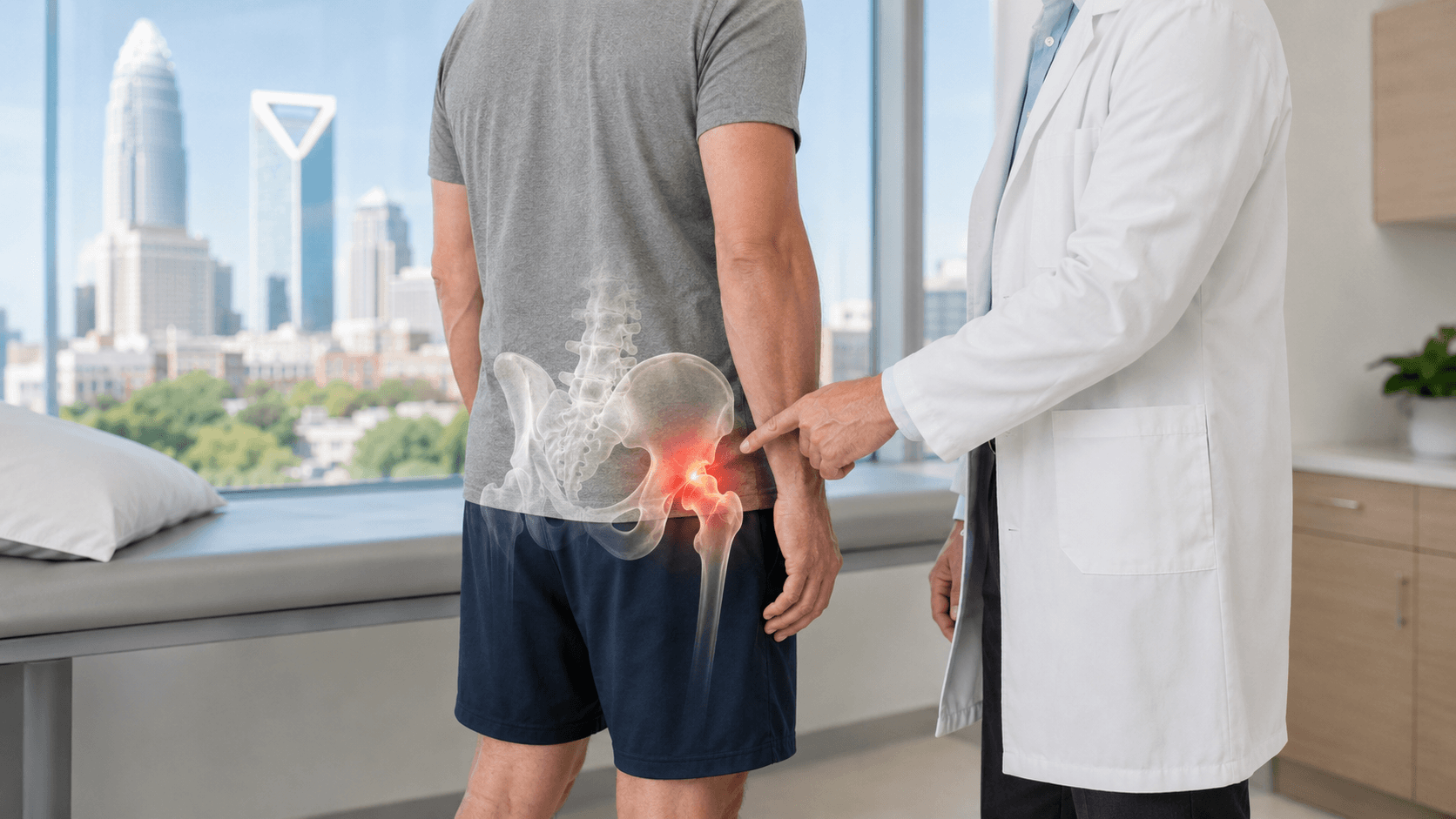
Hip Labral Tears: Avoiding Arthroscopic Surgery with Precision Injections in Charlotte
Hip Labral Tear Treatment Charlotte is the focus of this guide. Estimated reading time: 12 minutes | Category: Joint Health, Non-Surgical Treatments | Location: Charlotte, North Carolina
Hip Labral Tear Treatment Charlotte: Introduction: When Hip Pain Holds You Back
Hip labral tears are a common source of deep, aching hip pain that can make everyday activities—walking, sitting, or even sleeping—feel like a challenge. For many adults in Charlotte, North Carolina, the first recommendation they hear is arthroscopic surgery. But surgery isn’t the only option. At Joint Health Solutions, we specialize in hip labral tear treatment Charlotte using precision injections that can help you avoid the operating room entirely. With over 10 years of experience in non-surgical orthopedics, we’ve helped hundreds of patients return to their active lives without the risks and downtime of surgery. This article will explore how precision injections work, why they may be a better choice for you, and what to expect from a personalized treatment plan.
Hip labral tears are more common than many realize, affecting not only athletes but also individuals with repetitive twisting motions or structural hip issues. The labrum, a fibrocartilaginous structure, acts like a gasket or a suction seal, deepening the hip socket and distributing load across the joint. When it tears, the joint becomes less stable, leading to inflammation, pain, and eventually, if untreated, accelerated arthritis. Early, targeted intervention is key to preserving joint health. Our approach at Joint Health Solutions focuses on identifying the specific type of tear—whether it is a degenerative flap tear, a longitudinal tear, or a complex tear associated with femoroacetabular impingement (FAI)—and tailoring the injection strategy accordingly. By addressing the underlying biomechanical issues and inflammation, we aim to restore function and delay or eliminate the need for surgical repair.
Understanding Hip Labral Tears: Causes and Symptoms
The hip labrum is a ring of cartilage that surrounds the hip socket, providing stability and cushioning. A tear can occur due to trauma, repetitive motions, or structural abnormalities like femoroacetabular impingement (FAI). Common symptoms include a deep ache in the groin or hip, clicking or locking sensations, stiffness, and pain that worsens with prolonged sitting or pivoting. If you’re experiencing these signs, seeking hip labral tear treatment Charlotte early can prevent further joint damage.
It is important to distinguish between different types of labral tears, as the treatment approach can vary. For example, a tear caused by FAI often involves a “pincer” (overcoverage of the femoral head) or “cam” (bony bump on the femoral neck) impingement, which repeatedly pinches the labrum. Repetitive motions in sports like golf, soccer, or ballet can also lead to microtrauma and eventual tearing. The pain is often described as a dull ache in the groin, but it can also radiate to the lateral hip or even the lower back. Patients frequently report a sensation of the hip “giving way” or “catching,” and they may have difficulty putting on shoes or getting in and out of a car. A thorough physical examination, including the FABER (flexion, abduction, external rotation) test and the impingement test, helps confirm the diagnosis. Advanced imaging, such as MR arthrography, is often used to visualize the labrum and assess the tear’s size and location, which guides our injection strategy.
Why Avoid Arthroscopic Surgery?
Arthroscopic hip surgery involves small incisions, a camera, and instruments to repair or trim the labrum. While effective for some, it carries risks: infection, nerve damage, prolonged recovery (4–6 months), and the possibility that the tear may recur. Many patients also face a long rehabilitation process. For those with mild to moderate tears, non-surgical options like precision injections offer a safer, faster path to relief. Our approach at Joint Health Solutions focuses on treating the underlying inflammation and promoting natural healing, so you can avoid the scalpel.
“Beyond the immediate risks, surgery can lead to complications. The recovery timeline is demanding and carries several considerations:
-
Prolonged Recovery: Patients typically use crutches for 2–6 weeks and undergo months of physical therapy.
-
Potential Surgical Risks: Deep vein thrombosis (DVT), adverse reactions to anesthesia, and heterotopic ossification (abnormal bone growth).
-
Persistent Pain: Up to 20% of patients may experience persistent pain or require a revision procedure.
In contrast, precision injections carry minimal risks and allow patients to maintain their daily activities with little to no downtime.”
| Treatment | How It Works | Limitations | Risks |
|---|---|---|---|
| Pain Pills (NSAIDs) | Reduce inflammation temporarily | Does not heal the tear; long-term use can harm stomach, kidneys | GI bleeding, kidney damage, dependency |
| Cortisone Injections | Powerful anti-inflammatory that reduces pain | Effect lasts weeks to months; repeated use may weaken cartilage | Joint infection, cartilage damage with overuse |
| Arthroscopic Surgery | Repair or remove torn labral tissue | Long recovery, possible recurrence, requires anesthesia | Infection, nerve injury, blood clots, failure to relieve pain |
| Precision Injections (PRP, Hyaluronic Acid) | Stimulate healing, lubricate joint, reduce inflammation | May require multiple sessions; not for severe tears | Minimal: temporary soreness at injection site |
It is crucial to understand that not all labral tears are the same. A small, stable tear with minimal symptoms may respond well to conservative care, while a large, displaced tear causing mechanical locking may eventually require surgery. Our goal is to accurately stratify your condition using validated scoring systems, such as the Hip Outcome Score (HOS) or the modified Harris Hip Score, to determine the most appropriate treatment pathway. For many patients, precision injections serve as a definitive treatment, not just a delay tactic.
Precision Injections: A Non-Surgical Alternative
Precision injections deliver medication or regenerative substances directly into the hip joint under imaging guidance (fluoroscopy or ultrasound). This ensures accuracy and maximizes effectiveness. At Joint Health Solutions, we offer a range of injections tailored to your specific condition as part of your hip labral tear treatment Charlotte plan.
The term “precision” is key. Without image guidance, even experienced physicians may miss the joint space, leading to ineffective treatment or inadvertent injection into surrounding ligaments or tendons. Fluoroscopy, which uses real-time X-ray, allows us to visualize the bony landmarks and confirm proper needle placement with a small amount of contrast dye. Ultrasound, on the other hand, provides real-time visualization of soft tissues, including the labrum itself, and can be used to guide the needle directly to the tear site. This dual-modality approach ensures that the therapeutic agent reaches the precise location where it is needed most. Furthermore, we tailor the injectate composition based on the patient’s specific pathology. For example, a patient with a degenerative tear and concomitant arthritis may benefit more from hyaluronic acid, while a younger athlete with a traumatic tear may be better suited for PRP to stimulate tissue repair.
Types of Injections for Hip Labral Tears
Cortisone Injections
Cortisone is a strong corticosteroid that rapidly reduces inflammation. It can provide significant pain relief for weeks to months, allowing you to participate in physical therapy. However, it does not heal the labrum; it’s best used as a short-term solution.
Cortisone works by inhibiting the inflammatory cascade at the cellular level, reducing the production of prostaglandins and leukotrienes. This can be particularly helpful for patients who have a sudden flare-up of pain and need immediate relief to engage in rehabilitation. However, repeated cortisone injections (more than 3–4 per year) can have detrimental effects on cartilage health, potentially accelerating joint degeneration. Therefore, we use cortisone judiciously, often as a bridge therapy while other regenerative treatments take effect. It is also important to note that cortisone may provide a false sense of security—patients may feel well enough to return to high-impact activities too quickly, potentially worsening the underlying tear. We always combine cortisone injections with a structured activity modification plan and physical therapy to ensure safe recovery.
Hyaluronic Acid Injections
Also known as viscosupplementation, hyaluronic acid mimics natural joint fluid, lubricating the hip and cushioning the labrum. This can reduce friction and pain, especially in patients with early arthritis.
Hyaluronic acid is a naturally occurring glycosaminoglycan found in synovial fluid. In a healthy joint, it provides viscosity and elasticity, allowing smooth articulation. In an arthritic or injured hip, the concentration and molecular weight of hyaluronic acid decrease, leading to increased friction and pain. By injecting exogenous hyaluronic acid, we restore the viscoelastic properties of the synovial fluid, which can reduce pain, improve range of motion, and potentially stimulate the body’s own production of hyaluronic acid. A typical course involves 1–3 injections, spaced one week apart. Studies have shown that hyaluronic acid injections can provide pain relief for 6–12 months, and they are particularly effective for patients with mild to moderate osteoarthritis who also have a labral tear. For optimal results, we often combine hyaluronic acid with physical therapy to improve joint mechanics.
PRP Therapy (Platelet-Rich Plasma)
PRP uses your own blood, processed to concentrate platelets and growth factors. When injected into the hip, it can stimulate tissue repair and reduce inflammation. Studies show PRP may improve labral healing and delay or prevent surgery.
Platelet-rich plasma is at the forefront of regenerative orthopedics. Platelets contain alpha granules that release a host of growth factors, including platelet-derived growth factor (PDGF), transforming growth factor-beta (TGF-β), vascular endothelial growth factor (VEGF), and insulin-like growth factor (IGF). These factors recruit stem cells, promote angiogenesis, and stimulate collagen synthesis, all of which are critical for healing damaged fibrocartilage like the labrum. The preparation of PRP is critical: we use a double-spin centrifugation method to achieve a platelet concentration that is 4–5 times higher than baseline, while minimizing the presence of inflammatory white blood cells. Some studies suggest that leukocyte-poor PRP may be more beneficial for intra-articular injections, as it reduces the risk of a pro-inflammatory response. The PRP is then activated with calcium chloride or thrombin immediately before injection to initiate the release of growth factors.
Clinical evidence, including a 2020 study in the American Journal of Sports Medicine, has demonstrated that PRP injections can significantly improve pain and function in patients with labral tears, with many avoiding surgery for at least two years. We typically recommend a series of 2–3 PRP injections, spaced 4–6 weeks apart, for optimal results.
What to Expect During Your Injection Procedure
Your first visit begins with a comprehensive evaluation, including a physical exam and imaging review. If you’re a candidate for precision injections, the procedure is performed in our clinic. You’ll lie on a table, and the injection site is numbed. Using fluoroscopy, the physician guides a thin needle into the hip joint. The injection itself takes only a few minutes. You may feel mild pressure but rarely significant pain. Afterward, you’ll rest for 15–30 minutes before going home. Most patients resume normal activities the next day, with full effects developing over a few days to two weeks.
To ensure your comfort, we use a combination of topical anesthetic (lidocaine spray) and a small amount of local anesthetic (buffered lidocaine) at the skin entry point. The needle used is typically a 22- or 25-gauge spinal needle, which is very thin. For PRP or hyaluronic acid injections, the volume injected is usually 3–5 mL, which is well-tolerated within the joint capsule. After the injection, we apply a small bandage and ask you to remain in the clinic for a short observation period to monitor for any immediate adverse reactions, such as vasovagal syncope (fainting) or an allergic reaction (extremely rare).
You will be given specific aftercare instructions, which include applying ice to the area for 15–20 minutes every 2–3 hours for the first 24 hours, avoiding strenuous activity for 48 hours, and gradually resuming normal activities. We also recommend avoiding non-steroidal anti-inflammatory drugs (NSAIDs) for 1–2 weeks after PRP, as they can interfere with the inflammatory healing process that PRP is meant to stimulate.
How Joint Health Solutions Treats Hip Labral Tears Without Surgery
Fluoroscopy-Guided Injections
- We use real-time X-ray guidance to ensure precise placement of medication into the hip joint. This maximizes efficacy and minimizes risk.
- Precise delivery of medication to the hip joint using real-time imaging.
PRP Therapy
- Our PRP protocol involves drawing your blood, processing it in a centrifuge, and reinjecting the concentrated platelets into the tear site. This harnesses your body’s natural healing ability.
- Uses your own platelets to stimulate labral healing.
Cortisone Injections
- For acute inflammation, we may recommend a cortisone injection to provide rapid relief, often combined with PRP for longer-term benefits.
- Rapid anti-inflammatory relief for flare-ups.
Hyaluronic Acid Injections
- We offer hyaluronic acid to improve joint lubrication and reduce painful friction, especially when cartilage damage is present.
- Lubricates the joint to reduce friction and pain.
Physical Therapy
- Our therapists design a program to strengthen the hip stabilizers (glutes, core) and improve flexibility, reducing stress on the labrum.
- Strengthens muscles to support the hip.
Nutrition Plan
- An anti-inflammatory diet rich in omega-3s, antioxidants, and collagen-supporting nutrients can enhance healing and reduce pain.
- Anti-inflammatory diet to support joint health.
Our multidisciplinary approach is what sets us apart. We do not simply perform injections in isolation; we integrate them into a comprehensive treatment plan that addresses the root causes of the labral tear. For example, a patient with FAI will benefit from physical therapy that focuses on hip flexor stretching, gluteal strengthening, and core stabilization to reduce impingement. We also provide ergonomic advice for sitting, sleeping, and performing daily activities to minimize stress on the hip.
Nutritional counseling is another cornerstone: we recommend foods rich in omega-3 fatty acids (salmon, walnuts, flaxseeds), antioxidants (berries, leafy greens, turmeric), and vitamin C (citrus fruits, bell peppers) to support collagen synthesis and reduce systemic inflammation. For patients with underlying metabolic conditions like diabetes or obesity, we work with their primary care providers to optimize these factors, as they can significantly impact healing outcomes.
Recovery and Long-Term Management
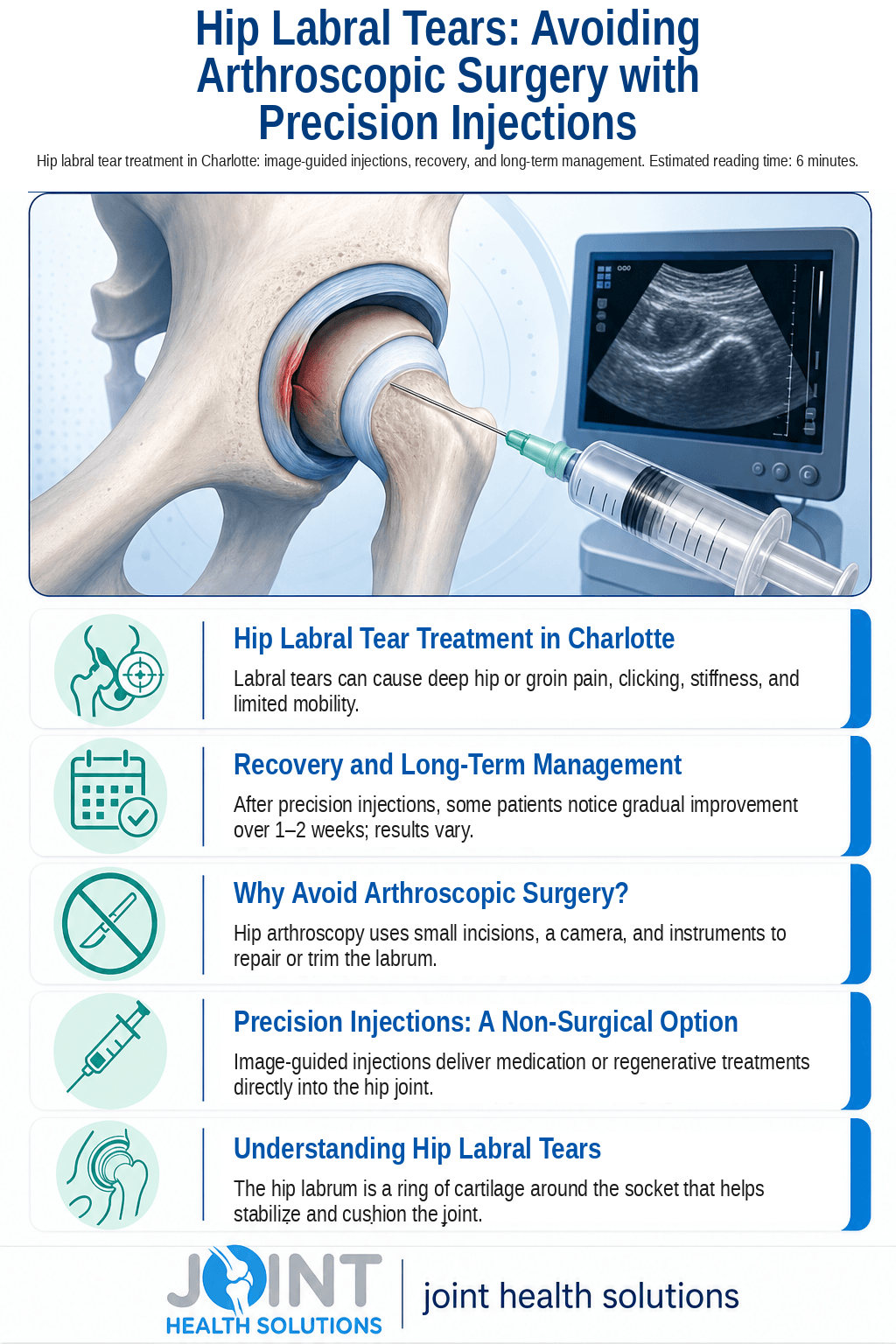
After precision injections, most patients experience gradual improvement over 1–2 weeks. We recommend avoiding high-impact activities for a few days, then gradually returning to normal movement. Physical therapy is key to long-term success. Many patients require a series of 2–3 injections over several months for optimal results. Our team will monitor your progress and adjust your hip labral tear treatment Charlotte plan as needed.
The recovery phase is an active process. We ask patients to keep a pain diary to track their symptoms and functional improvements. For the first 48 hours post-injection, we recommend relative rest—avoiding prolonged standing, walking, or sitting. Gentle range-of-motion exercises, such as heel slides and hip circles, can be started after 24 hours to prevent stiffness. After 48 hours, patients can begin a graduated walking program, starting with 10–15 minutes and increasing by 5 minutes per day as tolerated. Physical therapy typically begins within 1–2 weeks after the injection, focusing first on pain-free isometric exercises, then progressing to concentric and eccentric strengthening. We emphasize neuromuscular re-education to improve hip joint proprioception and control.
Frequently Asked Questions
How long does a hip labral tear injection take?
The procedure itself takes about 10–15 minutes. Including preparation and recovery, plan for 45–60 minutes total.
Are precision injections painful?
Most patients report only mild discomfort. We use a numbing spray and a thin needle to minimize pain.
How many injections will I need?
Many patients benefit from a series of 2–3 injections spaced several weeks apart, depending on the severity of the tear.
Can I return to sports after injections?
Yes, after a brief recovery period and physical therapy, most patients can gradually return to sports.
What is the success rate of injections for labral tears?
Studies show that PRP injections can help 70–80% of patients avoid surgery for at least 1–2 years.
Are there any side effects?
Side effects are rare but may include temporary soreness, swelling, or bruising at the injection site.
How soon will I feel relief?
Some patients feel improvement within a few days, but full benefits may take 1–2 weeks.
Will insurance cover precision injections?
Many insurance plans cover cortisone and hyaluronic acid injections. PRP may require prior authorization. Our team will verify your benefits.
Can injections make the tear worse?
No, when performed correctly, injections are safe and do not worsen the tear.
What if injections don’t work?
If you don’t achieve sufficient relief, we can discuss other options, including surgery. But many patients find success with injections.
Institutional Sources
-
Harvard Health Publishing (Harvard Medical School):
“Hip pain: Finding the cause and the best treatment.”
Harvard medical experts discuss how conservative treatments, including targeted injections and physical therapy, are often the first line of defense before considering surgery.
Read the Harvard Health Guide -
Mayo Clinic:
“Hip Labral Tear: Diagnosis & Treatment.”
Mayo Clinic’s orthopedic guidelines outline the use of diagnostic and therapeutic injections (such as corticosteroids) to manage labral tear symptoms without operating.
View Mayo Clinic Care Guidelines -
Cleveland Clinic:
“Hip Labral Tear: Management and Treatment.”
Cleveland Clinic highlights the transition toward regenerative medicine and precise joint injections as highly effective alternatives to arthroscopic hip surgery.
Read Cleveland Clinic Medical Insights