
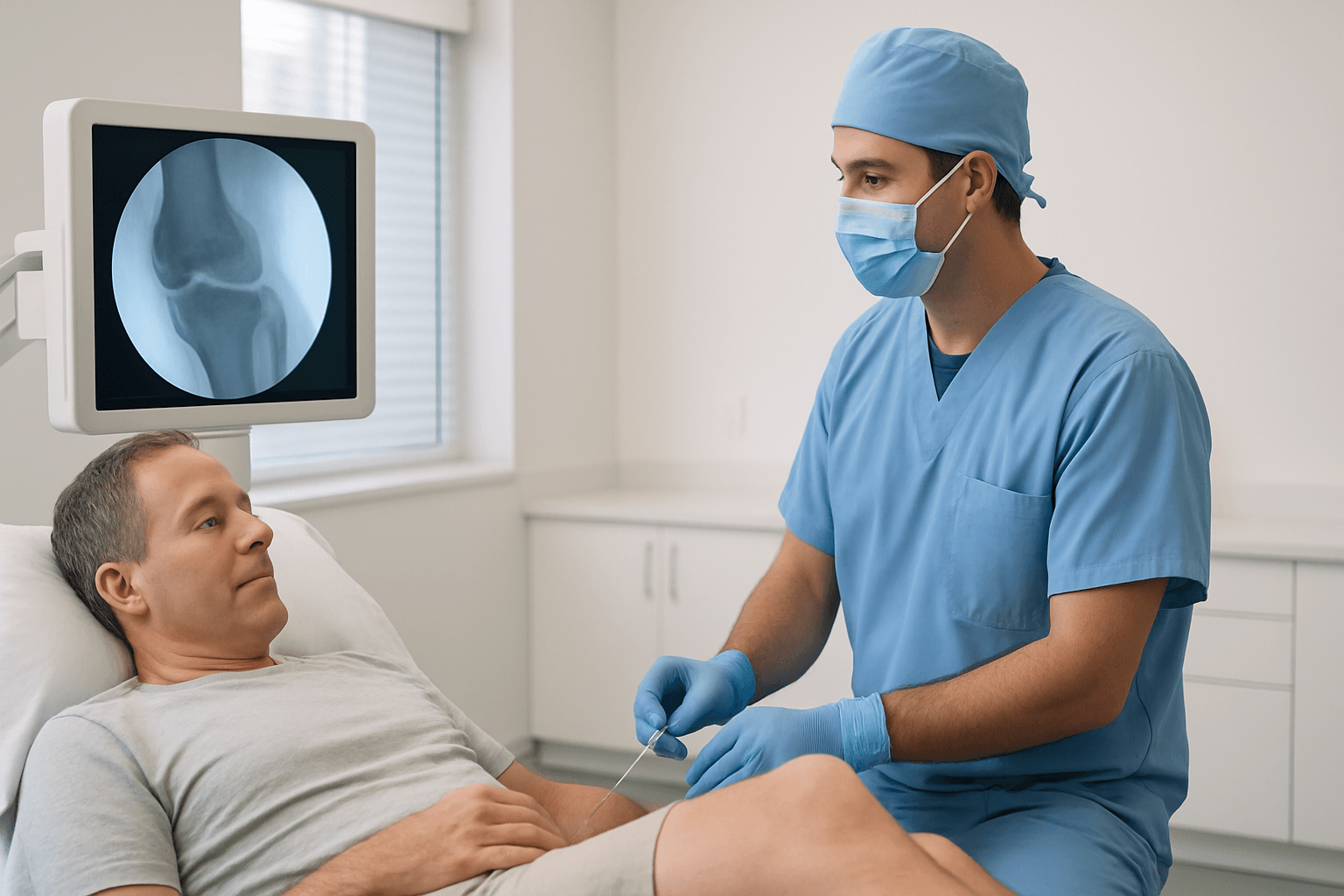
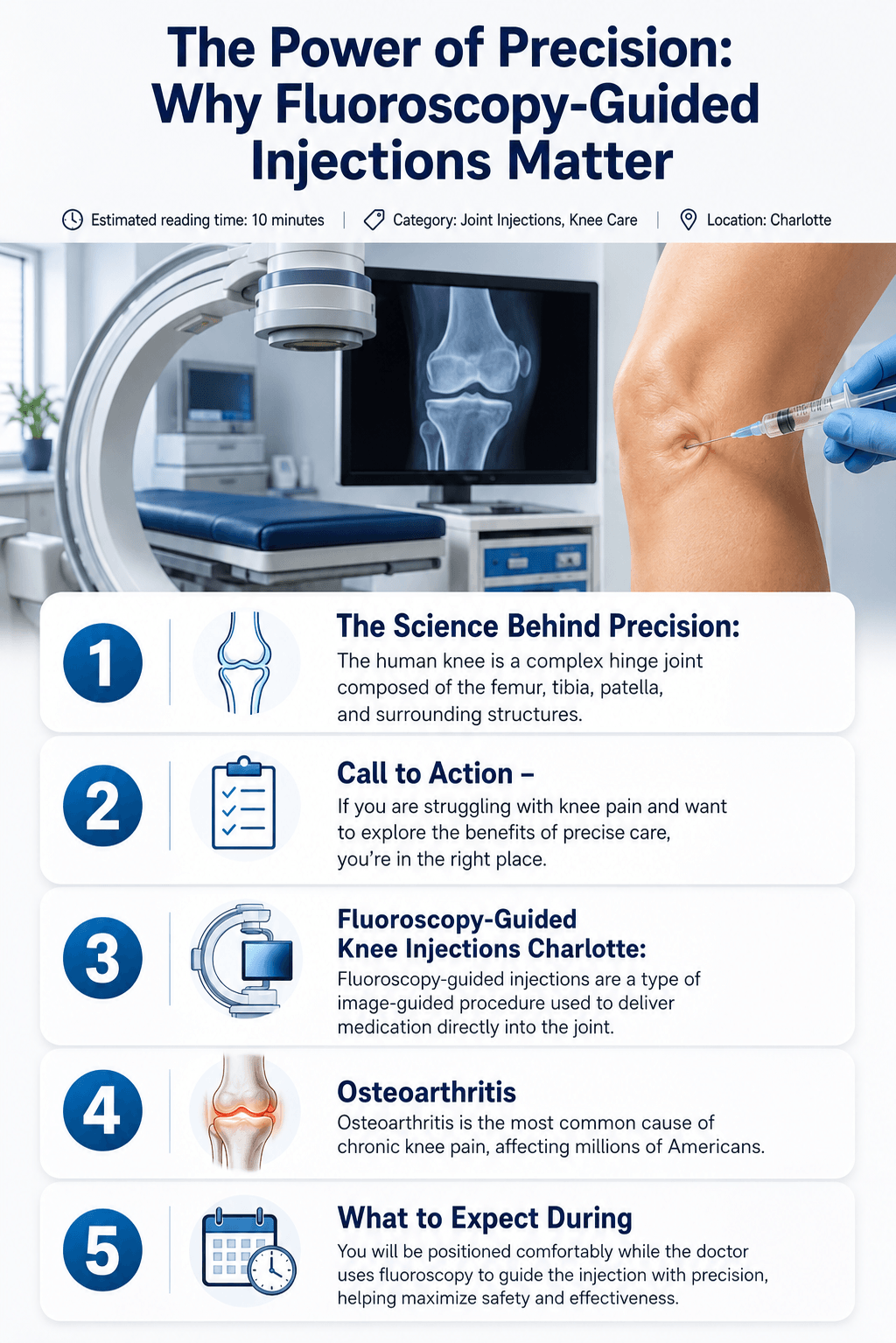
The Power of Precision: Why Fluoroscopy-Guided Injections Matter for Knee Care
Estimated reading time: 12 minutes | Category: Joint Injections / Knee Care | Location: Charlotte, North Carolina
If you suffer from chronic knee pain, you know how deeply debilitating it can be. Simple everyday activities like walking through the Freedom Park trail, climbing stairs, or even standing for short periods can become exhausting, painful challenges. Many patients actively try over-the-counter pain relievers, physical therapy, or even traditional steroid treatments, but without precise delivery, these therapies may never reach the exact anatomical source of the pain. That’s where modern image guidance completely changes the treatment landscape.
This advanced technique uses real-time X-ray video to guide the needle to the precise target within the knee joint capsule, ensuring that medication is delivered exactly where it’s needed most. At Joint Health Solutions, we are at the forefront of this precision medicine approach in Charlotte, North Carolina, offering patients a highly effective non-surgical option that maximizes therapeutic outcomes and minimizes clinical risk. In this comprehensive article, we explore why fluoroscopy-guided knee injections matter for long-term knee care and how they can help you get back to the active lifestyle you love.
What Are Fluoroscopy-Guided Knee Injections?
Fluoroscopy-guided knee injections are a type of advanced image-guided procedure used to deliver targeted medication directly into a joint space or specific soft tissue structure. Unlike traditional “blind” injections, where a physician relies entirely on surface anatomical landmarks and physical touch (palpation) to guide the needle, fluoroscopy provides continuous, real-time X-ray video imaging. This allows the treating physician to see the needle’s exact trajectory and position relative to bones, joint spaces, and adjacent tissues, ensuring flawless accuracy before any fluid is introduced.
For patients seeking effective knee injections, this specialized technique is particularly crucial because the human knee possesses a remarkably complex layout with multiple distinct compartments, fluid-filled bursae, and stabilizing ligaments. Common medications delivered via this method include highly refined cortisone injections for rapid inflammation relief, hyaluronic acid injections for mechanical joint lubrication, and advanced PRP therapy for cellular signaling and tissue stabilization. The entire procedure is safely performed in an outpatient clinic setting and takes only a matter of minutes. At Joint Health Solutions, our experienced medical providers use state-of-the-art fluoroscopy equipment to ensure the absolute highest level of precision and patient safety.
The Science Behind Precision: Why Imaging Guidance Matters
The human knee is a complex, weight-bearing hinge joint composed of the femur (thighbone), tibia (shinbone), patella (kneecap), and various intricate networks of ligaments, tendons, and protective cartilage matrices. The intra-articular joint space itself is incredibly narrow, and the ideal target area for injections can be as small as a few millimeters wide. Without continuous imaging guidance, even highly experienced physicians can miss the optimal target zone, leading to ineffective treatment or potential tissue complications such as injecting directly into a tendon, ligament, or surrounding blood vessel.
Peer-reviewed medical studies have consistently shown that traditional blind knee injections have an accuracy rate of only 60% to 80%, depending on the specific anatomical approach utilized. In stark contrast, fluoroscopy-guided knee injections achieve accuracy rates exceeding 95%. This major leap in spatial precision translates directly to superior patient outcomes: patients experience far more significant pain relief, longer-lasting clinical results, and a minimized risk of localized side effects. Furthermore, fluoroscopy equipment allows the physician to digitally document the successful injection with crisp images, providing a permanent medical record for future diagnostic reference. For patients across North Carolina seeking premier orthopedic care, fluoroscopy-guided knee injections represent the gold standard in modern precision medicine.
Common Knee Conditions Treated with Image Guidance
1. Osteoarthritis and Cartilage Degeneration
Osteoarthritis is the leading cause of chronic knee pain, affecting millions of adults nationwide. It occurs when the protective hyaline cartilage that cushions the ends of the bones gradually wears down over years of mechanical stress. High-precision cortisone injections can significantly reduce painful intra-articular inflammation, while specialized hyaluronic acid injections (viscosupplementation) restore crucial joint fluid lubrication. Precision is critical here because the dense therapeutic gel must be placed squarely within the narrow joint capsule to perform its mechanical shock-absorbing function.
2. Meniscal Tears
The meniscus consists of two C-shaped pieces of tough fibrocartilage that act as structural shock absorbers between the femur and tibia. Acute sports injuries or degenerative wear can cause localized sharp pain, swelling, and physical locking of the knee. Targeted injections can deliver anti-inflammatory medications directly to the periphery of the tear site, effectively dropping local swelling while the surrounding tissues stabilize.
3. Bursitis and Specialized Conditions
Bursitis involves the chronic inflammation of the bursae—small, fluid-filled friction pads that cushion the tendons and muscles surrounding the knee joint. Common variations include prepatellar bursitis and pes anserine bursitis. Fluoroscopy guidance allows for the ultra-precise delivery of anti-inflammatory agents straight into the thin bursa walls, providing rapid relief and reducing pocketed swelling without disturbing adjacent healthy tendons. In cases where fluid builds up abnormally within the joint capsule, our team also performs precision knee arthrocentesis to safely drain the fluid before administering medication.
4. Ligament Sprains and Chronic Tendonitis
Injuries to stabilizing structures such as the medial collateral ligament (MCL), lateral collateral ligament (LCL), or the thick patellar tendon can lead to localized functional pain. Precision delivery can pinpoint the exact origin of inflammation or microscopic structural injury, deploying advanced PRP therapy or soothing agents exactly where the fibers are damaged. This is especially transformative for stubborn sports conditions like patellar tendonitis (jumper’s knee).
Comparing Fluoroscopy Guidance to Traditional Blind Injections
To truly understand the immense clinical value of modern fluoroscopy guidance, it is helpful to look at it directly alongside the traditional blind injection approach. The following data highlights the distinct differences between these methodologies:
| Aspect | Traditional Blind Injection | Fluoroscopy-Guided Knee Injection |
| Clinical Accuracy | 60% – 80% (Highly variable) | Exceeding 95% (Gold Standard) |
| Joint Visualization | None (Relies entirely on tactile landmarks) | Continuous, real-time X-ray imaging |
| Target Placement | Approximate entry into general joint space | Exact pinpoint anatomical target localization |
| Complication Risk | Higher risk of needle misplacement or tendon trauma | Significantly minimized risk due to active guidance |
| Pain Relief Quality | Variable, frequently short-lived or suboptimal | More consistent, potent, and durable relief |
| Digital Documentation | None available | Permanent digital image record archived |
| Procedure Setup Time | 5 – 10 minutes | 10 – 15 minutes (Includes careful machine calibration) |
As the clinical landscape demonstrates, fluoroscopy-guided knee injections offer clear, undeniable advantages across accuracy, personal safety, and overall therapeutic efficacy. For patients throughout the Charlotte metro region, selecting a modern provider that offers this state-of-the-art guidance can make a monumental difference in long-term treatment outcomes.
Advanced Visual Verification: The Contrast Dye Advantage
A major technical advantage of utilizing fluoroscopy over other imaging modalities, such as baseline ultrasound, is the optional ability to utilize a specialized, radiopaque contrast dye before delivering any therapeutic medication. This process, known medically as an arthrogram confirmation, provides an extra layer of structural verification that is impossible to replicate with a traditional blind needle stick.
When a microscopic amount of contrast medium is introduced into the knee capsule under real-time fluoroscopic viewing, the physician can instantly see the dye spread out evenly through the internal synovial pathways. This visual spread creates a distinct “arthrogram outline” on the medical monitor, proving with 100% certainty that the needle tip rests precisely within the true joint space and has not drifted into adjacent fat pads or extra-capsular connective tissues. Once this fluid blueprint is confirmed on screen, the clinician can confidently inject your specific medication, completely assured that every drop will coat the arthritic surfaces and perform at maximum biological capacity.
Maximizing Longevity: Combining Injections with Structural Offloading
At Joint Health Solutions, we do not view fluoroscopy-guided knee injections merely as a quick fix to mask your symptoms for a few weeks. Instead, we incorporate these high-precision procedures as a vital launchpad for long-term structural joint preservation. Chronic knee pain often sets off a dangerous domino effect through the rest of your body: because moving hurts, you naturally begin to favor the opposite leg, change your gait, and avoid regular exercise. Over time, this inactivity leads to severe quadriceps weakness, joint stiffness, and accelerated cartilage degeneration in both knees.
To maximize the lifespan of your treatment, our comprehensive care plans frequently pair image-guided injections with biomechanical interventions, such as specialized medical bracing. For instance, if advanced osteoarthritis has eroded the cartilage primarily on the inner (medial) side of your knee, a custom-fitted offloading brace can be utilized alongside your injection therapy. While the precise medication eliminates internal friction and cellular inflammation, the offloading brace physically shifts your body weight away from the damaged compartment. This powerful, multi-angled clinical approach dramatically extends the duration of your pain relief, giving you the physical freedom to rebuild vital leg strength, restore your natural gait, and significantly delay or entirely avoid invasive total knee replacement surgery.
What to Expect During Your Procedure at Joint Health Solutions
If you are considering fluoroscopy-guided knee injections in Charlotte, here is an in-depth, step-by-step overview of what to expect at our dedicated medical facility:
-
Comprehensive Initial Evaluation: Your clinical journey begins with an in-depth consultation with our experienced medical providers. We review your complete history of knee pain, perform a comprehensive physical and mechanical exam of the joint, and carefully analyze your diagnostic films (such as X-rays or MRIs) to ensure you are an ideal candidate for precision image-guided therapy.
-
Sterile Preparation: On the day of your scheduled procedure, you will be comfortably positioned on our specialized, open fluoroscopy table. The target knee area is meticulously cleaned and prepped with a sterile solution, and a precise local anesthetic is applied to completely numb the skin and path of entry.
-
Real-Time Guided Injection: Our advanced fluoroscope is carefully swung into position to display a crystal-clear live view of your internal knee anatomy. Watching the digital screen continuously, our specialist gently guides an ultra-thin needle down into the exact target compartment. Once correct positioning is confirmed visually, your specific therapeutic mixture is delivered. Most patients note only a mild feeling of fullness or transient pressure during this step.
-
Post-Procedure Care and Discharge: The thin needle is smoothly withdrawn, the skin is cleansed, and a small protective bandage is applied. You will rest comfortably in our monitoring area for a brief period before being cleared to head home. Most individuals comfortably resume normal light daily activities within 24 hours, though we recommend refraining from high-impact sports or heavy weight-bearing for a couple of days to maximize fluid settling.
The entire clinical session typically spans 15 to 30 minutes from arrival to departure. Because the procedure is safe, minimally invasive, and requires only local numbing, the vast majority of our patients experience zero down-time and are completely able to drive themselves home afterward.
Call to Action – Book Your Consultation Today
If you are tired of living with restrictive knee pain and are ready to explore the clinical benefits of state-of-the-art fluoroscopy-guided knee injections, contact the medical experts at Joint Health Solutions in Charlotte today. Our dedicated clinical team is completely committed to providing advanced, precision-guided care designed to help you reclaim your mobility and live a full, pain-free life.
Call our local office today at 704-833-3566 to schedule your initial consultation with Dr. Jeffrey Galvin or Ariel Curtis, FNP-C, or explore our official website to learn more about our non-surgical treatment philosophies. Let us help you move comfortably again.
Medical Disclaimer
This article is for educational purposes only and is not a substitute for medical advice, diagnosis, or treatment. Results vary, and not every patient is a candidate for every treatment. A qualified healthcare provider should evaluate your condition and discuss risks, benefits, and alternatives before treatment.
Institutional Sources
-
PubMed / National Institutes of Health (NIH): Fluoroscopy-Guided Joint Injections: A Review of Accuracy and Outcomes
-
The American Journal of Sports Medicine: Image-Guided Knee Injections: What the Clinical Evidence Says
-
Mayo Clinic Proceedings: Corticosteroid Injections for Knee Osteoarthritis: Efficacy and Safety Profiles
-
Cochrane Database of Systematic Reviews: Hyaluronic Acid Injections for Knee Osteoarthritis Evidence
Frequently Asked Questions
How long does a fluoroscopy-guided injection take?
The actual injection takes only a few seconds, but the entire procedure (including positioning, imaging, and preparation) typically takes 15-30 minutes.
Is the procedure painful?
Most patients experience minimal discomfort. The injection site is numbed with a local anesthetic, and the needle is very thin. Some patients feel a brief pressure or mild sting.
How soon can I return to normal activities?
Most patients can resume light activities the same day. Strenuous exercise, heavy lifting, or prolonged standing should be avoided for 24-48 hours. Your provider will give specific instructions.
Are there any risks or side effects?
As with any injection, there is a small risk of infection, bleeding, or allergic reaction. Fluoroscopy guidance minimizes the risk of misplacement. Temporary increase in pain or swelling may occur. Serious complications are rare.
How many injections will I need?
The number of injections depends on the condition being treated. For osteoarthritis, a single corticosteroid injection may provide relief for weeks to months. Hyaluronic acid injections are often given as a series of 1-3 injections. PRP may require 1-2 sessions.
What medications are used in fluoroscopy-guided knee injections?
Common medications include corticosteroids (e.g., triamcinolone, methylprednisolone) for inflammation, hyaluronic acid (e.g., Synvisc, Euflexxa) for lubrication, and platelet-rich plasma (PRP) for healing.
Does insurance cover fluoroscopy-guided knee injections?
Many insurance plans cover medically necessary joint injections, including fluoroscopy guidance. Coverage varies, so it’s best to check with your provider. Our team can assist with pre-authorization.
How do I prepare for the procedure?
You may be advised to stop taking blood-thinning medications (e.g., aspirin, warfarin) a few days before the injection. Wear comfortable clothing. No fasting is required.
Can fluoroscopy-guided injections delay or avoid knee surgery?
For many patients, these injections provide significant pain relief and improved function, potentially delaying or avoiding the need for knee replacement surgery. However, results vary, and not every patient is a candidate.
Are fluoroscopy-guided injections safe for people with allergies?
If you have allergies to contrast dye or any medication, inform your provider. Corticosteroid injections may contain preservatives; alternatives can be used. Your provider will review your allergies beforehand.