

Maximizing Joint Lubrication: Hydration for Knee HA Injections in Charlotte
Published July 16, 2026 | Last reviewed: July 16, 2026 | Category: Joint Health, Injections | Location: Charlotte, North Carolina
🕒 12 MIN READ
If you are living with knee osteoarthritis, you have probably heard about hyaluronic acid (HA) injections — a treatment that replenishes the natural lubricant in your knee joint. A question we receive often is whether anything you do before the injection can improve how well it works. One area with a reasonable physiological basis is hydration.
This article explains the connection between systemic hydration and joint health, why being well-hydrated on the day of your injection is good general preparation, and what the evidence actually supports versus what remains extrapolated from basic physiology. We also cover what to expect during your appointment at Joint Health Solutions in Charlotte and how to support your joint health after the injection.
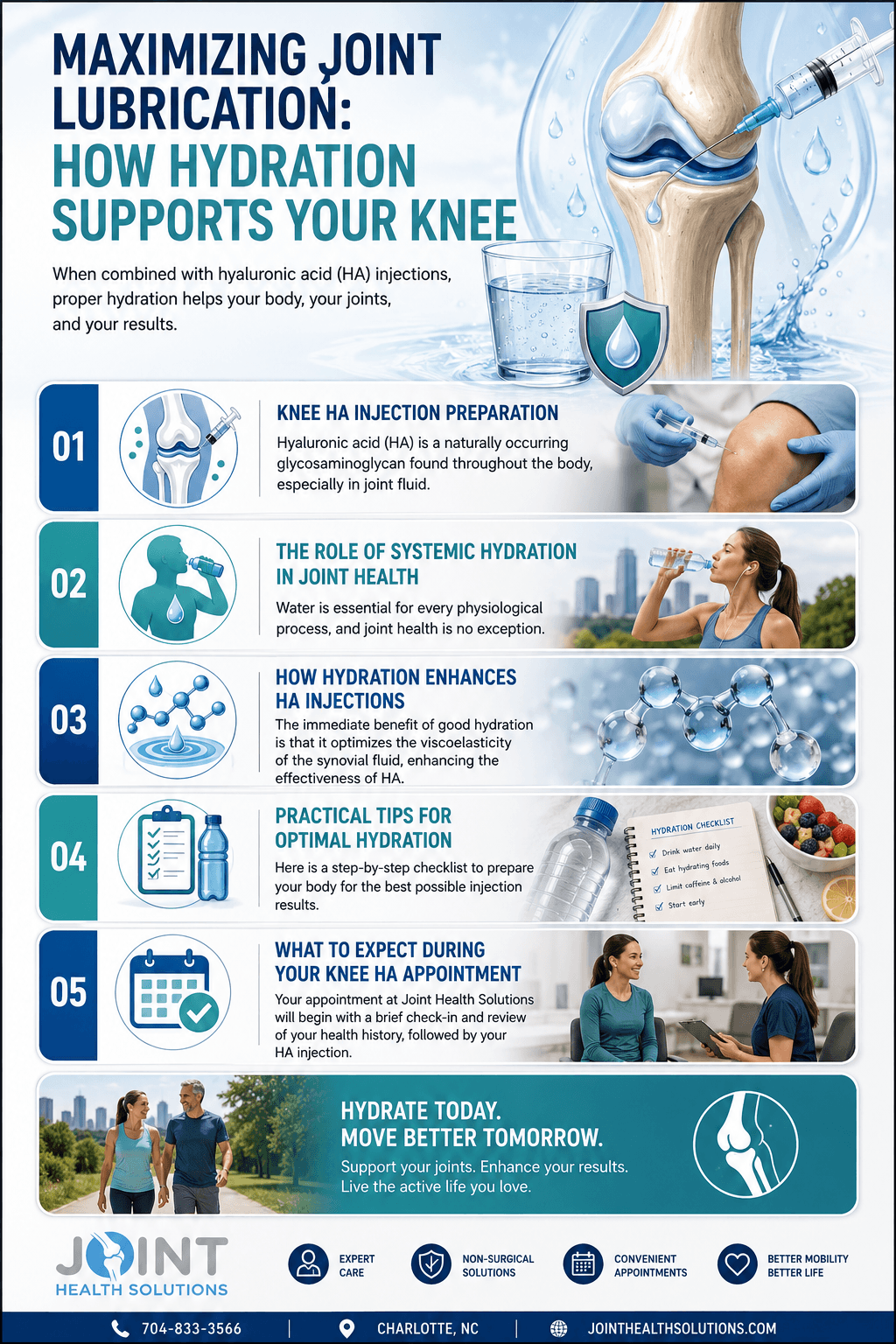
Proper hydration is sensible preparation for knee HA injections and supports overall joint health. Hyaluronic acid is a water-retaining molecule; the composition of synovial fluid is influenced by your body’s overall hydration status. Drinking adequate water — approximately 64 to 80 oz (8 to 10 glasses) daily in the week before your injection — is a low-risk, reasonable step. It supports vein access, general comfort, and normal physiological function. Note: direct evidence that pre-injection hydration specifically improves HA injection outcomes (duration, pain relief speed) has not been established in clinical trials; the rationale is based on joint physiology. HA injections themselves are FDA-approved for knee OA; most patients see benefit within 4 to 8 weeks, lasting approximately 6 months for most, up to 12 months for some.
Understanding Hyaluronic Acid and Joint Lubrication
Hyaluronic acid is a naturally occurring glycosaminoglycan found in connective tissues throughout the body, with the highest concentrations in synovial fluid and cartilage. In the knee joint, HA gives synovial fluid its viscoelastic properties — functioning as both a lubricant during rapid movement and a shock absorber under sustained compressive loading. The molecule can retain large amounts of water, which is central to its mechanical function.
In a healthy knee, HA concentration in synovial fluid typically falls in the range of 2.5 to 4 mg/mL. In knee osteoarthritis, both concentration and average molecular weight decline — the fluid becomes thinner and less protective. Cartilage surfaces experience increased friction, and the avascular cartilage tissue receives less efficient nutrient exchange from the diminished synovial fluid.
Viscosupplementation introduces a sterile, gel-like preparation of exogenous hyaluronic acid directly into the joint to supplement the depleted natural fluid. FDA-approved products include Synvisc, Euflexxa, Orthovisc, HYMOVIS ONE, and others. The primary mechanism is mechanical: restoring the lubricating and shock-absorbing properties of the synovial environment. Some in vitro studies suggest HA may also interact with cell surface receptors to modulate local inflammation, but the clinical significance of this biological signaling compared to the direct mechanical effect has not been clearly established.
How Hydration Relates to Joint Health
Cartilage is avascular — it has no direct blood supply and depends entirely on diffusion through synovial fluid for nutrient delivery and waste removal. Adequate systemic hydration influences the volume and composition of synovial fluid, which in turn affects this diffusion process. Research in cartilage biomechanics has established that cartilage contains roughly 65 to 80% water by weight, and that the water content of cartilage directly affects its load-bearing and compressive properties.
Dehydration affects joint physiology in several ways. Reduced fluid volume means less synovial fluid overall. The fluid that remains may have altered composition and reduced ability to coat cartilage surfaces uniformly. Long-term inadequate hydration is one of many lifestyle factors that can contribute to cartilage health decline.
Being well-hydrated on the day of your injection is still sensible for practical reasons: it makes vein access easier if blood work is needed, reduces the chance of feeling lightheaded, and supports normal physiological function during and after a procedure.
Hydration Guidelines for Preparation
The following table outlines general hydration guidance in the context of preparing for a joint injection appointment. These recommendations follow general medical pre-procedure guidance and basic joint physiology principles.
| Timeframe | Recommended Intake | Notes |
|---|---|---|
| 7 days before | 64–80 oz (8–10 glasses) daily | Begin increasing gradually if you currently drink less than this |
| Day before | 64–80 oz | Limit excessive caffeine and alcohol, which have diuretic effects |
| Injection day | Normal intake; drink water with a light meal | Avoid large volumes immediately before the procedure |
| After injection | Continue 64–80 oz daily | Supports overall recovery; no evidence it specifically extends HA duration |
Practical hydration tips
- Monitor urine color — pale yellow is the target; dark yellow indicates underhydration
- Drink a glass upon waking, with each meal, and once between meals
- Reduce but do not necessarily eliminate coffee or tea — replace one cup per day with water if reducing overall
- Eat water-rich foods: cucumbers, watermelon, lettuce, oranges
- Use a reusable water bottle to track daily intake
Individual fluid needs vary by body size, activity level, and climate. Charlotte summers are hot and humid; if you are physically active outdoors, your fluid needs will be higher than the 64 to 80 oz baseline.
Full Preparation Checklist for Your HA Injection Appointment
Hydration is one piece. Here is a complete preparation guide for your appointment at Joint Health Solutions.
One week before
- Begin increasing daily water intake gradually
- Review your current medications with your prescribing provider; ask whether to pause blood thinners (aspirin, warfarin, NSAIDs) before the injection
- Confirm your insurance coverage — our team can verify benefits before your appointment
Two to three days before
- Avoid strenuous activity that would significantly stress the knee
- Continue NSAIDs only if your provider has cleared you to do so; otherwise pause them as instructed
- Limit alcohol (diuretic effect; can affect bleeding risk)
Day before
- Drink your full water target; limit excessive caffeine
- Prepare comfortable clothing — loose pants or shorts that can be rolled above the knee
- Eat normally; there is no fasting requirement for this procedure
Injection day
- Eat a light meal before the appointment to avoid lightheadedness
- Drink water normally; avoid large volumes immediately before the procedure
- Arrive 15 minutes early for check-in
- Bring your medication list and insurance card
- Inform the clinician of any poultry allergies (some HA products are avian-derived; alternatives are available)
After the injection
- Apply ice to the site for 20 minutes at a time if there is soreness or swelling
- Avoid high-impact activity for 48 hours
- Resume light walking and normal daily activities the same day
- Continue adequate daily water intake
- Contact the clinic if post-injection pain is increasing rather than decreasing after 72 hours, or if you develop significant warmth, swelling, or fever
How HA Injections Compare to Other Knee Pain Treatments
| Treatment | How It Works | Established Benefits | Limitations & Risks |
|---|---|---|---|
| Oral NSAIDs / Acetaminophen | Reduce pain and inflammation systemically | Proven symptom relief; low cost; guideline first-line | Long-term NSAID use carries GI, renal, cardiovascular risks; does not restore joint lubrication |
| Corticosteroid Injections | Powerful local anti-inflammatory directly in joint | Rapid, meaningful short-term relief; guideline-supported for flares | Duration weeks to months; repeated use may affect cartilage; risk of infection, blood sugar elevation |
| Hyaluronic Acid Injections | Supplements synovial fluid viscosity and lubrication | FDA-approved for knee OA; modest but clinically meaningful pain relief; good safety profile; non-surgical | Modest effect size in many meta-analyses; less effective in severe OA; AAOS 2021 gives “inconclusive” recommendation; results vary |
| Physical Therapy | Strengthens muscles around joint; improves biomechanics | Guideline-recommended; durable functional improvements; no systemic risks | Requires consistent participation; slower onset than injections |
| Surgery (Knee Replacement) | Replaces damaged joint surfaces with implant | Highly effective for end-stage OA; durable outcomes | Invasive; recovery weeks to months; surgical risks including infection, blood clots, implant failure |
Evidence and Clinical Research
| Component | FDA Status | Evidence Level | Key Findings |
|---|---|---|---|
| Hyaluronic Acid Injections — Knee OA | FDA-approved for knee OA pain (multiple products) | Established clinical evidence (multiple meta-analyses) | Modest but clinically meaningful pain relief and functional improvement lasting approximately 6 months; good safety profile; most effective in mild to moderate OA |
| Systemic Hydration and Cartilage Health | N/A | Established for general cartilage physiology; direct link to HA injection outcomes is mechanistic / extrapolated | Articular cartilage is 65–80% water by weight; hydration status affects synovial fluid composition and cartilage nutrient diffusion; no clinical trials directly demonstrate that pre-injection hydration improves HA injection outcomes specifically |
| Hydration and HA Integration / Duration | N/A | Mechanistic / extrapolated; not established in RCTs | Physiologically plausible that a well-hydrated joint environment supports HA distribution; specific claims about accelerated HA clearance due to dehydration or extended duration due to hydration are not supported by published clinical studies on viscosupplementation |
What to Expect During Your Appointment
Your appointment at Joint Health Solutions will begin with a brief review of your health history and current symptoms. The injection itself typically takes 15 to 20 minutes including preparation. You will be seated or lying comfortably; the knee area is cleaned with antiseptic. Depending on your anatomy and the degree of OA, the clinician may use ultrasound or fluoroscopy to guide needle placement precisely into the joint space.
You may feel a brief pinch during needle insertion and mild pressure as the gel is delivered. The procedure is generally well-tolerated. After the injection, a small bandage is applied. You can walk out of the clinic and drive yourself home. Some patients experience mild soreness, warmth, or a sensation of fullness for 1 to 3 days — ice applied for 20 minutes at a time helps. Avoid high-impact activity for 48 hours.
If you are receiving a multi-injection course (e.g., 3 weekly injections), these short-term effects may recur mildly after each session. Improvement typically begins 4 to 8 weeks after the injection series is complete as the product integrates into the joint environment. If you develop significant increasing pain, joint warmth, swelling, or fever after the injection, contact our office — these signs warrant evaluation.
Post-Injection Care and Long-Term Joint Health
Hydration remains a sensible ongoing habit after your injection as part of general joint health maintenance. Beyond hydration, the following are well-supported components of long-term knee OA management:
- Low-impact exercise: Swimming, cycling, and walking on level surfaces help maintain joint mobility and muscle strength without placing excessive compressive force on the knee
- Quadriceps and hamstring strengthening: Periarticular muscle strength is one of the most modifiable factors in knee OA progression; it directly reduces the load transmitted to the joint surface
- Weight management: Each pound of body weight adds roughly 3 to 4 pounds of force across the knee joint during walking; even modest weight loss produces meaningful reductions in mechanical load
- Anti-inflammatory nutrition: Dietary patterns emphasizing omega-3 fatty acids, antioxidant-rich vegetables and fruits, and reduced ultra-processed food are associated with lower systemic inflammatory markers
- Follow-up: Attend scheduled follow-up appointments to assess response and determine whether repeat treatment or an alternative approach is indicated
At Joint Health Solutions we offer complementary services including offloading knee braces, physical therapy, nutrition plans, and PRP therapy to complement injection care.
Frequently Asked Questions
How much water should I drink before a knee HA injection?
We recommend 64 to 80 ounces (8 to 10 glasses) daily in the week before your injection as a general preparation step. This supports overall physiological function and vein access. There is no established clinical trial evidence that specific pre-injection hydration volumes directly improve HA injection outcomes; the rationale is based on joint physiology and good general practice.
Can dehydration affect the results of my injection?
Chronic dehydration affects cartilage health and synovial fluid composition generally. On the day of the injection, being adequately hydrated supports normal joint fluid volume and composition. Whether short-term hydration changes specifically alter HA injection outcomes has not been demonstrated in clinical trials.
What other preparations are recommended?
In addition to staying well-hydrated: discuss whether to pause blood-thinning medications with your prescribing provider; eat a light meal before the appointment; wear loose clothing with easy knee access; bring a complete medication list; inform the clinician of any poultry allergies if you know of them.
How long does it take for HA injections to work?
Many patients begin noticing improvement within 4 to 8 weeks after the injection series is complete. Some feel improvement earlier; the full benefit is typically assessed 6 to 8 weeks after the last injection. Duration of relief is approximately 6 months for most patients; some products and patients report benefit approaching 12 months.
Are there foods or drinks to avoid before the injection?
Avoid excessive alcohol in the days before, as it has a diuretic effect and can affect bleeding risk. Large amounts of caffeine can contribute to dehydration. There are no specific foods that interact with HA injections; a normal, balanced meal on the day of the appointment is appropriate.
Can I exercise before my injection?
Light daily activity is fine. Avoid strenuous exercise that significantly stresses the knee in the 24 hours before the injection. Your clinician will provide specific activity guidance based on your condition.
Is the injection painful?
Most patients report only a brief, mild pinch during catheter insertion — similar to a blood draw. The injection itself typically causes mild pressure or a sensation of fullness. A local anesthetic can be used if needed. Post-injection soreness at the site is common for 1 to 3 days; ice helps.
How many injections will I need?
Depending on the product, treatment involves one injection or a series of up to 3 injections spaced one week apart. Your clinician will recommend the appropriate product and regimen based on your clinical evaluation and insurance coverage.
Can I combine HA injections with other treatments?
Yes. HA injections are commonly used alongside physical therapy, offloading knee braces, and nutrition plans. Discuss your complete treatment plan with your provider at the consultation. Combining injection therapy with periarticular strengthening is particularly well-supported.
What are the risks?
Common and minor risks include temporary soreness, warmth, or swelling at the injection site. Serious complications — infection, allergic reaction, joint damage — are uncommon. Your provider will review the full risk profile before proceeding. The overall safety profile of HA injections is considered favorable in the literature.
Schedule a Consultation at Joint Health Solutions in Charlotte
If you’re considering HA injections for knee osteoarthritis or want to discuss your full range of non-surgical options, the first step is a clinical evaluation.
📞 Call: 704-833-3566
Location: 9350 Benfield Rd, Suite 109, Charlotte, NC 28269
Sources
Hyaluronic Acid Injections — Clinical Evidence
- Bannuru RR, et al. (2019). OARSI guidelines for the non-surgical management of knee, hip, and polyarticular osteoarthritis. Osteoarthritis and Cartilage. PubMed: 31278997
- Huang Y, et al. (2021). Efficacy and safety of intra-articular hyaluronic acid injection for knee osteoarthritis. Journal of Orthopaedic Surgery and Research. PubMed: 34011337
- Altman RD, et al. (2015). The mechanism of action for hyaluronic acid treatment in the osteoarthritic knee. BMC Musculoskeletal Disorders. PubMed: 26578847
Cartilage Composition and Hydration
- Bhosale AM, Richardson JB. (2008). Articular cartilage: structure, injuries and review of management. British Medical Bulletin. PubMed: 18514821
Guidelines
- American Academy of Orthopaedic Surgeons. (2021). Management of Osteoarthritis of the Knee: Evidence-Based Clinical Practice Guideline, 4th Edition. AAOS CPG 2021 — Viscosupplementation: “Inconclusive” recommendation
- Arthritis Foundation — Hyaluronic Acid Injections
Medical Disclaimer: This article is for educational purposes only and is not a substitute for medical advice, diagnosis, or treatment. The connection between pre-injection hydration and HA injection outcomes described in this article is based on joint physiology principles; it has not been directly validated in clinical trials on viscosupplementation. Hyaluronic acid injections do not reverse cartilage loss. Results vary by individual and OA severity. The AAOS 2021 CPG for knee OA gives an “Inconclusive” recommendation for viscosupplementation. A qualified healthcare provider must evaluate your specific condition before any treatment.