
How to Manage Knee Osteoarthritis Pain in Charlotte
Published July 14, 2026 | Last reviewed: July 14, 2026 | Category: Joint Health, Knee Pain | Location: Charlotte, NC
🕒 14 MIN READ
Knee osteoarthritis (OA) is a degenerative joint condition where cartilage wears down, causing pain, swelling, and stiffness. Improvement varies according to the cause and severity of knee pain, the treatment selected, overall health, and adherence to rehabilitation. Some treatments may produce gradual improvement, while others may not help. An evaluation is needed to determine realistic expectations. Non-surgical options available in Charlotte include hyaluronic acid injections, PRP therapy, physical therapy, and offloading knee braces. Candidates typically have mild to moderate osteoarthritis and have not found adequate relief from conservative measures.
What Is Knee Osteoarthritis?
Knee osteoarthritis (OA) is a degenerative joint disease where the cartilage that cushions the ends of your bones gradually wears down. This leads to pain, swelling, stiffness, and reduced mobility. While OA is a chronic condition, its symptoms can fluctuate based on weather, activity level, and other factors.
When the cartilage wears down, the underlying bone becomes exposed, leading to friction and inflammation. The synovial fluid, which normally lubricates the joint, may become less effective in some patients, contributing to stiffness. Recognizing individual triggers can help patients proactively adjust their routines and seek timely interventions.
Can Charlotte’s Summer Weather Affect Knee Pain?
Some people with arthritis report changes in joint pain when humidity, temperature, or barometric pressure changes. Research has identified modest associations in some studies, but evidence remains mixed and weather does not worsen the underlying cartilage damage. Responses vary considerably between individuals.
| Factor | Reported Association | Consideration |
|---|---|---|
| High Humidity | Some patients report increased joint discomfort | May relate to fluid retention in sensitive individuals; evidence is mixed |
| Increased Activity | Hot weather encourages more outdoor activities | May overload the arthritic knee if not paced appropriately |
| Dehydration | Some research suggests dehydration may affect synovial fluid | Staying adequately hydrated supports overall joint function |
| Barometric Pressure Changes | Some patients report increased pain before storms | Response varies considerably; not all individuals are affected |
For Charlotte residents, being aware of weather patterns may help in planning activities and pacing exercise. Weather is, however, just one of many factors influencing knee pain, and its role in OA symptoms should not be overstated.
3 Common Causes of Knee Osteoarthritis
Cause 1: Age-Related Wear and Tear
The most common cause of knee OA is the natural aging process. Over decades of use, the cartilage that cushions the knee joint gradually thins and loses its ability to absorb shock. This is particularly prevalent in adults over 50, but it can occur earlier in those with a history of joint stress.
Cause 2: Previous Joint Injury
Past trauma — such as a torn meniscus, ACL rupture, or fracture — can alter the joint’s natural alignment and mechanics. Even after complete rehabilitation, individuals with a prior knee injury remain significantly more likely to experience accelerated cartilage wear over time.
Cause 3: Repetitive Stress and Overuse
Occupations or hobbies that involve repetitive kneeling, squatting, or high-impact movements place exceptional stress on the knee joint. Over time, this targeted micro-trauma can strip away the cartilage layer, contributing to premature osteoarthritis.
Common Knee Osteoarthritis Symptoms
If you experience any of the following symptoms, it may be time to seek a professional evaluation:
- Persistent knee pain that does not improve with rest
- Stiffness after sitting or waking up that lasts more than 30 minutes
- Swelling around the knee that comes and goes
- A grinding, clicking, or popping sensation (crepitus) when moving
- Difficulty climbing stairs, getting up from a chair, or walking
- Pain that limits your daily activities or quality of life
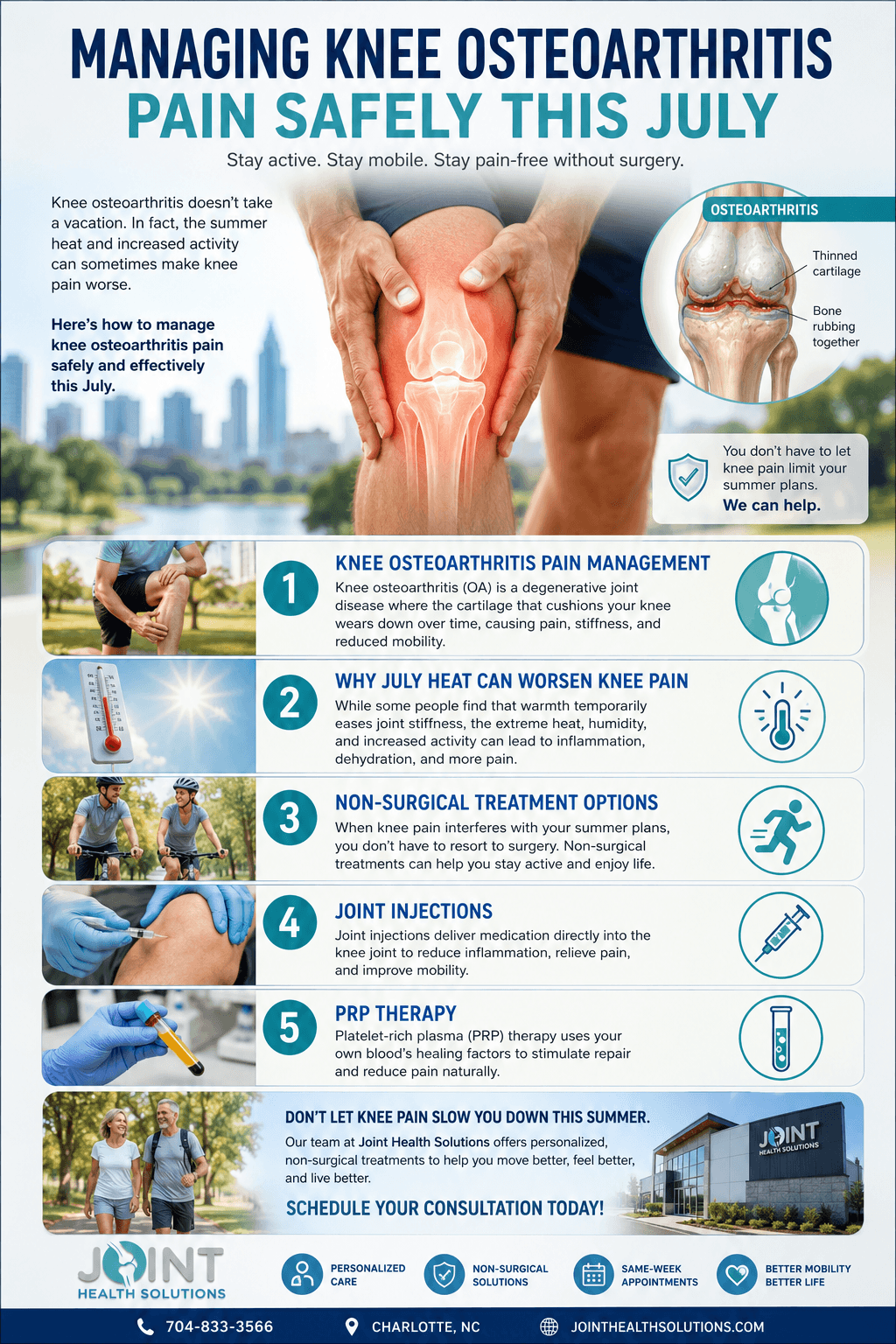
Managing Knee Osteoarthritis Pain Safely This July in Charlotte — infographic
When Knee Pain Needs Prompt Medical Attention
Seek immediate medical evaluation if you experience:
- Knee pain accompanied by fever, redness, or warmth around the joint
- Sudden, severe pain that prevents weight-bearing
- Knee that is visibly deformed or misshapen
- Inability to extend or fully flex the knee
- Pain that follows a fall or trauma
These symptoms may indicate conditions other than osteoarthritis, such as infection, fracture, or ligament injury, and should be evaluated promptly.
How Knee Osteoarthritis Is Diagnosed
Diagnosis typically involves:
- Medical history review: Discussion of symptoms, pain patterns, and medical history.
- Physical examination: Assessment of range of motion, stability, tenderness, and swelling.
- Imaging studies:
- X-rays: Can show joint space narrowing, bone spurs, and cartilage loss.
- MRI: May be ordered if X-rays are inconclusive or if other conditions are suspected.
- Additional testing: In some cases, joint aspiration may be performed to rule out gout or infection.
Evidence-Based Knee Osteoarthritis Treatment Hierarchy
Current clinical guidelines from AAOS, CDC, and the Arthritis Foundation recommend a stepped approach to knee OA management. The following hierarchy reflects the general evidence base and is intended to help patients understand where each option fits — not to replace a personalized evaluation.
| Tier | Options | Evidence Level |
|---|---|---|
| 1 — Foundational | Exercise / physical therapy, patient education, weight management when appropriate, activity modification | Established clinical evidence; recommended as first-line care |
| 2 — Symptom Management | Acetaminophen, NSAIDs (oral or topical), assistive devices, offloading braces | Established clinical evidence; individualized by health status and risk |
| 3 — Injection-Based | Corticosteroid injections, hyaluronic acid injections | Established to mixed evidence; FDA-approved options available; appropriate for selected patients who have not responded to tier 1–2 care |
| 4 — Limited or Emerging Evidence | PRP therapy, IV nutrient therapy | Limited human evidence; not FDA-approved for knee OA indication; not established first-line treatments; discuss evidence limitations with your provider |
| 5 — Surgical Evaluation | Arthroscopy (selected mechanical symptoms), partial or total knee replacement | Established evidence for appropriate candidates; reserved for failure of conservative care or advanced OA |
Evidence-Based First-Line Treatment
Exercise and Physical Therapy
Targeted physical therapy strengthens the muscles around the knee — particularly the quadriceps, hamstrings, and glutes — to improve joint stability and reduce stress on the cartilage. Exercise is a cornerstone of knee OA management supported by AAOS and CDC guidelines. Our therapists create personalized programs based on your specific needs and goals.
Evidence level: Established clinical evidence | Goal: Reduce pain, improve function
Weight Management When Appropriate
Excess body weight significantly increases stress on the knee joint. Research suggests that for every pound of body weight lost, knee joint load may decrease by approximately four pounds. CDC and AAOS guidelines support weight management as a foundational intervention for knee OA in patients for whom it applies.
Evidence level: Established clinical evidence | Goal: Reduce joint load
Activity Modification
Choosing low-impact activities like swimming, cycling, or using an elliptical machine can help maintain fitness while minimizing joint stress. Pacing activities and using assistive devices when needed can help manage symptoms during both summer and cooler months.
Evidence level: Established clinical evidence | Goal: Maintain function with less pain
Medication Considerations
Several medication options may help manage knee OA symptoms. Acetaminophen may help with pain relief. NSAIDs can reduce both pain and inflammation. Topical NSAIDs may be preferred for localized relief with fewer systemic side effects. Medication use should always be discussed with a healthcare provider, considering individual health status and potential side effects.
Evidence level: Established clinical evidence | Goal: Symptom management
Assistive Devices and Braces
- Offloading knee braces: Designed to shift weight away from the damaged part of the knee, reducing pain during walking and other weight-bearing activities.
- Canes or walkers: Can reduce joint load and improve stability when appropriate.
Evidence level: Established clinical evidence | Goal: Reduce pain, improve stability
Knee Injection Options
Corticosteroid Injections
Corticosteroid injections provide powerful, short-term anti-inflammatory relief. They can be useful for managing acute flares but should be used judiciously, as repeated injections over time may have adverse effects on cartilage. Candidacy and frequency should be determined by your provider.
Evidence level: Established clinical evidence | Duration: Weeks to months | Limitations: Not recommended for repeated long-term use
Hyaluronic Acid Injections (Viscosupplementation)
Hyaluronic acid injections restore knee lubrication by replenishing the synovial fluid that cushions the joint. This reduces friction and may improve shock absorption in some patients.
Evidence level: Mixed; FDA-approved for knee OA pain | Duration: Some patients report relief for 6 months or longer; duration varies | Limitations: Clinical guidelines vary; AAOS notes individualized assessment is important; not all patients experience benefit
Platelet-Rich Plasma (PRP) Therapy
PRP therapy uses your own blood plasma, concentrated with growth factors, to promote healing in damaged tissues. It may help reduce inflammation and support tissue repair in selected patients.
Evidence level: Limited human evidence; mixed study results | Regulatory status: PRP injections for knee osteoarthritis are not FDA-approved as a treatment for that indication. Certain devices used to prepare PRP may have FDA clearance for specific preparation purposes, which is different from approval of the resulting injection for knee osteoarthritis.
Treatments With Limited Knee-OA Evidence
Anti-Inflammatory IV Therapy
Intravenous therapy delivers a customized blend of vitamins, minerals, and anti-inflammatory agents directly into the bloodstream.
Evidence level: Limited human evidence; no high-quality clinical trials specifically for knee OA | Status: Not an established first-line treatment for knee osteoarthritis
Comparing Common Knee Osteoarthritis Treatment Options
| Treatment | Potential Purpose | Evidence Considerations | Limitations | When It May Be Discussed |
|---|---|---|---|---|
| NSAIDs / Acetaminophen | Pain relief | Established evidence for symptom relief | GI, kidney, liver risks; does not address cartilage loss | For initial symptom management |
| Corticosteroid Injections | Anti-inflammatory | Established evidence for short-term relief | May have adverse cartilage effects with repeated use; short duration | For managing acute flares |
| Hyaluronic Acid Injections | Joint lubrication | FDA-approved; mixed clinical guidelines | Results vary; no cartilage restoration | For patients not responding to first-line care |
| PRP Therapy | Tissue healing support | Limited evidence; mixed study results | Not FDA-approved for knee OA; cartilage regrowth not reliably demonstrated | For patients who understand the evidence limitations |
| Physical Therapy | Muscle strengthening | Established clinical evidence | Requires patient adherence | For all patients as foundational care |
| Surgery (Arthroscopy, Replacement) | Remove damaged tissue or replace joint | Established evidence for select patients | Invasive; long recovery; not appropriate for all patients | When conservative care fails in appropriate candidates |
Can Knee Osteoarthritis Be Reversed?
Knee osteoarthritis is a degenerative condition, and currently available treatments have not been shown to reverse the disease or reliably restore lost cartilage. The goal of treatment is to:
- Manage symptoms (pain, stiffness, swelling)
- Improve physical function
- Maintain quality of life
- Delay or potentially avoid surgery
Some treatments may support cartilage health or reduce inflammation, but none have been proven to regenerate significant cartilage loss in humans.
Managing Knee OA During Charlotte’s Hot Months
Charlotte summers bring heat, humidity, and increased outdoor activity — all of which can influence how knee OA symptoms are experienced. The following practical strategies may help patients stay active while managing their knee pain during warmer months.
- Choose low-impact activities: Swimming, cycling, and walking on flat surfaces reduce joint stress while maintaining fitness.
- Avoid peak heat: Exercise during cooler morning or evening hours when temperatures are lower.
- Stay hydrated: Adequate water intake supports general health and overall joint function.
- Use supportive footwear: Proper shoes reduce impact and joint stress with each step.
- Apply ice after activity: If swelling occurs, ice applied for 15–20 minutes can help manage post-activity inflammation.
- Pace yourself: Listen to your body, take rest breaks, and scale activity to your current pain level.
When Surgery May Be Appropriate
Surgery may be considered when:
- Conservative treatments have been exhausted without adequate relief
- Pain is severe and significantly impacts daily activities
- Joint damage is advanced (bone-on-bone)
- Quality of life is significantly diminished
Common surgical options:
- Arthroscopy: May be appropriate for mechanical symptoms but has limited benefit in advanced OA
- Knee replacement: For end-stage OA with bone-on-bone wear
Surgery decisions should be made in consultation with an orthopedic surgeon, weighing risks, benefits, and individual health status. Non-surgical care should typically be exhausted first.
What to Expect at Joint Health Solutions
Location: 9350 Benfield Rd, #109, Charlotte, NC 28269 | Phone: 704-833-3566
Your first visit begins with a thorough evaluation. We review your medical history, perform a physical exam, and may order imaging such as X-rays or MRI to assess the extent of cartilage loss and joint damage. Based on the findings, we discuss your options and develop a personalized treatment plan.
If you are a candidate for injections, the procedure is performed in our clinic and typically takes about 30 minutes. You may experience mild soreness afterward, but most patients return to normal activities within a day or two. We schedule follow-up visits to monitor your progress and determine whether additional treatments are needed.
Learn more about our knee arthritis treatment services in Charlotte.
Questions to Ask Before Choosing Treatment
- What is the expected benefit of this treatment for my specific condition?
- What evidence supports this treatment for knee osteoarthritis?
- What are the risks and potential side effects?
- How long will effects last if I respond?
- Is this treatment covered by my insurance?
- What is the plan if I don’t respond to this treatment?
- Can this treatment be combined with other approaches?
- What is the typical timeline for seeing results?
Frequently Asked Questions
Can heat make knee osteoarthritis worse?
For some people, yes. While gentle heat may temporarily ease stiffness, extreme heat and humidity may increase joint discomfort in sensitive individuals. Research on weather and OA symptoms is mixed, so responses vary. Listen to your body and use cooling measures or rest if heat aggravates your symptoms.
What non-surgical treatments work best for knee OA?
The most effective treatments vary by individual but commonly include physical therapy, weight management when appropriate, NSAIDs or acetaminophen, corticosteroid or hyaluronic acid injections, and offloading knee braces. A comprehensive plan often combines several approaches. A clinical evaluation is the best way to determine what is appropriate for your specific case.
Is it safe to exercise with knee osteoarthritis in summer?
Yes, with appropriate precautions. Choose low-impact activities like swimming or cycling, stay hydrated, avoid peak heat hours, and use supportive footwear. If pain increases, reduce intensity and consult a specialist for personalized guidance.
How long do joint injections last?
Corticosteroid injections typically provide relief for several weeks to a few months. Hyaluronic acid injections may provide relief for 6 months or longer in some patients. Duration depends on the severity of your arthritis, activity level, and individual response. Not all patients experience the same results.
When should I consider PRP therapy?
PRP therapy is often considered for patients with mild to moderate knee osteoarthritis who have not responded well to other conservative treatments and who understand the current evidence limitations. It may also be used alongside other therapies. Discuss candidacy and realistic expectations with your provider before proceeding.
Can an offloading knee brace really help?
Yes. An offloading knee brace is designed to shift weight away from the damaged part of the knee, reducing pain during walking and other weight-bearing activities. Many patients find it allows them to stay active with less discomfort, particularly during higher-activity summer months.
What should I expect during my first visit?
You’ll meet with a provider who will review your medical history, perform a physical exam, and may order imaging if needed. Together, you’ll discuss your goals and create a personalized treatment plan tailored to your needs and the current evidence.
Is physical therapy covered by insurance?
Many insurance plans cover physical therapy, especially when prescribed by a physician. Check with your insurance provider to confirm coverage. Our team can assist with insurance verification.
Can nutrition affect knee osteoarthritis?
While diet cannot cure arthritis or reverse structural joint damage, an anti-inflammatory dietary pattern rich in fruits, vegetables, and omega-3 fatty acids may help reduce systemic inflammation and support overall health. Nutrition is best understood as one component of a comprehensive management plan, not a standalone treatment. Speak with your provider or a registered dietitian for personalized guidance.
Do I need a referral to see a specialist?
Some insurance plans require a referral, while others do not. Check with your insurance carrier. Joint Health Solutions can help you navigate the process and schedule an appointment.
Is hyaluronic acid FDA-approved?
Yes. Several hyaluronic acid products have received FDA approval for knee osteoarthritis pain in patients who have not responded adequately to conservative therapy. FDA approval indicates the product met safety and efficacy standards in studied populations, but it does not mean every patient will benefit. Individual results vary.
What is osteoarthritis grading?
Osteoarthritis is often graded 0–4 based on joint space narrowing, bone spurs, and other imaging findings. Mild to moderate OA (grades 1–3) is generally more responsive to non-surgical treatments. Grade 4 (bone-on-bone) may require surgical evaluation.
Can knee pain be something other than osteoarthritis?
Yes. Pain can also result from meniscus tears, ligament injuries, tendonitis, gout, bursitis, or inflammatory arthritis. A proper evaluation is needed to identify the specific cause and select appropriate treatment.
How is knee OA different from inflammatory arthritis?
Knee OA is a degenerative condition affecting cartilage. Inflammatory arthritis (e.g., rheumatoid arthritis) involves the immune system attacking the joint lining, causing systemic inflammation that often affects multiple joints. Treatment approaches differ significantly, which is why accurate diagnosis matters.
Is osteoarthritis hereditary?
Genetics can play a role in osteoarthritis risk. Family history of OA, along with prior joint injury, body weight, and age, can increase the likelihood of developing the condition over time.
What is the role of synovial fluid in knee health?
Synovial fluid lubricates the joint, providing a smooth surface for movement. In OA, both the quantity and quality of synovial fluid can decline, leading to increased friction and pain. This is part of the rationale for viscosupplementation (hyaluronic acid injections) as a treatment option.
Ready to Take the Next Step?
If knee pain is limiting your daily activities, our board-certified providers at Joint Health Solutions are here to help. We will evaluate your condition and discuss which evidence-based treatments may be appropriate for you.
📞 Call us: 704-833-3566
Checklist for your first visit:
- Bring your insurance card and a photo ID
- List any current medications and supplements
- Wear comfortable clothing that allows access to your knee
- Arrive 15 minutes early to complete paperwork
- Bring any relevant imaging (X-ray, MRI) if available
Sources and Medical Review
Institutional Sources
- Centers for Disease Control and Prevention (CDC) — Arthritis
- Arthritis Foundation — Osteoarthritis
- National Institute of Arthritis and Musculoskeletal and Skin Diseases (NIAMS) — Osteoarthritis
- Mayo Clinic — Knee Osteoarthritis
Key Clinical References
- Bannuru RR, et al. (2019). OARSI guidelines for the non-surgical management of knee, hip, and polyarticular osteoarthritis. Osteoarthritis and Cartilage. PubMed: 31278997
- Derry S, et al. (2016). Topical NSAIDs for chronic musculoskeletal pain in adults. Cochrane Database. PubMed: 27103611
- Jevsevar D, et al. (2015). Viscosupplementation for Osteoarthritis of the Knee: A Systematic Review of the Evidence. Journal of Bone and Joint Surgery. PubMed: 26491131
- Belk JW, et al. (2021). Platelet-Rich Plasma Versus Hyaluronic Acid for Knee Osteoarthritis: A Systematic Review and Meta-analysis. American Journal of Sports Medicine. PubMed: 33264573
- AAOS Clinical Practice Guideline: Management of Osteoarthritis of the Knee (Non-Arthroplasty), 4th Edition. American Academy of Orthopaedic Surgeons, 2021.
Disclaimer: This content is for informational purposes only and does not constitute medical advice. Always consult with a qualified healthcare provider to determine if these treatments are appropriate for your specific condition. Results vary, and not every patient is a candidate for every treatment.