

Adhesive Capsulitis (Frozen Shoulder): Breaking the Cycle of Pain and Immobility
Frozen shoulder treatment Charlotte is the primary focus of this guide, designed to help you navigate one of the most debilitating joint conditions affecting the upper body.
Imagine reaching for a cup from the top shelf, only to be stopped by a sharp, unyielding pain in your shoulder. Or trying to put on a jacket, but your arm simply won’t lift high enough. For millions of people, this is the daily reality of adhesive capsulitis, commonly known as frozen shoulder. This condition doesn’t just limit movement; it disrupts sleep, affects work, and steals the joy from simple activities. If you’re searching for frozen shoulder treatment Charlotte, you’re likely tired of the cycle of pain and stiffness.
The good news is that effective, non-surgical solutions exist. At Joint Health Solutions, we specialize in breaking that cycle and helping you regain your range of motion without invasive procedures. Our approach focuses on understanding the unique stages of frozen shoulder and tailoring treatments that support your body’s natural healing. Whether you’re in the early painful phase or the later stiff phase, there is hope. Let’s explore what frozen shoulder is, why it happens, and how you can find lasting relief right here in Charlotte.
Frozen shoulder affects approximately 2% to 5% of the general population, with higher rates among individuals with certain metabolic conditions. The hallmark of this condition is a progressive loss of both active and passive range of motion, meaning that even when someone else tries to move your arm, the shoulder resists. This distinguishes frozen shoulder from other conditions like rotator cuff tears, where pain may limit movement but the joint itself is not inherently stiff. Understanding this distinction is critical for proper diagnosis and treatment. At Joint Health Solutions, we use detailed physical examinations and imaging studies, such as ultrasound or MRI, to confirm the diagnosis and rule out other pathologies. Our team is dedicated to providing compassionate, evidence-based care that addresses not just the symptoms but the underlying mechanisms of adhesive capsulitis.
What Is Adhesive Capsulitis (Frozen Shoulder)?
Adhesive capsulitis is a condition characterized by thickening and tightening of the shoulder joint capsule—the connective tissue that surrounds the ball-and-socket joint. This leads to progressive stiffness and pain, making it difficult to move the shoulder. The exact cause isn’t always clear, but it often develops after a period of immobility, such as after an injury or surgery. It’s more common in people between 40 and 60 years old, and women are affected more frequently than men. Conditions like diabetes, thyroid disorders, and heart disease can increase the risk.
Understanding that frozen shoulder is a real, treatable medical condition is the first step toward recovery. At Joint Health Solutions, we see many patients who have been told to ‘wait it out,’ but we believe in proactive, non-surgical care that can shorten the duration and ease the symptoms. To find specialized care for related upper extremity conditions, you can explore our dedicated Shoulder Pain Charlotte diagnostic resources.
To expand on the pathophysiology, the shoulder joint capsule is normally a flexible, elastic structure that allows for a wide range of motion. In adhesive capsulitis, the capsule becomes inflamed and then fibrotic, meaning it develops scar-like tissue that adheres to the underlying bone. This process is driven by an abnormal inflammatory response, often involving cytokines and growth factors that promote fibrosis. The result is a contracted capsule that restricts movement, much like a tight rubber band. Patients often describe a sensation of “catching” or “blocking” when trying to lift their arm overhead or reach behind their back.
This mechanical restriction is what differentiates frozen shoulder from simple muscle tightness or arthritis. Additionally, research has shown that individuals with diabetes are up to five times more likely to develop frozen shoulder, and they often experience a more prolonged and severe course. This is thought to be due to the effects of hyperglycemia on collagen metabolism and microvascular health. At Joint Health Solutions, we take a comprehensive approach, screening for underlying conditions and coordinating care with primary care physicians or endocrinologists when needed. Our goal is to treat the whole person, not just the shoulder.
Stages of Frozen Shoulder: The Cycle of Pain and Immobility
Frozen shoulder typically progresses through three overlapping stages. Recognizing which stage you’re in helps guide your customized frozen shoulder treatment Charlotte program. Each stage has distinct clinical features and optimal management strategies. Understanding this progression empowers patients to be active participants in their recovery, knowing what to expect and when to seek specific interventions.
Stage 1: The Freezing Stage
During this stage, pain increases gradually, and the shoulder starts to lose range of motion. Pain is often worse at night and with movement. This stage can last from 6 weeks to 9 months. Patients frequently report difficulty sleeping on the affected side, and the pain may radiate down the arm or into the neck. Activities like reaching for a seatbelt, combing hair, or putting on a bra become increasingly challenging. The pain is typically diffuse and aching, rather than sharp, and may be accompanied by muscle spasms in the shoulder girdle.
At this stage, the primary goal of treatment is pain control and inflammation reduction. At Joint Health Solutions, we emphasize gentle, passive range-of-motion exercises to prevent further stiffness without aggravating the inflammatory process. We also educate patients on proper sleep positioning, such as using a pillow to support the arm, to minimize nighttime discomfort. Early intervention during the freezing stage can significantly shorten the overall duration of the condition and prevent progression to severe stiffness.
Stage 2: The Frozen Stage
Pain may diminish, but stiffness persists. The shoulder becomes significantly restricted, making daily tasks challenging. This stage can last 4 to 12 months. During the frozen stage, the acute inflammatory phase subsides, and the capsule becomes thick and contracted. Patients often notice that the constant, gnawing pain gives way to a dull ache that occurs primarily at the end ranges of motion. However, the functional limitations become more pronounced. Simple activities like washing the back, reaching into a cupboard, or throwing a ball become impossible.
The shoulder may feel like it is “locked” in place, and attempts to force movement can cause sharp pain. In this stage, the focus of treatment shifts to stretching and mobilization. At Joint Health Solutions, our physical therapists use techniques such as joint mobilizations, soft tissue massage, and sustained stretches to gradually lengthen the capsule. We also incorporate modalities like heat or ultrasound to improve tissue extensibility. It is important to note that aggressive stretching during this stage can actually worsen the condition by causing microtrauma and reactive inflammation. Therefore, we emphasize a “low-load, prolonged stretch” approach, where gentle tension is held for 30 seconds to several minutes, multiple times per day. This method is scientifically proven to promote plastic deformation of collagen fibers, effectively increasing range of motion over time.
Stage 3: The Thawing Stage
Range of motion slowly improves. This stage can take anywhere from 5 months to 2 years. Without treatment, full recovery may take up to 3 years. Non-surgical interventions can help accelerate this process and reduce discomfort. During the thawing stage, the capsule begins to remodel and regain elasticity. Patients often describe a gradual “loosening” sensation, with incremental improvements in their ability to perform overhead activities. However, this stage can be frustrating because progress is not always linear; there may be plateaus or temporary setbacks.
It is crucial to maintain a consistent home exercise program during this period to sustain gains and prevent recurrence of stiffness. At Joint Health Solutions, we provide patients with detailed, illustrated home exercise handouts and use telehealth check-ins to monitor compliance and adjust the program as needed. We also emphasize the importance of strengthening the rotator cuff and scapular stabilizers, as these muscles often become weak and atrophied during the prolonged period of immobility. Strengthening not only improves function but also reduces the risk of future injury. By combining stretching, strengthening, and patient education, we help patients navigate the thawing stage with confidence and achieve the best possible outcome.
It is important to recognize that these stages can overlap, and not every patient experiences them in a textbook fashion. Some individuals may have a prolonged freezing stage with minimal stiffness, while others may transition quickly to the frozen stage. This variability underscores the need for personalized treatment plans. At Joint Health Solutions, we perform a comprehensive assessment at each visit, using objective measures such as goniometry (measurement of joint angles) and functional questionnaires to track progress. This data-driven approach allows us to tailor interventions to the individual’s specific stage and response to treatment. For example, a patient in the early freezing stage may benefit more from corticosteroid injections and gentle range of motion, while a patient in the frozen stage may require more intensive manual therapy and a structured stretching program. By matching treatment to the stage, we optimize outcomes and minimize unnecessary interventions.
Why Choose Non-Surgical Treatment in Charlotte?
Many patients worry that surgery is their only option, but that’s not the case. Non-surgical treatments for frozen shoulder focus on reducing inflammation, restoring mobility, and addressing underlying factors. In Charlotte, Joint Health Solutions offers a comprehensive suite of non-surgical therapies that are evidence-based and personalized. By choosing non-surgical care, you avoid the risks of anesthesia, infection, and lengthy recovery associated with surgery. Plus, our treatments can be combined for a synergistic effect. Our goal is to help you return to your active lifestyle as quickly and safely as possible.
To elaborate, surgical options for frozen shoulder, such as manipulation under anesthesia or arthroscopic capsular release, are reserved for cases that fail to improve with conservative care. While these procedures can be effective, they carry inherent risks, including infection, nerve injury, fracture, and the potential for recurrent stiffness. Additionally, recovery from surgery often requires several weeks of immobilization followed by intensive physical therapy, which can be both time-consuming and costly. In contrast, non-surgical treatments are low-risk and can be performed in an outpatient setting with minimal downtime.
At Joint Health Solutions, we have helped hundreds of patients avoid surgery by implementing a multidisciplinary approach that includes joint injections, physical therapy, and lifestyle modifications. Our success rates are comparable to or better than surgical outcomes, with the added benefit of a more gradual, natural recovery process. Furthermore, non-surgical treatments address the underlying causes of frozen shoulder, such as systemic inflammation or metabolic imbalances, rather than simply releasing the mechanical restriction. This holistic approach not only resolves the current episode but also reduces the risk of recurrence in the opposite shoulder. For patients seeking a safe, effective, and patient-centered alternative to surgery, Joint Health Solutions is the premier choice for frozen shoulder treatment Charlotte.
Non-Surgical Treatment Options at Joint Health Solutions
We offer a range of treatments tailored to your stage and severity of frozen shoulder. Each treatment is supported by rigorous scientific evidence and is administered by our team of experienced specialists. We believe in empowering patients with knowledge, so we take the time to explain the rationale behind each intervention, expected outcomes, and potential side effects.
-
Joint Injections:
Corticosteroid injections can reduce inflammation and pain, especially during the freezing stage. Fluoroscopy-Guided Injections ensure precise placement within the tight joint capsule. Hyaluronic Acid Injections may help lubricate the joint space, while PRP Therapy uses your own platelets to promote tissue healing. Corticosteroids work by suppressing the inflammatory cascade, reducing the production of pro-inflammatory cytokines and decreasing capillary permeability. This leads to a rapid reduction in pain and swelling, allowing patients to participate more comfortably in physical therapy.
The effects typically last 4 to 6 weeks, and a series of 1 to 3 injections may be recommended. Fluoroscopy guidance is crucial for accuracy, as it allows the physician to visualize the joint space and ensure the medication is delivered precisely where it is needed. This minimizes the risk of injecting into surrounding structures, such as tendons or blood vessels, and maximizes therapeutic benefit. Hyaluronic acid, also known as viscosupplementation, is a gel-like substance that naturally occurs in joint fluid. In frozen shoulder, the joint fluid becomes thin and less lubricating, contributing to stiffness. Injecting hyaluronic acid can restore the viscoelastic properties of the joint, improving glide and reducing pain.
Platelet-rich plasma (PRP) therapy is a regenerative treatment that involves drawing a small amount of the patient’s blood, processing it to concentrate platelets, and injecting it into the joint. Platelets contain growth factors that stimulate tissue repair and modulate inflammation. PRP is particularly useful in the subacute or chronic stages of frozen shoulder, where fibrosis is the dominant pathology. At Joint Health Solutions, we offer all three types of injections and work with patients to determine the best option based on their stage, medical history, and goals. We also combine injections with physical therapy for a synergistic effect, as the pain relief from the injection allows for more effective stretching and mobilization.
-
Physical Therapy:
Gentle, progressive stretching and strengthening exercises are crucial for restoring range of motion. Our therapists use hands-on techniques and teach you a home program to maintain progress. Physical therapy for frozen shoulder is not a one-size-fits-all approach; it must be carefully dosed to avoid exacerbating inflammation while still providing sufficient stimulus for tissue remodeling. In the early stages, the focus is on passive range of motion, where the therapist moves the patient’s arm without active muscle contraction. This includes techniques like pendulum exercises, supine external rotation stretches, and posterior capsule stretches.
As pain subsides, active-assisted exercises are introduced, where the patient uses their opposite arm or a pulley system to help move the affected arm. Strengthening exercises are typically reserved for the thawing stage, when the capsule has regained some elasticity and the risk of re-injury is lower. Our therapists also incorporate manual therapy techniques, such as joint mobilizations (grades I-IV) and soft tissue mobilization, to address muscle tightness and joint stiffness. These hands-on techniques can provide immediate improvements in range of motion and are particularly effective for patients who struggle with self-stretching due to pain or fear.
In addition to in-clinic sessions, we emphasize the importance of a home exercise program. Research shows that patients who perform daily stretching exercises achieve better outcomes than those who rely solely on clinic visits. At Joint Health Solutions, we provide each patient with a personalized home program, complete with written instructions, videos, and a log to track progress. We also use telehealth follow-ups to ensure proper technique and adherence. By combining skilled hands-on therapy with a robust home program, we maximize the potential for recovery.
-
Anti-Inflammatory IV Therapy and Nutrition Plan
Systemic inflammation can worsen frozen shoulder. Anti-Inflammatory IV Therapy delivers vital nutrients directly into your bloodstream, and a personalized nutrition plan helps reduce inflammation from the inside out. Systemic inflammation, often driven by diet, stress, or underlying medical conditions, can perpetuate the inflammatory response in the shoulder joint, making frozen shoulder more resistant to treatment. Anti-inflammatory IV therapy, also known as IV nutrient therapy, involves the intravenous administration of high-dose vitamins, minerals, and antioxidants that have potent anti-inflammatory properties.
Common components include vitamin C, magnesium, glutathione, and alpha-lipoic acid. These nutrients work synergistically to neutralize free radicals, reduce oxidative stress, and modulate immune function. The advantage of IV delivery is that it bypasses the digestive system, allowing for 100% absorption and rapid onset of action. A typical protocol involves a series of weekly infusions over 4 to 6 weeks, with maintenance infusions as needed.
In addition to IV therapy, we provide personalized nutrition plans that emphasize anti-inflammatory foods such as fatty fish (rich in omega-3s), leafy greens, berries, turmeric, and ginger, while minimizing pro-inflammatory foods like refined sugars, processed meats, and trans fats. We also address specific deficiencies that may be contributing to inflammation, such as vitamin D or omega-3 deficiency. Our registered dietitian works one-on-one with patients to develop realistic, sustainable dietary changes that support healing. By addressing both local joint inflammation and systemic inflammation, we create an optimal environment for recovery and reduce the likelihood of recurrence. This integrated approach sets Joint Health Solutions apart from conventional treatments that focus solely on the shoulder.
Comprehensive Care Summary
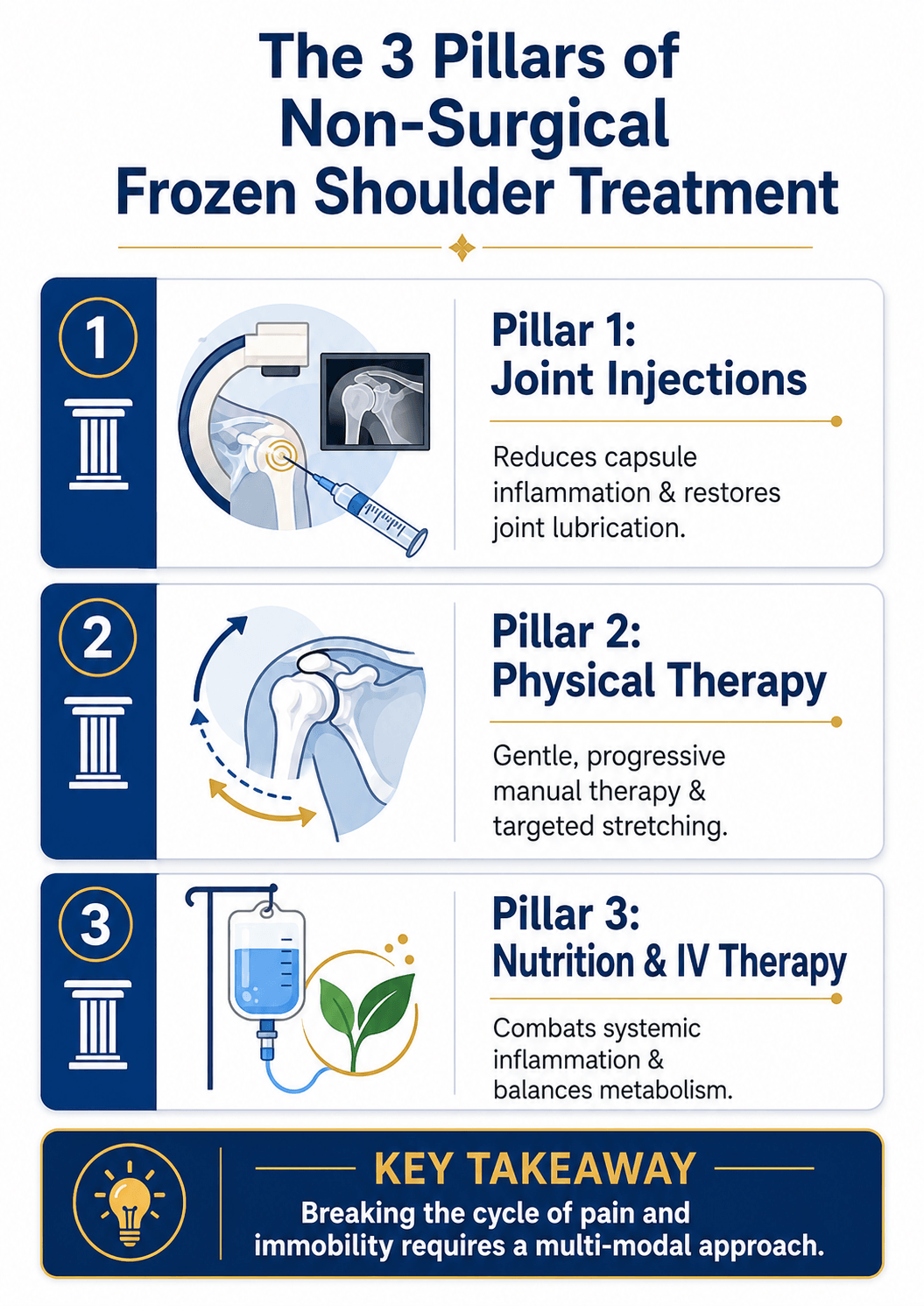
| Treatment Pillar | Core Mechanism | Targeted Benefit | Best For |
| Joint Injections | Corticosteroids, Hyaluronic Acid, or PRP under fluoroscopy. | Drastically reduces localized pain and restores lubrication. | Freezing and Frozen Stages |
| Physical Therapy | Custom stretching, joint mobilization, and guided home video plans. | Progressively lengthens the joint capsule and builds strength. | Frozen and Thawing Stages |
| Nutrition & IV | Anti-inflammatory meal planning paired with nutrient infusions. | Targets systemic metabolic imbalances and root causes. | All Recovery Stages |
What to Expect During Your Recovery
Recovery from frozen shoulder requires patience and consistency. With non-surgical treatment, many patients notice improvement within weeks. Your treatment plan may involve weekly visits for injections or therapy, along with daily home exercises. We monitor your progress and adjust the plan as needed. Most importantly, we empower you with knowledge and tools to manage your condition. You won’t be alone; our team supports you every step of the way.
To provide a more detailed roadmap, the typical recovery timeline at Joint Health Solutions unfolds as follows. During the first 2 to 4 weeks, the focus is on pain management and reducing inflammation. Patients may receive a targeted capsule injection and begin gentle, passive range-of-motion exercises. Many experience a substantial reduction in pain within the first week, allowing for better sleep and participation in daily activities. Between weeks 4 and 8, the emphasis shifts to restoring range of motion. Patients attend physical therapy 1 to 2 times per week and perform home exercises daily. During this phase, it is common to see measurable improvements in external rotation and overhead functionality.
Call to Action (CTA) with Internal Link
📅 Ready to break the cycle of shoulder pain and stiffness?
Don’t let adhesive capsulitis limit your life or disrupt your sleep any longer. Our specialized medical team in North Carolina is ready to design a non-surgical, multimodal treatment plan tailored exactly to your stage of recovery. Explore our comprehensive Treatments & Services and book your shoulder consultation online or call our office today to start reclaiming your mobility!
Frequently Asked Questions
How long does frozen shoulder last?
Without treatment, frozen shoulder can last 1 to 3 years. Non-surgical interventions may shorten this duration and reduce pain.
Can frozen shoulder recur?
Recurrence in the same shoulder is rare, but it can affect the opposite shoulder in up to 20% of patients.
Is physical therapy effective for frozen shoulder?
Yes, physical therapy is a cornerstone of treatment, helping to restore range of motion and strength when done gently and consistently.
What injections help frozen shoulder?
Corticosteroid injections reduce inflammation and pain. PRP and hyaluronic acid injections may also be beneficial in certain stages.
When should I see a specialist for shoulder pain?
If shoulder pain limits daily activities, disrupts sleep, or persists for more than a few weeks, consult a specialist.
Can frozen shoulder be treated without surgery?
Yes, most cases respond well to non-surgical treatments like injections, physical therapy, and anti-inflammatory strategies.
Is frozen shoulder painful all the time?
Pain varies by stage. It is often worse at night and with movement, but can be constant during the freezing stage.
Does diabetes affect frozen shoulder?
Yes, diabetes increases the risk and may make the condition more stubborn. Tight glucose control can help.
What is the first treatment for frozen shoulder?
Conservative care including pain management, gentle stretching, and anti-inflammatory measures is typically first-line.
Can I prevent frozen shoulder after an injury?
Early mobilization under guidance and physical therapy can reduce the risk of developing frozen shoulder.
Sources
-
American Academy of Orthopaedic Surgeons (AAOS) – Adhesive Capsulitis Clinical Guidelines
-
National Institutes of Health (NIH) – Non-Operative Treatment of Frozen Shoulder
-
Harvard Health Publishing – Treating a Frozen Shoulder Without Surgery
-
Journal of Shoulder and Elbow Surgery – Multimodal Care for Adhesive Capsulitis