Don’t Let Knee Osteoarthritis Stop Your Summer: Hyaluronic Acid Injections in Charlotte
Published July 15, 2026 | Last reviewed: July 15, 2026 | Category: Treatments & Services | Location: Charlotte, NC
🕒 12 MIN READ
Introduction
Summer in Charlotte means outdoor concerts, hiking the U.S. National Whitewater Center trails, gardening, and family barbecues. But for millions of Americans living with knee osteoarthritis, the warmer months can be a painful reminder of what they can no longer do. The stiffness, grinding sensation, and sharp pain with every step can turn a season of joy into one of limitation.
If you have been told your only options are painkillers, steroid shots that wear off quickly, or major surgery, you may feel stuck. But there is a proven, non-surgical treatment that may help: hyaluronic acid injections, also known as viscosupplementation. This FDA-approved therapy replenishes the natural lubricant in your knee joint, reducing friction and pain. In this article, we explain what viscosupplementation is, what the evidence shows, who is a good candidate, and what to expect at Joint Health Solutions in Charlotte.
Why Knee Osteoarthritis Flares Up in Summer
Many patients report increased knee pain during summer months — not because of the heat itself, but because of the sudden increase in activity. After months of relative inactivity, people tend to jump into high-impact activities: hiking, running, gardening, or extended walking tours — without gradual conditioning. This places stress on already damaged cartilage, triggering pain and inflammation.
Changes in barometric pressure and humidity may also play a role in how arthritis symptoms feel, though the mechanisms are not fully understood. Dehydration, more common in hot weather, can reduce the volume of synovial fluid and increase joint discomfort. Prolonged sitting during summer travel can worsen stiffness. These environmental factors compound the baseline impairment of an osteoarthritic knee.
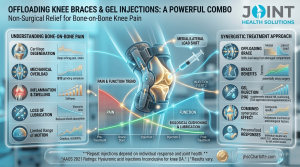
At Joint Health Solutions, we recommend addressing both the treatment itself and the surrounding context: pacing activity increases gradually, staying well hydrated, and using supportive measures like offloading braces alongside injection therapy when appropriate.
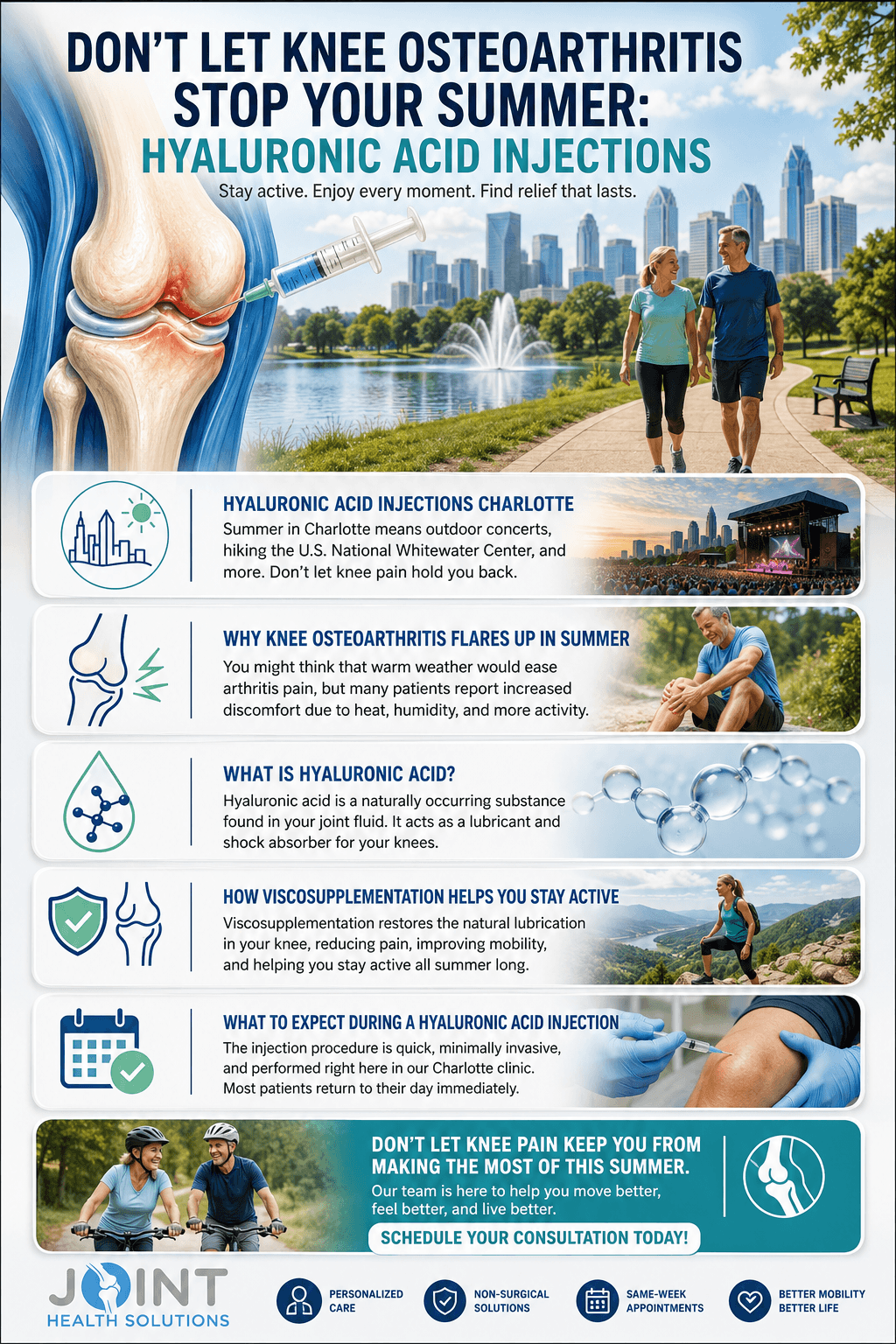
However, there is a proven, non-surgical treatment that can help you get back to the activities you love: hyaluronic acid injections Charlotte offers at Joint Health Solutions. This therapy, known as viscosupplementation, replenishes the natural lubricant in your knee joint, reducing friction and pain for months. Imagine walking through Freedom Park without wincing, playing with your grandchildren, or simply sleeping through the night without knee pain. In this article, we will explore why knee osteoarthritis flares in summer, how hyaluronic acid injections Charlotte can help, and what you can expect from treatment. If you are ready to reclaim your summer, read on to learn how hyaluronic acid injections Charlotte might be the solution you have been looking for.
Quick Answer
What Is Hyaluronic Acid Viscosupplementation?
Hyaluronic acid is a naturally occurring glycosaminoglycan that gives healthy synovial fluid its viscoelastic properties — it functions as both a lubricant during rapid movement and a shock absorber under slow, compressive loading. In knee osteoarthritis, the concentration and average molecular weight of hyaluronic acid in the joint fall, and the fluid loses its normal protective behavior. Friction between cartilage surfaces increases and the joint becomes less capable of absorbing mechanical stress.
Viscosupplementation introduces a sterile, gel-like preparation of exogenous hyaluronic acid directly into the joint space to supplement what the body is no longer producing adequately. FDA-approved products include Synvisc, Euflexxa, Orthovisc, HYMOVIS ONE, and TriVisc, among others. These products vary in their molecular weight and cross-linking technology, which affects their viscosity and residence time in the joint, though comparative clinical outcome data between products is mixed.
Some in vitro and animal studies suggest that exogenous hyaluronic acid may interact with cell surface receptors (notably CD44) on chondrocytes and synoviocytes, potentially modulating inflammatory pathways such as NF-κB and reducing local cytokine activity. These mechanistic findings are biologically plausible, but the extent to which they contribute to clinical benefit in patients — as opposed to the direct mechanical lubrication effect — has not been clearly established in high-quality human trials. The mechanical restoration of joint lubrication is the primary established mechanism.
How Viscosupplementation Helps You Stay Active
The primary goal is to reduce pain and improve joint mobility. By restoring the viscosity and elasticity of synovial fluid, hyaluronic acid injections can create a cushioning environment that reduces bone-on-bone contact and the friction that generates pain during movement. When pain is reduced, patients naturally move with better mechanics — reducing compensatory stress on the hips, lower back, and the contralateral knee that accumulates with chronic limping. This is one reason that early treatment often has a broader functional benefit than the injection site alone would suggest.
Viscosupplementation does not reverse existing cartilage loss or cure osteoarthritis. For patients with severe (grade IV, bone-on-bone) OA, results are less predictable, and surgical consultation may be the more appropriate next step. For those with mild to moderate OA, a successful injection course can provide a window of reduced pain that allows participation in physical therapy, gradual reconditioning, and summer activities with fewer limitations — which in turn supports long-term joint health.
For patients who wish to delay knee replacement for personal or logistical reasons, viscosupplementation can serve as a management bridge. Clinical studies show that repeat courses of HA injections are generally safe, with no evidence of accelerated cartilage loss from the treatment itself.
How Hyaluronic Acid Compares to Other Knee Pain Treatments
| Treatment | How It Works | Established Benefits | Limitations & Risks |
|---|---|---|---|
| Oral NSAIDs / Acetaminophen | Reduce pain and inflammation systemically | Proven symptom relief; widely accessible; guideline first-line | Long-term NSAID use: GI, renal, cardiovascular risks; does not restore lubrication |
| Corticosteroid Injections | Powerful local anti-inflammatory in the joint | Rapid, meaningful short-term relief; guideline-supported | Duration weeks to months; repeated use may accelerate cartilage loss; rare infection, blood sugar elevation |
| Hyaluronic Acid Injections (Viscosupplementation) | Supplements synovial fluid viscosity and lubrication | FDA-approved for knee OA; modest but clinically meaningful pain relief; good safety profile; non-surgical | Modest effect size in many meta-analyses; less effective in severe OA; AAOS 2021 CPG gives “inconclusive” recommendation; results vary by patient |
| Physical Therapy | Strengthens periarticular muscles; improves biomechanics | Guideline-recommended; durable functional improvements; no systemic risks | Requires consistent participation; slower onset of symptom relief than injections |
| Surgery (Knee Replacement) | Replaces damaged joint surfaces with implant | Highly effective for end-stage OA; durable long-term outcomes | Invasive; weeks to months recovery; surgical risks including infection, blood clots, implant failure |
Evidence and Clinical Research
| Component | FDA Status | Evidence Level | Key Findings |
|---|---|---|---|
| Hyaluronic Acid Injections — Knee OA | FDA-approved for knee OA pain (multiple products) | Established clinical evidence (multiple meta-analyses) | Modest but clinically meaningful pain relief and functional improvement; most studies show benefit to approximately 6 months; good safety profile; most effective in mild to moderate OA |
| High vs. Low Molecular Weight HA Formulations | Both FDA-approved | Limited / mixed evidence | Higher MW may provide superior lubrication in vitro; comparative clinical outcome data is inconsistent across trials; no clear superiority established in head-to-head RCTs |
| CD44 / Anti-inflammatory Signaling Mechanisms | Mechanistic context only | Mechanistic / in vitro evidence | In vitro studies suggest HA-CD44 binding may modulate NF-κB and reduce cytokine activity; the clinical significance of these mechanisms in humans compared to the direct lubrication effect is not established |
What to Expect During a Hyaluronic Acid Injection
The procedure is performed in-office and typically takes 15 to 20 minutes including preparation. Your clinician will examine the knee and may use ultrasound or fluoroscopy to guide precise needle placement into the joint space. The skin is cleaned with antiseptic; a local anesthetic may be applied. The hyaluronic acid gel is then injected. You may feel mild pressure or a sensation of fullness, but most patients tolerate the procedure well.
After the injection, you go home the same day. Mild soreness, warmth, or swelling at the site is common and typically resolves within 48 to 72 hours. Ice the knee for 20 minutes at a time if needed. We recommend avoiding high-impact activity and prolonged standing for 48 hours. Most patients can drive themselves home and resume light daily activities immediately.
Depending on the product selected, you may receive a single injection or a series of 1 to 3 injections spaced approximately one week apart. Most patients begin noticing improvement 4 to 8 weeks after the last injection in the series. If you experience significant post-injection swelling or pain that is increasing rather than settling, contact our office — this is uncommon but should be evaluated.
Preparing for Your Appointment
- Stay well hydrated — good hydration makes vein access easier if blood draw is needed and supports joint fluid
- Avoid blood-thinning medications (aspirin, ibuprofen) for a few days before the procedure, if your prescribing provider approves
- Wear loose-fitting shorts or pants that can be rolled above the knee
- Bring a complete medication and supplement list
- Inform your clinician of any poultry allergies — some HA products are derived from avian sources (rooster comb); non-avian alternatives are available
Is Viscosupplementation Right for You?
The best candidates for hyaluronic acid injections are adults with mild to moderate knee osteoarthritis (Kellgren-Lawrence grade 1 to 3 on imaging) who have not found adequate relief from first-line conservative care. This includes patients who have tried and not fully responded to structured physical therapy, weight management, oral analgesics, and activity modification.
Viscosupplementation is less likely to produce meaningful benefit in:
- Severe (grade IV, bone-on-bone) OA — though it is not absolutely contraindicated; discuss expectations with your provider
- Active joint infection
- Known allergy to hyaluronic acid products
- Patients with inflammatory arthritis as the primary diagnosis (RA, gout) without concurrent OA
A thorough evaluation at Joint Health Solutions — including medical history review, physical examination, and imaging review — is required before recommending viscosupplementation. We also discuss alternatives including corticosteroid injections, PRP therapy, and offloading braces, so you can make a fully informed decision.
Frequently Asked Questions
How long do hyaluronic acid injections last?
Most clinical studies report meaningful pain relief for approximately 6 months. Some patients and products show benefit approaching 12 months, particularly with higher molecular weight or cross-linked formulations — though comparative evidence is mixed. Duration depends on OA severity, activity level, body weight, and individual response. Not all patients respond.
Is the injection painful?
Most patients feel only mild discomfort — similar to a blood draw. A numbing spray or local anesthetic can be used to minimize discomfort during needle insertion. After the injection, mild soreness or swelling at the site is common for 1 to 3 days.
How many injections will I need?
This depends on the product. Some formulations are designed for a single injection; others involve a series of 3 weekly injections. Your clinician will recommend the appropriate product and regimen based on your clinical assessment and insurance coverage.
Can I exercise after the injection?
Gentle walking and light daily activities are fine the same day. We recommend avoiding high-impact activity (running, jumping, tennis) for 48 hours. Low-impact activities such as swimming and cycling can typically resume within a few days, based on how your knee feels.
Can I have a hyaluronic acid injection if I recently had a cortisone injection?
We generally recommend waiting at least 6 to 8 weeks after a corticosteroid injection before proceeding with viscosupplementation, to allow the joint environment to normalize. Your provider will determine the appropriate timing.
Will it help if I have bone-on-bone arthritis?
Viscosupplementation is most effective in mild to moderate OA. Patients with severe (grade IV, bone-on-bone) OA may still pursue it, but results are less consistent and expectations should be discussed honestly. In many cases, a surgical consultation is the more appropriate next step for grade IV OA.
Does insurance cover this?
Many Medicare plans and commercial insurers cover hyaluronic acid injections for knee OA when conservative care is documented and medical necessity criteria are met. Coverage varies by plan. Our team verifies benefits before your appointment. Call 704-833-3566.
How soon will I feel results?
Many patients begin noticing improvement 4 to 8 weeks after the injection series is complete, as the product integrates into the joint environment. Some patients notice earlier change; others require the full 6 to 8 weeks. Full benefit is typically assessed 6 to 8 weeks after the last injection.
Can I have injections in both knees at the same session?
Yes, bilateral injections are possible in the same visit when clinically indicated and the patient is comfortable with the approach. Your provider will discuss this option if both knees are symptomatic.
What if it doesn’t work?
If you do not experience meaningful relief after a completed course, your provider will discuss what options remain — including corticosteroid injections for acute flares, PRP therapy, continued physical therapy, or, when appropriate, a surgical consultation. We will not recommend repeating treatment indefinitely without evidence of benefit.
Schedule a Consultation in Charlotte
If knee pain has been limiting your summer — hiking, walking the greenways, or simply keeping up with your grandchildren — Joint Health Solutions can evaluate whether viscosupplementation or another non-surgical approach is right for you.
📞 Call: 704-833-3566
Location: 9350 Benfield Rd, Suite 109, Charlotte, NC 28269
Sources
- Bannuru RR, et al. (2019). OARSI guidelines for the non-surgical management of knee, hip, and polyarticular osteoarthritis. Osteoarthritis and Cartilage. PubMed: 31278997
- Huang Y, et al. (2021). Efficacy and safety of intra-articular hyaluronic acid injection for knee osteoarthritis: a systematic review and meta-analysis. Journal of Orthopaedic Surgery and Research. PubMed: 34011337
- Bellamy N, et al. (2006). Viscosupplementation for the treatment of osteoarthritis of the knee. Cochrane Database of Systematic Reviews. PubMed: 17143954
- Altman RD, et al. (2015). The mechanism of action for hyaluronic acid treatment in the osteoarthritic knee. BMC Musculoskeletal Disorders. PubMed: 26578847
- American Academy of Orthopaedic Surgeons. (2021). Management of Osteoarthritis of the Knee: Evidence-Based Clinical Practice Guideline, 4th Edition. AAOS CPG 2021 — Viscosupplementation: “Inconclusive” recommendation
- FDA — HYMOVIS ONE Premarket Approval
- Arthritis Foundation — Hyaluronic Acid Injections
Medical Disclaimer: This article is for educational purposes only and is not a substitute for medical advice, diagnosis, or treatment. Hyaluronic acid injections do not reverse cartilage loss or cure osteoarthritis. Results vary considerably by individual, OA severity, and product. The AAOS 2021 CPG for knee OA gives an “Inconclusive” recommendation for viscosupplementation — neither recommending for nor against the treatment. A qualified healthcare provider must evaluate your specific condition before any treatment is recommended. Not every patient is a candidate.