
Combining IV Hydration and Hyaluronic Acid Injections for Knee Relief in Charlotte
Published July 3, 2026 | Last reviewed: July 14, 2026 | Category: Conditions We Treat | Location: Charlotte, NC
🕒 12 MIN READ
If you are living with chronic knee pain, you know how it limits daily activities — walking, climbing stairs, sometimes even sleeping. Many patients in Charlotte explore non-surgical options that go beyond temporary symptom relief. One approach offered at Joint Health Solutions combines hyaluronic acid (HA) injections — a proven treatment for knee osteoarthritis — with anti-inflammatory IV therapy to address both local joint lubrication and systemic inflammatory factors.
This article explains what each treatment involves, what the evidence shows individually and in combination, who may be a candidate, and what to expect at your first visit.
Why Knee Pain Becomes Chronic: The Biology
The knee joint is surrounded by synovial fluid rich in hyaluronic acid, a large molecule that gives the fluid its viscous, shock-absorbing, and lubricating properties. In a healthy knee, this fluid reduces friction between the cartilage surfaces and helps cushion impact forces.
As osteoarthritis develops — through age-related wear, prior injury, or biomechanical stress — two things happen simultaneously. First, articular cartilage gradually thins and loses integrity. Second, the synovial fluid changes in both composition and volume: hyaluronic acid concentration falls, its molecular weight decreases, and the fluid’s viscoelastic properties decline. This creates increased friction, local inflammation, and pain. The inflammatory environment accelerates further cartilage and HA breakdown, perpetuating the cycle.
Hyaluronic acid injections aim to restore some of the fluid’s lubricating and cushioning properties from within the joint. Systemic factors — including chronic low-grade inflammation, oxidative stress, and poor nutritional status — may also influence the joint environment. IV hydration with anti-inflammatory nutrients is proposed as a way to address these systemic contributors, though the clinical evidence for this combination specifically is limited (see evidence table).
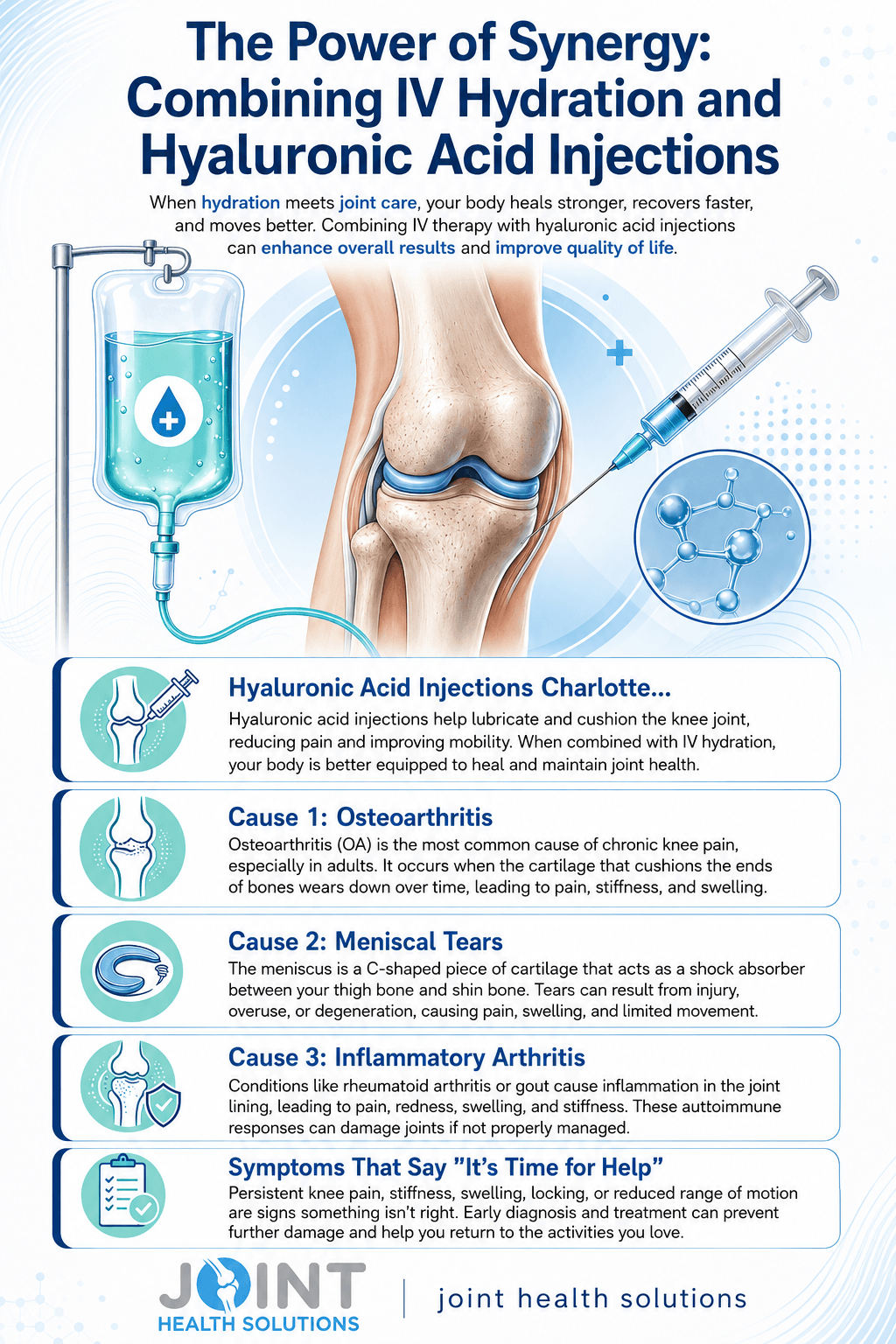
3 Common Causes of Chronic Knee Pain
1. Osteoarthritis
Osteoarthritis (OA) is the most common cause of chronic knee pain in adults, especially those over 50. It involves the progressive loss of articular cartilage through mechanical wear and biological changes. As cartilage thins, pain, stiffness, and swelling follow — particularly with weight-bearing activity.
Hyaluronic acid injections are FDA-approved for knee OA and are the primary indication for viscosupplementation. They are best suited for mild to moderate OA in patients who have not responded to first-line conservative care. A clinical evaluation confirms candidacy.
2. Post-Traumatic Arthritis and Meniscal Pathology
Prior knee injury — ligament tears, meniscal damage, or fracture — can accelerate cartilage wear and lead to post-traumatic arthritis. Some meniscal tears can be managed conservatively. HA injections may provide symptomatic relief by improving lubrication and reducing joint irritation in these patients; candidacy depends on the specific injury pattern and severity. IV therapy as an adjunct in this context has limited evidence and is not a first-line recommendation.
3. Inflammatory Arthritis
Conditions such as rheumatoid arthritis and gout cause immune-mediated or crystal-induced joint inflammation. These require specific systemic medical management — disease-modifying agents for RA, urate-lowering therapy for gout — that is beyond the scope of HA injections or IV therapy. HA injections may provide adjunctive symptom relief for the knee joint in inflammatory arthritis under appropriate specialist supervision, but they do not treat the underlying systemic disease. IV therapy with antioxidants is not an established treatment for RA or gout flares; patients with these conditions should be managed by a rheumatologist.
Symptoms That Indicate a Clinical Evaluation Is Warranted
- Persistent knee pain that interferes with walking, stairs, or daily activities
- Morning stiffness lasting more than 15–30 minutes
- Swelling that recurs or persists
- Grinding, clicking, or crepitus during knee movement
- Difficulty rising from a chair or getting in and out of a car
- Pain not adequately controlled by over-the-counter medications
- Progressive loss of function or range of motion
These symptoms can result from osteoarthritis, post-traumatic changes, meniscal pathology, or inflammatory arthritis — conditions that require imaging and physical examination to differentiate. A proper diagnosis comes first; treatment selection follows.
Understanding Your Treatment Options
Knee osteoarthritis is managed through a stepped approach. Each option has established indications, real benefits, and known limitations. Understanding the full picture allows for informed decision-making.
| Treatment | How It Works | Benefits | Limitations and Risks |
|---|---|---|---|
| NSAIDs / Acetaminophen | Reduce pain and inflammation systemically | Established evidence for symptom relief; guideline-recommended first line; low cost; widely available | Does not address joint structure; long-term NSAID use carries GI, renal, and cardiovascular risks; acetaminophen carries liver risk at high doses |
| Corticosteroid Injections | Powerful local anti-inflammatory | Established evidence for short-term relief; useful for acute flares; guideline-supported | Duration limited (weeks to months); repeated use may accelerate cartilage loss; blood sugar elevation in diabetic patients; joint infection risk (rare) |
| Physical Therapy | Strengthens surrounding muscles and improves joint mechanics | Guideline-recommended; addresses functional decline; no systemic side effects; benefits may be durable | Requires adherence and effort; may not fully resolve severe OA symptoms; slower onset than injections |
| Hyaluronic Acid Injections | Supplements synovial fluid viscosity | FDA-approved for knee OA; modest pain relief and functional improvement; good safety profile; non-surgical | Modest effect size in most meta-analyses; most benefit in mild-moderate OA; injection site reactions possible; results vary; not effective for all patients |
| IV Hydration / Anti-Inflammatory IV Therapy | Delivers fluids, vitamins, and anti-inflammatory agents systemically | May support systemic hydration and antioxidant status; can be combined with other treatments | Off-label and investigational for OA specifically; limited clinical evidence; bruising/infection at IV site; not for all patients; not covered by most insurance |
| Surgery (Knee Replacement) | Replaces damaged joint surfaces | Highly effective for end-stage OA; durable outcomes; restores function when conservative care fails | Invasive; recovery time of weeks to months; surgical risks (infection, blood clots, nerve damage, implant failure); not appropriate for all health statuses |
How Joint Health Solutions Approaches Knee OA
At Joint Health Solutions, we evaluate each patient individually to determine which combination of treatments best fits their OA severity, prior treatment history, functional goals, and medical situation.
Hyaluronic Acid Injections
Our primary viscosupplementation treatment for knee OA. Hyaluronic acid injections are given in a series of 1 to 3 injections spaced approximately one week apart, depending on the product used. We use fluoroscopic guidance to confirm accurate needle placement in the joint space before injection. Patients with mild to moderate knee OA who have not responded to first-line care are the typical candidates.
Fluoroscopy-Guided Injections
Fluoroscopy-guided injection uses real-time imaging to confirm the needle is correctly positioned in the joint space before the medication is delivered. This improves accuracy — particularly important when joint space narrowing makes access more challenging — and maximizes the likelihood that the HA reaches its target.
Cortisone Injections
Cortisone injections are used judiciously for acute inflammatory flares. When a patient has significant inflammation that is limiting function, a corticosteroid injection may provide rapid short-term relief and allow the patient to engage more effectively in physical therapy. They are not used as a standalone long-term strategy given the risks of repeated use.
Anti-Inflammatory IV Therapy
Anti-inflammatory IV therapy with vitamin C, glutathione, magnesium, and other components is available as a complementary option for patients interested in addressing systemic inflammation alongside local joint treatment. The mechanistic rationale — reducing systemic oxidative stress and inflammatory burden to create a more favorable environment for joint recovery — is biologically plausible. However, large-scale clinical trials specifically evaluating IV therapy combined with HA injections for knee OA are lacking. We present this as a supportive option, not a proven enhancer of HA injection outcomes.
Physical Therapy
Physical therapy targeting quadriceps strength, hip stability, and gait mechanics is a foundational, guideline-recommended component of knee OA management. We coordinate with physical therapists to support long-term function alongside injection therapy.
Offloading Knee Braces
Offloading knee braces redistribute force away from the most damaged compartment of the joint, reducing pain with activity. They are useful adjuncts for patients with compartmental OA who remain active.
The Rationale for Combining HA Injections with IV Hydration
The logic behind combining these two approaches is mechanistic: HA injections address the local joint environment directly, while IV hydration with anti-inflammatory nutrients addresses systemic factors that may influence how the joint heals and responds to treatment.
Systemic dehydration may reduce synovial fluid production and alter its composition. Elevated systemic oxidative stress and circulating inflammatory cytokines can penetrate the joint environment and accelerate cartilage breakdown. IV hydration with vitamin C and glutathione may help reduce this systemic inflammatory burden, potentially creating conditions more favorable to joint recovery.
These mechanisms are biologically plausible, supported by preclinical and mechanistic evidence. What has not been established in large randomized trials is whether this specific combination produces meaningfully better clinical outcomes than HA injections alone. Patients considering the combined approach should understand this distinction before proceeding.
Evidence and Clinical Research
The following table summarizes the current evidence for each component of this combined approach:
| Component | FDA Status | Evidence Level | Key Findings |
|---|---|---|---|
| Hyaluronic Acid Injections — Knee OA | FDA-approved for knee OA pain (multiple products: Synvisc, Euflexxa, Orthovisc, HYMOVIS, TriVisc, others) | Established clinical evidence (multiple meta-analyses) | Modest but clinically meaningful pain relief and functional improvement, typically up to 6 months; some products and patient subgroups show benefit to 12 months; good safety profile; most benefit in mild-moderate OA |
| IV Vitamin C | FDA-approved as a nutrient; high-dose IV use is off-label | Limited human evidence for OA specifically; established role in antioxidant defense and collagen synthesis | Reduces oxidative stress markers in human studies; specific clinical benefit for knee OA not established in large-scale trials |
| IV Glutathione | Not FDA-approved as a drug; available as supplement/compounded preparation | Limited human evidence; primarily mechanistic | Master antioxidant; laboratory evidence for free-radical neutralization; clinical benefit for OA not established in high-quality human trials |
| IV Hydration (Fluids) | FDA-approved for hydration and electrolyte replacement | Established for clinical dehydration; limited for OA specifically | Corrects fluid deficits rapidly; may support synovial fluid quality in dehydrated patients; no clinical trials specifically evaluating IV hydration for knee OA |
| Combination: HA + IV Hydration/Anti-Inflammatory Nutrients | Not specifically FDA-approved as a combination | Mechanistic rationale; no large-scale RCTs | Biologically plausible synergy; individual components have separate evidence bases; combined protocol has not been evaluated in powered clinical trials |
Evidence-Level Definitions:
- FDA-approved: Approved by FDA for a specific indication as stated.
- Established clinical evidence: Supported by multiple peer-reviewed human studies.
- Limited human evidence: Some human studies exist but are small, heterogeneous, or not specific to this indication.
- Mechanistic: Laboratory/preclinical evidence suggesting a plausible effect; does not prove patient benefit.
What to Expect at Your First Visit
Your first appointment begins with a comprehensive evaluation: medical history review, physical examination of the knee, and a discussion of your symptoms, activity level, prior treatments, and goals. If current imaging is not available or is outdated, we may recommend X-rays to assess joint space narrowing and confirm OA grade, or MRI if soft-tissue pathology is suspected.
If you are a candidate for HA injections, we explain the specific product, the injection series, realistic expected outcomes, and potential side effects. The injection is performed under fluoroscopic guidance to confirm accurate placement. Most patients tolerate it well — the procedure takes only a few minutes once setup is complete. You may experience mild soreness or swelling at the injection site for 24 to 48 hours. We recommend avoiding strenuous activity or impact on the knee for 48 hours following each injection.
For patients interested in IV therapy as an adjunct, this can be scheduled as a separate session or on the same day depending on your preference and clinical situation. IV therapy is available as a supportive option for eligible patients; it is not a required step before or after HA injections and is not presented as a prerequisite for the injection to work.
Follow-up is scheduled after the injection series to assess your response. If you do not experience meaningful improvement, we will discuss what options remain rather than repeating treatment indefinitely.
Who Is a Candidate?
- Adults with mild to moderate knee osteoarthritis confirmed on imaging
- Inadequate relief from first-line conservative care: physical therapy, weight management, NSAIDs, activity modification
- No active joint infection
- No known allergy to hyaluronic acid products
- Not appropriate for or not yet ready for surgical evaluation
Patients with end-stage knee OA (bone-on-bone on imaging) typically respond less well to viscosupplementation; surgical evaluation may be the more appropriate next step. A thorough clinical assessment is required before any recommendation.
Frequently Asked Questions
How long does relief from hyaluronic acid injections last?
Clinical studies most consistently show meaningful pain relief for approximately 6 months. Some products and patient subgroups show benefit extending toward 12 months. Individual results vary based on OA severity, activity level, body weight, and overall health. Not all patients respond.
Are there side effects from HA injections?
Common side effects are mild and temporary: injection site pain, swelling, or warmth for one to three days. A small percentage of patients experience a post-injection flare — a transient increase in pain and swelling usually resolving within a few days. Serious complications such as joint infection are rare. All risks are reviewed before your first injection.
How many injections are needed?
Most HA products are administered as a series of 1 to 3 injections, one per week. The number depends on the specific product used. Your clinician will select the product and series based on your clinical assessment and insurance coverage.
Can I combine HA injections with physical therapy?
Yes, and we encourage it. Physical therapy addresses the muscular and biomechanical contributors to knee OA pain — factors that HA injections do not treat. The two approaches are complementary, and research suggests that combining injection therapy with exercise-based rehabilitation may produce better long-term functional outcomes than either alone.
Is viscosupplementation covered by insurance?
Many Medicare plans and commercial insurers cover HA injections for knee OA when prior conservative treatment is documented and the patient meets specific criteria. Coverage varies by plan. Our team can verify your benefits before your appointment. Call us at 704-833-3566.
Who is a good candidate for this combined approach?
Good candidates are adults with mild to moderate knee OA who have not achieved adequate relief with conservative care and are not ready for — or not candidates for — knee replacement surgery. Interest in IV therapy as an adjunct is also considered, with the evidence limitations clearly explained.
How soon can I expect results after HA injections?
Some patients notice improvement within one to two weeks of the first injection. Others experience gradual relief that builds over the course of the injection series and the weeks following. Full benefit is typically assessed 4 to 6 weeks after the last injection in the series.
Can I drive after the procedure?
Most patients can drive themselves home after HA injection if they have not received sedating medications. If you experience significant discomfort or feel unsteady, have someone accompany you or wait in the clinic until you feel comfortable.
Do I need to stop other medications?
Some blood thinners may need to be temporarily adjusted before injection; do not stop any prescription medication without guidance from your prescribing provider. We will review your complete medication list before your procedure and provide individualized instructions.
What if HA injections do not provide enough relief?
If an injection series does not produce meaningful improvement, your provider will discuss what options remain — including whether PRP therapy, further conservative measures, or a surgical consultation would be the appropriate next step. We do not recommend repeating viscosupplementation indefinitely without evidence of benefit.
Schedule a Consultation in Charlotte
If you are managing chronic knee pain and want to explore whether hyaluronic acid injections — alone or alongside IV hydration — may be appropriate for your condition, Joint Health Solutions can provide a thorough evaluation and an honest conversation about the evidence.
📞 Call us: 704-833-3566
What to bring: Any recent knee imaging (X-ray or MRI reports), a list of current medications and supplements, notes on prior treatments and their outcomes, and your insurance card.
Sources
FDA Product Approvals — Hyaluronic Acid for Knee OA
- FDA — HYMOVIS® ONE Premarket Approval
- FDA — TriVisc Premarket Approval
- FDA — Synvisc Premarket Approval
Key Clinical References
- Bannuru RR, et al. (2019). OARSI guidelines for the non-surgical management of knee, hip, and polyarticular osteoarthritis. Osteoarthritis and Cartilage. PubMed: 31278997
- Huang Y, et al. (2021). Efficacy and safety of intra-articular hyaluronic acid injection for knee osteoarthritis: a systematic review and meta-analysis of randomized controlled trials. Journal of Orthopaedic Surgery and Research. PubMed: 34011337
- Altman RD, et al. (2015). The mechanism of action for hyaluronic acid treatment in the osteoarthritic joint. BMC Musculoskeletal Disorders. PubMed: 26578847
- Carr AC, Maggini S. (2017). Vitamin C and immune function. Nutrients. PubMed: 29099763 — Note: This reference supports vitamin C’s role in antioxidant defense and collagen synthesis; direct evidence for IV vitamin C reducing OA-specific inflammatory markers in high-quality human trials is limited.
- Padayatty SJ, et al. (2004). Vitamin C pharmacokinetics: implications for oral and intravenous use. Annals of Internal Medicine. PubMed: 15069351
Institutional Sources
- Mayo Clinic — Hyaluronic Acid Injection Route
- Hospital for Special Surgery (HSS) — Viscosupplementation
- Arthritis Foundation — Hyaluronic Acid Injections
Disclaimer: This content is for informational purposes only and does not constitute medical advice. Always consult with a qualified healthcare provider to determine whether these treatments are appropriate for your specific condition. Individual results vary. Hyaluronic acid injections have established FDA approval for knee osteoarthritis pain; the combination with IV hydration is an off-label integrative approach without large-scale RCT validation. The section on inflammatory arthritis (RA, gout) is informational only — these conditions require specialist medical management.