

Knee Cartilage Lubrication and Joint Support: Combining Hyaluronic Acid and PRP Therapy in Charlotte
Published July 11, 2026 | Last reviewed: July 14, 2026 | Category: Joint Health, Non-Surgical Treatments | Location: Charlotte, NC
🕒 18 MIN READ
Persistent knee pain rarely has a single cause. For many patients, cartilage thinning and the mechanical stress it places on surrounding muscles contribute together to a cycle of pain, stiffness, and limited function. Traditional approaches often address one issue at a time.
At Joint Health Solutions, we evaluate whether a combined approach — using hyaluronic acid injections to support joint lubrication alongside PRP therapy to support tissue healing — may be appropriate for patients who have not responded adequately to first-line care. This article explains how each treatment works, what the evidence shows for each individually and in combination, who may be a candidate, and what to expect.
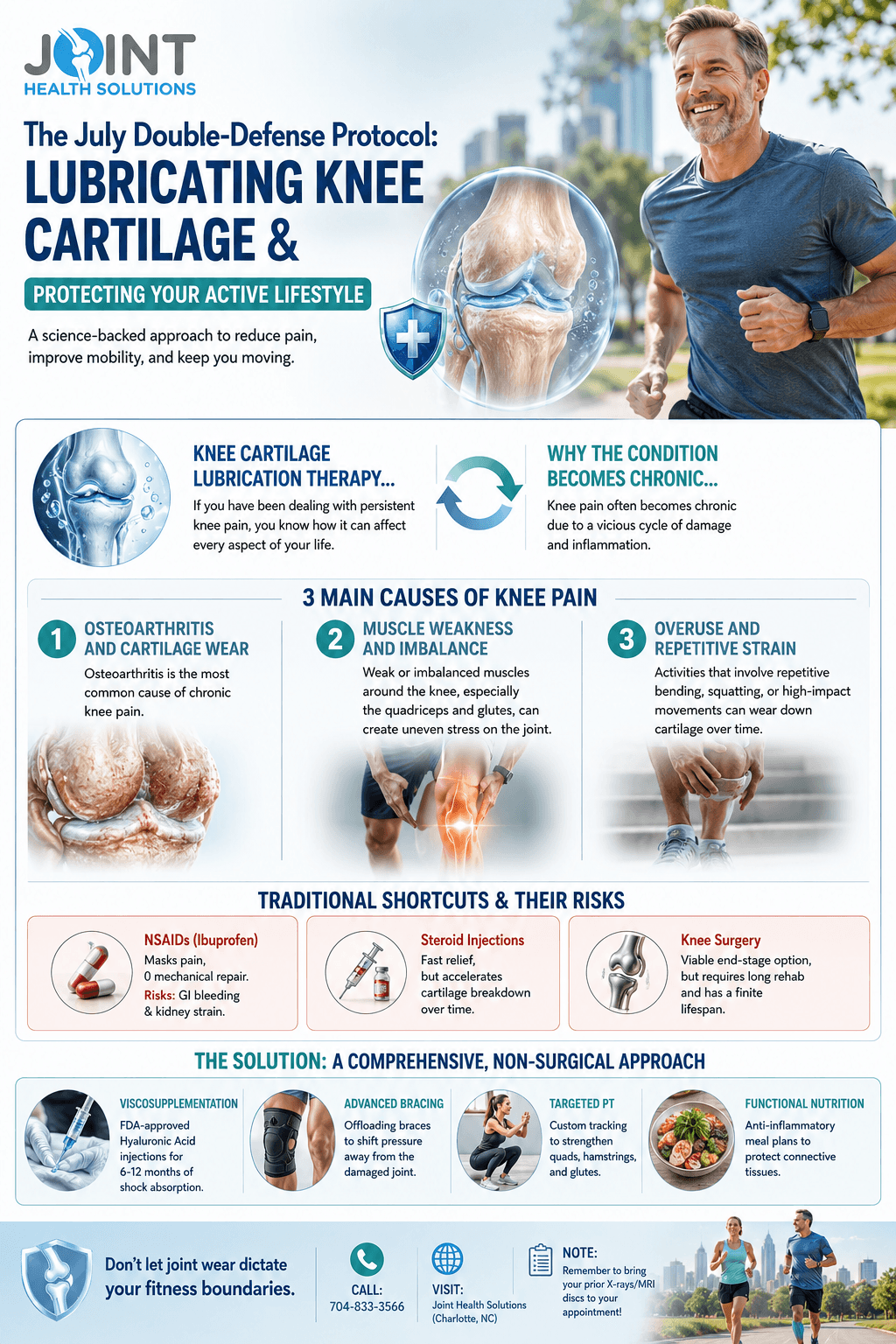
Why Knee Pain Can Become Chronic
Knee pain often becomes self-reinforcing. As cartilage wears down, the joint loses some of its natural cushioning and lubrication. This can increase friction and inflammation, leading to pain and swelling. The muscles surrounding the knee — particularly the quadriceps and hamstrings — work harder to stabilize a painful or structurally compromised joint. Over time, this additional demand can lead to muscle fatigue and weakness, which in turn reduces the joint’s ability to absorb mechanical load, placing more stress back on the cartilage and other structures.
Understanding this relationship helps explain why comprehensive management — addressing both the joint and the supporting musculature — is often more effective than treating either in isolation. Physical therapy and exercise are the most well-established ways to address muscle weakness around the knee. Injection therapies may play a supporting role in appropriate candidates.
3 Common Causes of Knee Arthritis and Muscle Fatigue
1. Osteoarthritis and Cartilage Degeneration
Osteoarthritis is the most common cause of chronic knee pain. It occurs when the protective cartilage cushioning the joint wears down over time, reducing the joint’s ability to absorb shock and move smoothly. The synovial fluid that normally lubricates the joint also changes in quality and quantity as OA progresses. Hyaluronic acid injections aim to supplement this fluid and reduce friction in patients with mild to moderate OA.
2. Muscle Weakness and Imbalance
Weak or imbalanced muscles around the knee — particularly the quadriceps and glutes — can place abnormal mechanical stress on the joint. When muscles cannot adequately absorb impact, more force is transmitted to the cartilage and subchondral bone. Addressing muscle strength through physical therapy is a guideline-recommended, foundational component of knee OA management.
3. Overuse, Injury History, and Repetitive Strain
Repetitive high-impact activity, prior joint injury, and cumulative mechanical stress can accelerate cartilage wear and leave the surrounding musculature in a chronically fatigued state. Athletes and physically active adults in Charlotte often present with a combination of joint and soft-tissue involvement that benefits from a personalized, multi-component management plan.
Symptoms That Suggest a Clinical Evaluation
- Persistent knee pain that does not improve with rest
- Stiffness after sitting or waking up
- Swelling around the knee
- A grinding, clicking, or popping sensation (crepitus) during movement
- Weakness or fatigue in the leg muscles
- Difficulty climbing stairs or rising from a chair
- Pain that limits daily activity or exercise
These symptoms may result from osteoarthritis, muscle dysfunction, or other conditions. A proper evaluation is required to identify the cause before any treatment is selected.
Understanding Your Treatment Options
Knee osteoarthritis management generally follows a stepped approach. Each option has established benefits, known limitations, and a defined place in the treatment hierarchy.
Oral Medications (NSAIDs and Acetaminophen)
NSAIDs (ibuprofen, naproxen) and acetaminophen are common first-line options with established evidence for symptom relief. They do not address the underlying structural changes in the joint. Long-term NSAID use carries gastrointestinal, kidney, and cardiovascular risks that warrant monitoring by a healthcare provider. These are appropriate starting points for many patients.
Corticosteroid Injections
Corticosteroid (steroid) injections have established evidence for short-term anti-inflammatory relief and are useful for acute flare management. They are not a long-term solution — repeated use over time may have adverse effects on cartilage and surrounding tissue — but they are a legitimate, guideline-supported tool when used appropriately.
Hyaluronic Acid Injections (Viscosupplementation)
Hyaluronic acid injections supplement the synovial fluid in the knee joint, potentially reducing friction and improving cushioning. FDA-approved products are available for knee OA pain in patients who have not responded to conservative therapy. Evidence shows modest benefit in selected patients; clinical guidelines vary in their recommendations. Not appropriate for advanced bone-on-bone arthritis.
PRP Therapy
PRP therapy uses concentrated growth factors from the patient’s own blood to support tissue healing. For intra-articular knee injection, there is a growing body of literature, though evidence remains mixed and the treatment is not FDA-approved for knee OA as a drug indication. PRP use in periarticular soft tissue and muscle is more experimental and has a less developed evidence base. Candidacy should be assessed individually.
Physical Therapy
Strengthening the muscles around the knee is guideline-recommended, foundational care for knee OA at all stages. Physical therapy addresses the muscle weakness and mechanical imbalance that often accompany joint degeneration. It has established evidence and should be part of any comprehensive management plan.
Surgery
Arthroscopy and knee replacement are well-established surgical options for appropriate candidates. Total knee replacement has extensive evidence for pain relief and functional improvement in patients with end-stage OA. Surgery is typically considered after conservative care has been exhausted. It is not appropriate for every patient, but it should not be dismissed when it is clinically indicated.
| Treatment | How It Works | Evidence Level | Key Limitations |
|---|---|---|---|
| NSAIDs / Acetaminophen | Reduce pain and inflammation | Established clinical evidence | Does not address joint structure; systemic risks with long-term use |
| Corticosteroid Injections | Powerful local anti-inflammatory | Established evidence for short-term relief | Short duration; frequent use may affect cartilage |
| Hyaluronic Acid Injections | Supplements synovial fluid | FDA-approved; mixed guideline recommendations | Results vary; not effective for advanced OA |
| PRP Therapy (intra-articular) | Delivers growth factors to joint tissue | Limited; mixed study results | Not FDA-approved as drug for OA; evidence varies by preparation |
| Physical Therapy | Muscle strengthening and mechanics | Established clinical evidence | Requires adherence |
| Surgery | Tissue removal or joint replacement | Established for appropriate candidates | Invasive; recovery time; not for all patients |
How Hyaluronic Acid and PRP Work — and How They May Complement Each Other
How Hyaluronic Acid and PRP Work — and How They May Complement Each Other
These two treatments target different components of knee dysfunction.
Hyaluronic acid is injected into the knee joint (intra-articular) to supplement the synovial fluid. Its primary role is mechanical — improving lubrication and cushioning. Some laboratory studies also suggest it may have anti-inflammatory properties within the joint environment, though this is considered mechanistic rather than a separately established clinical benefit.
PRP (platelet-rich plasma) is prepared from the patient’s own blood and contains concentrated growth factors including TGF-β, PDGF, and IGF-1. When injected intra-articularly, it may stimulate tissue repair and reduce inflammatory signaling within the joint. PRP has also been studied in periarticular soft tissue (tendons, ligaments), though evidence for direct intramuscular injection to address muscle fatigue specifically is more limited and considered experimental.
The theoretical rationale for combining them is that hyaluronic acid addresses the joint’s mechanical environment while PRP addresses the biological repair environment. However, it is important for patients to understand that no large-scale randomized controlled trials have specifically validated this combination as a superior approach compared to either treatment alone. At Joint Health Solutions, we discuss this evidence context with each patient before making a recommendation.
The Biology: Why the Joint and Surrounding Muscles Are Connected
Understanding the relationship between the joint and surrounding musculature helps clarify why a combined approach may be appropriate for some patients.
Mechanical Load Sharing
In a healthy knee, articular cartilage, synovial fluid, and surrounding muscles all contribute to managing the forces generated during movement. The quadriceps, hamstrings, and gastrocnemius perform controlled contractions that absorb and distribute mechanical load across the joint. When cartilage degenerates and joint pain increases, these muscles must work differently to maintain stability, which over time can lead to fatigue and altered movement patterns that place additional stress on the joint.
Arthrogenic Muscle Inhibition
Arthrogenic muscle inhibition (AMI) is a well-documented neurological phenomenon in which joint pain, swelling, or structural damage leads to reflex inhibition of the surrounding muscles — particularly the quadriceps. The presence of AMI can make it difficult to rebuild muscle strength through exercise alone, which is one reason why managing pain and joint inflammation is considered part of effective rehabilitation. Reducing intra-articular pain and swelling — whether through injections, medication, or other means — may help reduce AMI and improve the effectiveness of physical therapy. This is a mechanistic rationale, not a proven outcome specific to any particular injection approach.
Inflammatory Signaling Between Tissues
Research in musculoskeletal biology has identified communication between muscle tissue and the joint environment through inflammatory mediators. Chronically stressed or damaged muscle can release inflammatory signals that may influence the joint environment, and vice versa. This cross-tissue signaling is an active area of research. Current evidence supports reducing systemic and local inflammation through established means (exercise, weight management, appropriate medications); whether targeted injection into muscle tissue specifically modulates this signaling in clinically meaningful ways requires further study.
Evidence and Clinical Research
| Component | FDA Status | Evidence Level | Key Findings |
|---|---|---|---|
| Hyaluronic Acid Injections — Knee OA Pain (intra-articular) | FDA-approved for knee OA pain in patients who failed conservative therapy | Established clinical evidence (multiple meta-analyses) | Modest pain relief and functional improvement; good safety profile; duration and degree of response vary; AAOS guideline gives inconclusive recommendation |
| PRP Injections — Knee OA (intra-articular) | Not FDA-approved as a drug for knee OA; devices used to prepare PRP may have FDA clearance | Limited human evidence; mixed results | Some studies show pain reduction and functional improvement; results vary based on preparation, concentration, and patient selection; no consensus guideline recommendation |
| PRP — Periarticular soft tissue / muscle | Not specifically studied or approved for intramuscular “revitalization” in knee OA context | Experimental / limited evidence in this application | Evidence base for direct intramuscular PRP to address muscle fatigue associated with knee OA is very limited; should be discussed as an investigational approach |
| HA + PRP Combination | Not FDA-approved as a combination treatment | Limited; mechanistic rationale only | No large-scale RCTs specifically evaluating the combination; some smaller studies suggest additive benefit; cannot be stated as established clinical protocol |
Evidence-Level Definitions:
- FDA-approved: Received FDA approval for a specific indication.
- Established clinical evidence: Supported by multiple peer-reviewed human studies and/or guideline recommendations.
- Limited human evidence: Some human studies exist but are small, inconsistent, or not replicated at scale.
- Experimental: Biologically plausible but without adequate clinical trial support for the specific application.
What to Expect at Joint Health Solutions
Your first visit begins with a comprehensive evaluation: medical history, physical examination of the knee, review of current treatments, and discussion of your goals. We will assess whether imaging such as X-rays or MRI is needed to characterize the degree of cartilage loss and rule out other causes of pain.
If you are a candidate for injection therapy, we will explain each treatment, its evidence basis, its limitations, and realistic expectations for your specific situation. We do not recommend injection treatments that are not appropriate for your clinical presentation.
Hyaluronic acid injections are performed intra-articularly (into the knee joint) and typically involve one to three injections spaced about one week apart. The procedure takes a few minutes in the office. Mild soreness afterward is common and resolves within one to two days. High-impact activity should be avoided for 48 hours post-injection.
PRP therapy, when recommended, is also performed in-office. The process requires a blood draw, centrifugation to concentrate the platelets, and injection. The site of injection — intra-articular, periarticular, or soft tissue — will depend on the clinical assessment. The procedure typically takes 30 to 45 minutes in total. We will discuss the specific protocol, evidence basis, and expected timeline with you before proceeding.
Most patients are able to return to normal daily activities the following day. Physical therapy is often coordinated alongside injection therapy to address the muscle component of knee function.
Learn more about our hyaluronic acid injection service and PRP therapy.
Who May Be a Candidate?
Patients who tend to respond best to this type of combined approach typically share the following profile:
- Mild to moderate knee osteoarthritis confirmed on imaging (typically Kellgren-Lawrence grade 1–3)
- Inadequate relief from first-line conservative care (exercise, NSAIDs, weight management)
- Not appropriate for or not yet ready for surgical evaluation
- Motivated to participate in a rehabilitation plan alongside injection therapy
- No active joint infection, bleeding disorder, or known allergy to components of either treatment
Patients with severe bone-on-bone arthritis (grade 4) typically respond less well to viscosupplementation and may be better served by surgical evaluation. A thorough clinical assessment is required before any recommendation is made.
Questions to Ask Before Starting Treatment
- Am I a good candidate for each of these treatments given my OA grade?
- Where exactly will the PRP be injected, and why is that site appropriate for my condition?
- What is the evidence for each treatment individually — and for the combination?
- What realistic outcomes should I expect, and over what timeframe?
- What happens if I don’t respond to one or both treatments?
- How will physical therapy fit into the plan?
- Which treatment is covered by insurance, and what are the out-of-pocket costs for PRP?
Frequently Asked Questions
How do hyaluronic acid and PRP work differently?
Hyaluronic acid supplements the synovial fluid in the joint, primarily improving mechanical lubrication and cushioning. PRP delivers concentrated growth factors from the patient’s own blood to support the biological repair environment. They are different mechanisms acting on different aspects of joint dysfunction, which is why some providers consider them complementary in appropriate patients.
Are there clinical trials on using them together?
Smaller studies have explored the combination and some have reported additive benefit, but no large-scale randomized controlled trials have specifically validated HA plus PRP as a combination protocol superior to either alone. The rationale is biologically plausible, but patients should understand they are not choosing a treatment with the same level of evidence as either treatment individually. We discuss this with every patient before recommending the combination.
How long does each treatment take?
Hyaluronic acid injections take a few minutes per session. PRP requires a blood draw and centrifugation step before injection, so the full appointment typically takes 30 to 45 minutes. If both are performed in the same visit, plan for approximately one hour including preparation.
How soon will I notice results?
Hyaluronic acid may take two to four weeks to produce noticeable improvement. PRP timelines also vary — some patients notice changes within a few weeks, while others take longer. Neither treatment produces instant results, and completing the recommended series is important for evaluating response.
Are the injections painful?
Both are generally well-tolerated. We use appropriate technique and may apply local numbing to minimize discomfort. Some patients experience mild soreness, swelling, or warmth at the injection site for one to two days afterward. Serious complications such as infection are rare and will be discussed before treatment.
Can I combine this with physical therapy?
Yes, and we typically recommend it. Physical therapy is the most evidence-supported intervention for addressing muscle weakness around the knee, and injection therapy may help reduce the pain that limits rehabilitation. The two approaches work better together for most patients.
Is PRP covered by insurance?
Hyaluronic acid injections are often covered by insurance when conservative care has been documented and the product is FDA-approved. PRP is typically considered elective and is not routinely covered by most insurance plans. Our team can verify your benefits and discuss costs during your consultation. Call us at 704-833-3566.
What are the side effects?
For both treatments, common side effects include mild injection site pain, swelling, or redness that resolves within a day or two. PRP drawn from the patient’s own blood has a very low allergic risk. A small subset of patients may experience a local inflammatory reaction after hyaluronic acid injection (pseudoseptic reaction). Serious complications such as infection are rare. All risks will be discussed before any procedure.
Can I have these injections if I’ve had steroid injections before?
Generally yes, but most providers recommend a washout period of several weeks after a corticosteroid injection before proceeding with either hyaluronic acid or PRP. Steroids can temporarily alter the local joint environment and may affect outcomes. Your provider will advise on timing.
Will this combination help me avoid knee replacement?
For some patients with mild to moderate OA, non-surgical treatments may provide enough relief to delay or avoid surgery. However, neither hyaluronic acid nor PRP can reverse cartilage damage or stop OA progression. Patients with advanced OA may ultimately require surgical evaluation regardless of injection outcomes. The goal is to manage symptoms and maintain function through appropriate non-surgical care for as long as is practical.
What does “not FDA-approved” mean for PRP?
It means PRP has not been reviewed and approved by the FDA as a drug for a specific indication like knee osteoarthritis. Devices used to prepare PRP may have FDA clearance for the preparation process itself. Absence of drug approval does not mean the treatment is illegal or unsafe — it means its clinical evidence has not met the threshold for formal drug approval for that indication, which is a meaningful distinction patients should understand when making their decision.
How does this compare to stem cell therapy?
Stem cell therapy for knee OA is an active area of research but currently has even less established clinical evidence than PRP. Regulatory status varies by product and preparation method. Hyaluronic acid and PRP have longer clinical track records and better-developed evidence bases for knee OA. Your provider can help you compare options based on your specific clinical picture and the current state of the evidence.
Schedule a Consultation in Charlotte
If knee pain and muscle fatigue are limiting your activity, our board-certified providers at Joint Health Solutions can evaluate your condition and discuss whether hyaluronic acid injections, PRP therapy, or a combination approach may be appropriate for you.
📞 Call us: 704-833-3566
What to bring to your first visit:
- Any prior knee imaging (X-ray discs, MRI reports)
- A list of current medications and supplements
- Notes on your symptoms — what triggers them and what makes them better or worse
- Your insurance card and photo ID
- A list of questions for the provider about your condition and options
Sources
Institutional and Guideline Sources
- American Academy of Orthopaedic Surgeons (AAOS) — Management of Osteoarthritis of the Knee (Non-Arthroplasty), 4th Edition Clinical Practice Guideline, 2021
- U.S. Food and Drug Administration — Drug Approvals and Databases
- Mayo Clinic — Osteoarthritis: Diagnosis and Treatment
- Hospital for Special Surgery (HSS) — Viscosupplementation for Knee Osteoarthritis
- National Institute of Arthritis and Musculoskeletal and Skin Diseases (NIAMS) — Osteoarthritis
- Arthritis Foundation — Osteoarthritis
Key Clinical References
- Jevsevar D, et al. (2015). Viscosupplementation for Osteoarthritis of the Knee: A Systematic Review of the Evidence. Journal of Bone and Joint Surgery. PubMed: 26491131
- Belk JW, et al. (2021). Platelet-Rich Plasma Versus Hyaluronic Acid for Knee Osteoarthritis: A Systematic Review and Meta-analysis. American Journal of Sports Medicine. PubMed: 33264573
- Bannuru RR, et al. (2019). OARSI guidelines for the non-surgical management of knee, hip, and polyarticular osteoarthritis. Osteoarthritis and Cartilage. PubMed: 31278997
- Rice DA, McNair PJ. (2010). Quadriceps arthrogenic muscle inhibition: neural mechanisms and treatment perspectives. Seminars in Arthritis and Rheumatism. PubMed: 19217154
- Altman RD, Manjoo A, Fierlinger A, et al. (2015). The mechanism of action for hyaluronic acid treatment in the osteoarthritic knee: a systematic review. BMC Musculoskeletal Disorders. PubMed: 26578847
Disclaimer: This content is for informational purposes only and does not constitute medical advice. Always consult with a qualified healthcare provider to determine whether these treatments are appropriate for your specific condition. Individual results vary, and not every patient is a candidate for every treatment described. The combination of hyaluronic acid and PRP as described in this article has not been validated by large-scale randomized controlled trials as a superior protocol to either treatment used individually. All medical claims, treatment-outcome claims, and provider experience statements should be verified by Joint Health Solutions before publication.