
Non-Surgical Knee Osteoarthritis Treatment Options
Quick Answer: Non-surgical knee osteoarthritis treatment usually starts with exercise-based care, education, activity adjustments, and weight loss when appropriate. Medications, bracing, assistive devices, and injections may be considered depending on symptoms, medical history, goals, and clinical assessment. These options may help reduce pain and improve function, but they do not reverse arthritis or make surgery impossible later.
If you are looking for practical guidance in the Charlotte area, Joint Health Solutions provides conservative, minimally invasive joint care at its Charlotte clinic. You can request an appointment or use the clinic’s 704-833-3566 contact number to discuss whether an evaluation may be appropriate.
What Non-Surgical Knee Osteoarthritis Treatment Can and Cannot Do
Non-surgical knee osteoarthritis treatment is not one single procedure. It is a plan that may combine movement, education, symptom control, mechanical support, and selective procedures when appropriate. The goal is usually to improve day-to-day function, reduce avoidable flare-ups, support mobility, and help people make informed choices about their next steps.
Knee osteoarthritis is a chronic joint condition. It often involves cartilage changes, inflammation, stiffness, muscle weakness around the joint, and changes in how the knee handles load. Because those factors vary from person to person, a helpful plan for one adult may not be the right plan for another.
Conservative care can be meaningful, especially when it is personalized and followed consistently. However, it is important to be realistic. Non-surgical knee osteoarthritis treatment does not regrow a normal knee joint, does not eliminate osteoarthritis, and does not promise surgery avoidance for every person. It may help many people manage symptoms and remain active, while others may need reassessment if pain, swelling, instability, or function continues to worsen.
For broader condition education, you can read more about osteoarthritis, knee arthritis, and knee pain on the Joint Health Solutions website.
Non-Surgical Knee Osteoarthritis Treatment at a Glance
The table below summarizes how common options generally fit into a conservative care plan. It is not a substitute for diagnosis or a personalized treatment recommendation. Non-surgical knee osteoarthritis treatment should be matched to the person’s symptoms, health history, and goals.
| Option | Typical role in conservative care | What to discuss during assessment |
|---|---|---|
| Exercise and physical therapy | Often a core starting point to improve strength, mobility, balance, and function | Current activity level, pain triggers, movement limits, and realistic goals |
| Education and self-management | Helps people understand pacing, flare management, activity modification, and long-term habits | Daily demands, work or sport needs, and what has or has not helped before |
| Weight loss when appropriate | May reduce mechanical stress on the knee in adults who are overweight or obese | Health history, nutrition needs, and sustainable changes rather than quick fixes |
| Topical or oral NSAIDs | May help pain and function when not contraindicated | Medication safety, current prescriptions, medical conditions, and clinician guidance |
| Bracing or cane use | May help unload the knee, improve confidence, or support function in selected situations | Knee alignment, walking pattern, comfort, fit, and daily-use practicality |
| Corticosteroid injection | May provide short-term symptom relief for some people | Symptom pattern, timing, prior response, and whether injection is appropriate |
| Hyaluronic acid injection | Mixed-evidence option; not recommended for routine use by AAOS, but may be considered selectively | Prior treatments, documented criteria, payer rules, and expectations |
| PRP therapy | Selective option with more uncertainty than core conservative care | Evidence limitations, coverage limits, goals, and whether it fits an individual plan |
This overview can help you prepare for a conversation with a clinician. The right knee osteoarthritis treatment options depend on more than an X-ray report. Pain location, swelling, activity tolerance, medical history, medications, strength, joint stability, and personal priorities all matter.
Comparing Knee Osteoarthritis Treatment Options
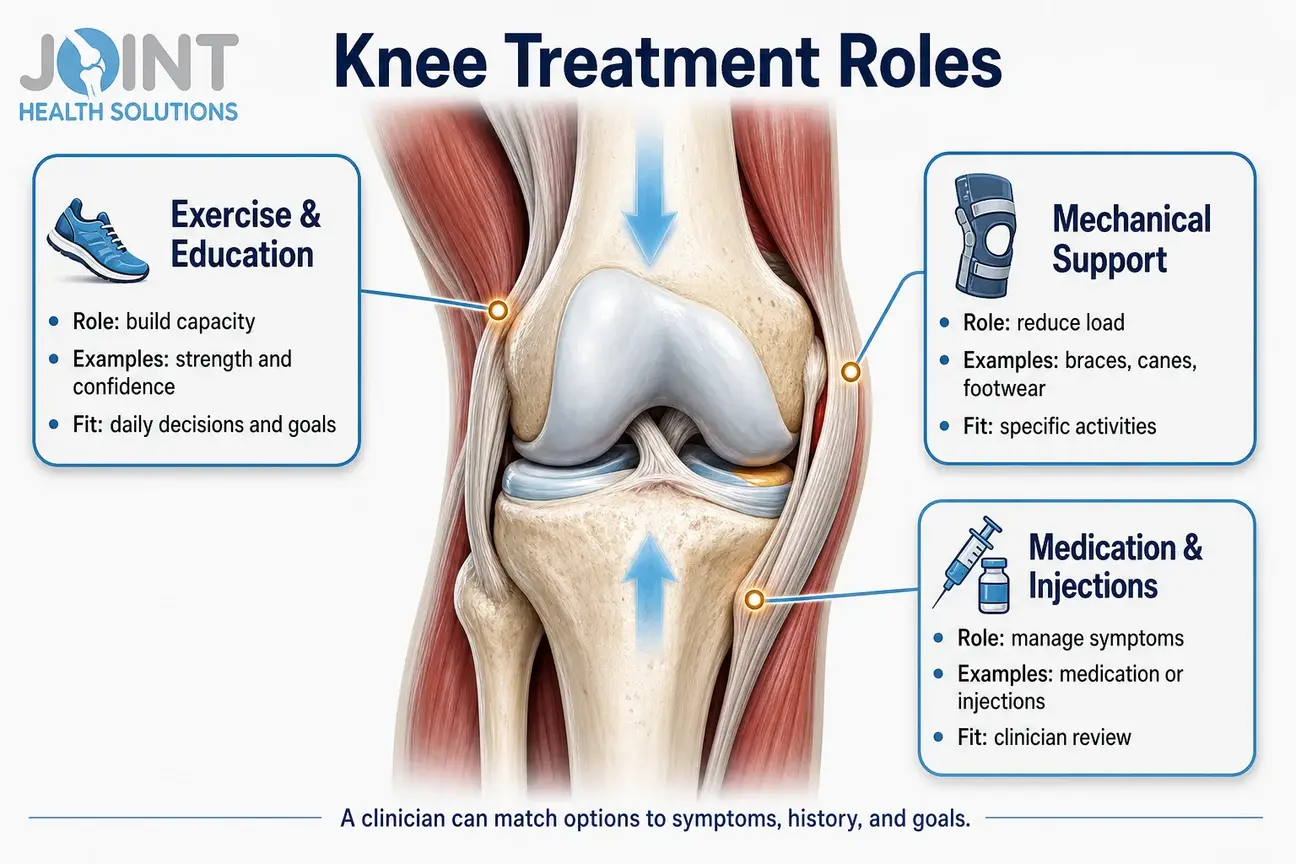
Knee osteoarthritis treatment options are often easier to understand when they are grouped by purpose. Some options build capacity, some reduce load, some help manage symptoms, and some are considered only after a clinician reviews whether they fit the person’s situation. Non-surgical knee osteoarthritis treatment often works more effectively when these categories support each other instead of competing.
Exercise-based care and education are usually foundational because they address strength, confidence, and daily decision-making. Bracing, canes, footwear changes, and pacing may reduce stress on the knee during specific activities. Medication and injection discussions usually focus on symptom relief, and suitability depends on health history and clinical findings.
No table or article can decide which path is right for an individual. A person with mild stiffness after long walks may need a different plan than someone with repeated swelling, major stair limitations, or several medical conditions. That is why non-surgical knee osteoarthritis treatment should remain flexible and reassessed as symptoms, goals, and function change.
Physical Therapy for Knee Osteoarthritis and Exercise-Based Care
Physical therapy for knee osteoarthritis is one of the most important parts of evidence-informed care. Current AAOS knee osteoarthritis guideline materials state that supervised exercise, unsupervised exercise, and/or aquatic exercise are recommended over no exercise to improve pain and function. That does not mean every exercise is right for every knee. It means movement is usually part of the foundation.
A well-designed program may include strengthening, range-of-motion work, balance training, gait training, and gradual return to activities. For many adults, the focus is not simply “doing more.” It is learning how to move in ways that build capacity without repeatedly provoking symptoms.
Supervised care can be especially useful when someone feels unsure about what is safe, has stopped activity because of pain, or has difficulty progressing on their own. Physical therapy may also help identify movement patterns that place extra stress on the knee. At Joint Health Solutions, physical therapy is a confirmed service for patients with joint pain, osteoarthritis, mobility limitations, or musculoskeletal injuries when it fits the individual treatment plan.
For many adults, non-surgical knee osteoarthritis treatment begins with this kind of movement plan because it can be adapted. A program may start with small, tolerable goals and progress as strength, confidence, and symptom control improve.
Why strengthening matters in knee arthritis treatment
Knee arthritis treatment often focuses on the joint surface, but the muscles around the knee are also important. The quadriceps, hamstrings, hip muscles, and calf muscles all help control how force moves through the knee. When strength, balance, or coordination declines, everyday movements such as stairs, squatting, standing from a chair, or walking on uneven ground may become more difficult.
Exercise does not have to be aggressive to be useful. A plan may start with tolerable, low-impact movements and progress gradually. Some people do better with land-based exercise, while others may tolerate aquatic exercise more comfortably. The important point is that the program should match the person’s current ability and be adjusted over time.
How to think about pain during activity
Many people with knee osteoarthritis worry that any pain during activity means they are damaging the joint. Pain is a signal to respect, but it does not always mean new injury is occurring. A clinician or physical therapist can help distinguish expected exercise discomfort from symptoms that call for modification or reassessment.
A practical goal is to find the right “dose” of movement: enough to build strength and confidence, not so much that symptoms flare for days. This is one reason a personalized plan can be more useful than a generic list of exercises. The plan can account for stairs at home, job duties, recreational goals, balance concerns, and other joint conditions.
Self-Management: The Everyday Part of Non-Surgical Care
Non-surgical knee osteoarthritis treatment often works better when people understand their condition and have tools for daily decision-making. Self-management is not the same as “figure it out alone.” It means learning how sleep, activity, pacing, footwear, weight changes, work demands, and flare patterns may influence symptoms.
Education can help people avoid two common extremes. One extreme is doing too little because of fear, which may lead to more stiffness and weakness. The other is pushing through every symptom, which may lead to repeated flare-ups. A balanced plan respects the knee while still supporting movement and quality of life.
Helpful self-management topics may include:
- How to pace activity across the day rather than doing all demanding tasks at once
- How to use warm-up, mobility work, and rest breaks wisely
- How to track which activities trigger swelling, stiffness, or next-day pain
- How to choose low-impact exercise options that fit personal preferences
- How to prepare for travel, stairs, yard work, or recreational activity
- When to seek reassessment rather than continuing the same routine
These decisions are personal. Someone who wants to garden, someone who stands for work, and someone who wants to keep playing recreational sports may need different strategies even if they all have knee osteoarthritis.
Weight Loss When Appropriate
Weight loss is not relevant to every person with knee osteoarthritis, and it should be discussed respectfully. For adults who are overweight or obese, AAOS guideline materials state that sustained weight loss is recommended to improve pain and function. This recommendation is about reducing mechanical stress and supporting overall health, not assigning blame for arthritis.
Even when weight loss is appropriate, the approach should be sustainable. Short-term, extreme plans can be hard to maintain and may not support long-term joint health. A clinician may discuss nutrition, activity tolerance, medical history, and realistic goals as part of a broader plan.
Joint Health Solutions lists nutrition plans for joint health as a confirmed service when an individual plan includes nutrition support. Nutrition is not a stand-alone answer for knee osteoarthritis, but it may be one piece of non-surgical knee osteoarthritis treatment for selected patients.
Topical and Oral NSAIDs When Not Contraindicated
Medication decisions should be individualized and made with appropriate clinical guidance. AAOS knee osteoarthritis materials state that topical NSAIDs should be used to improve function and quality of life when not contraindicated. The same materials state that oral NSAIDs are recommended to improve pain and function when not contraindicated.
NSAIDs are anti-inflammatory medications. Some are applied to the skin over the painful area, while others are taken by mouth. They may provide symptomatic relief for some people, but they are not appropriate for everyone. Medical history, other medications, kidney function, cardiovascular considerations, gastrointestinal history, and other factors may affect whether an NSAID is suitable.
This article does not recommend a specific medication, dose, or schedule. If you are considering NSAIDs, discuss your situation with a qualified clinician or pharmacist, especially if you take other medications or have chronic health conditions. The phrase “when not contraindicated” matters because a medication that is reasonable for one person may not be safe for another.
In a non-surgical knee osteoarthritis treatment plan, medication is usually viewed as one possible support, not the entire strategy. It may be paired with movement, pacing, bracing, or other clinician-guided choices.
Offloading Knee Brace and Assistive Device Options
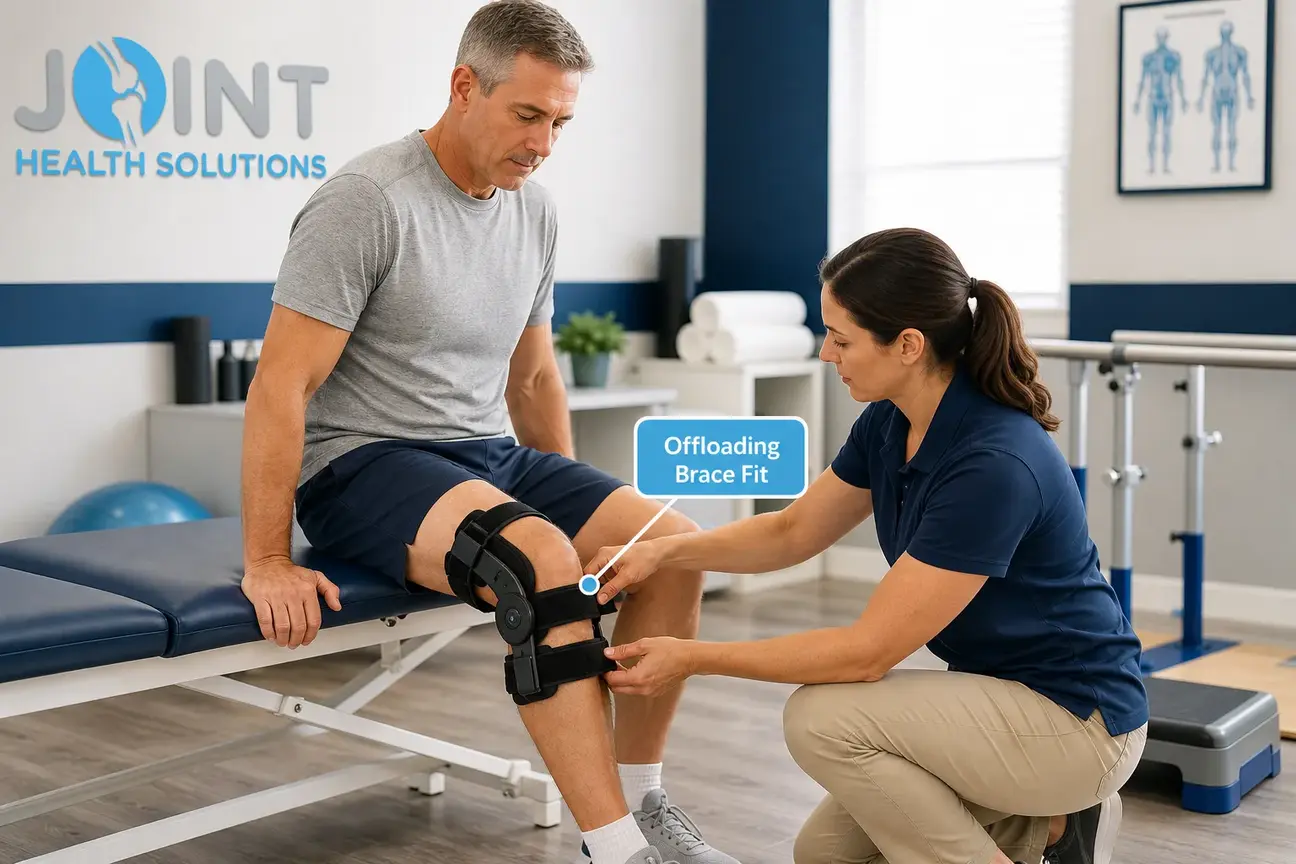
An offloading knee brace may be considered when mechanical support could help reduce stress in a particular part of the knee. AAOS guideline materials state that brace treatment could be used to improve function, pain, and quality of life. They also state that canes could be used to improve pain and function.
Bracing is not automatically helpful for every person with knee osteoarthritis. Fit, comfort, knee alignment, activity demands, skin tolerance, and willingness to use the brace all matter. A brace that sits unused in a closet will not support daily function. A brace that fits well and is used appropriately may help some people stay active with more confidence.
Joint Health Solutions offers offloading knee braces for patients for whom an offloading brace is appropriate. A clinical assessment can help determine whether bracing belongs in an individual plan and how it should be combined with strengthening, activity changes, or other options.
Canes, footwear, and load management
Assistive devices can sometimes feel discouraging at first, but they may be practical tools rather than signs of defeat. A cane, when used correctly, may reduce load through a painful knee and improve walking tolerance for some people. Footwear choices and activity pacing can also affect how the knee feels during the day.
Load management is a simple idea: the knee has a current capacity, and daily demands place load on it. Non-surgical knee osteoarthritis treatment tries to improve capacity where possible and reduce unnecessary overload where practical. Bracing, canes, exercise, and pacing can all fit into that larger strategy.
Knee Injections for Osteoarthritis: Where They Fit
Knee injections for osteoarthritis are not usually a replacement for exercise, education, and self-management. They are better understood as selective tools that may fit certain situations after clinical assessment. The type of injection matters, because corticosteroid injections, hyaluronic acid injections, and PRP therapy have different evidence profiles, goals, and coverage considerations.
Joint Health Solutions provides knee injections in Charlotte for adults with clinically assessed knee pain or conditions when appropriate. The practice also provides broader joint injection options. Eligibility, timing, and expected role depend on the patient’s assessment and individual treatment plan.
Injections should be discussed in context. A person may want short-term symptom relief to participate more comfortably in physical therapy, or they may be exploring options after oral or topical approaches have not been enough. Another person may not be a good candidate for a given injection. Results vary, and no injection should be presented as a promised solution.
When injections are considered, non-surgical knee osteoarthritis treatment still needs a broader plan. Symptom relief may be useful, but long-term management usually also involves strength, pacing, function goals, and reassessment when symptoms change.
Cortisone injections for short-term symptom relief
AAOS guideline materials state that intra-articular corticosteroids could provide short-term relief for knee osteoarthritis. This wording is important. Corticosteroid injections may help some people during a flare or period of increased symptoms, but they are not a way to remove osteoarthritis.
At Joint Health Solutions, cortisone injections are a confirmed service for patients for whom corticosteroid injection is appropriate. A clinician may consider current symptoms, prior treatment response, medical history, and goals before deciding whether this option fits an individual plan.
Because the expected role is generally short-term symptom relief, cortisone should not be framed as the whole strategy. It may be one part of non-surgical knee osteoarthritis treatment, often alongside strengthening, activity modification, bracing, or other conservative measures.
Hyaluronic acid injections: mixed evidence and coverage details
Hyaluronic acid injections, also called viscosupplementation, are more complex. AAOS knee osteoarthritis guideline materials state that hyaluronic acid intra-articular injections are not recommended for routine use in symptomatic knee osteoarthritis. That does not mean no clinician ever considers them; it means the evidence does not support routine use for everyone with symptomatic knee osteoarthritis.
Joint Health Solutions offers hyaluronic acid injections for patients for whom viscosupplementation is appropriate. A careful conversation should include what has already been tried, what the patient hopes to improve, whether documentation criteria are relevant, and how benefits and limitations are understood.
Medicare coverage is a separate question from whether a treatment is clinically discussed. CMS Local Coverage Determination L39260 says hyaluronic acid injections for knee osteoarthritis are considered reasonable and necessary only when documented criteria are met. Those criteria include symptomatic knee osteoarthritis, pain that interferes with functional activities, and specific documentation requirements. For repeated series, prior response and timing requirements, including at least six months since the prior series, are part of the policy.
Coverage can vary by treatment and plan. Covered and out-of-pocket costs should be reviewed before treatment, and patients should verify details with the practice and insurer. Accepting an insurance payer is not the same as a specific procedure being covered for every patient.
PRP therapy: a cautious, selective discussion
PRP therapy, or platelet-rich plasma therapy, is often discussed by people researching non-surgical knee osteoarthritis treatment. It uses a patient’s own blood product that is processed to concentrate platelets before being injected into the target area. However, PRP should be framed carefully for knee osteoarthritis because the evidence is less settled than for core options such as exercise, weight loss when appropriate, NSAIDs when not contraindicated, and bracing.
Joint Health Solutions provides PRP therapy for patients for whom PRP is appropriate. That does not mean PRP is right for every person with knee osteoarthritis. A patient-centered discussion should include evidence uncertainty, goals, cost or coverage questions, and how PRP would fit with the rest of a conservative care plan.
Original Medicare generally does not cover PRP injections used for osteoarthritis, knee pain, shoulder pain, or other orthopedic musculoskeletal joint conditions. Medicare has a separate, limited national coverage policy for autologous PRP used for qualifying chronic non-healing diabetic wounds for up to 20 weeks when requirements are met. That wound-care exception is distinct from routine orthopedic PRP for knee osteoarthritis.
Medicare Advantage plan details, prior authorization rules, cost sharing, and supplemental benefits vary by plan. Prior authorization approval does not turn an otherwise excluded service into a covered benefit. Patients considering PRP should obtain plan-specific written confirmation before treatment when coverage is a concern.
How a Personalized Care Plan May Combine Options
Most conservative plans are not built around a single choice. A person might use physical therapy for strength and gait mechanics, a topical medication when not contraindicated, pacing strategies for flare prevention, and an offloading brace for longer walking days. Another person may focus on aquatic exercise, weight loss when appropriate, and selective injection discussion.
The sequence matters. For many adults, exercise-based care and education are the foundation. Symptom-relief tools may make it easier to participate in movement and daily responsibilities. Mechanical supports may help reduce load. Injections may be considered when symptoms, goals, and assessment findings support that discussion.
At Joint Health Solutions, care is centered on clinical assessment and an individual treatment plan. You can learn more about the clinic’s non-surgical options and what to expect before deciding whether to schedule a consultation. A consultation does not promise a particular treatment, but it can help clarify which options may be appropriate.
A combined non-surgical knee osteoarthritis treatment plan should also be practical. If a plan is too complicated, too uncomfortable, or disconnected from daily life, it may be hard to follow. Practical planning can include how often someone can attend visits, what activities matter most, and which strategies are realistic at home.
When Home Care May Not Be Enough
Some people can manage mild, stable symptoms with education, movement, pacing, and guidance from their usual healthcare team. Others benefit from a more formal assessment, especially when symptoms interfere with work, sleep, walking, stairs, exercise, or caregiving responsibilities.
Consider seeking clinical assessment when knee pain is persistent, recurring, worsening, associated with repeated swelling, or limiting activities that matter to you. Assessment may also be appropriate if you are unsure whether symptoms are from osteoarthritis or another condition. A clinician can help distinguish knee osteoarthritis from other causes of knee pain and discuss a plan that matches your situation.
For urgent or emergency symptoms, call 911 or go to an emergency department. Joint Health Solutions does not provide emergency or 24/7 urgent care.
Charlotte-Area Non-Surgical Knee Care
Joint Health Solutions is a conservative, minimally invasive, non-surgical joint care clinic in Charlotte, North Carolina. The clinic is located at 9350 Benfield Rd, #109, Suite 109, Charlotte, NC 28269. Patients may travel from nearby communities, but the physical clinic is in Charlotte only.
If you are exploring non-surgical knee osteoarthritis treatment in the Charlotte area, a clinical assessment can help sort through the practical choices: exercise-based care, medication questions, bracing, and whether injection options should be discussed. You can contact Joint Health Solutions or use the clinic’s 704-833-3566 contact number with questions about scheduling.
The clinic serves people who are able to visit the Charlotte location. It does not provide mobile, in-home, door-to-door, or off-site treatment.
What to Ask During a Knee Osteoarthritis Visit
A productive visit often starts with clear questions. You do not need to know which treatment you want before you are assessed. In fact, the purpose of evaluation is to help connect symptoms, function, history, and goals to appropriate options.
Questions you may want to bring include:
- What findings suggest knee osteoarthritis, and could anything else be contributing to my symptoms?
- What activities should I continue, modify, or temporarily reduce?
- Would physical therapy for knee osteoarthritis be appropriate for my goals?
- Could an offloading knee brace or cane help my function?
- Are topical or oral NSAIDs appropriate for me, or should I avoid them?
- If an injection is discussed, what is the goal: short-term relief, function support, or another purpose?
- How do cortisone, hyaluronic acid, and PRP differ in evidence and coverage considerations?
- What signs would mean my plan should be reassessed?
These questions help keep the focus on informed, patient-centered care rather than a one-size-fits-all pathway. Non-surgical knee osteoarthritis treatment is most useful when it is connected to daily life: walking, stairs, exercise, work, hobbies, and independence.
Building Realistic Expectations
Realistic expectations are part of good care. If someone expects a single treatment to erase knee osteoarthritis, disappointment is likely. If someone understands that symptoms can often be managed with a layered plan, it becomes easier to measure progress in practical ways.
Useful progress markers may include walking farther with fewer flare-ups, climbing stairs with more confidence, reducing next-day soreness after activity, improving range of motion, or feeling more prepared to manage symptom changes. These are functional goals, not assured outcomes.
It is also reasonable for goals to change. A plan that made sense during a painful flare may need adjustment once symptoms calm. A home exercise routine may need progression after strength improves. A brace may be useful for certain activities but not others. A non-surgical knee osteoarthritis treatment plan should be revisited when it no longer matches the person’s symptoms or life demands.
Progress can be uneven. Some weeks may feel better than others because activity demands, sleep, stress, weather, or other health issues can influence symptoms. Non-surgical knee osteoarthritis treatment is usually a continuing process of adjusting the plan, monitoring function, and staying realistic about what each option is meant to do.
Key Takeaways
Non-surgical knee osteoarthritis treatment usually works through a combination of strategies rather than one isolated fix. The most guideline-supported foundations include exercise, self-management education, and weight loss when appropriate. Topical and oral NSAIDs may be used when not contraindicated, and bracing or canes may help selected people improve pain or function.
Injections can be considered selectively. Corticosteroid injections could provide short-term relief for some people. Hyaluronic acid has mixed evidence and is not recommended for routine use by AAOS, though CMS policy may consider it reasonable and necessary for knee osteoarthritis only when documented criteria are met. PRP should be discussed cautiously because evidence and coverage are less certain for knee osteoarthritis.
The most helpful plan is individualized. If knee pain is limiting your mobility or quality of life, clinical assessment can help clarify what conservative options may fit your needs and what expectations are realistic. Non-surgical knee osteoarthritis treatment should support informed decisions, not pressure people toward a one-size-fits-all choice.
Medical disclaimer: For general education only; not a substitute for professional medical advice, diagnosis, or treatment. Suitability and results vary, and individual needs require clinical assessment.
Frequently Asked Questions
What is the most supported non-surgical treatment for knee osteoarthritis?
The most supported foundation usually includes exercise-based care, education, and self-management. Weight loss is recommended in adults who are overweight or obese. Other options, such as NSAIDs when not contraindicated, bracing, canes, or injections, may be considered based on clinical assessment.
Do physical therapy and exercise really help knee arthritis?
Yes, exercise is a guideline-supported part of knee arthritis care. AAOS materials state that supervised exercise, unsupervised exercise, and/or aquatic exercise are recommended over no exercise to improve pain and function. The right program should be matched to the person’s symptoms, ability, and goals.
When are NSAIDs used for knee osteoarthritis?
Topical and oral NSAIDs may be used for symptom relief when not contraindicated. AAOS materials state that topical NSAIDs should be used to improve function and quality of life when not contraindicated, and oral NSAIDs are recommended to improve pain and function when not contraindicated. Medication decisions should be discussed with a clinician or pharmacist.
Are knee braces useful for arthritis pain?
Knee bracing may help selected people. AAOS materials state that brace treatment could be used to improve function, pain, and quality of life. Fit, comfort, knee alignment, activity needs, and willingness to use the brace all affect whether bracing is practical.
Are cortisone shots only a short-term option?
Corticosteroid injections are generally discussed as a short-term symptom-relief option for knee osteoarthritis. AAOS materials state that intra-articular corticosteroids could provide short-term relief. They do not eliminate osteoarthritis, and suitability depends on clinical assessment.
Is hyaluronic acid covered by Medicare for knee osteoarthritis?
CMS policy says hyaluronic acid injections for knee osteoarthritis are considered reasonable and necessary only when documented criteria are met. Coverage depends on the treatment, plan, documentation, and individual circumstances. Patients should verify details with the practice and insurer before treatment.
Does Medicare cover PRP for knee arthritis?
Original Medicare generally does not cover PRP injections for orthopedic joint conditions such as knee osteoarthritis. Medicare has a narrow separate policy for qualifying chronic non-healing diabetic wounds, which is different from knee arthritis care. Medicare Advantage details vary, so written plan-specific confirmation is important.
When should I get a clinical assessment instead of trying home care alone?
Assessment may be appropriate when knee pain persists, worsens, limits walking or stairs, causes repeated swelling, affects sleep or work, or makes you unsure what is safe. For urgent or emergency symptoms, call 911 or go to an emergency department.
Sources
- AAOS Clinical Practice Guidelines page
- AAOS Management of Osteoarthritis of the Knee (Non-Arthroplasty) guideline PDF
- AAOS Knee Osteoarthritis guideline infographic PDF
- CMS Hyaluronic Acid Injections for Knee Osteoarthritis LCD L39260
- CMS Intraarticular Knee Injections of Hyaluronan LCD L39529
- CMS Hyaluronic Acid Injections for Knee Osteoarthritis article