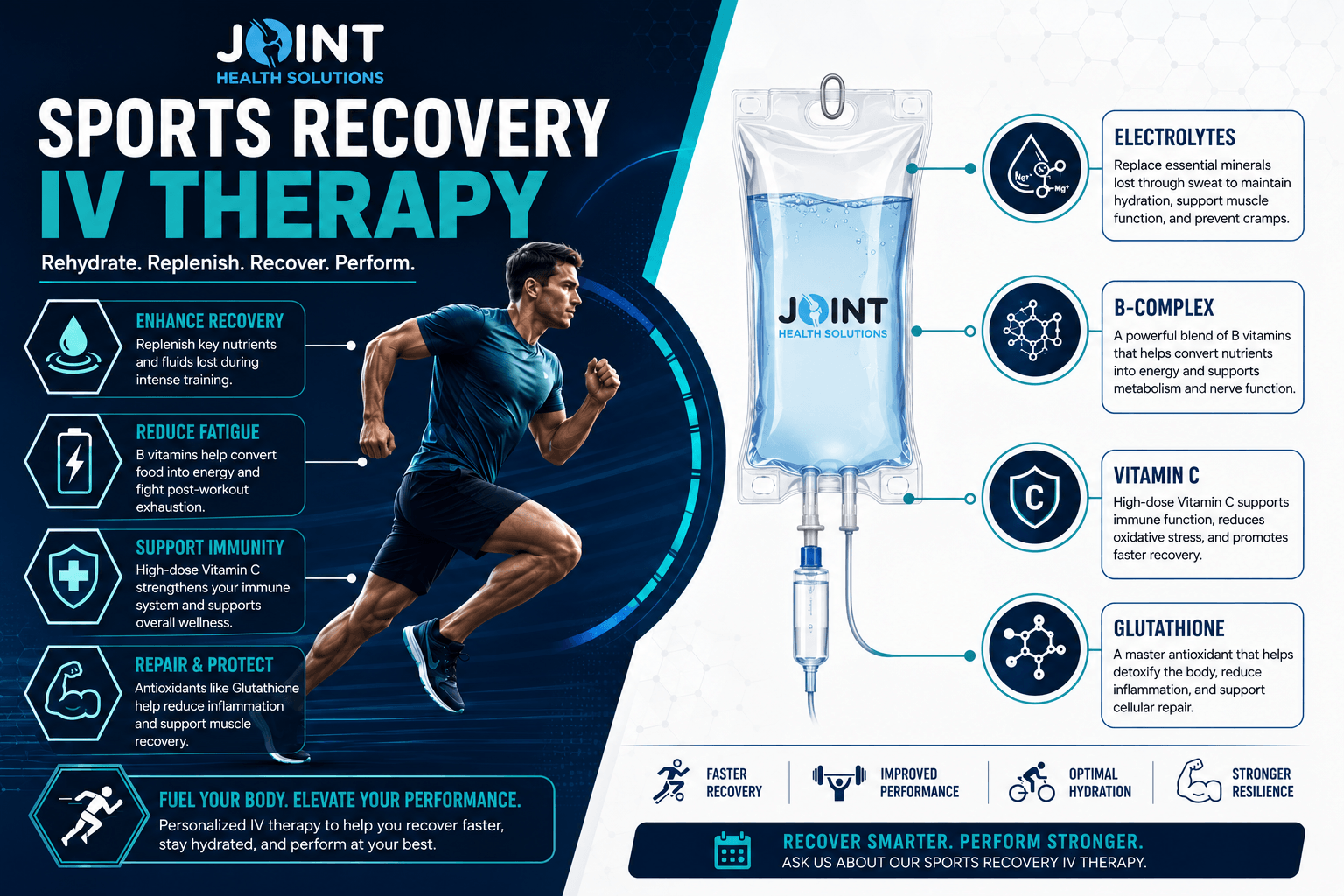
Custom Sports Recovery IV Therapy in Charlotte | Faster Recovery for Athletes
How We Customize Sports Recovery IV Therapy for Optimal Results in Charlotte
Published July 2, 2026 | Last reviewed: July 14, 2026 | Category: Treatments & Services | Location: Charlotte, NC
🕒 12 MIN READ
After an intense training session, a competitive event, or a demanding stretch of workouts, the body loses fluids, electrolytes, and nutrients at a rate that standard oral supplementation may not fully address in the immediate post-exercise window. Athletes who train at high volume or compete in multi-day events increasingly consider sports recovery IV therapy as a tool to accelerate rehydration and nutrient replenishment.
At Joint Health Solutions, we tailor each sports recovery IV therapy protocol to the individual athlete based on their sport, training load, medical history, and recovery needs — rather than using a generic off-the-shelf formulation. This article explains what goes into that customization, what the evidence shows, and what to expect from a session.
Quick AnswerSports recovery IV therapy delivers fluids, electrolytes, vitamins, and antioxidants directly into the bloodstream, bypassing the gastrointestinal tract. A typical session lasts 30 to 60 minutes. Because IV administration achieves 100% bioavailability for the administered dose, it can correct hydration and electrolyte deficits more rapidly than oral supplementation — which is the primary rationale for its use in athletic recovery contexts. Current evidence for IV therapy in healthy athletes is limited; most studies show rapid rehydration benefits, but performance and recovery advantages over well-executed oral rehydration are less clear in the literature. Protocols are customized based on each athlete’s assessment, sport, and training context. Candidacy requires a clinical evaluation.
The Rationale for IV Delivery in Athletic Recovery
When an athlete consumes fluids and nutrients orally, absorption depends on gastric emptying, intestinal transit, and mucosal uptake. During and immediately after high-intensity exercise, this process is complicated by splanchnic vasoconstriction — a well-documented physiological response in which blood flow is redirected from the gastrointestinal tract to active muscles and the cardiopulmonary system. Research has documented significant reductions in mesenteric blood flow during maximal and submaximal exercise, which can reduce GI absorptive capacity and cause GI distress symptoms common in endurance athletes.
IV administration bypasses this entirely. Fluids, electrolytes, and nutrients enter the bloodstream directly, achieving full bioavailability for the dose administered, regardless of GI status. This is the core pharmacological advantage of the IV route.
Whether this translates into meaningfully better athletic recovery outcomes than well-executed oral rehydration depends on the clinical context. For athletes with severe dehydration, significant electrolyte losses, or GI absorption difficulties post-exercise, IV delivery offers a clear practical advantage. For healthy athletes with mild dehydration and intact GI function, the evidence for IV versus oral rehydration is less clear — some studies show comparable outcomes when oral rehydration is executed correctly. See the evidence table below.
Oral vs. Intravenous Nutrient Delivery: Key Differences
Feature
Oral Supplementation
Intravenous (IV) Therapy
Bioavailability
Varies by nutrient and dose; highly dose-dependent for vitamins (e.g., vitamin C absorption falls sharply at high oral doses)
100% for the administered dose
Speed of absorption
1–4 hours (requires GI transit)
Immediate (direct to bloodstream)
GI impact
Can cause bloating, cramping, or nausea, especially post-exercise
No GI strain during delivery
Clinical context
Adequate for most athletes with mild dehydration and intact GI function
Advantageous when rapid rehydration is needed, GI absorption is compromised, or electrolyte losses are severe
At Joint Health Solutions, sports recovery IV therapy is designed to complement, not replace, foundational recovery: structured nutrition, adequate sleep, and physical therapy remain the primary recovery tools. IV therapy is considered when the clinical picture supports its use as an additional intervention.
How We Customize Sports Recovery IV Therapy for Optimal Results in Charlotte.
The Science Behind Customized IV Formulas
Individual athletes differ in sweat rate, electrolyte losses, baseline nutrient status, body composition, and dietary patterns. A single generic formulation cannot account for these differences. Our customization process aims to address the specific physiological deficits each athlete presents with, rather than applying a standardized protocol.
Magnesium and Electrolyte Restoration
Exercise physiology research documents that intracellular magnesium concentrations decrease during prolonged, high-intensity exercise. Magnesium functions as a cofactor in ATP synthesis, neuromuscular transmission, and muscle relaxation. Depletion contributes to cramping, prolonged muscle fatigue, and impaired energy production. IV administration corrects electrolyte imbalances rapidly and precisely, allowing us to calibrate sodium, potassium, magnesium, and calcium doses based on the individual’s assessment rather than estimated averages.
Antioxidants and Oxidative Stress
High-intensity aerobic and anaerobic exercise increases oxygen consumption, which generates reactive oxygen species (free radicals). A baseline level of oxidative stress is a normal stimulus for muscular adaptation. Excessive free-radical accumulation, however, can damage cell membranes and contribute to delayed-onset muscle soreness (DOMS) and prolonged inflammatory response. Antioxidants such as vitamin C and glutathione are included in many sports recovery protocols on the basis that they may help manage this oxidative burden. The evidence for this mechanism in humans is biologically plausible but not yet conclusively established in high-quality clinical trials — see the evidence table.
Customization by Sport and Athlete Profile
A long-distance runner with heavy sweat losses during peak training may benefit from a formula emphasizing higher magnesium, electrolytes, and vitamin C to support collagen synthesis in stressed connective tissue. A strength or power athlete experiencing significant DOMS may benefit more from antioxidant loading and amino acid support. A multi-day competitor may prioritize rapid volume restoration and glycogen-sparing electrolytes between race stages.
B-complex vitamins — particularly B6 and B12 — support energy metabolism through mitochondrial pathways and assist in red blood cell production. We assess each athlete’s presentation and tailor the formula accordingly, adjusting doses based on the clinical evaluation rather than applying fixed standard doses to every patient.
Hydration and Fluid Dynamics
Research has shown that dehydration of approximately 2% of body weight can impair endurance performance and increase injury risk. Our team estimates fluid volume requirements based on training duration, environmental conditions, and estimated sweat rate. Solution osmolarity is matched to the athlete’s state — isotonic formulations for standard rehydration, slightly hypotonic when cellular water replenishment is the priority — to optimize fluid distribution into the intracellular compartment without causing vascular irritation.
These minerals maintain fluid balance, osmotic pressure, neuromuscular function, and muscle contraction cycles. Restoring them intravenously can correct acute post-exercise deficits more rapidly than oral electrolyte supplementation, particularly when GI absorption is compromised.
2. Vitamin C (Ascorbic Acid)
A water-soluble antioxidant involved in collagen synthesis, which is relevant to connective tissue repair following eccentric loading and tissue micro-trauma. At high oral doses, vitamin C absorption is significantly limited; IV delivery achieves higher plasma concentrations. Evidence for performance benefit at high IV doses is mixed — antioxidant effect is biologically plausible, but clinical outcomes data in athletes is limited.
Serve as cofactors in mitochondrial energy pathways, supporting the conversion of macronutrients into ATP. Also support red blood cell production and neurological function. IV B-complex is most relevant when deficiency or suboptimal status is contributing to fatigue; benefit in athletes with adequate baseline status is less clear.
4. Glutathione
A tripeptide antioxidant synthesized in the liver that plays a role in free-radical neutralization and liver detoxification. Laboratory evidence for glutathione’s antioxidant effects is well-established; clinical evidence specifically demonstrating reduced DOMS or improved sports recovery outcomes in humans is limited. Included in protocols where oxidative stress management is the primary goal, with the evidence limitation disclosed to patients.
Taurine: Supports intracellular calcium regulation, which affects muscle contraction and excitability. Some human studies show reduced muscle damage markers with taurine supplementation.
L-Arginine: Precursor to nitric oxide (NO), which promotes vasodilation and blood flow. Evidence for performance benefit in athletes is mixed; may support tissue perfusion during recovery.
L-Carnitine: Supports mitochondrial fatty acid transport. Some evidence for modest reduction in post-exercise muscle damage biomarkers; clinical significance for athletes is debated.
6. Zinc
An essential trace mineral involved in enzyme function, protein synthesis, and immune cell activity. Intense training temporarily suppresses immune function; zinc adequacy supports immune defense and tissue repair. Most relevant when zinc status is suboptimal.
7. Toradol (Ketorolac) — When Clinically Indicated
Toradol (ketorolac) is an FDA-approved NSAID that can be added to a protocol when short-term management of acute musculoskeletal pain is clinically indicated. It is limited to a maximum of 5 days and carries standard NSAID risks including GI and renal effects. Risks and alternatives are discussed before use; it is not a routine component of all sports recovery IVs.
Our Five-Step Customization Process
Step 1: Comprehensive Initial Consultation
Your first appointment begins with a detailed intake covering athletic history, current training load, specific recovery concerns, and upcoming events. We conduct a complete medical review — including lab results, medications, and allergy history — to rule out contraindications such as renal insufficiency, cardiac conditions, or fluid retention disorders. This medical screening determines whether IV therapy is appropriate and which formulation is safe for you.
Step 2: Physiological and Hydration Assessment
We assess your current physical state using relevant markers: recent micronutrient panels if available, hydration status, training logs, and symptoms. For appropriate patients, bioimpedance analysis may be used to estimate total body water distribution and identify specific fluid or electrolyte deficits. This moves the formulation decision from guesswork to objective data.
Step 3: Formula Design
Using the consultation data and physiological assessment, our clinical team selects a base fluid volume (typically 500mL to 1,000mL of Normal Saline or Lactated Ringer’s) and calculates appropriate dosages for electrolytes, vitamins, antioxidants, and amino acids based on your individual needs. The formula reflects your sport type, training intensity, sweat profile, and any identified deficiencies — not a standard template.
Step 4: Clinical Administration
Once the formula is prepared by our compounding pharmacy partner, you are seated in our treatment lounge. A registered nurse accesses a peripheral vein — typically in the forearm or antecubital fossa — using sterile technique. The infusion runs 30 to 60 minutes. Vital signs are monitored throughout. The needle insertion registers as a brief pinch; the infusion itself is painless. Many patients rest, read, or use their phone during the session.
Step 5: Post-Infusion Monitoring and Follow-Up
After the infusion is complete, we note your response — energy level, any adverse reactions, soreness patterns over the following days. This feedback is used to adjust your protocol for subsequent sessions, refining the formula as your training cycle changes. If you do not respond meaningfully after an initial series, we discuss alternatives rather than continuing indefinitely.
What to Expect During Your Session
Upon arrival at our Charlotte clinic, you are guided to our treatment lounge and seated in a recliner. Your nurse will clean the injection site, apply a temporary tourniquet, and introduce the IV catheter. Once the drip begins, the session is yours — read, rest, listen to a podcast, or catch up on messages.
Timeline
Activity
0–5 minutes
Clinical intake and vital signs
5–10 minutes
IV placement (sterile technique)
10–50 minutes
Infusion — rest, read, or work
50–60 minutes
Catheter removal, bandage, discharge
It is common to feel a mild cooling sensation in the arm as room-temperature fluid enters the vein, or a brief metallic taste with certain vitamins — both are normal and temporary. After the catheter is removed, a small bandage is placed at the site. Most patients feel well enough to resume normal activities the same day; we recommend avoiding strenuous exercise and alcohol for the rest of the day and drinking additional fluids. Some patients notice improved hydration within hours; others feel the greatest benefit the following morning. Individual responses vary.
Who May Benefit From Sports Recovery IV Therapy
Athletes who may be appropriate candidates include those who train at high intensity or volume, compete in multi-day events, experience recurrent cramping or post-exercise GI distress that limits oral hydration, or want to support recovery between high-demand training blocks. Benefit is most clearly supported for athletes with clinical dehydration or documented electrolyte depletion following extreme exertion.
IV therapy is less clearly supported as a routine supplement for well-nourished athletes with mild dehydration who can rehydrate effectively orally. It is not a substitute for training, nutrition, sleep, or physical therapy — these remain the primary drivers of athletic recovery and adaptation.
Evidence and Clinical Research
Component
FDA Status
Evidence Level
Key Findings
IV Fluids (Normal Saline, Lactated Ringer’s)
FDA-approved for hydration
Established for clinical dehydration; limited for routine athletic use
Effective for treating significant dehydration; rehydration rate is faster than oral, but performance differences vs. oral rehydration in healthy athletes are modest and context-dependent
Magnesium
FDA-approved as nutrient; IV use for deficiency is standard care
Established for treating deficiency; limited specifically for sports performance
Reduces cramping and neuromuscular dysfunction associated with deficiency; supports energy metabolism
Vitamin C (high-dose IV)
FDA-approved as nutrient; high-dose IV use is off-label
Mixed evidence in sports recovery
May reduce oxidative stress markers; role in collagen synthesis is established; high-quality RCT evidence for sports recovery outcomes is limited
B-Complex Vitamins
FDA-approved as nutrients
Established for treating deficiency; limited for athletes with adequate baseline status
Support energy metabolism and red blood cell production; benefit in well-nourished athletes is less clear
Glutathione (IV)
Not FDA-approved as a drug; available as supplement/compounded preparation
Limited human evidence; primarily mechanistic and animal studies
Antioxidant properties established in laboratory models; evidence for reduced DOMS or improved recovery in athletes is limited
Amino Acids (Taurine, L-Arginine, L-Carnitine)
Generally recognized as safe as nutrients; IV use is off-label
Limited to mixed; varies by compound
Some evidence for reduced muscle damage markers (taurine, L-carnitine); vasodilation effect of arginine is mechanistically sound; clinical outcomes for athletes are variable
Toradol (Ketorolac)
FDA-approved for short-term pain management (≤5 days)
Established clinical evidence
Reduces acute musculoskeletal pain; GI and renal risk with prolonged use; not for routine use
Evidence-Level Definitions:
Established clinical evidence: Supported by multiple peer-reviewed human studies.
Mixed evidence: Some supportive human data, but inconsistency or methodological limitations across studies.
Limited human evidence: Small studies or evidence primarily from deficiency or clinical populations that may not generalize.
Mechanistic / animal studies: Laboratory or animal findings; do not prove clinical benefit in humans.
Important: Current scientific evidence for routine IV therapy use in healthy, well-nourished athletes remains limited. The combination of nutrients in a single IV formulation for sports recovery is off-label and investigational as a combination treatment. Oral rehydration, when executed correctly, achieves comparable recovery outcomes in many athletic contexts. IV therapy is best viewed as a supplementary tool for specific clinical scenarios — not a universal performance accelerator. Discuss the evidence, risks, and alternatives with your clinician.
Safety and Candidacy
Who May Be a Good Candidate
Athletes training at high intensity or volume with significant electrolyte losses
Endurance athletes competing in multi-day events
Athletes with post-exercise GI distress that limits oral rehydration
Those with documented electrolyte deficiencies contributing to cramping or fatigue
Athletes who want medically supervised recovery support alongside nutrition and physical therapy
Who Should Avoid IV Therapy
Severe kidney disease (impaired fluid and electrolyte handling)
Congestive heart failure (fluid overload risk)
Known allergies to any components of the infusion
Active infection or fever
Uncontrolled hypertension
Always disclose your complete medical history and medication list to your clinician before your first session.
Medication Interactions
Athletes on blood thinners (warfarin, apixaban, rivaroxaban, clopidogrel, etc.) may have a higher risk of bruising or bleeding at the IV site. Inform our team of all medications and supplements you are taking before your appointment.
Compounding Pharmacy Policy
At Joint Health Solutions, we use compounding pharmacies when clinically appropriate. Compounding involves preparing customized formulations — for example, adjusting doses, combining ingredients, or creating preservative-free preparations — to meet specific patient needs.
Category
Description
Safety Status
Physician-prescribed from a licensed compounding pharmacy
Prepared by a state-licensed pharmacy following USP standards
Legitimate, regulated, and appropriate when clinically indicated
Online peptide labs / research-only vendors
Sell products “for research use only” without a prescription
Unregulated; identity, purity, sterility, and storage are uncertain
Direct-to-consumer sellers
Sell IV vitamins or peptides without medical oversight
Unsupervised; risk of adverse effects and contamination
We advise athletes to obtain IV therapy only through a qualified healthcare professional and to avoid online sellers that do not meet pharmacy and medical-provider standards.
No compounded preparation is FDA-approved, and no pharmacy is “FDA-certified.” However, licensed compounding pharmacies operate under state regulations and USP compounding standards, which provide important quality and safety safeguards.
Frequently Asked Questions
How is the IV formula customized for me?
Your formula is determined based on your sport, training intensity, sweat profile, medical history, and recovery goals assessed during your consultation. We select the appropriate fluids, electrolytes, vitamins, antioxidants, and amino acids to match your specific presentation — not a standard template.
How long does a session take?
A typical session lasts 30 to 60 minutes for the infusion, plus intake and preparation time. Total clinic time is generally 45 to 75 minutes.
Is there downtime after treatment?
Most patients resume normal light activity the same day. We recommend avoiding strenuous exercise, alcohol, and heavy meals for the rest of the treatment day, and staying well hydrated. Follow your clinician’s specific post-session guidance.
How many sessions are recommended?
Frequency depends on your training schedule and clinical response. Some athletes use IV therapy after peak training sessions or competitions; others use it during high-load blocks. Your provider will recommend a frequency that aligns with your goals and adjusts based on your response.
Can IV therapy help with sports injuries?
For acute musculoskeletal pain, Toradol (ketorolac) can be added to an IV protocol when clinically appropriate. Nutrients supporting tissue repair (vitamin C for collagen synthesis, amino acids) may complement recovery from minor injury. For significant injuries, IV therapy works alongside — not instead of — physical therapy and appropriate medical evaluation.
Are there side effects?
Side effects are generally mild and uncommon: bruising at the IV site, a mild cooling sensation during infusion, or a temporary metallic taste with certain vitamins. Serious complications such as infection or severe allergic reactions are rare when administered by trained clinical staff. Inform us of any allergies or prior reactions before your session.
Is IV therapy safe for all athletes?
Most athletes are appropriate candidates after a clinical evaluation. IV therapy is not recommended for those with kidney disease, congestive heart failure, active infection, uncontrolled hypertension, or known allergy to infusion components. A thorough evaluation confirms safety before treatment.
Can I combine IV therapy with other treatments?
Yes. IV therapy is designed to complement — not replace — structured nutrition, physical therapy, adequate sleep, and appropriate training load management. We can coordinate with your coaching or physical therapy team when helpful.
How soon will I feel the effects?
Many patients notice improved hydration and reduced fatigue within hours. Others feel the greatest benefit the following morning. Individual responses vary based on baseline hydration status, the degree of exertion, and the specific formulation administered.
Do I need a prescription?
No prescription is required to schedule a consultation. However, a clinical evaluation is required before treatment to confirm candidacy and design the appropriate protocol. Call us at 704-833-3566 to schedule.
What does evidence say about IV therapy vs. oral rehydration for athletes?
Studies show that IV fluid administration achieves faster rehydration rates than oral intake. However, several well-designed studies have found that when athletes are given adequate time and volume, oral rehydration can achieve comparable performance outcomes. IV therapy provides the clearest advantage when rapid rehydration is needed, oral intake is impaired (e.g., post-GI distress), or electrolyte losses are severe. For routine mild dehydration in healthy athletes, the performance advantage of IV over oral rehydration is not conclusively established.
Book Your Sports Recovery IV Consultation in Charlotte
If you are looking for a medically supervised, individualized recovery tool to complement your training, Joint Health Solutions can assess whether sports recovery IV therapy is appropriate for you.
Key Clinical References — Sports Hydration and IV Therapy
Maughan RJ, et al. (2007). Fluid and electrolyte intake and loss in elite soccer players during training. International Journal of Sport Nutrition and Exercise Metabolism. PubMed: 17607008
Sawka MN, et al. (2007). American College of Sports Medicine position stand: exercise and fluid replacement. Medicine & Science in Sports & Exercise. PubMed: 17277604 — Key reference for 2% dehydration and performance.
Latzka WA, Sawka MN. (2000). Hyperhydration and glycerol: thermoregulatory effects during exercise in hot climates. Canadian Journal of Applied Physiology. PubMed: 10815020
Rowell LB. (1974). Human cardiovascular adjustments to exercise and thermal stress. Physiological Reviews. PubMed: 4370008 — Classic reference for splanchnic vasoconstriction during exercise.
Padayatty SJ, et al. (2004). Vitamin C pharmacokinetics: implications for oral and intravenous use. Annals of Internal Medicine. PubMed: 15069351
Maughan RJ, et al. (2018). IOC consensus statement: dietary supplements and the high-performance athlete. British Journal of Sports Medicine. PubMed: 29540394
Disclaimer: This content is for informational purposes only and does not constitute medical advice. Always consult with a qualified healthcare provider before starting IV therapy. Individual results vary. The combination of IV nutrients for sports recovery is off-label and investigational as a combined treatment; evidence strength varies by component. IV therapy is not a substitute for structured nutrition, sleep, and physical therapy.
Frequently Asked Questions
Can a specific diet cure my arthritis?
No. Diet is not a cure for arthritis and it cannot reverse structural damage like cartilage loss. However, it can help manage systemic inflammation. To address structural issues, you may want to learn about PRP therapy.
Should I stop eating nightshades immediately?
Not necessarily. Scientific reviews find no consistent association between nightshades and increased joint pain. Unless you personally notice a flare-up, they are generally safe and nutritious.
How do I know if gluten is causing my joint pain?
Diagnosis involves ruling out celiac disease first through blood tests while you are still eating gluten. If you need professional guidance on joint health, you can contact us for a consultation.
Are there other non-dietary ways to support my joints?
The Dietary Guidelines for Americans recommend limiting added sugar to less than 10% of your daily calories to help manage overall health and inflammation.
Does dairy cause inflammation in everyone?
No. A 2019 systematic review found no consistent evidence linking dairy consumption to increased inflammation in healthy adults.
What is Non-Celiac Gluten Sensitivity (NCGS)?
NCGS is a condition where individuals experience symptoms like joint pain and brain fog after eating gluten, despite not having celiac disease or a wheat allergy.
Why are omega-3 fatty acids important for joint health?
Omega-3 fatty acids, found in fish and flaxseeds, can reduce the production of inflammatory cytokines that contribute to joint pain.
Can I diagnose a food sensitivity on my own?
It is not recommended. You should consult a primary care provider or registered dietitian before starting an elimination diet, especially to ensure proper testing for conditions like celiac disease
What is the ideal ratio of Omega-6 to Omega-3?
While the typical Western diet is 15:1, a ratio of 4:1 or lower is considered more anti-inflammatory and better for managing joint pain.