
Neck & Shoulder Pain Relief | IV Therapy for Trapezius Tightness in Charlotte
Published July 17, 2026 | Category: Conditions We Treat | 🕒 12 min read
Introduction
If you spend hours hunched over a computer, gripping a steering wheel, or staring at a phone, you know the familiar ache that settles into your upper back and neck. That tension — often originating in the trapezius muscles — can become a chronic source of discomfort that disrupts sleep, limits mobility, and dims your quality of life.
At Joint Health Solutions, we understand that chronic muscle tightness is more than a nuisance — it’s a signal that your body needs targeted recovery support. This guide explores how IV hydration therapy, combined with other non-surgical treatments, can help release stubborn trapezius tightness and restore your comfort. Whether you’re a desk worker, a fitness enthusiast, or someone simply tired of living with neck pain, understanding the role of hydration and muscle recovery can be a genuine game-changer.
We’ll walk you through the anatomy of the trapezius, why conventional approaches often fall short, and how anti-inflammatory IV therapy can complement your recovery journey.
Why the Condition Becomes Chronic (The Biology)
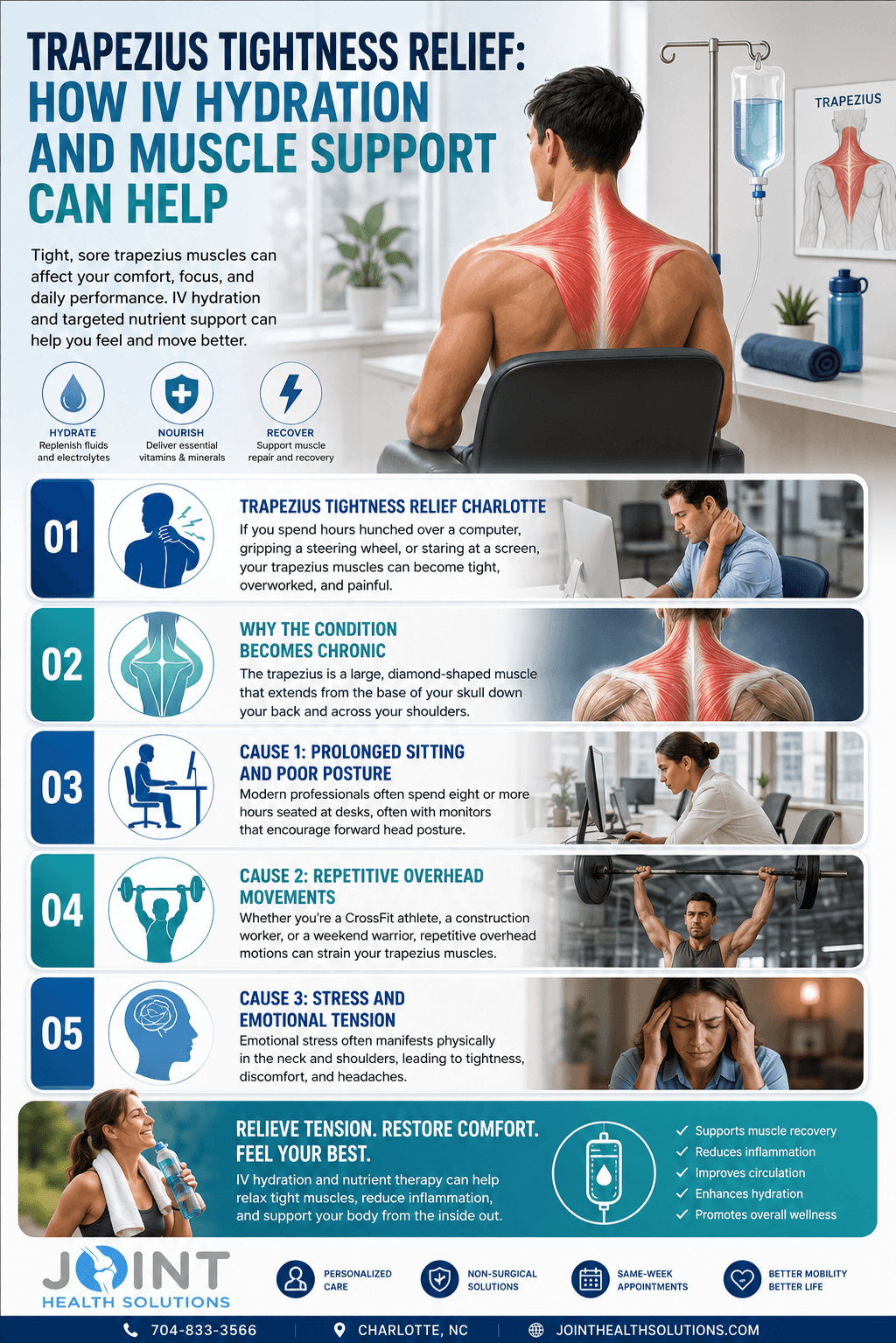
The trapezius is a large, diamond-shaped muscle that extends from the base of your skull to the middle of your back and across your shoulders. It plays a crucial role in posture, shoulder movement, and neck support. When this muscle is overworked or held in a contracted state for prolonged periods — common in sedentary jobs or repetitive activities — it can develop trigger points: hyperirritable spots within the muscle that refer pain to the head, neck, or arms.
Chronic trapezius tightness often stems from a cycle: poor posture leads to muscle strain, which causes inflammation and reduced blood flow, which in turn leads to more tension and pain. Dehydration exacerbates this cycle because muscles require adequate fluid to maintain elasticity and flush out metabolic waste products like lactic acid. When you’re dehydrated, muscle fibers become more prone to spasms and adhesions.
IV hydration may help interrupt this cycle by replenishing fluids and electrolytes, restoring the muscle’s natural environment. Additionally, pro-inflammatory cytokines can accumulate in trigger points, perpetuating pain. Anti-inflammatory IV therapy — which often includes glutathione, vitamin C, and magnesium — may help modulate this response, though the evidence for these specific IV components in the context of trapezius tightness is largely mechanistic (see the evidence table below).
3 Common Causes
Cause 1: Prolonged Sitting and Poor Ergonomics
Modern professionals often spend eight or more hours seated at desks, with monitors that are too low or chairs that lack lumbar support. This forces the trapezius to work harder to keep the head upright, leading to fatigue and tightness. Over time, the muscle adapts by staying partially contracted, creating a chronic state of tension. Simple ergonomic adjustments can help, but for many patients the damage is already done — which is why targeted treatments like trigger point injections and IV therapy can be useful for breaking the cycle.
Cause 2: Repetitive Overhead Movements or Lifting
Whether you’re a CrossFit athlete, a construction worker, or a weekend warrior, repetitive overhead motions place immense strain on the trapezius. The muscle is responsible for stabilizing the shoulder blades and neck during these movements. Without adequate recovery, micro-tears and inflammation accumulate, leading to chronic tightness. Sports recovery IV therapy can accelerate healing by delivering nutrients directly to the bloodstream, promoting faster repair of muscle tissue.
Cause 3: Stress and Emotional Tension
Emotional stress often manifests physically in the neck and shoulders. The trapezius is particularly sensitive to stress hormones like cortisol, which can increase muscle tone and contribute to tension headaches. Many patients report that their trapezius tightness flares up during high-pressure periods. Combining stress management techniques with therapies such as anti-inflammatory IV drips and physical therapy can provide more comprehensive relief than either approach alone.
Symptoms That Say “It’s Time for Help”
When trapezius tightness becomes chronic, it can produce a range of symptoms beyond simple achiness:
- Tension headaches that start at the base of the skull and radiate to the forehead
- Limited range of motion when turning your head or lifting your arms
- A burning sensation between the shoulder blades
- Numbness and tingling down the arms due to nerve compression
- Sleep disturbances, as finding a comfortable position becomes difficult
If you’ve tried rest, stretching, and over-the-counter medications without lasting improvement, it may be time to explore professional non-surgical options. Ignoring these symptoms can lead to compensatory movement patterns that affect the lower back, hips, and even knees over time.
The Problem with Conventional Treatments (Pills, Steroids, Surgery)
Many people first reach for oral anti-inflammatories or muscle relaxants when trapezius tightness strikes. While these can provide temporary relief, they don’t address the underlying muscle dysfunction and can have side effects including gastrointestinal irritation or drowsiness. Corticosteroid injections may reduce inflammation but can weaken muscle tissue over time if used repeatedly. Surgery — such as scalene release or nerve decompression — is invasive, carries procedural risks, and is rarely indicated for trapezius tightness.
| Treatment | How It Works | Limitations | Risks |
|---|---|---|---|
| Oral Pills (NSAIDs, Muscle Relaxants) | Reduce inflammation and muscle spasm systemically | Does not address trigger points; temporary relief | Stomach ulcers, kidney issues, drowsiness |
| Steroid Injections | Powerful anti-inflammatory at the site | Can weaken tissue with repeated use; not a long-term solution | Tissue atrophy, infection, tendon rupture |
| Surgery (e.g., scalene release) | Releases compressed nerves or muscles | Invasive; recovery time; rarely necessary for tightness alone | Infection, nerve damage, scarring |
| Non-Surgical Care (IV Hydration, Trigger Point Injections, PT) | Targets hydration, inflammation, and muscle function | Requires multiple sessions; may not be covered by insurance | Minor bruising, rare infection at IV/injection site |
How Joint Health Solutions Treats It Without Surgery
At Joint Health Solutions, we offer a range of non-surgical treatments tailored to your specific needs. Our approach begins with a thorough evaluation to identify the root causes of your trapezius tightness, then combines therapies to optimize muscle recovery and reduce inflammation.
Anti-Inflammatory IV Therapy
Our anti-inflammatory IV therapy delivers a customized blend of fluids, electrolytes, vitamins, and antioxidants directly into your bloodstream, bypassing the digestive system for rapid absorption. Ingredients like glutathione, vitamin C, and magnesium may help reduce oxidative stress and inflammation in the trapezius muscle. Some patients report feeling a reduction in tightness within a few hours, while others require several sessions before noticing sustained improvement. Learn more about IV therapy.
Sports Recovery IV Therapy
For active individuals, sports recovery IV therapy focuses on replenishing nutrients lost during exercise and promoting muscle repair. It includes amino acids, B vitamins, and electrolytes to support tissue healing. This can be particularly useful if your trapezius tightness is linked to repetitive overhead movements or weightlifting. Learn more.
Trigger Point Injections
Trigger point injections involve placing a small amount of anesthetic or saline directly into tight muscle knots. This helps relax the muscle and break the pain cycle. When combined with IV therapy, effects may be longer-lasting because the muscle is better hydrated and less inflamed. This combination is commonly used at our clinic for neck and shoulder complaints. Learn more.
Joint Injections (Shoulder, etc.)
If trapezius tightness is part of a broader joint issue, we offer fluoroscopy-guided injections for precision. These may include cortisone, hyaluronic acid, or PRP (platelet-rich plasma) to reduce inflammation and support healing where appropriate.
Physical Therapy
Our physical therapists design personalized exercise programs to strengthen supporting muscles, improve posture, and release tension. Stretching, manual therapy, and modalities like ultrasound can complement IV therapy for comprehensive care. Explore physical therapy options.
Nutrition Plan
A nutrition plan rich in anti-inflammatory foods can support overall muscle health and recovery. Learn more about our nutrition plan.
The Science Behind the Approach (Evidence Summary)
Evidence supporting IV hydration specifically for trapezius tightness is limited — there are no large randomized controlled trials examining this precise combination. The physiological rationale is compelling: adequate hydration supports muscle elasticity and nutrient delivery, and reducing systemic inflammation may benefit muscular trigger points. However, patients should understand that the evidence base for IV therapy in this context is largely mechanistic or drawn from small studies, not the same level of proof as, say, established trigger point injection protocols.
Trigger point injections for neck and shoulder pain are better supported by clinical evidence. A systematic review published in Archives of Physical Medicine and Rehabilitation found that needling therapies (both dry needling and injection) produced clinically meaningful reductions in myofascial trigger point pain.1 Physical therapy remains a cornerstone of conservative management.
| Component | FDA Status | Evidence Level | Key Findings |
|---|---|---|---|
| IV Hydration for Muscle Recovery | Not a medical device; individual nutrient components are FDA-recognized | Limited human evidence; mechanistic rationale | Adequate hydration supports muscle elasticity and metabolic waste clearance; IV-specific benefit for trapezius tightness not established in RCTs |
| Trigger Point Injections | Not FDA-approved for this specific use; anesthetic components are FDA-approved | Established clinical evidence for neck/shoulder myofascial pain | Needling therapies reduce trigger point pain; combination with PT improves outcomes1 |
| Glutathione (IV) | Not FDA-approved as a drug; available as a supplement | Mechanistic / limited human evidence | May reduce oxidative stress markers; no proven benefit for trapezius tightness in high-quality trials2 |
| Vitamin C (IV) | FDA-approved as a nutrient; high-dose IV use is off-label | Limited human evidence | May reduce oxidative stress; limited evidence for muscle tightness specifically |
| Hydration and Exercise Performance | N/A (dietary practice) | Established for oral hydration; limited for IV route specifically | Dehydration impairs muscle function and recovery; oral hydration is well-supported3 |
- FDA-approved: The product has received FDA approval for a specific indication.
- Established clinical evidence: Supported by multiple peer-reviewed human studies.
- Limited human evidence: Some human studies exist but are small or inconsistent.
- Mechanistic/animal studies: Findings from laboratory or animal research; do not prove patient benefit.
- Investigational: Not yet approved; being studied in clinical trials.
Important Note: The combination of IV hydration with other therapies for trapezius tightness represents an integrated, personalized approach rather than a separately FDA-approved protocol. Large-scale randomized controlled trials evaluating this specific combination for trapezius tightness are lacking. Individual results vary, and not every patient is a candidate for every treatment.
What to Expect During Your First Visit to Joint Health Solutions
Your first appointment begins with a comprehensive consultation. You’ll discuss your symptoms, medical history, and goals. Our provider will perform a physical exam, assessing posture, range of motion, and trigger points. If IV therapy is recommended, you’ll receive a personalized blend. The session is comfortable, lasting about 45 minutes to an hour, and you can relax in a recliner while the IV drip runs.
Many patients report some degree of relief after their first session, though optimal results often require a series of visits. We also discuss complementary treatments like trigger point injections or physical therapy, and will guide you through all available options so you can make an informed decision. Schedule your consultation.
Why Joint Health Solutions
Joint Health Solutions has served the Charlotte area with non-surgical relief from musculoskeletal pain. Our team combines expertise in orthopedics, physical therapy, and integrative medicine. We stay current with the latest research and techniques, and our clinic is equipped with state-of-the-art technology for fluoroscopy-guided injections and IV therapy.
We pride ourselves on compassionate, patient-centered care. When you’re looking for a provider for neck and shoulder pain, you want someone who listens and delivers evidence-based results — that’s what we offer. Learn more about Joint Health Solutions.
Book Your Consultation
Don’t let trapezius tightness control your life. Our team is ready to design a personalized treatment plan that may include IV hydration, trigger point injections, and physical therapy. Call 704-833-3566 to book your appointment. Experience the difference that non-surgical, evidence-based care can make.
Sources
- Cummings TM, White AR. Needling therapies in the management of myofascial trigger point pain: a systematic review. Arch Phys Med Rehabil. 2001;82(7):986–992. PMID 11441390
- Pizzorno J. Glutathione! Integr Med (Encinitas). 2014;13(1):8–12. PMID 26770075
- Maughan RJ, et al. IOC Consensus Statement: Dietary Supplements and the High-Performance Athlete. Br J Sports Med. 2018;52(7):439–455. PMID 29540394
- American Academy of Orthopaedic Surgeons (AAOS) — Neck Pain Treatment Options. Available at: aaos.org
- Simons DG. New views of myofascial trigger points: etiology and diagnosis. Arch Phys Med Rehabil. 2008;89(1):157–159. PMID 18164347
Frequently Asked Questions
How does IV hydration help with trapezius tightness?
IV hydration delivers fluids and electrolytes directly into the bloodstream, which may improve muscle elasticity and help flush out metabolic waste. The mechanistic logic is sound, though large clinical trials specifically for trapezius tightness are lacking. It is typically used as part of a broader treatment plan, not as a standalone cure.
Can IV therapy replace trigger point injections?
Not necessarily. IV therapy addresses systemic hydration and inflammation, while trigger point injections target specific muscle knots. They often work best together as part of a comprehensive plan.
How many IV sessions are needed for muscle recovery?
The number varies depending on the severity of your condition. Many patients benefit from a series of 4–6 sessions, but your provider will tailor the frequency to your needs and response to treatment.
Is IV therapy covered by insurance?
IV therapy is often considered elective and may not be covered by insurance. We offer transparent pricing and can discuss payment options during your consultation.
What should I expect during an IV therapy session?
You’ll relax in a comfortable chair while a small IV is inserted. The drip runs for about 45 minutes. Most patients find it painless and relaxing.
Are there side effects of IV therapy?
Side effects are rare but may include minor bruising at the insertion site or a temporary metallic taste from certain vitamins. Serious complications are uncommon. Your provider will review your medical history before recommending IV therapy.
Can I combine IV therapy with physical therapy?
Yes. IV therapy may reduce inflammation and improve tissue hydration, which can complement the work done during physical therapy sessions.
How soon will I feel relief?
Some patients notice improvement within a few hours to a day after their first session; others require several sessions before sustained relief. Individual response varies, and your provider will set realistic expectations at your consultation.
Do you offer sports recovery IV therapy for athletes?
Yes. Our sports recovery IV therapy is designed for athletes and active individuals and includes amino acids and B vitamins to support muscle repair.
What makes Joint Health Solutions different?
We offer a personalized, non-surgical approach that combines multiple therapies under one roof. Our team is dedicated to helping you find relief without surgery. Learn more about us.
At Joint Health Solutions, we offer a range of non-surgical treatments tailored to your specific needs. Our approach begins with a thorough evaluation to identify the root causes of your trapezius tightness. Then, we combine therapies to optimize muscle recovery and reduce inflammation.