
Conditions We Treat / Shoulder Pain Treatment Concord NC
Shoulder pain can interfere with lifting, reaching, dressing, exercising, working, and sleeping comfortably. Adults searching for Shoulder Pain Treatment Concord NC can visit Joint Health Solutions for symptom-led evaluation and personalized nonsurgical care planning.
Joint Health Solutions provides shoulder pain evaluation and nonsurgical care for adults traveling from Concord and Cabarrus County to our Charlotte clinic at 9350 Benfield Road. We do not currently operate a physical clinic in Concord.
Because shoulder pain can have several possible causes, treatment should begin with an evaluation rather than an assumption that every patient needs an injection, rehabilitation program, or surgical procedure.
Care is led by experienced medical professionals, including Dr. Jeffrey Galvin and Ariel Curtis, FNP-C.
Joint Health Solutions evaluates adults experiencing shoulder pain, stiffness, weakness, instability, night discomfort, or reduced range of motion. Depending on the likely cause and severity of symptoms, care can involve activity guidance, physical therapy, a treatment-specific consultation, or selected injection options. Significant injuries, dislocations, progressive weakness, and advanced joint damage can require orthopedic or urgent medical assessment.

Consider scheduling an evaluation when shoulder pain persists, repeatedly returns, becomes worse, or begins limiting normal activity.
An evaluation can be appropriate when symptoms affect:
Other reasons to seek care include painful clicking or catching, a feeling that the shoulder is unstable, increasing stiffness, or symptoms following a fall, collision, lifting injury, or sudden pulling movement.
These symptoms do not identify a diagnosis by themselves. Several shoulder conditions can produce similar pain, stiffness, or weakness.
Some shoulder symptoms should not wait for a routine office appointment. Seek urgent or emergency assessment when you experience:
A traumatic dislocation, fracture, infection, serious tendon injury, or non-shoulder medical emergency requires prompt evaluation.

The shoulder depends on several joints, tendons, muscles, bursae, and stabilizing structures working together. Pain can arise from gradual degeneration, repetitive loading, stiffness, inflammation, or acute injury.
The rotator cuff is a group of muscles and tendons that helps lift, rotate, and stabilize the arm. Rotator cuff problems can cause:
Pain when lifting or lowering the arm, Night pain, Weakness, Pain when lying on the affected side, Difficulty reaching overhead, Crackling or catching sensations
Symptoms can develop gradually from repetitive use or suddenly after an injury. A major traumatic tear or progressive weakness can require orthopedic assessment.
The bursa above the rotator cuff can become irritated, particularly with repeated overhead movement. Pain is often noticeable when lifting the arm, reaching outward, or lying on the affected side.
Bursitis and rotator cuff-related pain can overlap, so treatment should not be selected from the symptom location alone.
Frozen shoulder, also called adhesive capsulitis, causes pain and progressive loss of movement. Both active motion and assisted motion can become restricted.
It often develops gradually and can pass through painful, stiff, and recovery stages. The timeline varies substantially, and no treatment can guarantee rapid restoration of full motion.
Shoulder osteoarthritis can cause deep aching, stiffness, grinding, and reduced movement. Symptoms can become noticeable during reaching, lifting, dressing, or sleep.
Arthritis is only one possible cause of shoulder pain. Detailed condition-specific information belongs on the Shoulder Arthritis Treatment
Instability can develop after a dislocation, repeated subluxation, ligament injury, or gradual loss of support. The shoulder can feel loose, unreliable, or as though it could slip out of place.
Recurrent instability frequently requires orthopedic evaluation, particularly in active patients or after significant trauma.
The shoulder labrum helps deepen the socket and support stability. Labral injuries can produce catching, clicking, instability, pain with overhead activity, or discomfort in certain positions.
A suspected significant labral injury can require imaging or specialist referral.
Lifting, repetitive work, sports, sudden activity changes, or inadequate recovery can irritate shoulder muscles and surrounding soft tissues.
Symptoms often improve with appropriate activity changes and gradual rehabilitation, but persistent weakness or loss of motion deserves evaluation.
At Joint Health Solutions, shoulder pain care begins with a detailed clinical evaluation. We review your symptoms, pain pattern, medical history, daily activities, and mobility concerns. The goal is to understand how shoulder pain is affecting your life and what treatment options may help.

At Joint Health Solutions, Shoulder Pain Treatment Concord NC begins with a detailed clinical evaluation. We review your symptoms, medical history, movement limitations, pain pattern, and activity goals to better understand what may be contributing to your discomfort.
Your provider asks when the pain started, what movements make it worse, what helps, and whether you have stiffness, weakness, or reduced range of motion.
We evaluate how your shoulder moves during lifting, reaching, rotating, and normal daily use.
Your provider checks shoulder strength, tenderness, stability, flexibility, and functional movement.
After your evaluation, we create a care plan based on your symptoms, shoulder function, and treatment goals.
The appropriate treatment depends on the likely cause, symptom severity, injury history, medical considerations, and the patient’s functional goals.

Temporarily reducing aggravating movements can help settle symptoms while preserving safe use of the arm.
The goal is usually not complete inactivity. Prolonged avoidance can contribute to stiffness and loss of strength in some conditions.
Activity changes can include:

Physical therapy can focus on movement, strength, flexibility, shoulder-blade control, and gradual return to function.
Depending on the condition, a plan can include:
Physical therapy can improve symptoms and function for selected rotator cuff conditions. However, a significant tear can still progress structurally, making follow-up important when weakness persists or worsens.
Learn more about Physical Therapy

A corticosteroid injection can be considered for selected patients when inflammation-related pain limits sleep, daily movement, or participation in rehabilitation.
Current evidence supports mainly short-term improvement for rotator cuff-related shoulder pain. It should not be presented as tendon healing or permanent treatment.
Repeat injections require caution, especially when a rotator cuff tear or future surgical repair is being considered.
Learn more about Cortisone Injections
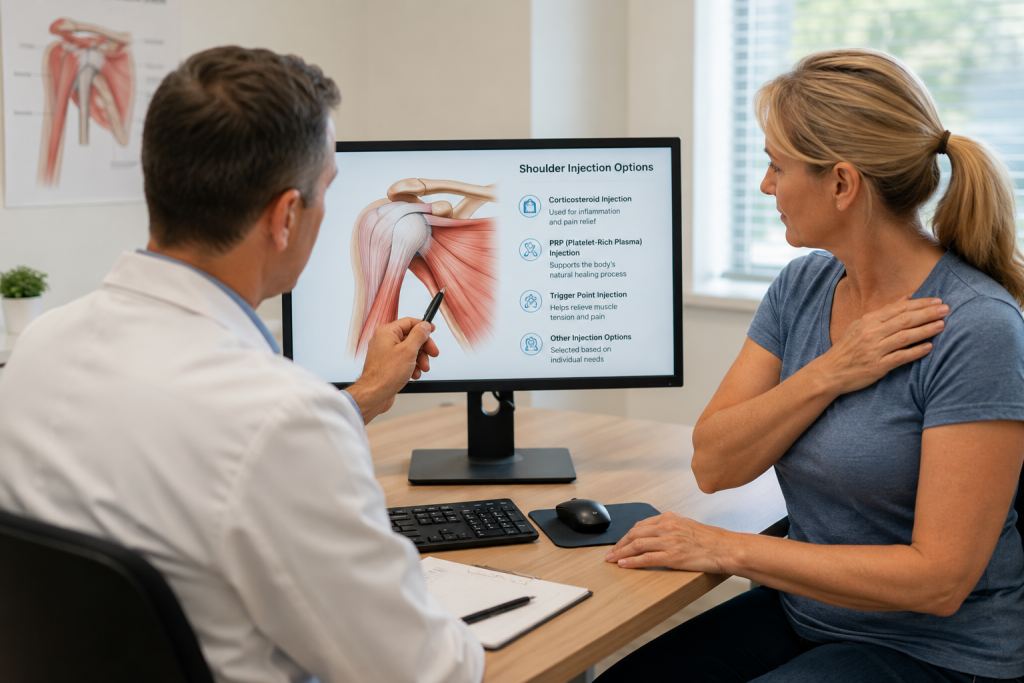
An injection should be considered only after the likely cause, treatment alternatives, medical history, and limitations have been reviewed.
The dedicated Shoulder Injections page explains procedure-specific options, preparation, risks, and aftercare.
This shoulder-pain page does not recommend hyaluronic acid as routine shoulder arthritis care because major AAOS guidance found no demonstrated benefit for glenohumeral osteoarthritis.

PRP is prepared from a sample of the patient’s own blood. Research results vary according to the shoulder condition, PRP preparation, and study design.
AAOS guidance states that routine PRP use may not be indicated for nonoperative management of full-thickness rotator cuff tears. PRP does not guarantee tendon healing, cartilage restoration, or avoidance of surgery.
Learn more about PRP Therapy

Toradol is a brand associated with ketorolac, a nonsteroidal anti-inflammatory medication used for short-term acute pain management.
An IM injection is administered into a muscle rather than directly into the shoulder joint. It is not routine long-term treatment for arthritis or chronic rotator cuff symptoms and has gastrointestinal, kidney, cardiovascular, and bleeding risks.
Learn more about Toradol IM Injections
| Treatment or Approach | Commonly Considered For | Typical Goal | General Timing | Evidence Considerations | Important Limitations |
|---|---|---|---|---|---|
| Activity Modification | Symptoms aggravated by lifting, sports, or repetitive use | Reduce irritating load while maintaining safe movement | Begins immediately and changes with progress | Commonly used as an initial conservative approach | Excessive rest can contribute to weakness or stiffness |
| Physical Therapy | Rotator cuff symptoms, stiffness, weakness, or movement limitations | Improve shoulder movement, strength, and daily function | Requires consistent participation over time | Evidence supports improved patient-reported outcomes in selected rotator cuff cases | Some tears can progress even when symptoms improve |
| Cortisone Injection | Selected inflammation-related or rotator cuff symptoms | Provide short-term pain and function support | Individual response and duration of relief vary | A single injection may be considered for short-term improvement in selected patients | It does not repair a tendon, and repeated use requires caution |
| PRP Therapy | Selected tendon or joint concerns following evaluation | Support possible symptom or functional improvement | Improvement, when present, may occur gradually | Evidence varies by condition, and routine use is not supported for full-thickness tears | Results vary and structural healing is not guaranteed |
| Toradol IM Injection | Selected acute pain presentations | Provide short-term systemic pain control | Intended for short-term use only | Treatment duration is limited by official medication guidance | It is not a chronic shoulder treatment and has important medication risks |
| Orthopedic Referral | Major injury, dislocation, progressive weakness, instability, or advanced damage | Obtain specialist evaluation and discuss broader treatment options | Timing depends on urgency and examination findings | Referral may be appropriate when conservative care is unsuitable or insufficient | An orthopedic referral does not automatically mean surgery |
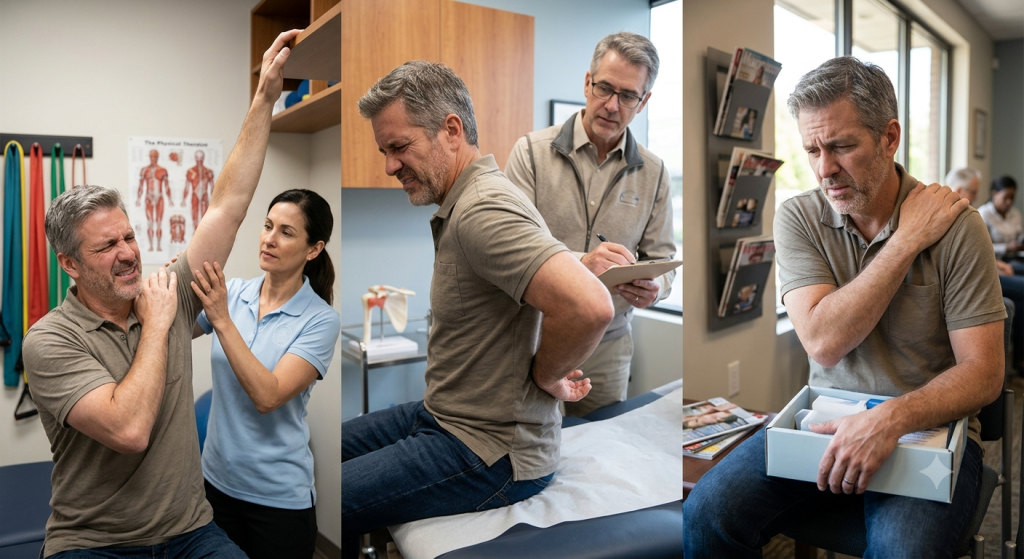
Improved symptoms do not prove that arthritis has been reversed, a tendon has healed, or future surgery has been prevented.
A shoulder treatment plan can depend on:

Important limitations include:
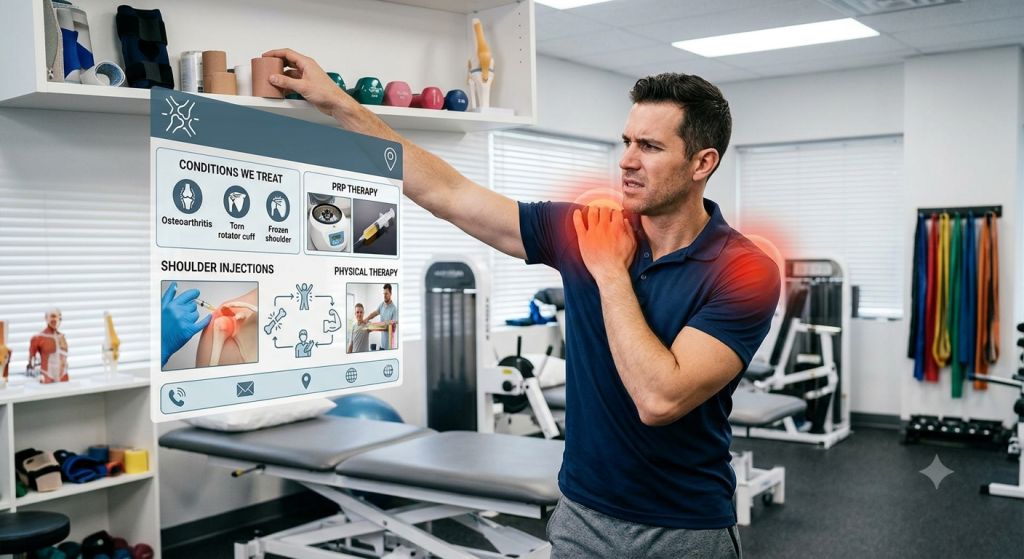
Referral can be appropriate when there is:
Referral does not mean that surgery will automatically be recommended. It provides access to additional assessment and a discussion of operative and nonoperative options.
Symptom-Led Evaluation
Care begins by considering the likely source and functional impact of symptoms rather than assuming every patient needs the same procedure.
Nonsurgical Care Focus
Conservative and minimally invasive pathways are considered when clinically appropriate.
Individualized Treatment Planning
Recommendations take the symptom pattern, medical history, movement limitations, previous care, and patient goals into account.
Evidence-Aware Communication
Treatment discussions include expected goals, evidence limitations, alternatives, and circumstances that warrant referral.
Provider-Led Care
The verified care team includes Ariel Curtis, FNP-C, Joint Injection Specialist, and Jeffrey Galvin, MD, Medical Director.
Learn more about the Joint Health Solutions providers
Referral-Aware Approach
Nonsurgical treatment is not presented as the only pathway. Orthopedic or urgent assessment remains appropriate when symptoms or findings require it.

Discuss when the pain began, whether an injury occurred, which movements are difficult, and how symptoms affect work, sleep, or activity.

Bring a current medication list, relevant health history, and details about previous treatment.

The provider can assess tenderness, strength, active and passive motion, stability, and functional movement.

Bring prior imaging reports or orthopedic records when available.
The next step can involve activity guidance, physical therapy, a procedure-specific consultation, further assessment, or orthopedic referral.
Schedule an evaluation when shoulder pain continues, repeatedly returns, or begins limiting lifting, reaching, dressing, work, exercise, or sleep. Increasing stiffness, weakness, instability, or difficulty raising the arm also deserves assessment. Seek urgent care after major trauma, suspected dislocation, deformity, sudden loss of arm function, or fever with a hot and swollen shoulder.
Common possibilities include rotator cuff irritation or tears, bursitis, frozen shoulder, osteoarthritis, instability, labral injury, and muscle strain. Repetitive lifting and overhead activity can also contribute. Several conditions create similar symptoms, so pain location alone does not confirm the cause. A focused history and examination help determine whether conservative care, further assessment, or referral is appropriate.
Many shoulder problems can initially be managed without surgery. Depending on the cause, care can include activity modification, physical therapy, progressive strengthening, or a selected injection. Nonsurgical treatment is not appropriate for every condition. A fracture, unreduced dislocation, major traumatic tear, progressive weakness, recurrent instability, or advanced arthritis can require orthopedic evaluation.
The evaluation can include a review of symptoms, injury history, medications, earlier treatments, and activity goals. The provider can assess active and assisted movement, tenderness, strength, stability, and functional use of the arm. Existing imaging or records can be reviewed when available. Additional imaging or orthopedic referral can be recommended when the findings require further clarification.
Physical therapy can improve movement, strength, pain, and function for many rotator cuff-related conditions. A program can include range-of-motion work, shoulder-blade control, progressive strengthening, and activity modification. However, a significant tear can still enlarge or weaken over time. Persistent or progressive weakness should be reevaluated rather than managed indefinitely through exercise alone.
No. Many patients improve through activity changes, physical therapy, and gradual strengthening without an injection. A shoulder injection is considered when the suspected condition, symptom severity, medical history, previous care, and treatment goals support it. The provider should explain the intended goal, possible risks, alternatives, evidence limitations, and whether referral should be considered first.
No. A cortisone injection can provide short-term pain and function support for selected patients, but it does not repair a torn tendon. Multiple injections require caution because they can affect tendon integrity, and an injection close to a planned surgical repair can influence outcomes. Its role should be discussed within a broader care plan.
No. PRP contains concentrated platelets prepared from the patient’s blood, but this does not establish guaranteed tendon repair. Research differs by condition and preparation method. AAOS guidance states that routine PRP use may not be indicated for nonoperative management of full-thickness rotator cuff tears. Expected benefits, costs, limitations, and alternatives should be reviewed beforehand.
Referral is appropriate after a major injury, suspected fracture or dislocation, sudden substantial weakness, recurrent instability, a suspected major tear, or symptoms that continue despite suitable conservative care. Advanced shoulder arthritis with major loss of function can also warrant surgical consultation. Referral provides access to further evaluation and does not mean an operation is inevitable.
Persistent shoulder pain, stiffness, weakness, or reduced motion can have several possible causes. A focused evaluation can help clarify whether conservative care, a treatment-specific consultation, further assessment, or orthopedic referral should be considered.
Joint Health Solutions serves patients from Concord, Kannapolis, Harrisburg, Midland, Mount Pleasant, and nearby Cabarrus County communities from its Charlotte clinic.
Visit the Concord service-area page for broader location information. Current coverage and payment information is available on the Insurance and Financing page. Coverage depends on the patient’s plan, diagnosis, service, and authorization requirements.